
Sales territory planning divides accounts, regions, or segments among reps using firmographic data, account tiers, and buyer intent signals. A structured territory plan balances workloads, sets realistic quotas, and helps every seller hit their targets.
What if every rep on your sales team spent the year calling on the same pool of accounts while a whole region sat untouched?
That's a common outcome of poor territory design. Without a structured approach, reps overlap on the same prospects, quota targets get set without real data behind them, and sales leaders discover coverage gaps only after a missed quarter.
McKinsey research on B2B sales growth outperformance found that leading companies are 50% more likely than slow-growers to review and reallocate account coverage monthly, treating territory management as an ongoing, data-driven process rather than a one-time exercise.
A structured sales territory plan gives every seller a realistic shot at hitting their targets and closing more deals from their assigned territories.
What Is a Sales Territory Plan?
A sales territory plan is a strategic document that defines which accounts, regions, or market segments each rep or team is responsible for pursuing.
Think of it as the foundational operating framework for your sales team. It answers the "who covers what" question before the first outreach goes out. Without it, you get overlap, coverage gaps, and wasted effort that compounds through the year.
Key components a solid sales territory plan covers:
-
Assignment rules: clear criteria for how accounts and prospects get allocated to each rep, removing ambiguity from day one
-
Revenue targets: individual quota and revenue goals tied to the realistic value of each territory, not just a percentage of last year's number
-
Market potential: an estimate of the addressable revenue and account count within each assigned territory
-
Named accounts: specific high-priority accounts that need focused attention from your most experienced sellers
-
Sales cycle expectations: guidance on expected deal complexity and average close time for accounts in each segment
Territory design is not just about dividing markets evenly. The primary goal is to match the right rep to the right accounts given their relationships, vertical expertise, and experience level. Done well, it gives sales managers a clear structure for reviewing territory performance and making informed decisions about where to invest resources.
How Do You Carve Sales Territories?
No two companies carve territories the same way, and that's by design. The method you choose should reflect how your buyers buy, how your product is sold, and what your team structure looks like today.
There are three foundational approaches most sales organizations rely on, often in some combination. Most teams build territories based on a blend of two or more of these models: geographic territories refined by account tier, for example.
| Method | How It Works | Best For | Common Challenges |
|---|---|---|---|
| Geographic | Divide by country, region, or specific geographic area | Field sales, travel-heavy products, markets with local regulations | Uneven market density creates imbalanced workloads |
| Industry vertical | Assign reps by sector (healthcare, technology, finance) | Products with vertical-specific use cases | Some verticals have far more market opportunity than others |
| Account tiers | Group accounts by company size, deal size, and revenue potential | B2B products with wide ICP ranges | Tier definitions need frequent updates as market conditions chang |
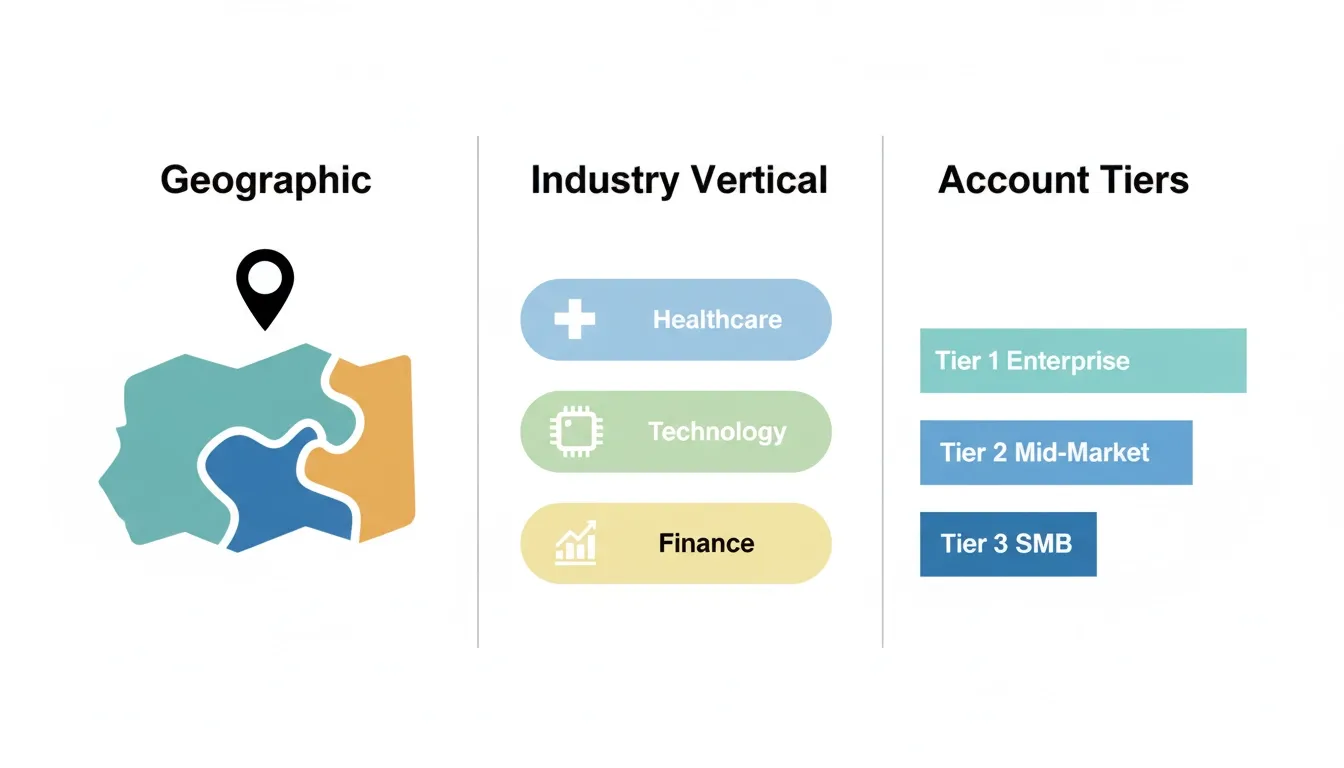 Three territoryarving methods compared: geographic zones, industry verticals, and account tiers
Geographic Territories
The oldest carving model and still widely used. You divide the market by country, region, state, or specific geographic area, assigning one rep to the Midwest and another to Europe.
-
Works well when your product involves local nuances: regulations, travel requirements, and regional relationship norms
-
Keeps team management and reporting straightforward
-
Risk: market density varies significantly by location. Geographic territories can produce unbalanced workloads if you rely on maps alone without firmographic data behind them
Industry Verticals
Instead of a map, you split accounts by vertical. One rep covers healthcare, another covers technology, a third handles finance.
-
Reps develop deep expertise in their vertical's specific challenges, which buyers notice and appreciate
-
Personalized outreach becomes natural when a seller genuinely understands the industry's dynamics and buyer preferences
-
Risk: vertical opportunity varies. Some industries have far more addressable accounts than others, requiring regular rebalancing to keep quotas fair
-
Hunters focused on new customer acquisition in a vertical become effective once they understand that segment's buying patterns
Account Tiers
You build territories based on revenue potential, deal size, and company size. Enterprise accounts in Tier 1 go to senior reps with the skills to navigate complex deals; mid-market accounts sit in Tier 2; smaller prospects get covered by hunters on a high-volume model or lower-cost channels.
-
Matches the intensity of sales effort to actual opportunity value, reducing wasted effort on low-fit accounts
-
Tiers-based structures let you direct your best sellers toward the highest revenue potential accounts
-
Named accounts can be pulled out separately to give them focused attention regardless of tier placement
-
Risk: tier definitions need updating as market conditions shift. An account that was Tier 3 last year might belong in Tier 1 today after a funding round
Some companies also separate hunters (focused on new customer acquisition) and farmers (focused on customer retention and growing existing relationships), a useful division that sits on top of whichever carving model you choose.
Using Firmographic and Market Data to Size Your Territories
The biggest mistake in territory design isn't picking the wrong carving model. It's sizing territories without real data.
Many sales leaders rely on gut feel or historical data from a single year, but markets shift fast. The market opportunity in a region can double when a new regulation kicks in or shrink when a key buyer segment starts consolidating. Building your plan on real firmographic signals from the start gives you territories that hold up through the year and are defensible when leadership asks how you set quotas.
What data-backed territory sizing actually involves:
-
TAM/SAM analysis: break your total addressable market into segments by geography, industry, and company size before assigning anyone a territory
-
Account scoring: rank prospects by signals like revenue size, employee count, tech stack, and growth trajectory
-
Buyer intent data: layer buying signals on top of firmographic data to prioritize the accounts most likely to be in an active purchase cycle right now
-
Lookalike modeling: if your best customers share specific firmographic traits, you can identify gaps in coverage by finding untapped accounts that match the same profile
The goal is to build territories where every seller starts with a fair, data-backed portion of the market, not just a zip code or a list of company names.
What Firmographic Signals Matter Most?
Not all firmographic data points carry the same weight. A data-driven approach means choosing signals that actually predict fit and likely conversion.
The most useful signals for territory sizing:
-
Company size (employee count and estimated revenue): segments accounts between enterprise, mid-market, and SMB tiers
-
Industry and sub-vertical: confirms the account matches your product marketing and ideal customer profile
-
Tech stack: reveals whether an account already uses complementary tools or competing products, a key timing signal for outreach strategy
-
Growth trajectory: hiring trends, funding rounds, and recent product launches indicate buying power and urgency
-
Product marketing fit: accounts that mirror your existing customer profile tend to close faster and generate stronger customer retention
This is where AI tools and advanced analytics matter. Manually sifting through vast amounts of firmographic data isn't feasible at meaningful scale. Platforms that analyze vast amounts of company-level signals can surface the right accounts and flag coverage gaps you'd otherwise miss entirely, allowing you to build a smarter territory model without weeks of manual research.
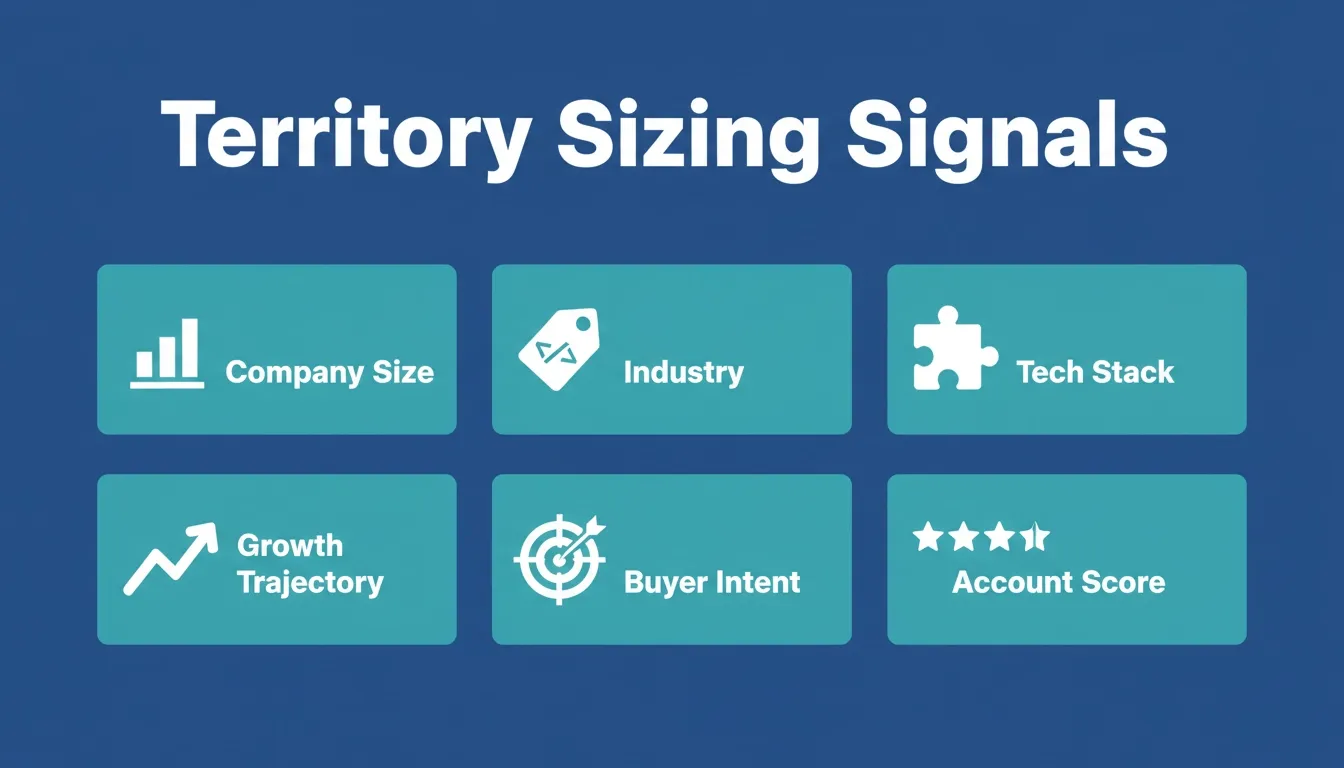 Key firmographic signals used to score and size sales territories with real market data
How Lookalike Accounts Help You Size a Region
Start with your best customers. Pull the firmographic profile of accounts with the best retention, biggest deal size, and shortest sales cycle. Then use that profile as a model to find untapped accounts that match.
This approach:
-
Gives you a data-backed count of how many high-potential accounts actually exist in each proposed territory
-
Helps you identify gaps where a territory looks large on paper but contains few real matches to your ideal customer profile
-
Lets you balance territories based on qualified market opportunity rather than raw account count
-
Makes it easier to build realistic goals and revenue targets that reps will accept rather than resent
According to Forrester's State of Business Buying, 2024 report, 86% of B2B purchases stall during the buying process, often because sellers are chasing the wrong accounts from the beginning. Advanced customer segmentation built into territory assignments from day one reduces that risk and keeps pipeline efficiency higher across every territory.
What Does a Sales Territory Plan Template Include?
A solid sales territory plan template doesn't need to be complex. It needs to be consistent, usable by every rep without hand-holding, and built around the metrics that actually drive decisions.
Here's a practical structure any sales team can adapt. The most important components of any effective sales territory plan are the revenue targets and pipeline coverage ratio — without those two anchors, the rest of the document risks becoming a list of intentions rather than an operational guide.
| Section | What to Include |
|---|---|
| Territory definition | Carving logic, account assignment rules, named accounts, boundary criteria |
| Revenue targets | Annual and quarterly quota, expected deal size, new vs. existing account revenue split |
| Market overview | TAM/SAM for the territory, key competitors present, ICP match rate |
| Pipeline plan | Current pipeline by stage, self-sourced pipeline target, pipeline coverage ratio |
| Outreach strategy | Priority segments, email and call activities, marketing campaigns aligned to territory |
| Key metrics | Win rate, demos delivered, close rate, forecast accuracy, activity metrics per stage |
| Review cadence | Quarterly and annual schedule, who owns changes, how performance data feeds back |
A common shortcut some leaders take is the "five minute territory plan": a quick sketch of who covers what with no supporting data. That's a reasonable starting point for a very early-stage team where agility matters more than precision. But as your team scales past a handful of sellers, guesswork starts producing missed opportunities and pipelines that are hard to recover from mid-year.
Your plan should also capture each rep's self-sourced pipeline target, not just total pipeline. When reps understand how much of their current pipeline needs to come from their own outreach activities versus inbound or marketing campaigns, they can better manage sales activities day to day and set realistic goals that feed into forecast accuracy.
A great territory plan is a living document. The most effective sales territory plan gets reviewed, updated, and refined as performance data comes in, not submitted in January and forgotten by March. Pairing your territory plan with a purpose-built sales app can help reps track activity, pipeline, and account coverage in one place.
Best Practices for Keeping Territories Balanced and Current
Building a solid plan is step one. Keeping it relevant as the market shifts is where most teams fall short.
Territories age. Accounts get acquired. Reps leave and new hires join. A region that looked strong in January can become thin by June if no one is paying attention. These are the best practices that help sales leaders stay ahead of those changes before they compound into a real performance problem.
-
Review territory assignments every quarter: Markets shift faster than annual planning cycles. A quarterly review catches most imbalances before they affect results significantly
-
Use performance data to spot imbalances: If one rep consistently hits 140% of quota while peers struggle to reach 80%, the territory split may be the issue rather than the rep's skills
-
Involve reps in the review process: Feedback from individual contributors about their assigned territories often surfaces coverage gaps that CRM data alone misses
-
Track pipeline efficiency, not just revenue: Pipeline coverage ratio and pipeline efficiency metrics tell you whether assigned territories have enough qualified prospects to support the quota at any given moment
-
Set clear ownership for territory management: Ambiguity about who manages which accounts creates overlap, wasted effort, and data entry problems that compound over time
-
Communicate territory changes early: Reps who feel blindsided by reassignments lose motivation. Collaboration and transparency in the review process directly affect morale and reduce the burnout that thin, data-poor territories create
-
Share best practices across the team: Knowing what works in one territory and rolling those insights across the sales team increases sales effectiveness for everyone
"If someone has a lower quarterly number by raw revenue but did so by making the most out of a less-than-promising territory, the latter fact is more indicative of their quality than the former."— Heather McLean, eSpatial, via the Sales Management Association
That observation points to a broader truth: imbalanced territories distort performance data. Thoughtful resource allocation and territory balance are among the most direct levers sales leaders have to improve outcomes across the team.
When Should You Rebalance Territories?
There's an art to knowing when to rebalance versus when to leave well enough alone. You don't need to restructure your territory strategy every year. The goal is to adjust when the data tells you something has materially changed.
Good triggers for a rebalancing review:
-
A rep leaves or a new hire joins, requiring redistribution of assigned accounts
-
You expand a product line or move into a new market segment
-
Pipeline data shows one territory generating three times the opportunity of another for two consecutive quarters
-
External changes, such as new competitors entering, major account acquisitions, or new regulations, shift the value of a region materially
-
Year-over-year performance data shows consistent territory imbalance that cannot be explained by rep skill or experience
Accept that some level of rebalancing is part of the job. Planning for these scenarios at the beginning of the year, rather than reacting in the middle of a quarter, gives your team more stability and less stress.
Keeping Coverage Maps Accurate With CRM Data
Your CRM is only as useful as the data in it. Coverage maps built on stale records provide a false sense of territory health.
Best practices for CRM-backed territory management:
-
Build assignment rules directly into your CRM so new accounts route to the right territory automatically, cutting data entry errors and routing delays
-
Run a monthly check on data hygiene to catch accounts that changed company size, industry classification, or ownership. These changes affect tier placement and territory assignments
-
Track activities per territory, not just pipeline value, to see where reps are spending time versus where the actual opportunity exists in each assigned territory
-
Flag any account in an assigned territory that hasn't been touched in 90 days. A quick click in your CRM surfaces at-risk records before they fall through entirely
-
Share coverage reports with sales leaders each quarter so they can make informed decisions about where to direct more attention, add sellers, or trim activities
Keeping your coverage maps up to date is a discipline, not a one-time task. The teams that build this cadence into their workflow find that territory management stops feeling like overhead and starts generating real forward momentum. If you're building or improving your CRM infrastructure, see how CRM app development can support more accurate territory tracking at scale.
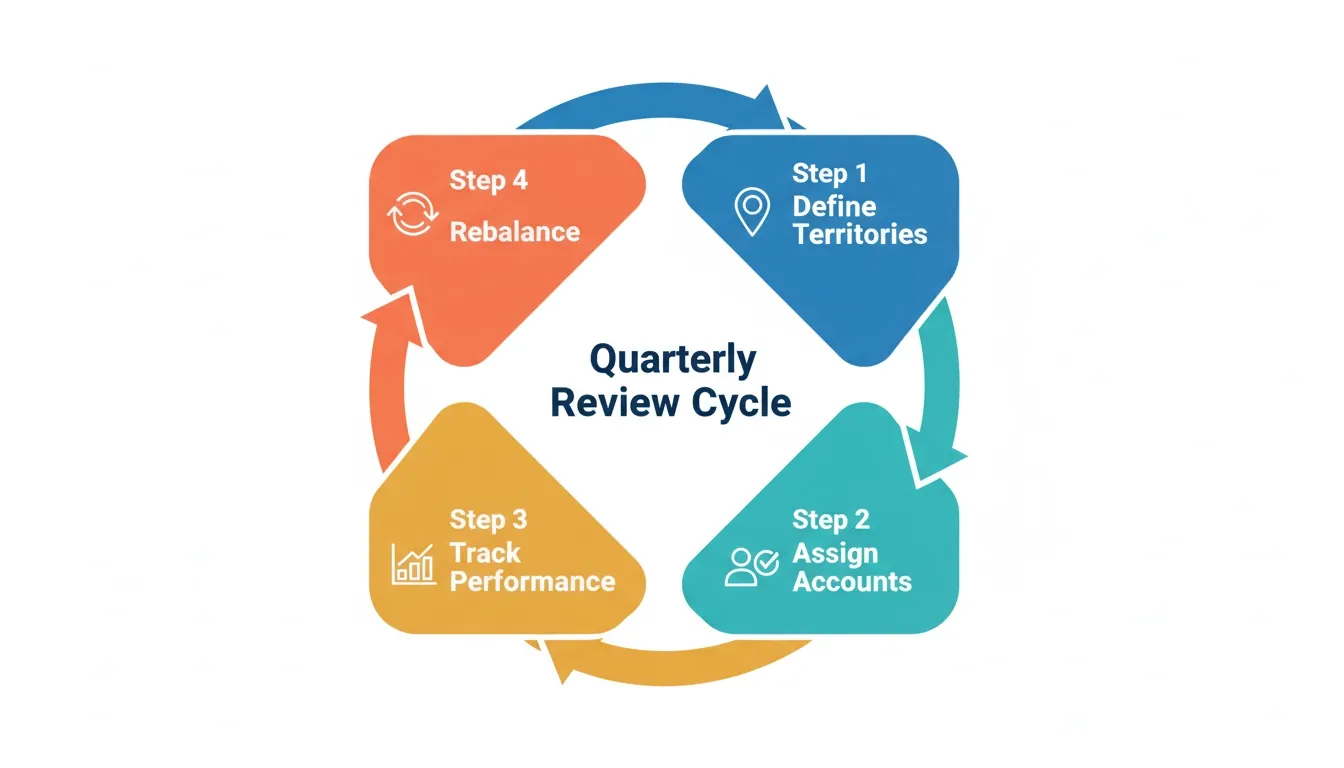 The ongoing territory management cycle: define, assign, track, and rebalance to keep coverage current
What Rocket Brings to Your Territory Decisions
Most teams build their territories from last year's CRM data, a spreadsheet, and instinct. That process works well enough at small scale, but it breaks down fast as you add more sellers, expand into new markets, or try to build territory models that hold up through the year.
Rocket addresses the data problem at two levels.
Rocket Intelligence watches the companies you care about in real time, tracking changes across website activity, hiring signals, LinkedIn activity, GTM motion, product launches, news and media shifts, and more. For sales leaders building territories, that means you can set territory assignments based on live buyer intent signals rather than static account lists from last quarter.
You can see which accounts in any assigned territory are actively expanding, which are entering a buying cycle, and which have recently changed leadership, a classic trigger for new customer acquisition. This kind of AI-powered account intelligence makes territory prioritization more precise.
Instead of dividing accounts equally across sellers, you direct your best reps toward the accounts with the highest current buying signals, a shift that meaningfully increases sales effectiveness across the team and keeps every seller focused on the right opportunities.
Rocket Solve handles the market sizing piece. Give it a segment definition and a geography, and it runs structured market analysis using AI: TAM/SAM estimates, competitive mapping, and firmographic breakdowns you can use to size territories with real data rather than guesswork. It turns "we think there are about 400 accounts in that region" into a number you can defend to leadership and build a quota plan around.
Together, they replace the manual process of stitching together account data, market reports, and CRM exports before planning season even begins. Rocket.new is the right platform for sales teams that want territory decisions backed by real market intelligence rather than last year's spreadsheet.
Competitors that rely on static enrichment tools cannot analyze vast amounts of real-time account signals and surface them in a ranked, personalized format. That gap in sales productivity compounds every quarter as your data ages and markets shift.
Start building your territories with actual market data. Visit Intelligence to see how account intelligence works, or read how Rocket Solve approaches market analysis from raw signals to structured output.
Turning Territory Strategy Into Consistent Revenue
Getting the carving model right is a great start, but it's the ongoing process of reviewing coverage, updating assignments, and feeding real market data back into the plan that separates sales organizations that hit their numbers from those spending Q3 firefighting imbalanced pipelines. A plan that works well in January won't automatically hold up in June without active management.
Start with the data you have, set a consistent review cadence, and build feedback loops from your reps from the beginning. The sales teams that treat their territory plan as a living document, not a one-time annual project, consistently close more deals, build more predictable pipelines, and give every seller a fair shot at winning.
Rocket gives you the account intelligence and market analysis to make that whole process faster and more defensible. Start building smarter territories today and put real market data behind every quota you set.
Table of contents
- -What Is a Sales Territory Plan?
- -How Do You Carve Sales Territories?
- -Geographic Territories
- -Industry Verticals
- -Account Tiers
- -Using Firmographic and Market Data to Size Your Territories
- -What Firmographic Signals Matter Most?
- -How Lookalike Accounts Help You Size a Region
- -What Does a Sales Territory Plan Template Include?
- -Best Practices for Keeping Territories Balanced and Current
- -When Should You Rebalance Territories?
- -Keeping Coverage Maps Accurate With CRM Data
- -What Rocket Brings to Your Territory Decisions
- -Turning Territory Strategy Into Consistent Revenue