
A unique selling proposition is the one specific reason your target audience picks you over every competitor. Brands with a sharp USP attract better-fit customers, build genuine loyalty, and give their sales team a single answer that closes deals.
A unique selling proposition is the one specific reason your target audience picks you over every competitor, a single, defensible claim no rival can honestly copy. Brands with a sharp USP consistently attract better-fit customers, build genuine brand loyalty, and give their sales team a single answer that actually closes deals.
According to Salesforce, competition with other businesses ranks among the top five challenges sales reps face today.
What is a USP?
A USP, sometimes called a unique selling point, is a focused, specific benefit statement that sets a product or service apart from competing alternatives. It answers the question every buyer silently asks before handing over money: "Why this brand, and not the one right next to it?"
The USP definition most practitioners use is straightforward: a USP is the one specific benefit a brand can claim that its competitors cannot. That one claim shapes everything: the homepage headline, the sales pitch, the product roadmap. A company's USP sits at the intersection of what it does best, what the target audience cares about most, and what competitors have left unclaimed in the market.
A USP is not a slogan or a tagline. A genuine, unique selling point is so specific to how a business actually works that copying it would require a competitor to fundamentally change their own business model. That specificity is what makes a good USP worth building.
Why Does a USP Matter for Your Business?
Think of a USP as the short, honest answer every buyer is really asking. A well-crafted selling proposition shapes decisions across the whole company, from how the product team prioritizes features to how a sales rep handles an objection on a call.
Here is what a clear USP helps a business do:
-
Filters mismatched buyers out early, so prospective customers self-select based on what the brand actually stands for
-
Anchors all marketing messages around one defensible claim that competitors cannot easily copy
-
Builds brand loyalty by drawing in customers who genuinely share the company's brand values
-
Gives the business a real competitive advantage in crowded markets where products look similar on the surface
Without a clear USP, businesses default to competing on price, a race almost no company wins for long. The USP becomes the internal compass that keeps brand messaging sharp and every part of the business oriented around one clear promise. You can explore how this connects to broader competitive strategy frameworks that shape how companies win markets.
What's the Difference Between a USP, Value Proposition, and Positioning?
Three terms, three different jobs, yet they get mixed up constantly. Knowing where each one starts and ends makes all three more useful in practice.
One key insight from a Zendesk guide on selling propositions puts it plainly: "Your unique selling point has to be something that every team member can defend. If your marketing team decides to craft a catchy line that your sales team can't back up, you'll come across as dishonest."
That is the real test a USP must pass; it is not just a headline, it is a shared internal standard every part of the company can stand behind.
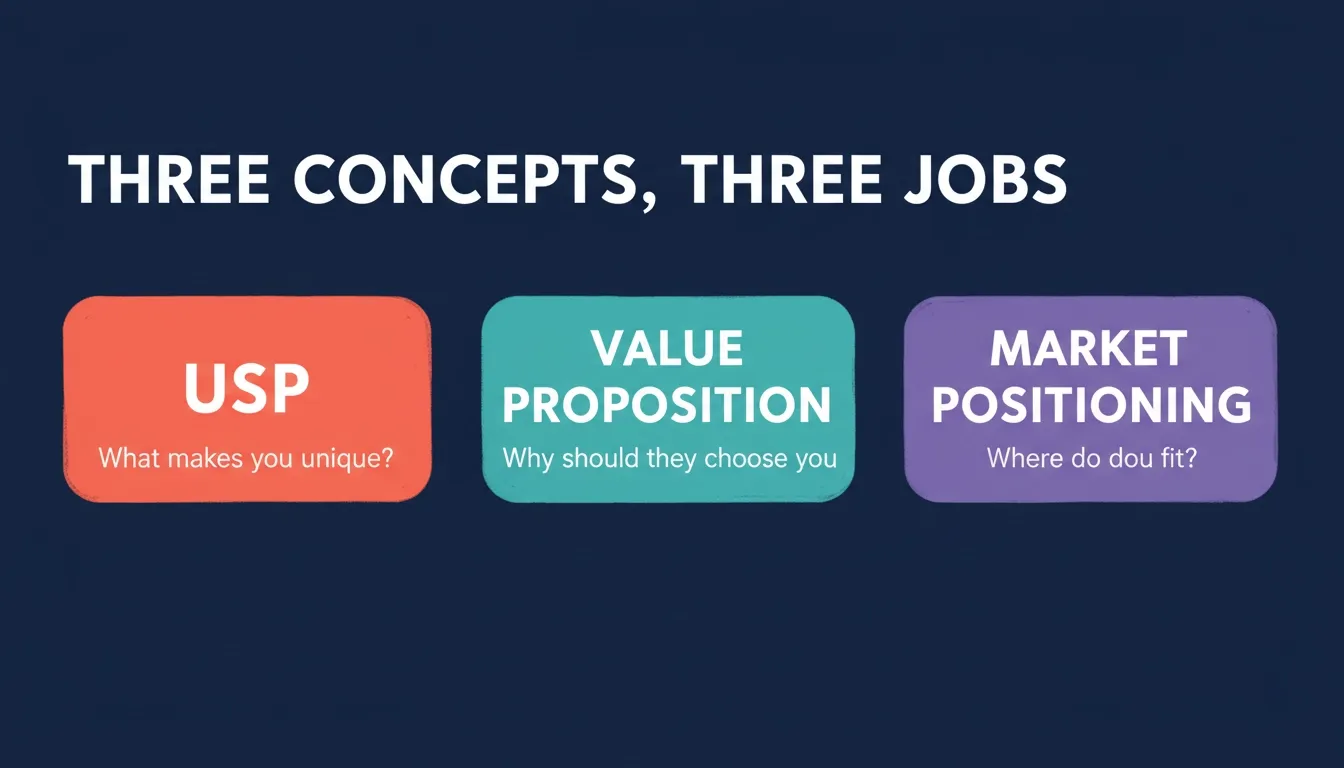 USP, value proposition, and market positioning each answer a different question. All three must align for your brand messaging to land.
| Concept | Core Question | Scope | Audience-Facing |
|---|---|---|---|
| USP | Why choose you over competitors? | One singular, ownable claim | Yes, headline-level |
| Value Proposition | What value does this product deliver? | Full set of benefits and outcomes | Yes, detail-level |
| Unique Value Proposition | What is unique about our full benefit set? | Broader than a USP; can be segment-level | Yes |
| Market Positioning | Where does this brand live in the buyer's mind? | Category-level strategic framing | Indirect |
Think of market positioning as the stage, the value proposition as the script, and the USP as the single line no other brand on that stage can deliver with any credibility. Getting the USP right means the value proposition and positioning work more easier, because the core differentiator is already pinned down.
Famous USP Examples Worth Studying
Real brands give the clearest picture of what makes a selling proposition work. The strongest unique selling proposition examples share one trait: each one picks a specific benefit and refuses to claim everything at once. CXL's deep analysis of 21 USP examples breaks down exactly why these selling points work across B2B, e-commerce, and DTC brands.
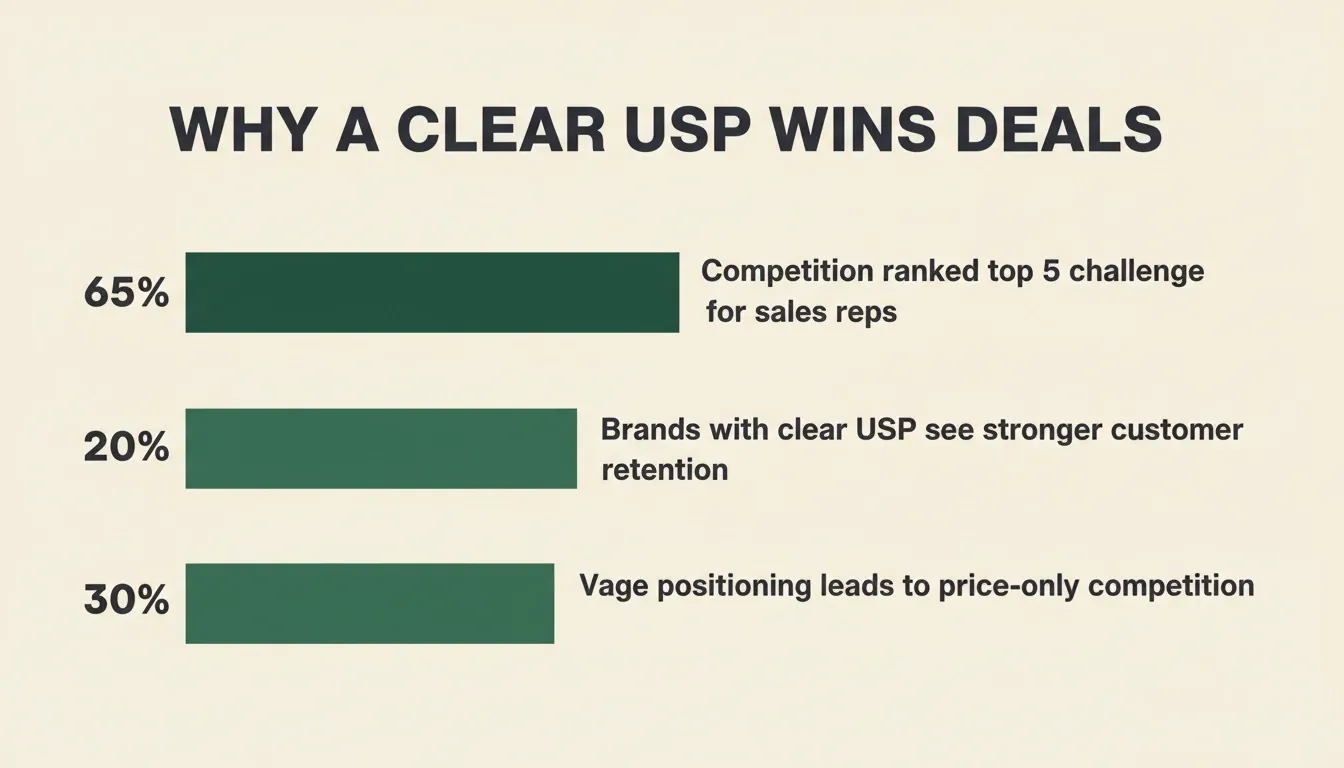 Competition is a top-five challenge for sales reps. Brands with a specific, defensible USP consistently outperform those competing on price alone.
Here is what four iconic brands teach us about making a unique selling point stick:
-
Death Wish Coffee: "The world's strongest coffee." It speaks directly to buyers who find most blends too mild, and the brand actively invites potential customers who want a smooth experience to go elsewhere. The USP is specific enough to filter the wrong people out naturally.
-
Allbirds: Built around merino wool and eucalyptus-based materials, Allbirds created a clothing brand on one axis: planet-friendly comfort. No competing brand owns that specific combination the same way.
-
TOMS Shoes: TOMS pioneered the "buy one, give one" model. Even as that model evolved, TOMS built lasting brand loyalty because its selling point was rooted in genuine purpose; customers felt genuinely good about every purchase.
-
Hiut Denim: "We make jeans. That's it." This small business makes one product, entirely in-house, and markets its singular focus as its USP. Every detail of the business model backs it up completely.
Each company made a deliberate choice to be something specific for a specific audience, and let that choice shape everything else. Brand unique in focus. The promise is clear and defensible. The audience is narrow enough to resonate deeply. This is also the foundation of strong brand messaging for landing pages, where a sharp USP directly drives conversion.
How Do You Actually Write a USP?
A good, unique selling proposition does not come from a single brainstorming session. Writing a compelling selling proposition takes research, clarity, and a willingness to say less than you want to.
Step 1: Know Your Ideal Customer
A good USP starts with knowing your ideal customer in very specific terms, not "marketers" or "small business owners" in the abstract, but a clearly defined person with a particular problem and a particular goal. Vague audiences produce vague USPs every time.
Use customer segmentation to go deeper: what recurring needs did your product originally solve? What phrases appear again and again in competitor reviews? The more precise the customer definition, the more resonant the selling proposition becomes.
Step 2: Map Competitor Claims
This is the step most businesses skip, and it matters more than any other. Visit each competitor's website, read their homepage, their About page, their product pages, and note the primary benefit each rival leans on most. You need this list before you can write a good selling proposition, without it, you are writing in the dark.
Look for patterns and absences. The gap in that list is where a genuine USP lives. A USP that fills a real gap is far stronger than one that simply restates what everyone else already says. Understanding how to build a competitive intelligence program makes this step repeatable and systematic.
Step 3: Find Your Specific Benefit
Now find the one specific benefit that sits in the gap you found and that your product can genuinely deliver. Your own USP needs to be so true and so specific that it would feel dishonest for a competitor to copy it.
Use customer interviews, surveys, and market research to gather real evidence. A good USP focuses on the outcome for the customer, not on how the product works internally, because customers care about what changes for them, not the mechanism behind it.
Step 4: Write One Sentence and Test It
A solid USP fits in one sentence. It names the target audience, the specific benefit, and the differentiator. Test it with your sales team; if they can say it naturally at the start of a call without reading from notes, you are close.
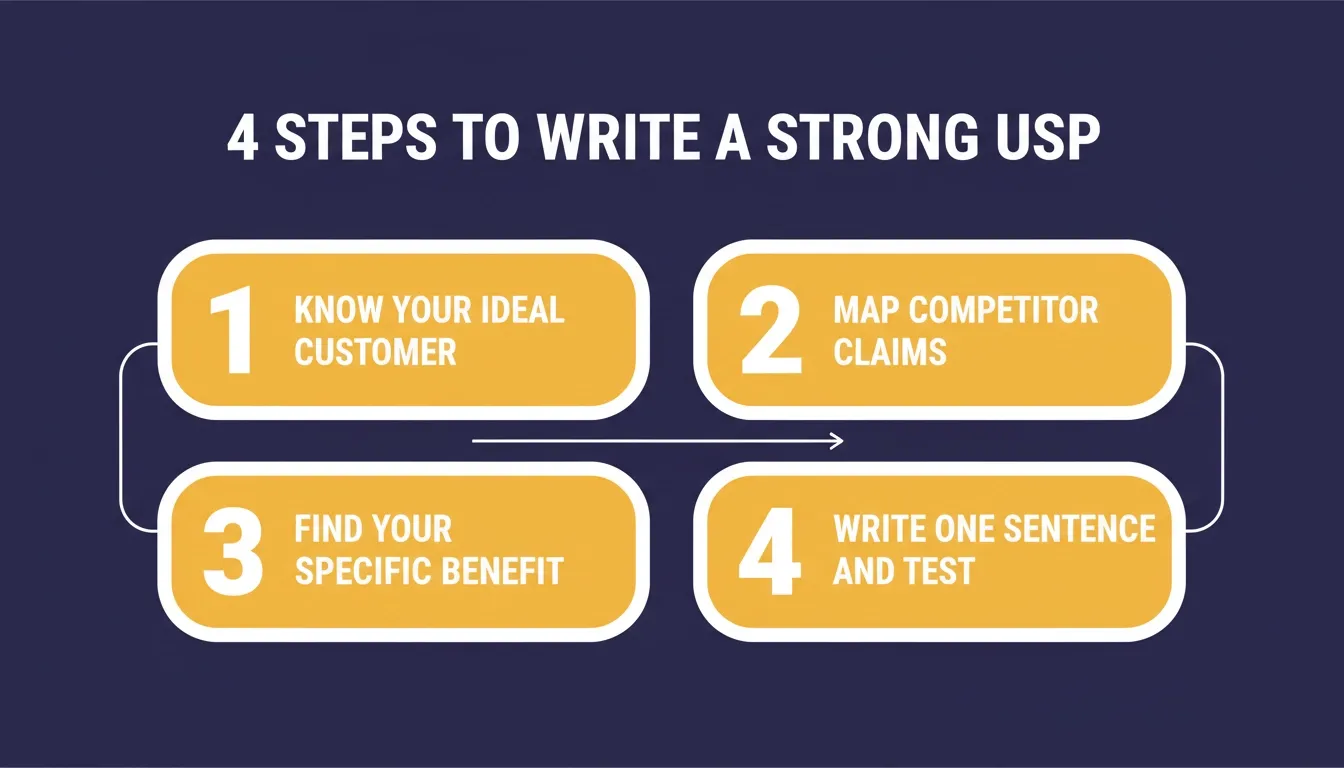 Each step builds on the last. Skip competitor research, and the whole proposition loses its edge.
Then commit: communicating your USP consistently across all marketing materials, your website, and every pitch is what turns a well-crafted selling proposition into something buyers actually remember.
A USP that lives only in a document is not really a USP yet. This is where tools like Rocket's Build platform help founders ship the landing page and product that actually reflect their USP from day one.
Finding White Space Your Competitors Leave Open
Most companies write their USP before they do the one thing that matters most: mapping what every competitor is already claiming. That shortcut produces generic, forgettable selling propositions that blend into the market rather than standing out from it.
Why Most Competitive Research Falls Short
Manual competitive analysis is slow, uneven, and easy to get wrong. The typical approach, visiting each competitor's website independently, noting a few phrases, and adding everything to a spreadsheet, produces conclusions from incomplete data that are already weeks or months out of date. A USP built on stale research is a USP built on a false foundation.
White space is the specific benefit nobody is claiming, the customer needs that every brand in your category touches on but never puts at the center of its story. Finding it requires reading across every competitor's marketing messages at the same time, looking for patterns and absences rather than isolated lines.
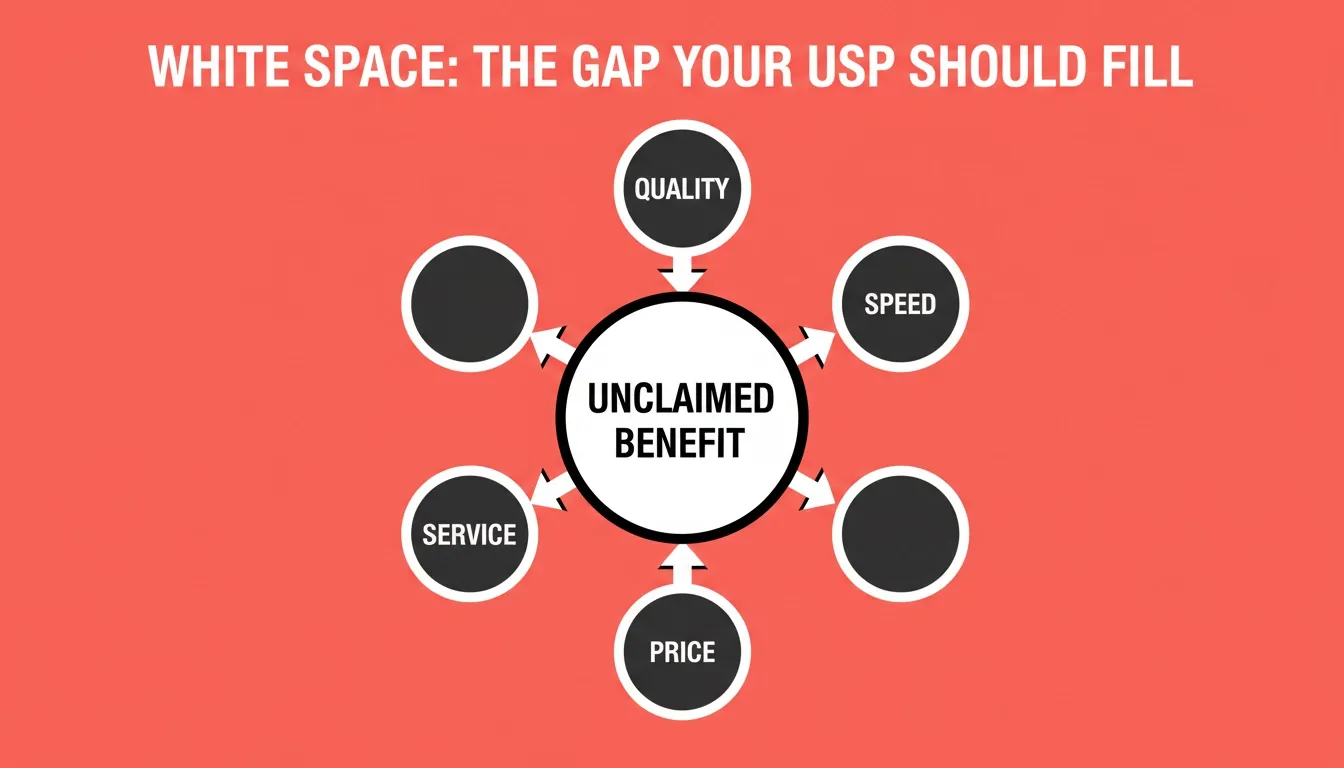 White space is the unclaimed benefit in your market. The strongest USPs are built on gaps competitors leave open, not on claims everyone already makes.
Because competitors change their messaging constantly, a unique selling point that was genuinely unique six months ago may now belong to three rivals. The brands that consistently find and hold white space monitor the competition on an ongoing basis, and they keep giving prospective customers a story no one else is telling yet. This is also why competitive intelligence careers and roles are growing so fast inside modern GTM teams.
How Rocket.new Maps Competitor Claims So Yours Stands Out
What if you could see every claim your competitors are making, in real time, organized by signal type, without spending forty hours a month doing manual research?
That is exactly what Rocket Intelligence was built to do.
Rocket Intelligence monitors every public surface a company operates on: website messaging, social accounts, news coverage, job boards, review platforms, and traffic patterns. When something changes, a signal is created, interpreted with context, and delivered as actionable Intel, ranked based on your role and your specific competitive priorities.
Here is what helps a team build a USP:
-
See competitor claims as they change, not after the fact, so your unique selling point stays current
-
Identify which selling points each rival leans on most, so you know exactly what positioning is already taken
-
Spot the emerging gap, the customer need nobody in your market is addressing yet
-
Build your selling proposition around a genuinely open position, not one that only feels open based on old data
Unlike tools focused purely on keyword signals, Rocket Intelligence reads the full business narrative of every company you follow, including pricing changes, product launches, hiring patterns, and public messaging simultaneously. A competitor can shift their homepage headline or pivot their target audience, and you will know before that shift becomes the new conventional wisdom in your market.
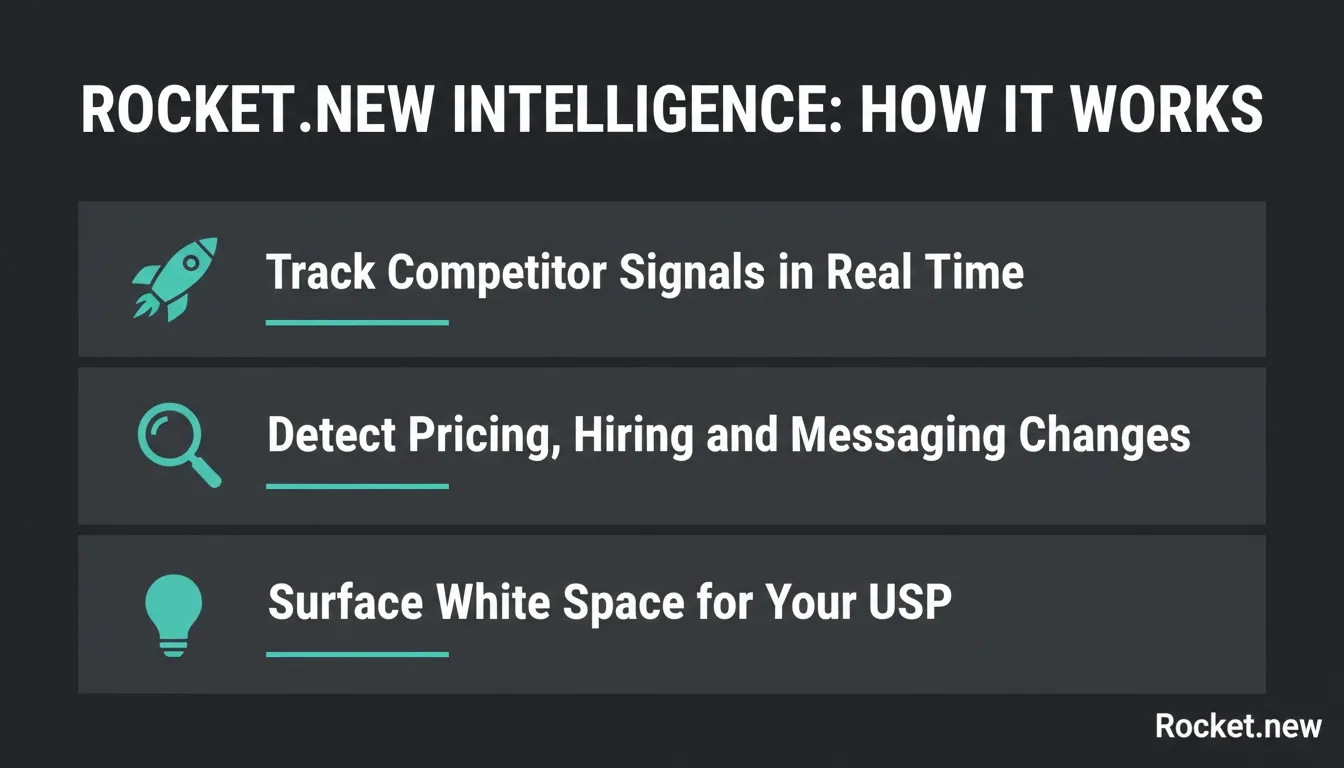 Rocket Intelligence tracks competitor signals across website, social, hiring, and pricing, and surfaces the white space where your USP should live.
Rocket Intelligence also delivers a daily brief for each company you follow, a synthesized paragraph connecting everything that moved across surfaces in the past 24 hours into one strategic picture, plus a direct implication written in the context of your competitive position. You can also use Rocket's Solve feature to run structured competitive teardowns and market analysis that feed directly into your USP research.
Build a USP Your Competitors Cannot Match
A clear selling proposition is one of the best investments a company makes. It narrows focus, sharpens marketing messages, and gives the sales team a single, honest answer to the question every prospect is silently asking. The brands that win in competitive markets don't just have good products; they have a specific, defensible reason why customers should choose them over everyone else.
Get the research right first. Know what competitors are claiming. Find the gap. Then write the statement that fills it, and say it everywhere.
A strong, unique selling proposition is built on knowing exactly what the competition claims and what gap they leave open. That knowledge is exactly what Rocket.new provides.
Start building with Rocket and let your next selling proposition be the one that fills the gap your competitors left open.
Table of contents
- -What is a USP?
- -Why Does a USP Matter for Your Business?
- -What's the Difference Between a USP, Value Proposition, and Positioning?
- -Famous USP Examples Worth Studying
- -How Do You Actually Write a USP?
- -Step 1: Know Your Ideal Customer
- -Step 2: Map Competitor Claims
- -Step 3: Find Your Specific Benefit
- -Step 4: Write One Sentence and Test It
- -Finding White Space Your Competitors Leave Open
- -Why Most Competitive Research Falls Short
- -How Rocket.new Maps Competitor Claims So Yours Stands Out
- -Build a USP Your Competitors Cannot Match