
For B2B teams, knowing which companies to target separates a full pipeline from wasted outreach. Firmographics give sales and marketing teams the signal they need to focus on the right accounts. Rocket.new continuously tracks company signals so your firmographic profiles never go stale.
What if the main reason your outreach keeps missing isn’t the copy or the channel, but the companies you’re targeting?
Firmographics, the company-level attributes that describe an organization’s size, industry, revenue, and geography, are what high-performing sales and marketing teams use to separate likely buyers from the rest. These attributes answer one question: Does this company fit?
Research from McKinsey found that companies that personalize based on richer business profiles generate 40% more revenue than slower-growing peers. The segments built from solid company-level attributes close at higher rates and convert with less effort. This guide covers what those attributes look like in practice, where to collect them, and how to put them to work.
What Are Firmographics, Exactly?
The word “firmographic” borrows directly from “demographic” but shifts the lens from individual people to organizations as a whole. Firmographics describes the observable characteristics of a company, the verifiable traits that say something meaningful about how a business operates and what it can spend.
Sales and marketing teams use these attributes to analyze their target market at the company level rather than the individual level. Core firmographic attributes include industry classification, company size, geographic location, annual revenue, ownership structure, and tech stack.
Unlike demographic data, which maps individual traits like age, gender, or marital status, firmographics attaches to the business itself as an organizational entity. Knowing the firmographic profile of a company tells you whether it is worth pursuing before you spend a single message.
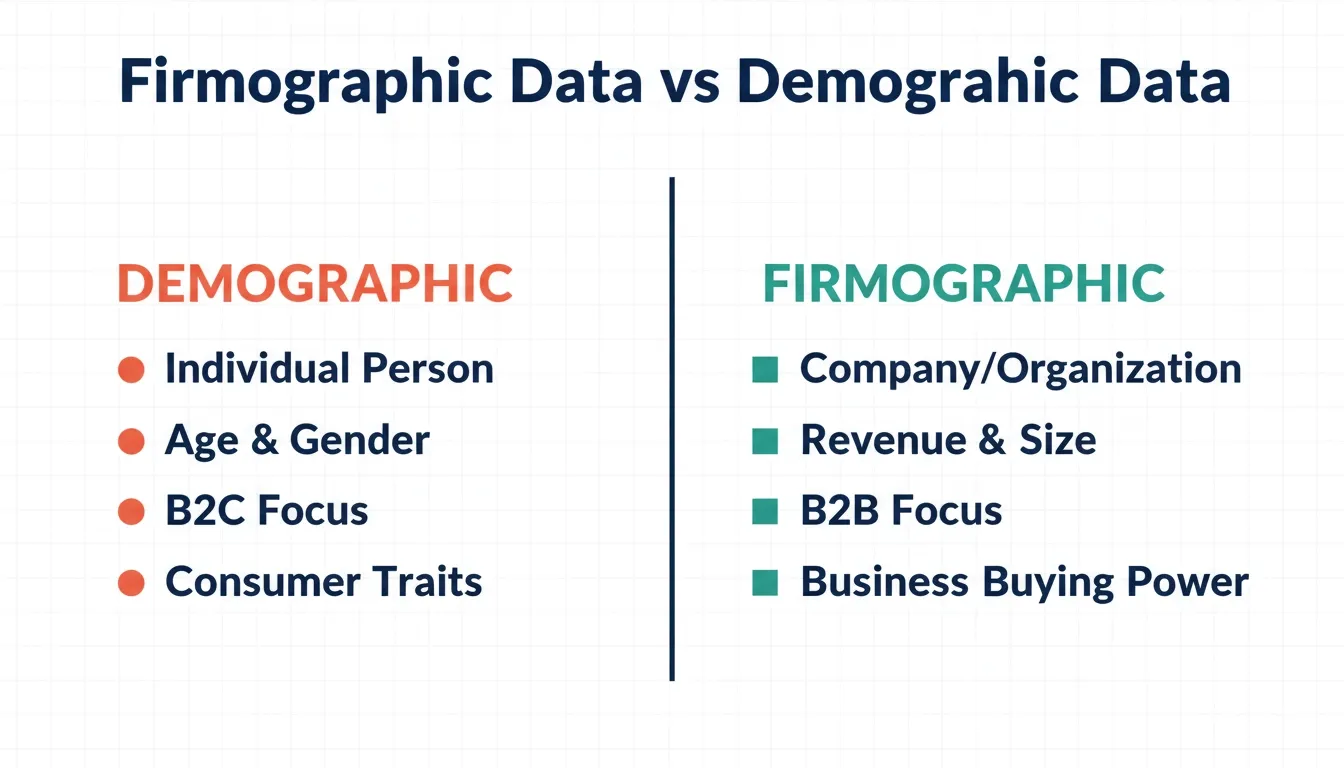 Firmographic data targets organizations; demographic data targets individuals. For B2B teams, firmographics is the primary lens.
How Firmographics Differ from Demographics
Individual people have demographics. Organizations have firmographics. The two describe different kinds of subjects, and mixing them up creates targeting gaps that are hard to trace.
| Attribute | Demographic | Firmographic |
|---|---|---|
| Subject | Individual person | Company or organization |
| Examples | Age, gender, income | Company size, industry, revenue |
| Used by | B2C marketers | B2B sales and marketing teams |
| Identifies | Consumer traits | Business buying potential |
| Main sources | Consumer surveys, census | Business registries, data providers |
Demographic data tells a story about a person. Firmographic data tells a story about a business.
The Core Attributes That Define a Company Profile
Six attributes form the backbone of any complete firmographic profile. Together, they paint a clear picture of whether a given account belongs in your pipeline.
-
Industry type: the vertical the company operates in, such as healthcare, manufacturing, or software
-
Company size: measured by employee count or annual revenue, separating enterprise, mid-market, and startup accounts
-
Geographic location: the country, region, or city where the company operates
-
Annual revenue: a proxy for budget, purchasing power, and deal size potential
-
Ownership structure: whether the company is publicly traded, privately owned, or venture-backed
-
Tech stack: the tools and platforms a company already runs, which shape what they can adopt or replace
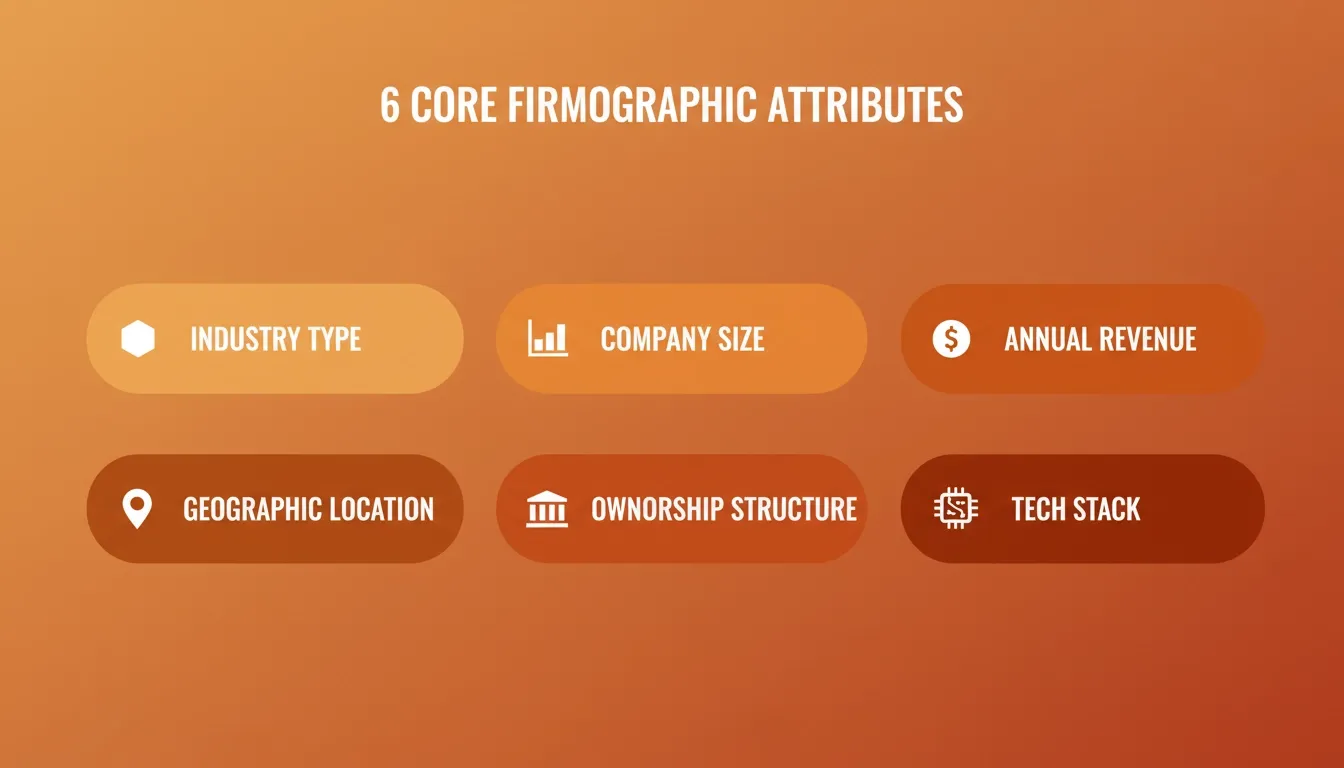 The six firmographic attributes that define every B2B company profile.
Which Attributes Matter Most for B2B Targeting?
Company Size and Revenue
Company size is often the first filter a sales team applies. Teams are often segmenting customers based on company size and revenue signals when prioritizing accounts. Employee count tells a rep whether to expect a long procurement process or a fast single-buyer close. A 50-person startup has one decision-maker; a 5,000-person enterprise may have ten.
Annual revenue is the clearest signal of the budget ceiling. A $2M company is unlikely to sign a six-figure contract. Revenue and funding together describe the financial posture of an account: whether they are in growth mode, consolidation mode, or contraction.
In practice, revenue data helps judge a company's financial health and revenue growth trajectory, showing whether an account could become one of your high-value accounts and supporting sharper sales and marketing efforts as well as more efficient lead generation efforts.
Industry, Location, and Ownership
Industry type determines regulatory requirements, compliance considerations, and the vocabulary your pitch needs to use. The right industry filter alone can cut a prospect list in half and sharply improve engagement rates.
Geographic location affects compliance, outreach timing, and whether field sales make sense. Location data also supports market expansion analytics by showing where target companies cluster geographically.
Ownership structure shapes the buying dynamic: publicly traded companies face quarterly scrutiny, while private companies generally have faster decision cycles. Analysts can also compare industry and company-size segments to spot churn prediction patterns, see which groups cancel most often, and refine market segments.
Tech stack is where firmographic and technographic data overlap. Knowing whether a company runs Salesforce tells you whether your product plugs in cleanly or requires significant change.
Where Do Revenue Teams Collect Firmographic Data?
Most sales and marketing teams gather firmographic data from four main channels: their own forms and surveys, third-party data providers, public records, and CRM enrichment workflows.
The challenge is freshness; collecting firmographic data only works when the inputs stay accurate over time, because a firmographic profile that was accurate six months ago may already be wrong.
For a deeper look at B2B data types and how to select providers, Rocket’s complete guide to B2B data covers sourcing, quality standards, and compliance in detail.
First-Party Methods
Surveys and enrichment forms embedded in gated content are one way to source firmographic data, alongside surveys and primary research, by capturing company information directly from the target company. Gate registration flows can ask for firmographic fields like company size, industry, and role, these inputs feed directly into CRM workflows and segmentation engines.
Accuracy is highest for first-party sources, but scale is lowest. First-party collection is valuable for enriching existing accounts, but it won’t fill the gap when building a net-new prospect list from scratch, even though it often delivers accurate firmographic data with stronger accuracy than completeness compared with other sources.
Third-Party Data Providers
The major providers, ZoomInfo, Clearbit, and Apollo, aggregate company information from multiple sources and use it to enrich firmographic data at scale, pulling from company websites, job boards, news sources, and public filings. The core challenge with third-party sources is outdated records; data degrades steadily as companies change structure, headcount, and direction. The best vendors verify records and pass accurate firmographic data into CRM systems or APIs.
Providers with real-time or frequent refresh cycles are more reliable. Database size rarely correlates with data freshness.
Public Records and Directories
Public records and company websites provide publicly available company information such as legal entity names, registered addresses, and basic corporate structure, but compiling it usually takes manual work.
SEC filings can add detailed revenue figures for public companies, though those sources may also be outdated by the time teams pull them together. Business directories like trade association lists provide publicly available information at the industry level.
Three source types feed into a company profile, which flows through segmentation into targeted outreach.
No single source is complete on its own. Combining them is what produces a firmographic profile worth building a go-to-market strategy around, and public sources can still help with industry reports, even if they are not always current enough on their own.
How Firmographic Segmentation Sharpens B2B Targeting
Firmographic segmentation is the practice of segmenting customers based on shared firmographic traits and treating each group as a distinct target audience with distinct messaging.
It is the single most reliable way to move from generic outreach to targeted campaigns that resonate, support tailored marketing strategies, and improve marketing efforts across different customer segments with more effective marketing campaigns.
According to HubSpot, 91% of marketers report that segmentation improved email performance. That result follows directly from the precision that good firmographic profiles make possible, leading to stronger conversion rates.
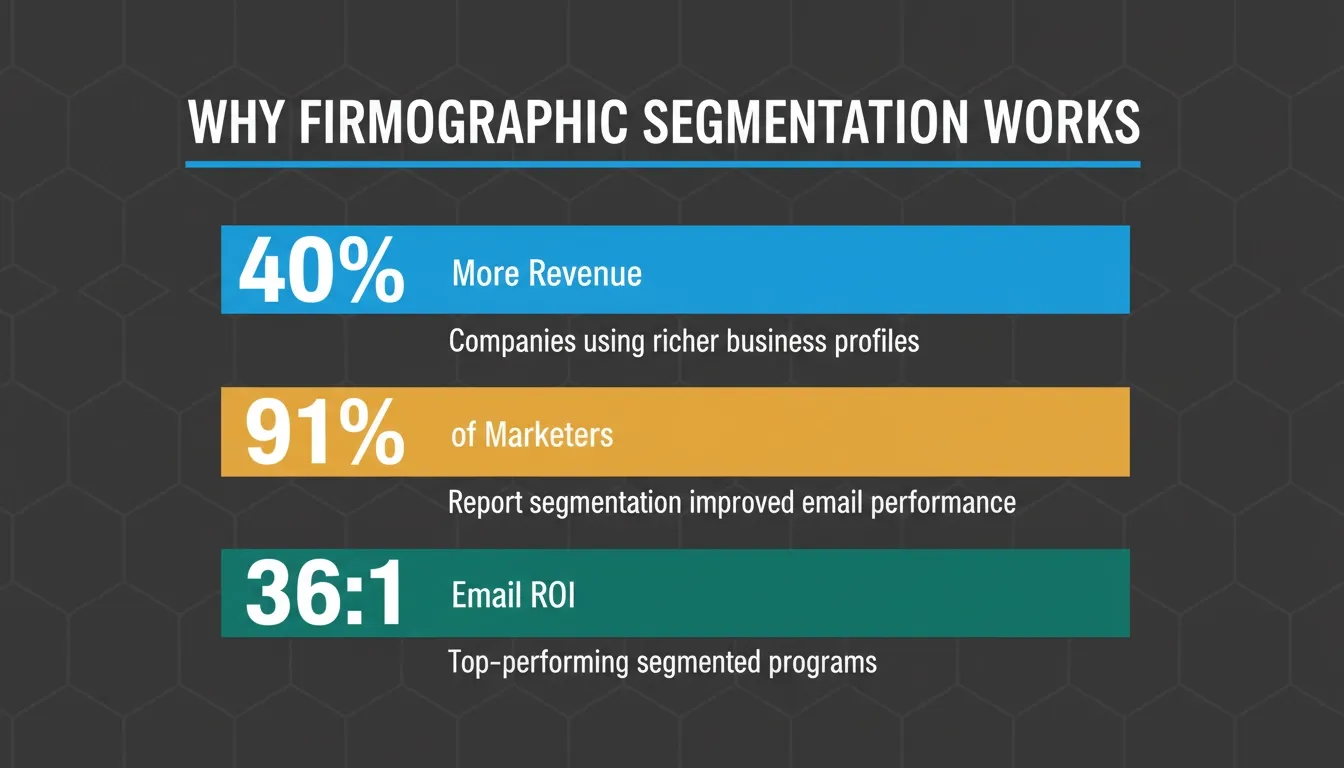 Firmographic segmentation consistently drives measurable revenue and engagement improvements across B2B programs.
Building an Ideal Customer Profile
Firmographic segmentation at the ICP level starts with a simple question: what do your best accounts actually have in common? An ideal customer profile begins by analyzing your best customers — the accounts that renewed, expanded, and referred others.
Firmographic criteria like “mid-market SaaS companies with 50-200 employees based in North America” become a filter, not a description, helping you set a target company size and identify companies that match your best customers.
Using firmographic traits to define your ICP gives the sales team a consistent qualification standard that does not vary from rep to rep.
By leveraging firmographic data this way, teams can prioritize target companies more consistently and build a competitive advantage in lead generation efforts.
Lead Scoring and Prioritizing Accounts
Once an ICP exists, firmographic segmentation powers lead scoring directly by ranking sales prospects based on how well their profiles fit ideal customer criteria.
Account scoring then prioritizes leads by assigning higher scores to companies with the most profitable firmographic traits.
Lead scoring assigns point values to firmographic attributes that match your ICP: an account in the right target industry, right size band, and right geography scores higher.
Prioritize high-value accounts by firmographic fit first, then layer in behavioral signals like website visits or content engagement. Good lead scoring makes the pipeline predictable.
Personalizing Campaigns by Segment
When you know a company’s industry type, revenue band, and company size, marketing platforms can personalize campaigns around that company’s industry-specific pain points. Marketing teams running campaigns across multiple customer segments can create distinct ad copy, email sequences, and dedicated pages for each segment, which supports tailored marketing strategies and more effective marketing campaigns.
Litmus research shows 35% of companies achieve an email ROI of 36:1 or more, with the highest-performing programs segmenting precisely and personalizing deeply. Targeted marketing campaigns built on firmographic attributes cost less to run because they reach fewer, better-qualified accounts.
When teams use firmographic data in ABM, account engagement and conversion rates improve because messaging matches each segment’s needs.
“Real-time enrichment waterfalls. Event-driven automation from intent signals. Confidence scoring on every contact record. Multi-provider data validation before any outreach fires.” - (source)
That is what effective marketing strategies look like at the execution level, especially when intent data and a prospect’s marketing automation tools add more context for personalization, and it all starts with firmographic segmentation done well.
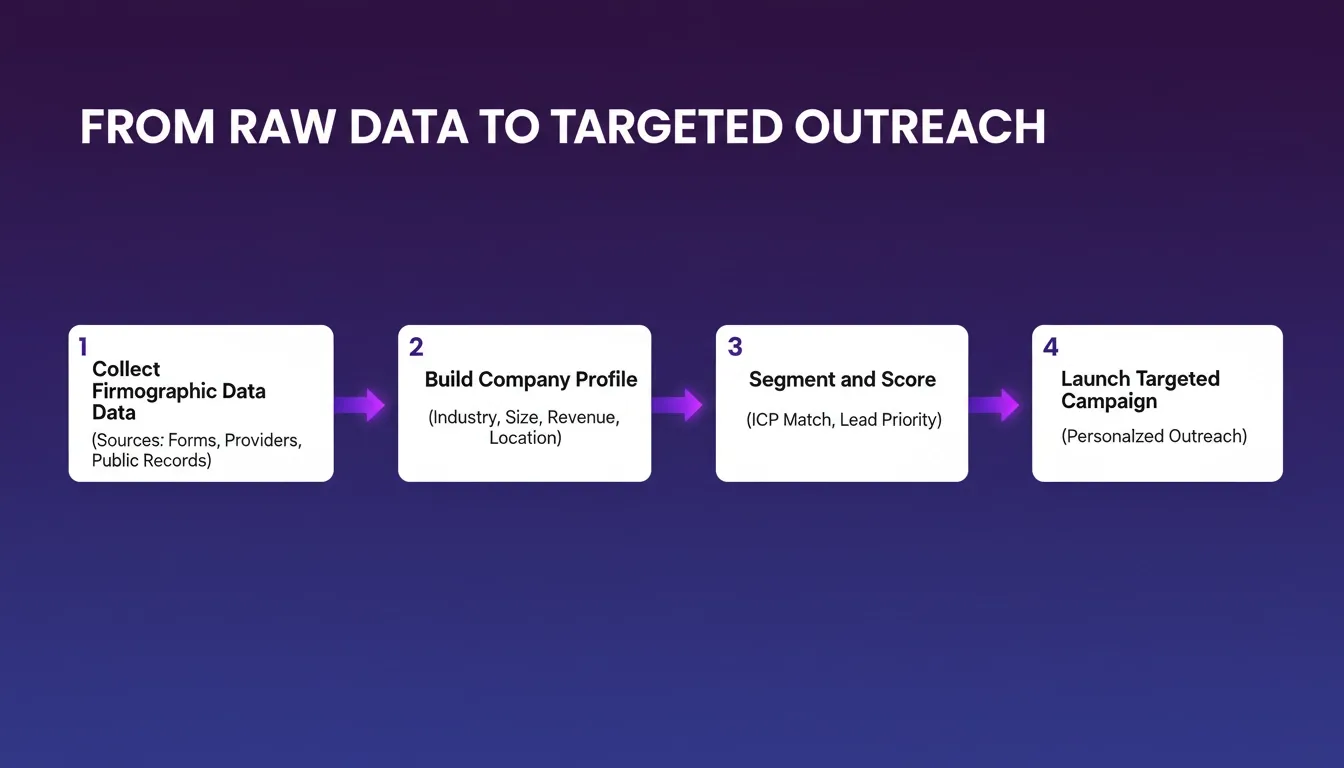 From raw data to targeted outreach: teams use firmographic data to sharpen relevance, and segmentation at each stage raises relevance and lowers wasted spend.
How Rocket Keeps Your Company Data Fresh and Actionable
Good firmographic profiles degrade the moment they’re written. Companies restructure, executives change, headcount shifts, and revenue bands move, none of which a static database reflects automatically. The sales team that sent a perfectly targeted sequence last quarter may be working from stale profiles today.
This is the gap Rocket’s Intelligence feature is built to close. By monitoring target accounts continuously across every public platform they operate on, it converts static firmographic snapshots into live company intelligence that sales and marketing teams can actually act on.
What Static Data Providers Get Wrong
Static providers treat firmographic profiles as snapshots. ZoomInfo and similar platforms offer broad databases with solid initial coverage, but refresh cycles leave gaps for accounts that change between updates. CRM data ages silently: most sales teams notice the problem only after a sequence bounces or a prospect corrects a rep mid-call.
No static provider can tell you when a key account just raised a funding round, changed its CEO, or began hiring in a new region. These are the events that fundamentally change whether and how to reach them.
How Rocket Tracks Company Signals in Real Time
Rocket Intelligence monitors target accounts continuously across website, social, news, GTM, traffic, product, people, business, and reviews, ten pillars at once. Rather than a periodic export, Rocket delivers real-time signals: website changes, hiring moves, leadership shifts, funding announcements, and social activity, all tied back to the firmographic profile of each account.
For the sales team, this means knowing a target account just expanded its engineering team before sending a pitch, not three months later when the CRM gets refreshed. Growth trends in a target company become visible before they show up in a quarterly report. Rocket connects with your existing workflow, so enriched, current profiles flow directly into the tools your team already uses.
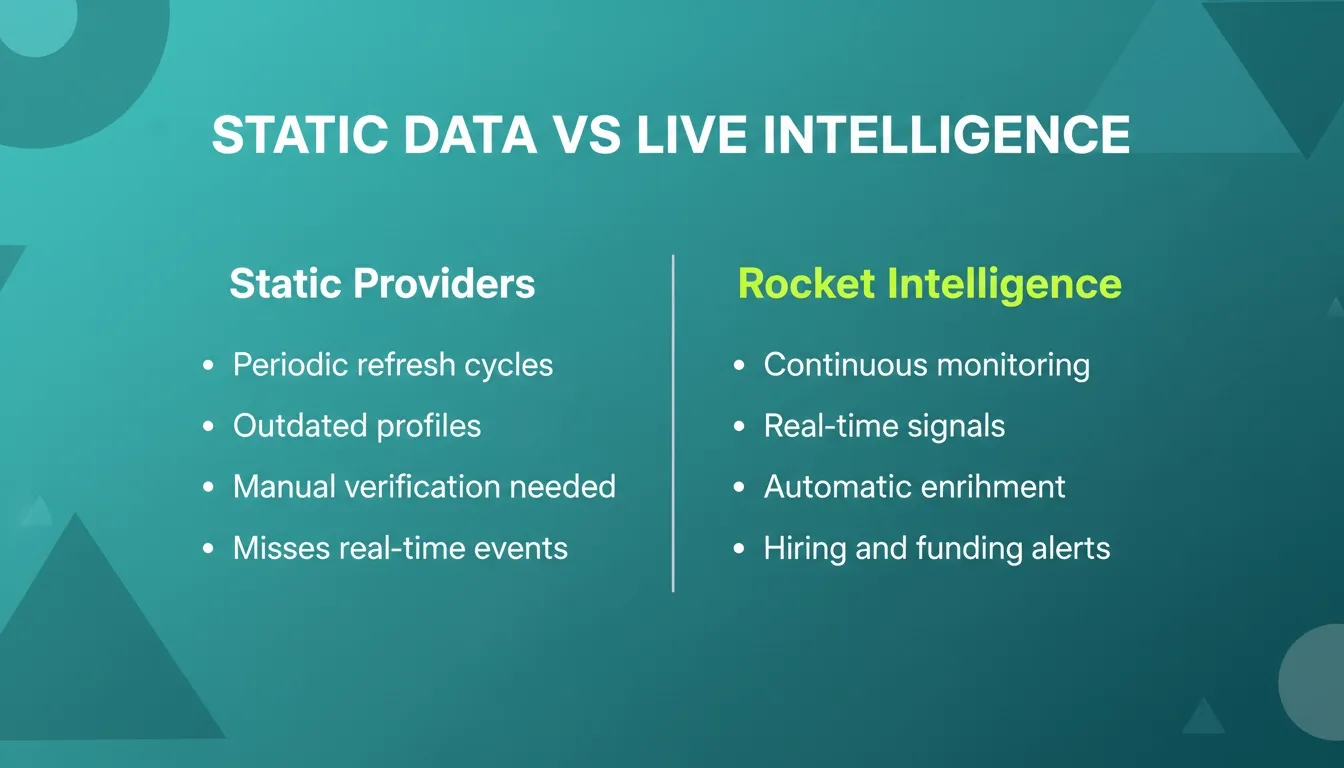 Rocket Intelligence replaces periodic snapshots with continuous monitoring across ten company signal pillars.
When a target company shifts its positioning, changes its tech stack, or moves into a new industry vertical, Rocket’s Intelligence documentation explains how signals surface in near-real time, giving your team a chance to respond before the window closes. You can also explore how data enrichment works alongside live intelligence to keep your profiles complete and current.
Turn Firmographic Intelligence Into Revenue Growth
Firmographics, the company-level attributes that describe size, industry, revenue, location, and ownership, are the foundation every B2B targeting decision should rest on. When the attributes are accurate and current, the entire go-to-market stack gets sharper: ICPs become filters, lead scoring becomes predictive, and campaigns stop burning budget on accounts that were never going to close.
The difference between good and great firmographic segmentation comes down to data quality over time. Live company intelligence is what keeps it reliable.
Ready to move from stale snapshots to live company intelligence?
Start building on Rocket and put real-time firmographic data to work for your go-to-market team.
Table of contents
- -What Are Firmographics, Exactly?
- -How Firmographics Differ from Demographics
- -The Core Attributes That Define a Company Profile
- -Which Attributes Matter Most for B2B Targeting?
- -Company Size and Revenue
- -Industry, Location, and Ownership
- -Where Do Revenue Teams Collect Firmographic Data?
- -First-Party Methods
- -Third-Party Data Providers
- -Public Records and Directories
- -How Firmographic Segmentation Sharpens B2B Targeting
- -Building an Ideal Customer Profile
- -Lead Scoring and Prioritizing Accounts
- -Personalizing Campaigns by Segment
- -How Rocket Keeps Your Company Data Fresh and Actionable
- -What Static Data Providers Get Wrong
- -How Rocket Tracks Company Signals in Real Time
- -Turn Firmographic Intelligence Into Revenue Growth