
Sales enablement tools span four core categories: content management, training and coaching, sales intelligence, and competitive battlecards. This guide breaks down each category, how they connect, and a clear framework for building a stack that actually closes deals.
Why do some sales teams consistently hit quota while others struggle with the same prospects?
For most teams, the difference comes down to enablement. Research from G2 shows organizations with a dedicated sales enablement strategy see a 49% higher win rate on forecasted deals, yet the majority of sales and marketing teams still build their stack without a clear plan.
This blog walks through every major category of enablement tools, from content management to competitive battlecards, and gives sales leaders a clear picture of what each layer does, how the categories connect, and what to prioritize when building an enablement program that actually closes deals.
What Counts as Sales Enablement?
The term gets applied loosely across a lot of functions. Before picking any enablement tool, it helps to agree on what the discipline actually covers and what falls outside it.
At its core, sales enablement is the ongoing process of equipping sales teams with the knowledge, content, and resources they need to engage buyers and close more deals. It sits at the intersection of sales and marketing, with enablement teams acting as the bridge between what marketing creates and what sellers use in the field.
Different organizations define it differently. Some treat it as purely a content management concern, making sure reps can find the right deck before a customer call. Others build full sales enablement programs that span training, coaching, competitive intelligence, and sales process in one coordinated effort. The data consistently favors the more complete approach.
What falls inside the scope of a sales enablement program:
-
Sales content: Decks, case studies, email templates, whitepapers, and sales collateral that help reps communicate value to buyers at each stage of the buyer journey
-
Sales training: Onboarding curricula and structured learning paths that make new reps productive faster and help tenured sellers sharpen their skills
-
Sales coaching: Manager-led and AI-assisted feedback loops that improve rep behavior based on real sales calls and customer data from the field
-
Process and methodology: Defined plays, sequences, and scripts that guide how reps move deals through the sales cycle
-
Competitive intelligence: Battlecards, win/loss data, and market signals that give sellers a clear answer when competitor names come up in customer conversations
What sits outside it: general marketing campaigns, brand work, and anything not directly connected to equipping reps to engage and close.
The reason this definition matters is that every category above maps to a different class of enablement tool. Getting clear on scope first means your team picks what it actually needs rather than what sounds most compelling in a demo.
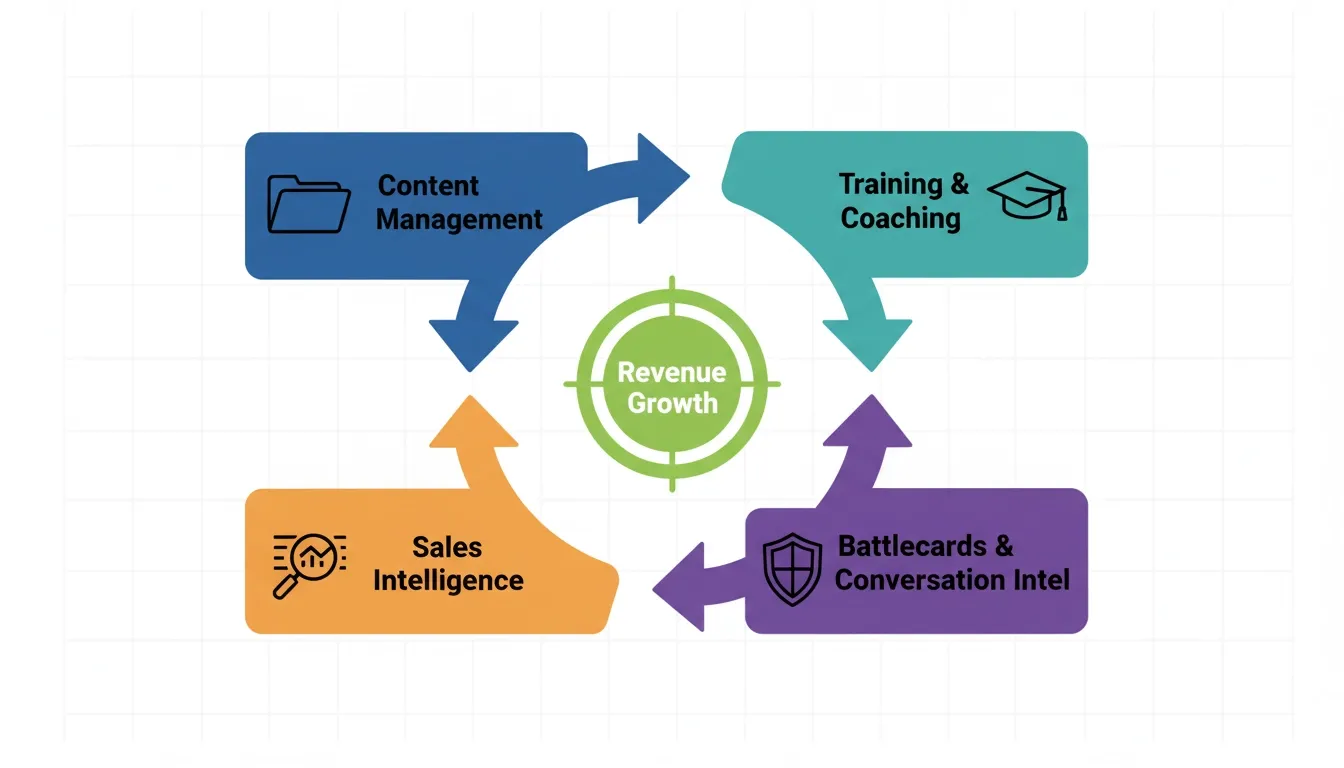 The four core pillars of sales enablement and how they connect to drive revenue outcomes.
The Four Categories That Make Up a Winning Stack
Sales and marketing teams that consistently hit their numbers tend to share one thing: their tech stack covers all four core functions. Miss one layer and the gap tends to show up in sales performance, sales cycle length, or win rates. Here is how the categories break down.
Content Management and Sales Collateral
Content without structure is clutter waiting to frustrate a rep before a call. Sales content management tools give marketing teams and sales teams a centralized place to store, tag, and surface materials, so sellers spend their time selling rather than searching for a slide deck.
What a solid content management layer handles:
-
A searchable library for decks, case studies, one-pagers, and whitepapers that sellers can access by deal stage or prospect type
-
Sales content analytics tracking which assets get used and which sit untouched, so marketing teams can focus creation efforts on what actually converts
-
Automated suggestions that surface relevant content inside the rep's CRM at the right moment in a deal, without requiring manual search
-
Governance controls that let sales managers and marketing teams keep materials on-brand and accurate without chasing down old versions
-
Knowledge management tools like Guru that store process guides, battlecard FAQs, and quick-answer resources in a searchable format alongside your full content library
Platforms like Seismic, Highspot, and Guru sit in this space. Seismic and Highspot offer strong CMS capabilities and Seismic Learning modules, though both rely on dedicated enablement teams to keep the content inside them current.
Sales Training and Coaching Platforms
Reps need more than good content. They need to know how to use it, when to deploy it, and how to handle the objections that follow. Sales training platforms and dedicated sales coaching tools close the gap between onboarding day one and consistent on-the-job performance.
What a strong training and coaching setup covers:
-
Structured learning paths, quizzes, and certifications for new hire onboarding and ongoing development across the sales organization
-
AI-powered role-play simulations and call recording review for skill-building outside of formal manager-led sessions
-
Dashboards that let sales managers track module completion and spot reps who need more focused coaching opportunities
-
Learning management system modules for organizations that need formal curricula and certification tracks alongside core sales skills
Mindtickle and Highspot both operate here, each with a different balance of LMS depth and coaching agility. Seismic Learning suits organizations with more complex training requirements.
Sales Intelligence Tools and Analytics
Knowing who to reach, when to reach them, and what to say matters as much as having the right content ready. Sales intelligence tools give reps the data they need to prioritize accounts, time outreach, and walk into customer calls with genuine context on potential customers.
A complete intelligence layer provides:
-
Technographic and firmographic data on target accounts pulled from company websites and third-party data providers
-
Intent signals showing which accounts are actively researching solutions in your category right now, so outreach lands when buyers are already looking
-
CRM enrichment that keeps customer data accurate without depending on manual entry from busy sales reps across the sales organization
-
Sales analytics and reports that connect activities to sales pipeline health and revenue outcomes
-
Conversation intelligence signals from past sales calls that reveal which messaging approaches correlate with revenue growth
HubSpot Sales Hub and Salesforce cover CRM and baseline analytics for most sales organizations. ZoomInfo and 6sense handle intent data and account enrichment. For competitive intelligence specifically, Rocket Intelligence monitors every public signal a competitor generates and delivers a structured daily brief rather than a raw feed of alerts.
Battlecards and Conversation Intelligence
Battlecards are quick-reference sheets reps pull up the moment a competitor enters a sales call. Conversation intelligence tools make those battlecards smarter over time by mining recorded calls for the objections, phrases, and responses that have actually won deals.
What this category of enablement tool addresses:
-
Pre-built battlecard templates for each key competitor, with clear positioning for why buyers choose your solution over theirs
-
AI-powered analysis of call recordings that surfaces competitor mentions and common objections automatically, without requiring a PMM to review every transcript
-
Real-time prompts that coach reps on what to say as a customer conversation unfolds, drawing on responses that proved effective in past competitive deals
-
Win/loss data loops that feed back into the battlecard update cycle so content reflects current competitive reality, not last quarter's messaging
Gong and Chorus lead the conversation intelligence category. Klue and Crayon focus on the competitive battlecard side. The common friction point across all of these enablement tools: PMM teams still carry the manual burden of writing and updating the content inside the cards, which means battlecard quality depends on available headcount.
Sales Enablement Category Comparison
| Category | Primary Job | Who Owns It | Key Outcome |
|---|---|---|---|
| Content management | Organize and surface collateral | Marketing / Enablement | Right content at the right moment |
| Training and coaching | Build rep skills over time | Sales managers / L&D | Faster ramp, better quota attainment |
| Sales intelligence | Prioritize accounts and time outreach | Sales ops / RevOps | Better targeting, higher revenue growth |
| Battlecards and conversation intel | Win competitive deals | Product marketing / CI | Higher win rates in live deals |
Most teams need enablement tools across at least three of these categories to run a complete program. Skipping competitive intelligence is the most common gap, and usually the most expensive one.
How Does Competitive Intelligence Power Your Enablement?
Of the four categories above, competitive intelligence is where teams most often underinvest, yet it is also where the biggest win rate gaps tend to hide. So how does it actually connect to the rest of your stack?
Competitive intelligence feeds everything else. When it runs well, signals from monitoring flow directly into battlecard content, which shows up in sales training and coaching programs, which improves how reps perform on actual sales calls. The cycle reinforces itself when win/loss data gets fed back into the signal layer.
Here is what that cycle looks like:
The problem most enablement teams run into is that this cycle breaks somewhere in the middle. Signals come in but never become structured battlecard content. The battlecards exist but never reach reps in their daily work. Win/loss data lands in a spreadsheet nobody opens.
Research on leading competitive sales enablement platforms shows the sales teams that most consistently close competitive deals deliver deal-specific, AI-powered intelligence directly into the rep's workflow at the right moment. Publishing a PDF and hoping reps find it before the call is not a competitive enablement program.
"From sales onboarding to selecting sales enablement solutions, creating sales enablement content, and everything in between, a successful sales enablement strategy remains a balance of art and science." — Federico Presicci, Sales Enablement Advisor
The implication for enablement teams is real: most organizations are still navigating this without a clear standard. The competitive intelligence loop breaks down precisely because every sales team is figuring it out with imperfect information and limited resources.
So when evaluating any enablement tool in the sales intelligence or competitive intel space, the most useful question is simple: does this actually change what a rep says on a call this week, or does it produce a report that lands in a folder?
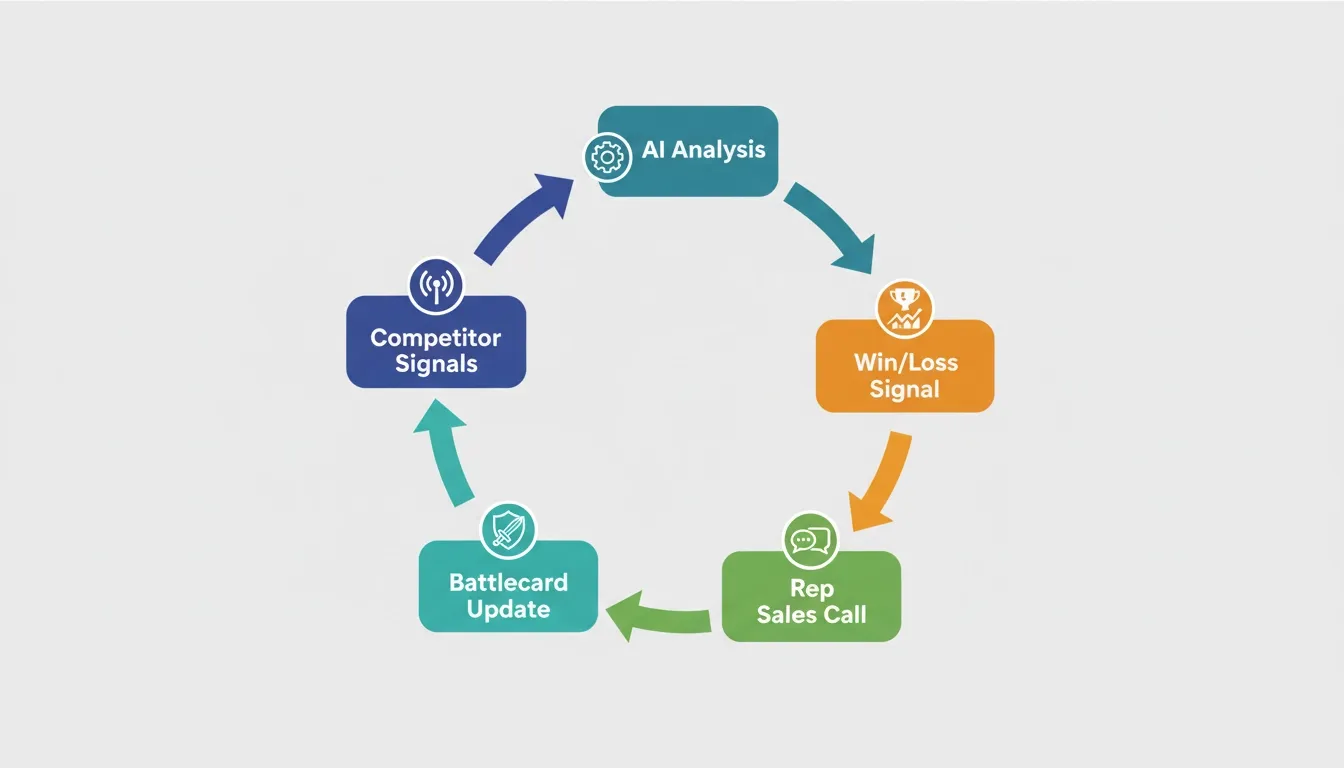 How competitive intelligence flows from raw signals into field-ready battlecards and back again through win/loss data.
How Do You Choose the Right Stack for Your Team?
There is no single best sales enablement software package that works for every organization. The right combination of enablement tools depends on where your current gaps are, how your sales operations and RevOps teams are set up, and what your existing CRM and workflows can support.
Four questions cut through most of the noise when sales leaders are evaluating options:
Where do your deals actually stall? If deals die because reps cannot find the right content, prioritize a content management system. If they stall because reps struggle with competitive objections, prioritize intelligence and battlecard enablement tools. If new reps take three to four months to hit full productivity, prioritize sales training and coaching platforms. Start with the real bottleneck in your sales process, not the most heavily marketed product.
What does your team size justify? A 10-rep sales team and a 200-rep sales organization need very different sales enablement platforms. Smaller teams benefit from enablement tools that are quick to set up, easy to maintain, and light on admin overhead. Larger sales organizations can absorb more complex platforms offering deeper analytics, granular permissions, and dedicated revenue operations dashboards that sales managers and sales leaders use daily.
What does your current tech stack already include? Every enablement tool you add needs to connect with your CRM and existing workflows without adding friction. Salesforce and HubSpot Sales Hub anchor most sales enablement software setups. Check which platforms connect natively with what you already use before committing to anything that creates more process than it removes.
Are you measuring the right outcomes? Research drawn from 21 different sales enablement studies confirms that the outcome metrics sales leaders now prioritize include win rate, quota attainment, sales cycle length, and content adoption rate. If your best sales enablement software does not surface these metrics clearly, a new purchase will not fix the visibility problem.
Sales enablement leaders who build the best programs treat their stack as a system, not a collection of individual subscriptions. Content management feeds training. Training informs coaching. Intelligence powers battlecards. Battlecards improve sales calls. Calls generate win/loss data that feeds back into the content layer.
One component that sits outside the four categories but connects all of them is continuous competitive monitoring. That is what Rocket Intelligence delivers.
If you want to understand how sales intelligence software fits into a broader revenue stack, that guide covers the selection criteria in detail.
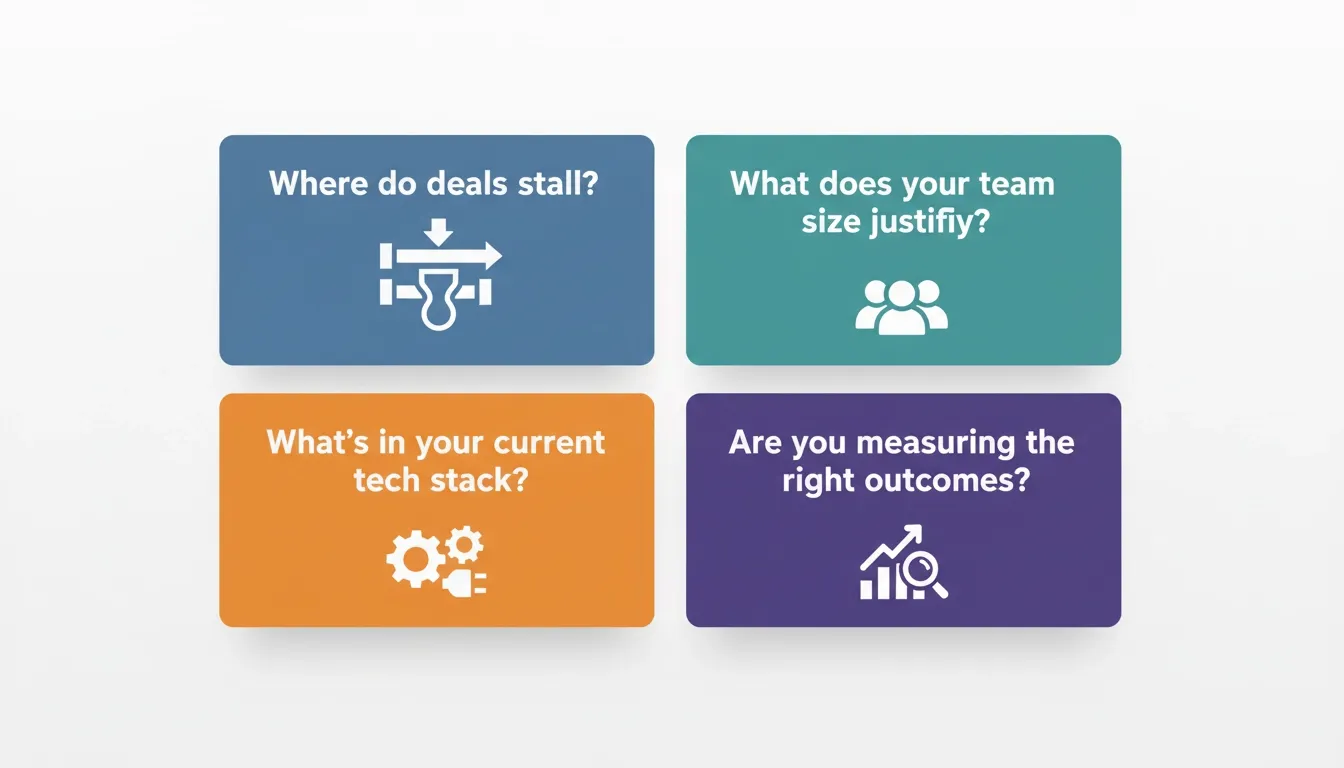 Use these four questions to cut through vendor noise and identify the right enablement tools for your team.
How Rocket Intelligence Turns Competitor Signals into Ready-to-Use Battlecards
Most competitive intelligence setups are reactive by design. A PMM hears from a rep that a competitor launched a new feature. They check the website, draft an update to the battlecard, send it to a Slack channel. By the time the updated card reaches the field, the team has already run competitive deals without it.
Rocket Intelligence works differently. It monitors every public surface a competitor operates on continuously, tracking six signal categories in parallel: website changes, social media activity, news and press coverage, customer reviews, hiring velocity and executive moves, and performance marketing activity across LinkedIn, Meta, and TikTok.
What that means in practice for sales and enablement teams:
-
No manual monitoring needed: Rocket watches competitor websites, LinkedIn, G2 and Glassdoor reviews, and ad activity automatically, delivering results directly into Salesforce, Slack, and email inboxes, so your team does not need a dedicated analyst for each competitor
-
Daily structured briefs: Instead of a feed of raw alerts, Rocket delivers a synthesized brief every morning with three outputs: what changed, why it matters for your business specifically, and what your team should do next
-
AI-powered signal interpretation: A pricing page change in isolation is noise. That same change alongside enterprise-focused social posts, defensive review responses about security, and new enterprise sales job openings is a single clear strategic signal. Rocket reads the cluster, not the individual event
-
Connection to deal research: When a rep is preparing for a high-stakes competitive deal, Rocket Solve produces a deal-specific brief from discovery notes and live competitive intelligence in minutes, not days
Unlike other enablement tools that rely on conversation intelligence recordings or web scraping alone, Rocket combines all six signal categories into one interpreted brief. Sales operations teams, product marketing managers, and sales leaders all pull from the same live source, with no duplicate monitoring effort and no stale data.
You can also explore how building a competitive intelligence program from the ground up connects to your broader sales enablement strategy.
Your Sales Enablement Stack: The Path from Signals to Closed Deals
Getting a sales enablement program right is not about having the most tools or the highest-priced platform. It is about covering the right categories and making sure the intelligence your team generates from real deals flows back into how you train, coach, and prepare reps for the next call.
The four categories mapped in this guide, content management, training and coaching, sales intelligence, and competitive battlecards, are the building blocks every revenue team needs. Get the layers connected, measure the right outcomes, and let data from actual customer conversations inform everything else. The program compounds from there.
If your team is still relying on reactive competitive monitoring, a stale battlecard deck, or manual rep prep before high-stakes calls, there is a faster path. Start turning competitor signals into field-ready intelligence at Rocket.new and see how continuous competitive monitoring changes what your reps say in the room.
Table of contents
- -What Counts as Sales Enablement?
- -The Four Categories That Make Up a Winning Stack
- -Content Management and Sales Collateral
- -Sales Training and Coaching Platforms
- -Sales Intelligence Tools and Analytics
- -Battlecards and Conversation Intelligence
- -Sales Enablement Category Comparison
- -How Does Competitive Intelligence Power Your Enablement?
- -How Do You Choose the Right Stack for Your Team?
- -How Rocket Intelligence Turns Competitor Signals into Ready-to-Use Battlecards
- -Your Sales Enablement Stack: The Path from Signals to Closed Deals