
Rocket.new keeps pace with 2026 market demands by combining AI-driven insights, automation, and real-time data analysis, enabling businesses to monitor competitors, adapt strategies quickly, and stay ahead in fast-moving industries.
What does it take for a small marketing team to compete with big agencies?
It’s no longer about size; it’s about how you operate. Small teams today are closing the gap by combining smart decisions with AI-powered platforms like Rocket.new. Tasks that once needed full research departments, competitor tracking, insights, and campaign building can now be handled faster and more efficiently.
According to research from ActiveCampaign and Marketing Brew, AI saves marketers an average of 13 hours per week nearly a third of a standard workweek while cutting an average of $4,739 per month in operational costs. The gap between small marketing teams and large research agencies used to feel permanent. Not anymore.
This blog will show you exactly how to use these shifts to compete and win with a smaller team.
The Old Gap
Before AI-powered tools arrived, the difference came down to three things: access to data, speed of analysis, and the ability to act on insights fast. Here is how that gap used to look:
| Factor | Research Agency | Two-Person Marketing Team |
|---|---|---|
| Competitive research | Weeks of structured analysis | Manual searches, limited data |
| Competitive intelligence | Ongoing monitoring systems | Sporadic competitor checks |
| Campaign performance | Dedicated analysts and dashboards | DIY reporting, often delayed |
| Asset building | Design and dev teams on retainer | Freelancers or slow manual process |
| Pricing strategy | Market research and financial modeling | Gut feel and competitor guessing |
| Lead scoring | Dedicated CRM support and data science | Basic tracking, no real model |
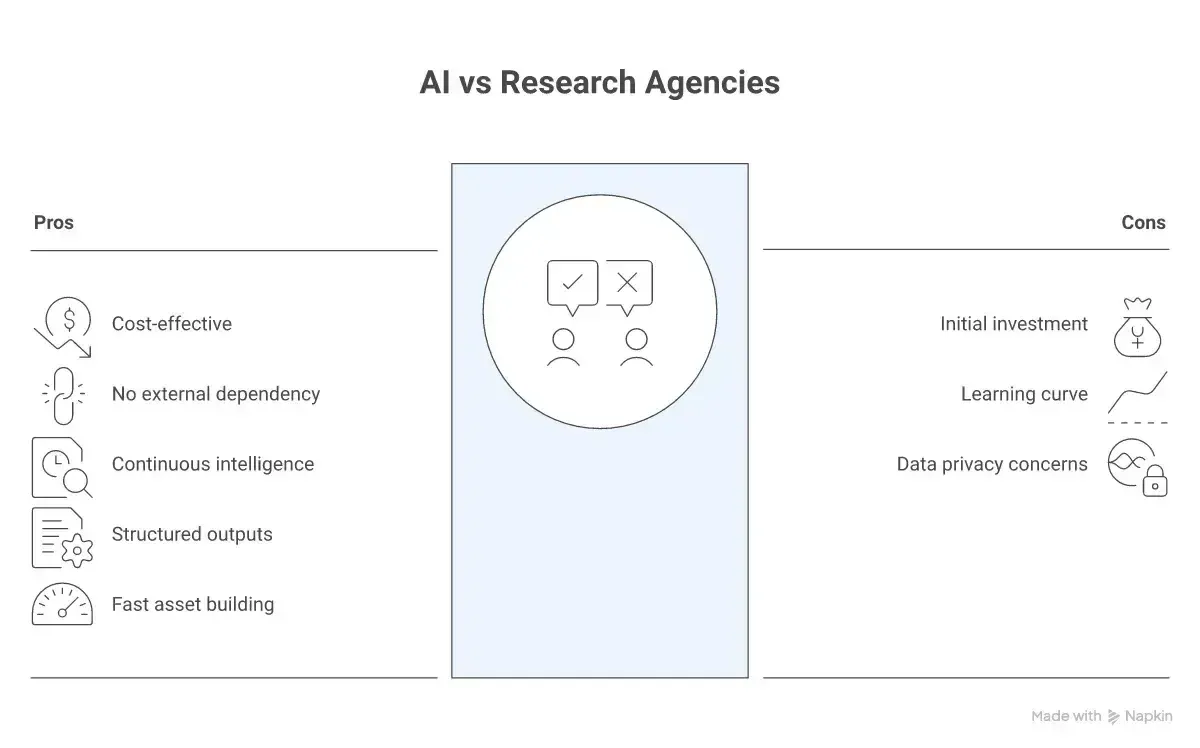 That is what the old structure looked like. AI-powered platforms have closed nearly every one of those gaps.
What AI Tools Change for Small Teams?
AI isn’t just making things faster it’s expanding what small marketing teams are actually capable of doing.
According to SurveyMonkey research, 88% of marketers now use AI in their daily work, and 75% say it helps them compete more effectively with larger organizations. That shift is changing how small teams operate.
What actually changes:
-
Access to real competitive intelligence, not guesswork
-
Faster research and insight generation
-
Ability to create high-quality marketing assets in-house
-
More structured and data-backed decision making
-
Reduced dependence on external agencies
When these capabilities come together, the mindset shifts. Small teams stop waiting on agencies—and start moving with speed and confidence.
This is where small teams gain their edge by turning AI into a multiplier, not just a tool.
How Marketing Teams Use Rocket.new?
Rocket.new is the world’s first Vibe Solutioning platform a single system where marketing teams can research what to do, build what they need, and monitor what matters.
Instead of juggling multiple tools, everything runs in one connected environment where context carries across workflows. That means no repetition, faster execution, and smarter decisions that build on each other over time.
How small marketing teams use it:
-
Run continuous competitor research without manual effort
-
Turn raw market signals into clear, actionable insights
-
Build campaigns, content, and assets within the same system
-
Track competitor moves and market shifts in real time
-
Align strategy, execution, and analysis in one workflow
With everything connected, teams don’t lose time switching tools or rethinking context. They move faster, stay sharper, and operate with the clarity usually reserved for much larger organizations.
This is how small teams turn a single platform into a complete competitive advantage.
AI Competitive Intelligence Without the Agency
Rocket.new’s Intelligence pillar continuously monitors every public platform your competitors operate on. It doesn’t just collect data it interprets signals in context, showing what those changes actually mean for your brand, campaigns, and next moves.
Marketing teams receive daily, weekly, and monthly briefings directly in their workflow. Instead of digging through scattered updates, they see structured insights on pricing changes, campaign shifts, messaging evolution, and product moves right when it matters.
What this enables:
-
Continuous visibility: Always-on tracking across competitor channels
-
Contextual insights: Clear understanding of what changes actually mean
-
Timely decision-making: Act on fresh data, not outdated reports
-
Strategic awareness: Spot patterns in pricing, messaging, and positioning
-
Faster response cycles: Move the moment competitors shift
Competitors change direction. Your team sees it immediately and responds just as fast. This is how small teams replace slow, expensive research cycles with real-time competitive awareness.
AI Research & Strategy with Solve
Rocket.new’s Solve pillar turns any business question into a complete, structured solution usually within 60 to 90 minutes. Instead of relying on external research agencies, marketing teams can run competitive assessments, define positioning, and plan campaigns directly within one system.
What this enables:
-
End-to-end strategy: From insights to execution in one flow
-
Evidence-backed outputs: Key findings supported with real data
-
Risk visibility: Built-in risk matrix for smarter decisions
-
Clear execution plans: Defined owners, timelines, and next steps
-
Flexible refinement: Improve outputs through follow-up prompts
-
Ready-to-share deliverables: Export as PDFs or presentation decks
This shifts control back to the team. What once required agency retainers can now be done in-house faster, cheaper, and on demand. This is how small teams produce agency-level strategy without the agency..
Build Apps & Landing Pages From Strategy
Marketing teams don’t just need ideas they need assets. Rocket.new’s Build capabilities turn strategy into production-ready landing pages, websites, and apps using simple natural language inputs.
What this enables:
-
Strategy-to-asset execution: Go from idea to live build in one flow
-
Production-ready output: SEO structure, accessibility (WCAG), and performance built in
-
Seamless integrations: Connect tools like Mailchimp, Google Analytics, Stripe, and Mixpanel
-
No dev dependency: Launch without waiting on engineers or agencies
-
Faster campaign rollout: Reduce delays and move ahead of competitors
When teams can build and deploy without bottlenecks, execution speed becomes a real competitive advantage. This is how small teams turn strategy into live assets without slowing down.
Campaign Performance in One System
After launch, Rocket.new’s built-in analytics track visitors, conversions, and Core Web Vitals without needing extra tools. Everything is measured directly where the work happens.
For marketing teams running multiple campaigns, this creates a tighter loop between strategy, execution, and performance. There’s no switching between platforms or piecing together scattered data.
With everything in one system, context stays intact. Teams see what’s working, adjust faster, and keep improving without losing momentum.
How AI-Powered Teams Move From Idea to Execution
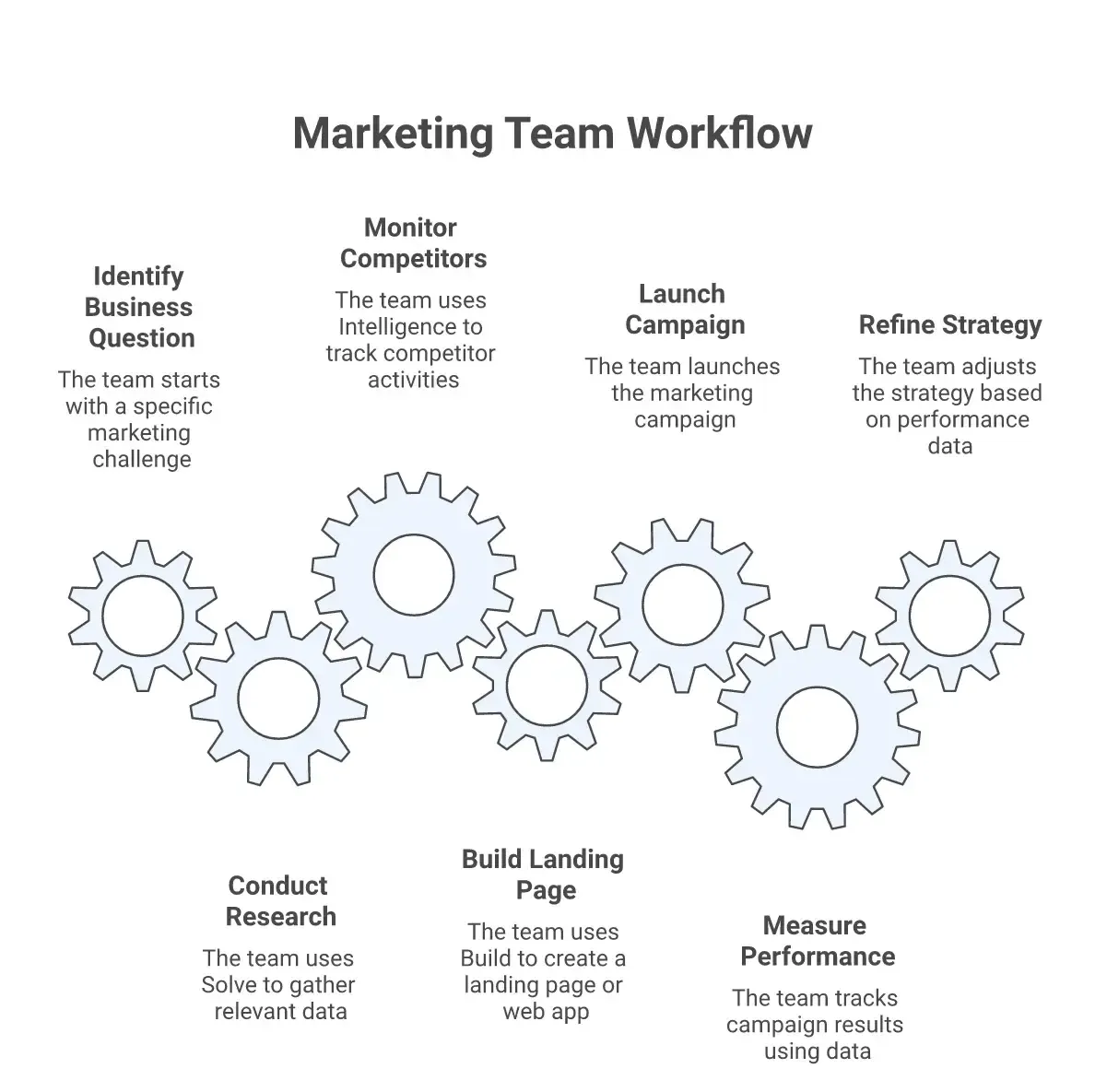
Here is the typical workflow for a marketing team using Rocket.new:
Every step feeds the next. Research informs the build. Competitor signals update the strategy. Campaign data drives decisions. Nothing lives in silos. The value of this model is that context carries across the whole process - so marketing teams are always building on prior work, not starting over.
What the Industry Is Saying
From a 2026 Marketing Brew and ActiveCampaign research report on AI-powered marketing:
"For teams with limited resources, AI can serve as a competitive equalizer. The savings you gain by automating and streamlining operations can be reinvested in your team or doubled down on in your marketing efforts. Among AI power users, 89% believe AI makes their business more competitive against larger organizations." - Marketing Brew / ActiveCampaign, 2026
That is the shift small marketing teams are experiencing. Not just saving time - redirecting that time toward higher-value work that actually moves the needle on ROI.
Where Other AI Tools Fall Short
Most AI builders like Bolt, Lovable, or v0 focus only on execution. They build what you tell them, but they don’t help teams decide what’s worth building, what competitors are doing, or what performance data actually means.
What this leads to:
-
Fragmented workflows: Different tools for research, building, tracking, and analytics
-
Lost context: Insights don’t carry across platforms
-
Tool overload: More time managing software than doing actual work
-
Slower execution: Delays caused by switching between systems
-
Disconnected decisions: No compounding of insights over time
Rocket.new solves this with a shared context architecture. Research, building, and intelligence all connect so decisions build on each other instead of getting lost. This is the structural difference that gives small teams speed without the chaos of multiple tools.
Small Teams Win Bigger
Small marketing teams never lacked talent they lacked access to data, research power, and fast execution. That’s changing. With platforms like Rocket.new, small teams can now operate with the same capabilities once reserved for large agencies.
A two-person team can run competitive research, generate strategy briefs, build production-ready assets, and track competitors all in one system. Big brands still have scale, but when small teams gain similar capabilities at a fraction of the cost, the gap shrinks fast.
If you want to compete like a full-scale agency without the overhead, Rocket.new shows how small teams can do it all in one platform.
Table of contents
- -The Old Gap
- -What AI Tools Change for Small Teams?
- -How Marketing Teams Use Rocket.new?
- -AI Competitive Intelligence Without the Agency
- -AI Research & Strategy with Solve
- -Build Apps & Landing Pages From Strategy
- -Campaign Performance in One System
- -How AI-Powered Teams Move From Idea to Execution
- -What the Industry Is Saying
- -Where Other AI Tools Fall Short
- -Small Teams Win Bigger