
Retool alternatives like Rocket, Appsmith, Budibase, ToolJet, and Microsoft Power Apps help teams build internal tools faster, with better pricing, self-hosting, and code ownership options.
Tired of Retool's per-user pricing?
You are not alone. Many teams are switching to retool alternatives that offer more flexibility, lower costs, and better control over their internal apps.
According to Statista, low-code and no-code platforms are expected to grow to $52.3 billion by 2026, which shows how strong the demand for internal apps and web applications has become.
This blog compares the top Retool alternatives, covering pricing, self-hosting, mobile support, and code ownership, so your team can make an informed decision.
Why Teams are Switching from Retool
Retool is a capable internal tool builder. However, several friction points push teams to look elsewhere:
- Per-user pricing compounds fast. Retool's Business plan charges $50/month per builder. A team of 20 pays $1,000/month before internal or external user fees are added.
- Vendor lock-in with no code export. Retool apps live inside a proprietary environment. There is no full code export, and migrating means rebuilding from scratch.
- Self-hosting restricted to Enterprise plans. Retool's pricing page confirms self-hosting is available on Enterprise plans only. This removes an option many teams had previously relied on.
- Steep learning curve for non-developers. Effective use requires SQL knowledge, REST API understanding, and JavaScript for custom logic. This keeps the work on developers' plates.
- Limited native mobile app support. Retool supports mobile apps. However, native iOS and Android delivery requires the Business plan or higher.
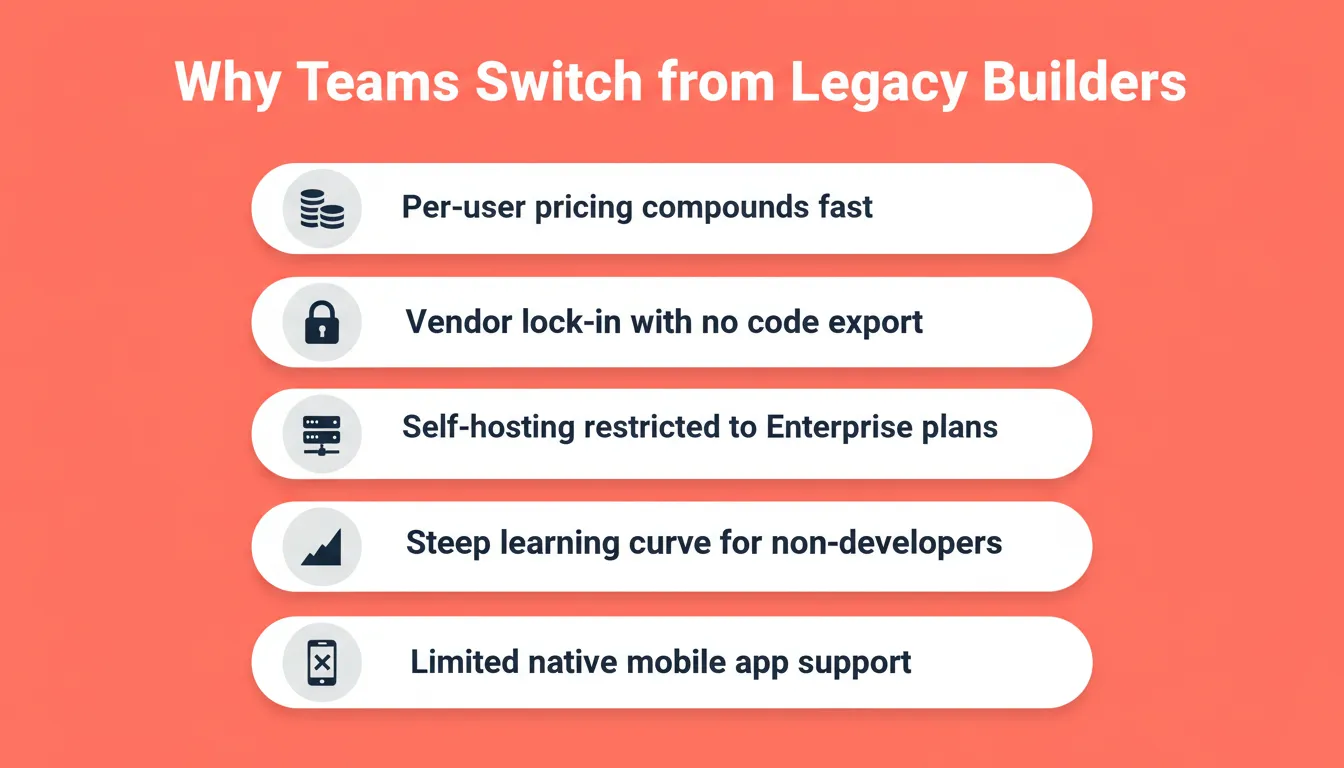
Five common pain points that drive teams to search for retool alternatives.
Is Retool Free?
Retool offers a free plan capped at five users. Beyond that, paid plans start at $10/month per builder on the Team plan. The Business plan costs $50/month per builder and $15/month per internal user. Enterprise pricing is custom.
For a team of 20 builders on the Business plan, that is $1,000/month. This total does not include internal or external user charges. This per-user model is the most cited reason teams search for alternatives to Retool.
Retool Pricing at a Glance
| Plan | Builder (per user/mo) | Internal User (per user/mo) | Self-Hosting |
|---|---|---|---|
| Free | $0 (up to 5 users) | $0 | No |
| Team | $10 | $5 | No |
| Business | $50 | $15 | No |
| Enterprise | Custom | Custom | Yes (Enterprise only) |
Top Retool Alternatives
| Platform | Approach | Self-Hosting | Mobile Apps | Code Ownership | Free Tier |
|---|---|---|---|---|---|
| Rocket | AI natural language generation | No (cloud) | Yes, iOS and Android | Full export | Yes |
| Appsmith | Drag-and-drop, open source | Yes | No | Full (open source) | Yes |
| Budibase | Low-code drag-and-drop | Yes | PWA only | Full (open source) | Yes |
| ToolJet | Drag-and-drop, open source | Yes | No | Full (open source) | Yes |
| Microsoft Power Apps | Low-code, Microsoft ecosystem | No (Azure) | Yes | Limited | Yes (limited) |
Top Retool Alternatives
1. Rocket: AI-Native App Generation
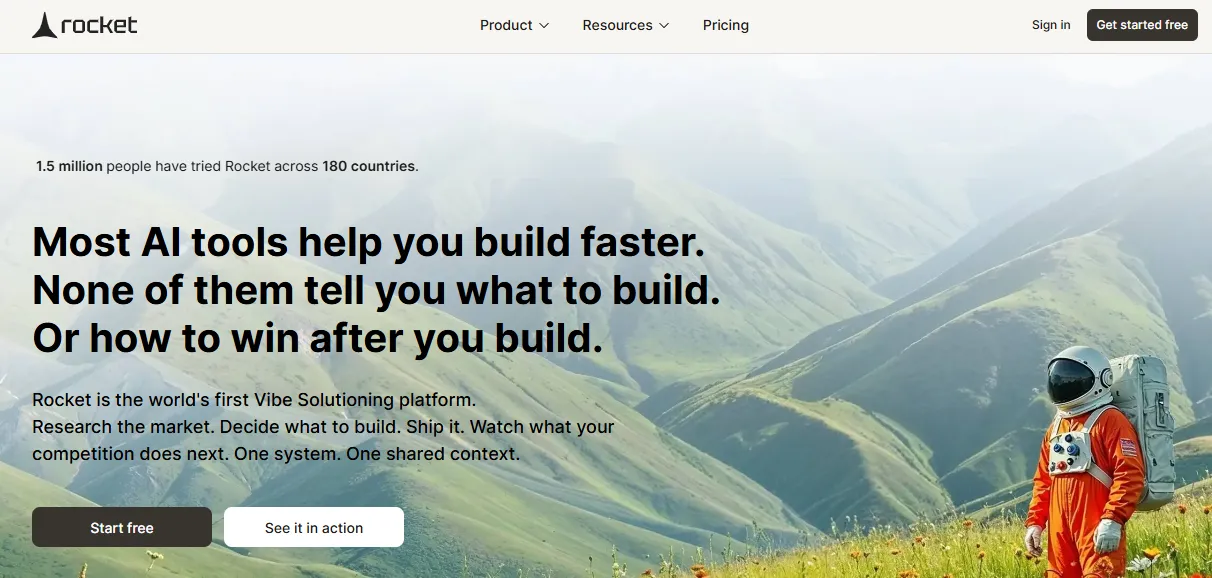
Rocket is a fundamentally different kind of retool alternative. Rather than assembling components manually in a drag-and-drop builder, you describe your internal tool in plain English. Rocket then generates a fully functional app with UI, navigation, logic, and production-ready code.
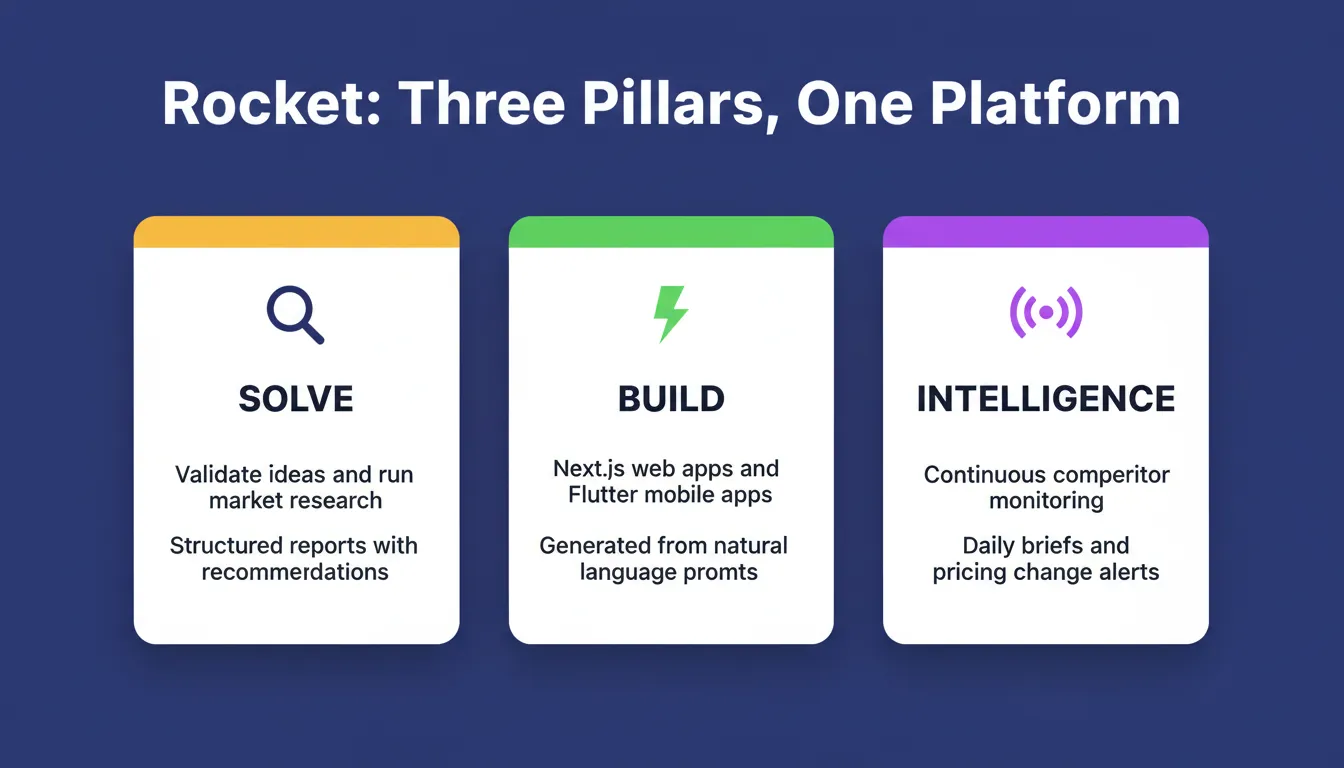
Rocket is built around three pillars that work independently or together: Build for generating web and mobile apps, Solve for market research and validation before you build, and Intelligence for continuous competitor monitoring.
What makes Rocket different for internal tools:
- Natural language generation. Describe your admin panel or CRUD app in plain language. Rocket plans the architecture, writes the code, and shows a live preview, typically in under three minutes.
- Full code ownership. Web apps output in Next.js, mobile apps in Flutter. Download the complete source code at any time and deploy it anywhere.
- Figma to code. Import a Figma design and Rocket converts it to working, production-ready code.
- GitHub import. Connect a Next.js TypeScript repository and continue building with AI. Changes sync back via pull requests.
- 25+ built-in integrations. Supabase, Stripe, Airtable, Google Sheets, Notion, Linear, Mixpanel, Mailchimp, Twilio, and more.
- Flat pricing. Costs do not scale per user. A team of 50 pays the same plan rate as a team of 5.
- Versions and rollback. Built-in version history lets you roll back any change without losing work.
- WCAG accessibility and GDPR compliance. Both are built as defaults into every generated app.
1.5 million people across 180 countries have tried Rocket, including teams building internal ops tools, admin dashboards, client portals, and compliance trackers.
 What you can build with Rocket for internal use:
- Admin panels with role-based access control and user authentication
- CRUD apps connected to Supabase, Airtable, or Google Sheets
- Multi-step approval workflows with notification triggers
- Reporting dashboards pulling from multiple data sources
- Client portals with external user login and request tracking
Best for: Teams that want to ship internal tools faster without a steep learning curve, need both web and mobile apps from one platform, want full code ownership, and prefer flat pricing over per-user billing.
2. Appsmith: The Leading Open Source Retool Alternative
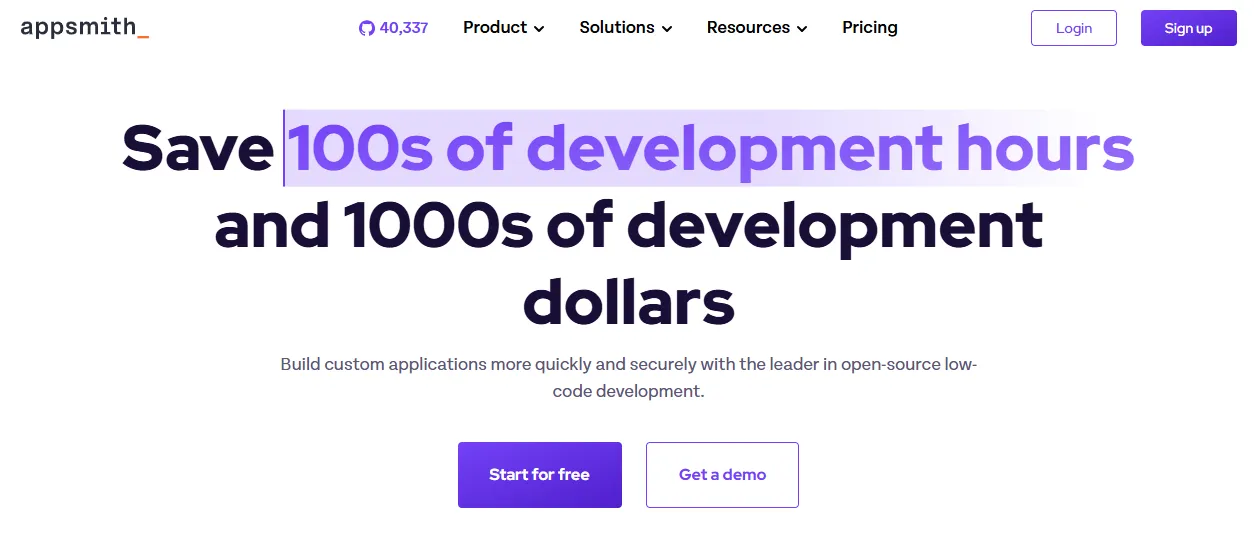
Appsmith is the most widely adopted open source retool alternative. It offers a drag-and-drop interface, a rich library of UI components, and strong connectivity to SQL databases, REST APIs, and GraphQL endpoints.
| Plan | Price | Users | Self-Hosting |
|---|---|---|---|
| Free | $0 | Up to 5 (cloud) | Yes (community edition) |
| Business | $15/mo per user | Up to 99 | Yes |
| Enterprise | $2,500/mo | 100+ | Yes (managed hosting add-on) |
Key capabilities include a self-hosted community edition with no per-user fees, Git-based version control for team collaboration, custom JavaScript logic for complex workflows, and support for PostgreSQL, MySQL, MongoDB, REST APIs, and GraphQL.
One limitation to note: Appsmith does not generate native mobile apps. In addition, AI-assisted generation features are less mature than newer platforms.
Best for: Developer-led teams that want open source freedom, self-hosting, and strong database connectivity without per-user pricing.
3. Budibase: Low-Code for Complex Internal Apps
 Budibase is a low-code development platform that handles workflow automation and data synchronization well. It is particularly strong for teams building complex internal applications that require fine-grained access control.
| Plan | Price | Creators | End Users | Self-Hosting |
|---|---|---|---|---|
| Pro | $19/mo | 1 included | $5/user/mo add-on | Yes |
| Premium | $49/mo | 1 included | $5/user/mo add-on | Yes |
| Business | $299/mo | 3 included | $5/user/mo add-on | Yes |
| Enterprise | Custom | Custom | Custom | Yes (flexible) |
Key capabilities include a drag-and-drop visual interface with pre-built components, self-hosting on the open source plan, an automation builder for multi-step workflows with conditional logic, row-level security and granular role-based access control, and REST API and database connectors including PostgreSQL, MySQL, MongoDB, and S3.
One limitation to note: Native mobile app support is limited to progressive web apps (PWAs), not true iOS or Android apps.
Best for: Teams that need enterprise-grade access control, self-hosting, and workflow automation for complex internal apps.
4. ToolJet: Flexible Open Source Builder
 ToolJet is an open source low-code platform with a growing set of AI-native features. It supports both JavaScript and Python for custom logic. It also connects to over 75 data sources, making it one of the most flexible builders in the retool alternatives space.
| Plan | Price | Builders | End Users | Self-Hosting |
|---|---|---|---|---|
| Free | $0 | 2 | Up to 50 | Yes (community) |
| Pro | $79/builder/mo | Unlimited | Up to 50 | Yes |
| Team | $199/builder/mo | Unlimited | Up to 100 | Yes |
| Enterprise | From $3,000/mo | Custom | Unlimited | Yes |
Key capabilities include a drag-and-drop UI builder with 80+ pre-built components, connections to 75+ data sources including databases, APIs, and cloud services, support for JavaScript and Python for custom logic, self-hosting on the open source plan, and a visual workflow automation builder.
One limitation to note: The free tier limits builders to 2 and apps to 2. The Team plan at $199/builder/month is significantly higher than entry-level alternatives.
Best for: Teams that need broad data source connectivity, custom code flexibility, and self-hosting, and have developers comfortable with a builder-style workflow.
5. Microsoft Power Apps: The Enterprise Ecosystem Option
 Microsoft Power Apps is a relevant retool alternative for organizations already running on Microsoft 365 and Azure. It offers a low-code drag-and-drop builder for web and mobile apps with deep integration into the Microsoft ecosystem.
| Plan | Price | Apps | Self-Hosting |
|---|---|---|---|
| Developer Plan | Free | Unlimited (dev/test only) | No (Azure) |
| Premium | $20/user/mo (billed yearly) | Unlimited | No (Azure) |
| Premium (2,000+ seats) | $12/user/mo (billed yearly) | Unlimited | No (Azure) |
| Enterprise | Contact sales | Unlimited | No (Azure) |
Key capabilities include deep integration with SharePoint, Dynamics 365, Teams, and Azure services, support for both web and mobile app creation, and large enterprise support with compliance certifications.
One limitation to note: Power Apps is tightly coupled to Microsoft infrastructure. Teams outside the Microsoft ecosystem face a steep setup cost. Apps are also not portable outside the Microsoft environment.
Best for: Enterprises already invested in Microsoft 365 and Azure that want low-code internal tools without leaving their existing ecosystem.
Pricing Comparison for a Team of 20
One of the most searched questions around retool alternatives is cost at scale. Here is a direct comparison for a team of 20 standard users per month:
| Platform | Estimated Cost (20 users/mo) | Self-Hosting | Code Export |
|---|---|---|---|
| Retool (Business) | ~$1,000+ (builders) + ~$300 (internal users) | Enterprise only | No |
| Rocket | Flat plan rate (not per-user) | No | Yes (Next.js + Flutter) |
| Appsmith (Business) | ~$300 ($15 x 20) | Yes | Yes (open source) |
| Budibase (Business) | $299 flat + $100 end users ($5 x 20) | Yes | Yes (open source) |
| ToolJet (Team) | ~$3,980 ($199 x 20 builders) | Yes | Yes (open source) |
| Microsoft Power Apps (Premium) | ~$400 ($20 x 20) | No (Azure) | Limited |
Pricing based on official sources as of 2026. Verify current rates before purchasing.
How to Choose the Right Retool Alternative
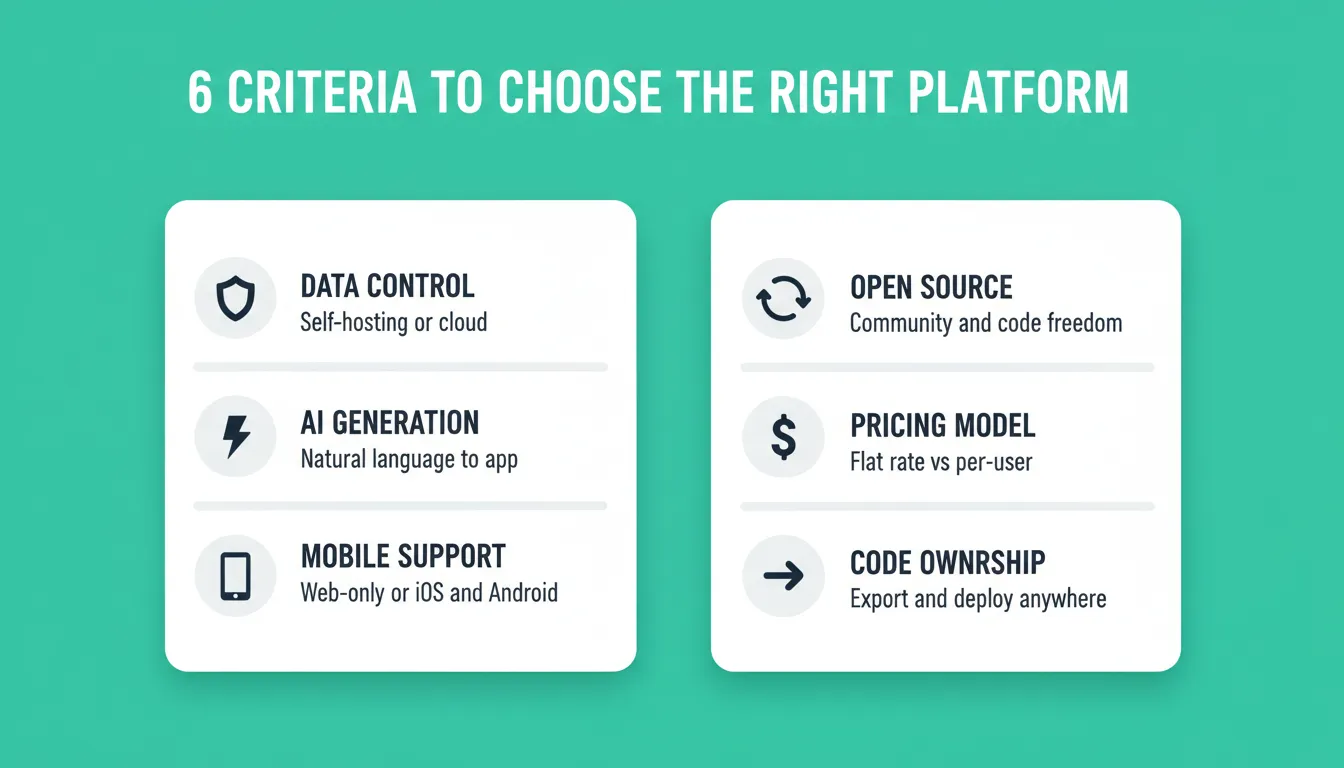
Six criteria to evaluate when choosing between retool alternatives: data control, open source, AI generation, pricing model, mobile support, and code ownership.
Use this framework when evaluating alternatives to retool:
- Choose Rocket if you want AI-generated apps, flat pricing, full code ownership, and both web and mobile output from one platform.
- Choose Appsmith if you want the most mature open source retool alternative with strong database connectivity and self-hosting.
- Choose Budibase if you need enterprise-grade access control, self-hosting, and complex workflow automation.
- Choose ToolJet if you need the broadest data source connectivity and are comfortable with JavaScript or Python custom logic.
- Choose Microsoft Power Apps if your organization is already on Microsoft 365 and Azure.
What Types of Internal Tools Can You Build?
All five platforms support the core internal tool use cases. Here is where each one excels:
| Use Case | Best Platform | Why |
|---|---|---|
| Admin panel with role-based access | Rocket or Budibase | AI generation (Rocket) or granular permissions (Budibase) |
| CRUD app on existing database | Appsmith or ToolJet | Strong DB connectors, open source |
| Multi-step approval workflow | Budibase or Rocket | Visual automation (Budibase) or natural language (Rocket) |
| Native mobile internal tool | Rocket | Only platform generating true iOS and Android apps |
| Microsoft Teams integration | Power Apps | Native Microsoft ecosystem integration |
| Reporting dashboard | Any | All support multiple data sources and chart components |
For a deeper look at what is possible, explore what types of internal tools you can build with AI, from approval workflows to client portals.
How to Migrate from Retool
If you are currently on Retool and evaluating a switch, here is a practical path forward:
- Audit your existing Retool apps. List every app, its data sources, and its active user count.
- Pick your replacement platform. Use the decision framework above to match your team's priorities.
- Rebuild one non-critical app first. Start with a low-stakes internal tool to validate the workflow.
- Map all data source connections. Ensure your new platform supports the same databases and APIs.
- Set up role-based access control. Configure user permissions on the new platform before switching users over.
- Run both platforms briefly in parallel. Give your team two to four weeks to validate before fully decommissioning Retool.
On Rocket, this process is significantly faster. Describe your existing Retool app in plain language and Rocket generates a working equivalent, often in under ten minutes.
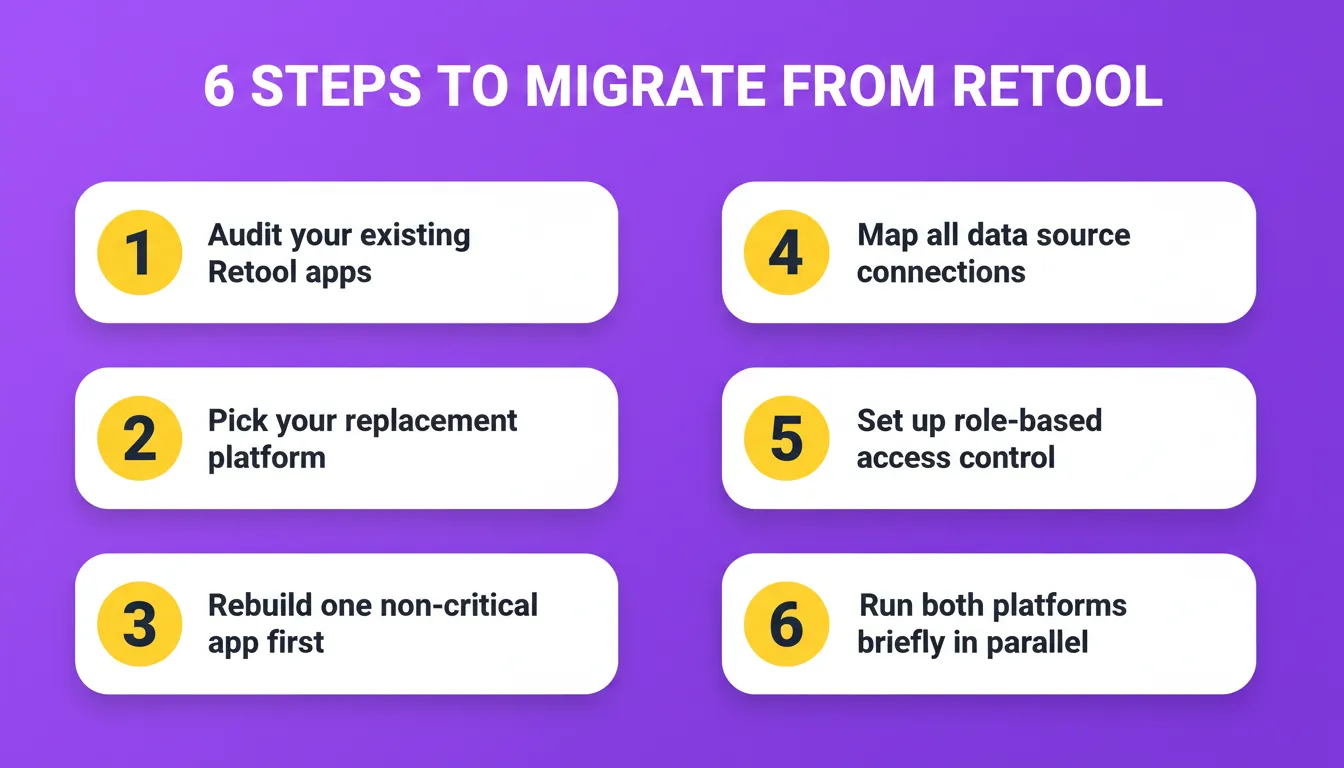
A practical six-step migration path for teams moving away from Retool.
The Right Internal Tool Platform Starts with the Right Thinking
The internal tool space has more capable, affordable options than ever. Whether your team needs open source self-hosting, enterprise-grade access control, or AI-powered generation that ships in minutes, there is a retool alternative built for your situation.
As AI-native builders mature, the gap between "describe it" and "deploy it" will keep shrinking. Teams that choose platforms with full code ownership and flat pricing today are better positioned to scale without cost surprises tomorrow.
You have a tool to build. Describe it in plain language on Rocket, and it ships, production-ready, fully yours, in minutes.
Table of contents
- -Why Teams are Switching from Retool
- -Is Retool Free?
- -Retool Pricing at a Glance
- -Top Retool Alternatives
- -Top Retool Alternatives
- -1. Rocket: AI-Native App Generation
- -2. Appsmith: The Leading Open Source Retool Alternative
- -3. Budibase: Low-Code for Complex Internal Apps
- -4. ToolJet: Flexible Open Source Builder
- -5. Microsoft Power Apps: The Enterprise Ecosystem Option
- -Pricing Comparison for a Team of 20
- -How to Choose the Right Retool Alternative
- -What Types of Internal Tools Can You Build?
- -How to Migrate from Retool
- -The Right Internal Tool Platform Starts with the Right Thinking