Rork AI is great for quick mobile prototypes but struggles with scalability, design control, and full-stack development. Rocket.new, on the other hand, offers web + mobile support, backend integrations, collaboration, and a free plan, making it the better choice for building production-ready apps.
Is the AI app builder you picked turning your app idea into a real product, or just giving you more to debug?
Here is the direct answer: Rork AI is a mobile-focused tool with a narrow scope, and that scope comes with real costs. According to Trustpilot, Rork sits at 2.9 out of 5 stars, driven by bugs and near-absent customer support.
Meanwhile, Rocket.new crossed 400,000 users and $4.5M ARR in just three months of its beta, with customers from Meta, PayPal, and PwC already building on it. If you are choosing where to build, those numbers matter.
What is Rork AI?
Rork AI is a mobile-first vibe coder tool. It takes plain text descriptions and generates React Native code for iOS and Android apps. The whole concept is focused on speed: go from ideas you describe in plain English to a prototype on your phone.
Here is what Rork does on paper:
-
Takes app ideas from text and generates native code for iOS and Android
-
Produces apps compatible with the Apple App Store and Google Play
-
Let users test on the device via QR code using Expo Go, no complex setup required
-
Allows full React Native codebase export at any time
-
Provides basic authentication and data storage as the only backend support
For solo founders who want to validate ideas fast, that sounds appealing. The tool can take a concept from description to prototype in one session, and users who need a quick MVP to show investors get a working build fast.
The catch is significant. Rork only generates code for mobile apps. It cannot generate websites, full-stack applications, or internal tools. If your project needs anything past a React Native app, Rork is the wrong tool, and users hit this ceiling quickly.
The Real Limitations of Rork AI
Let us look at where things go sideways. Builders who move past basic prototypes tend to hit similar issues. Here is the pattern:
-
No visual editor for design control or clean UI adjustments
-
No free plan and no trial period
-
App store deployment requires real technical knowledge
-
Repeated bugs, crashes, and errors in user feedback
-
No web app support, no backend depth, and no analytics
No Visual Editor or Clean UI Control
Rork AI lacks a visual drag-and-drop editor, making customization difficult for users without coding knowledge. While Rork is designed to be user-friendly and intuitive, that simplicity comes at a cost when you need precise control over how your app looks and behaves.
-
All output design is determined entirely by the AI based on your prompt
-
Rork AI relies heavily on user descriptions, which can lead to issues if the descriptions are ambiguous
-
Rork AI may miss nuanced functionalities due to its reliance on user input, leaving the final output short of what you envisioned
-
Rork AI does not provide user interface control, which can limit design flexibility
-
Rork AI lacks manual app design options, which can restrict customization
-
If the AI misreads your description, you have no visual way to correct the code output
-
You re-prompt and burn through message credits, hoping the next message that generates lands closer
For any vibe coder who cares about layout and feel, this is a consistent wall. Rork AI's app designs can be generic, lacking uniqueness in user experience, and apps rarely match the vision on the first attempt.
Expensive Pricing with No Free Plan
-
Entry-level plan: $20 per month for 100 messages, no free plan available
-
Higher tiers reach $200 per month for 1,000 messages
-
Rork AI operates on a non-rollover credit-based subscription model, potentially leading to increased costs during development
-
A moderately complex app can exhaust 100 messages in one session
-
Users report spending far more than expected just to iterate on one app idea
-
No trial period means paying before knowing whether the tool fits your ideas
Deployment, Errors, and Missing Web Support
Publishing to the App Store or Google Play is not automated. Users handle developer account setup, app signing, certificates, and submission manually. While Rork AI generates legitimate native code, allowing apps to access device features like cameras and be submitted to app stores, getting through that submission process without guidance is a real barrier for non-technical builders. Users who hit errors during submission find no support resources to guide them.
Stability is a real issue. Users have reported significant bugs and crashes when using Rork AI for complex projects. Product Hunt reviews from 2025 flag errors like black screens and app crashes consistently. Each failed session costs message credits and kills team focus.
Then there is the web gap. Rork AI's lack of web hosting may limit its appeal to users looking for a unified web and mobile presence. Rork cannot generate websites, web app code, or landing pages. There is no integration with Supabase, Stripe, or third-party services. No analytics, no monitoring, and no internal tools support.
Rork AI does not support technical languages either, limiting its flexibility for developers who want to extend or customize what gets generated. Builders who discover all of this after investing time in prototypes are left with no path forward on the same tool.
Feature Comparison: Rork AI vs Rocket.new
Here is a feature comparison across the capabilities that matter for real app development.
| Feature | Rork AI | Rocket.new |
|---|---|---|
| Mobile App Generation | Yes, React Native | Yes, Flutter |
| Web App Generation | No | Yes, Next.js |
| Full Stack Applications | No | Yes |
| Internal Tools | No | Yes |
| Visual Editor | No | Yes, Visual Edit |
| Figma to Code | No | Yes |
| Backend Integration | Basic auth only | Supabase and Stripe |
| Free Plan | No | Yes, 1M tokens |
| Template Library | Limited | 25,000 plus templates |
| Team Collaboration | No | Yes |
| Deployment | Manual via Expo | One click to Netlify |
| Analytics and Monitoring | No | Yes |
| SaaS Platforms Support | No | Yes |
This feature comparison makes the gap concrete. Rork stays in one lane. Rocket.new covers the full track.
Community Insight: What Builders Are Saying
Real user feedback cuts through faster than any marketing post. When builders hit the real limits of AI tools, the community is direct about it.
From the Rocket.new blog on AI app builder comparisons, this Reddit quote captures the experience of many users:
"I'm trying to build an app using AI, but I'm stuck on where to start. Tried a few tools and the results have been mixed. Still learning which platform actually helps me get to a usable app."
Key insights from what the community reports:
-
Most AI builders shine on the first prompt, but fail once code complexity grows
-
Rork's chat-only approach means every layout tweak is another prompt round with no visual preview
-
Deployment errors block many non-technical users from reaching app store success
-
Builders who need web and mobile together always switch tools after starting with Rork
Rocket.new: The Platform Built to Go the Full Distance
Here is where things change, guys. Rocket.new is not just a Rork alternative. It is a complete vibe solutioning AI app builder that covers everything from the first prompt to a production-ready product your team can launch and scale.
Rocket.new converts natural language prompts into full-stack applications. It generates fully functional apps across web and mobile in one workflow. Since its June 2025 beta, it has reached 400,000 users in 180 countries and $4.5M ARR, backed by $15M from Salesforce Ventures and Accel. About 80% of users are building "serious" app projects with real backend systems, not just prototypes.
Top Features of Rocket.new
Here is what builders get when they work on Rocket.new. These features cover every stage from idea to deployment:
-
25,000 plus templates: free to use across web apps, mobile applications, internal tools, dashboards, and saas platforms, saving up to 80% of tokens for app building.
-
Flutter for mobile: generates production-ready Flutter code for native iOS and Android apps
-
Next.js for web: builds full-stack web applications with server-side rendering and modern routing
-
Figma to code: converts designs directly into working production code
-
Visual Edit mode: click any element on any of your pages and modify it without another prompt
-
Supabase and Stripe integration: real payments and database systems configured from the first generation
-
One-click deployment: push to Netlify or export clean code to any environment
-
Team collaboration: multiple team members can build, review, and iterate in real time
-
Analytics and monitoring: track app performance and user activity from within the tool
-
One prompt generation: describe your idea once and generate a complete app with code ready to ship
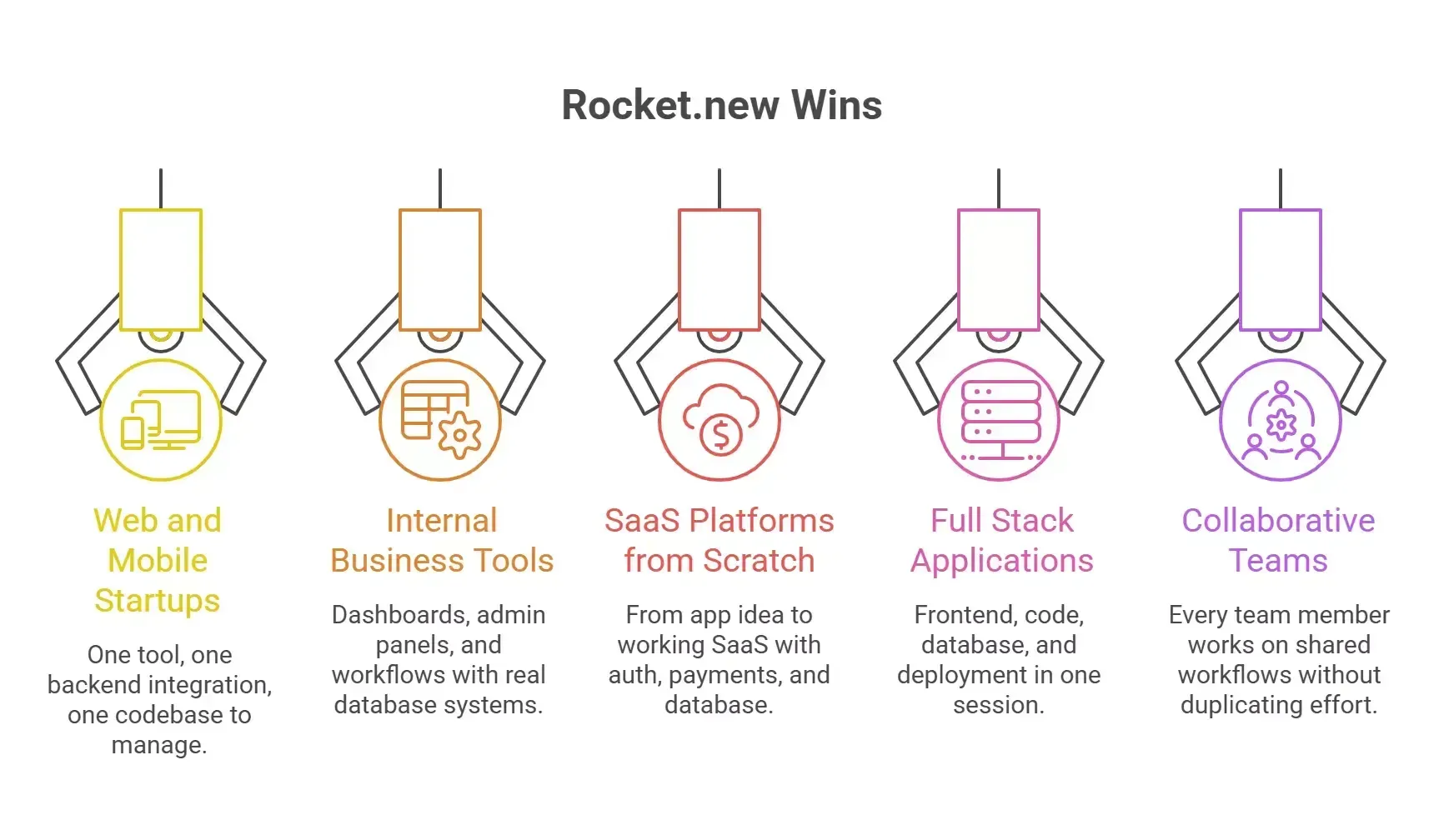
Where Rocket.new Wins Against Rork in Real Use Cases:
-
Startups building web and mobile together: one tool, one backend integration, one codebase to manage
-
Internal tools for business teams: dashboards, admin panels, and workflows with real database systems
-
SaaS platforms from scratch: from app idea to working saas with auth, payments, and database in one project
-
Full stack applications for non-developers: frontend, code, database, and deployment in one session
-
Teams focused on collaboration: every team member works on shared workflows without duplicating effort
Whether you are a startup founder, a vibe coder, or a developer trying to streamline development without losing code control, Rocket.new is built for your ideas.
Generous Free Plan with Transparent Pricing at Rocket.new
Getting started on Rocket.new costs nothing. While Rork AI charges before you even know if the tool fits your ideas, Rocket.new lets builders discover real value first with a free plan that includes 1M tokens.
-
Free plan available with 1M tokens, no credit card required to get started
-
Transparent paid tiers designed to scale with your project, not drain your budget on iteration
-
The 25,000-plus template library saves a significant portion of tokens, meaning your credits go further on every build
-
One prompt generation produces a complete, fully functional app in a single session, so you are not burning through credits on repeated attempts to get the basics right
-
Teams can collaborate within shared workflows, spreading the cost across contributors instead of one user carrying the entire message budget alone
-
No surprise overages from a non-rollover credit model, giving teams predictable costs as app development scales
Where Rork AI users report spending far more than expected just to iterate on one app idea, Rocket.new users start for free, build faster with templates, and only move to paid tiers when they are already seeing results. That is the kind of pricing structure that respects both your budget and your time.
Key Insights: How to Pick the Right Builder
The choice between these builders is not close once you look at the full picture. Here are the key insights that should focus your decision:
-
You need web and mobile: Rork cannot generate websites at all
-
Your team needs collaboration: Rork has none; Rocket.new has it built in from day one
-
You want to build saas tools or internal tools: Rork does not support either
-
You need real backend integration: Rork's basic auth is not production-ready
-
You want to test before paying: only Rocket.new offers a free plan
-
Your project is a full-stack application: Rork cannot start you there
The data support these key insights:
-
Rork: $2.8M from a16z, 743,000 monthly visits, 2.9 out of 5 Trustpilot from real users
-
Rocket.new: $15M raised, 400,000 users across 180 countries, 10,000 paying subscribers, $4.5M ARR in three months
Wrapping Up: Rork Has a Ceiling, Rocket.new Does Not
The limitations of Rork AI compared with Rocket.new trace back to one core problem: Rork was built to do one thing. That focus makes it fast for a narrow task. But it also means users outgrow the tool the moment their app idea gets serious.
Rocket.new was built for the full journey. From apps for mobile to full-stack web projects, from internal tools to SaaS platforms, from a single prompt to fully functional apps, Rocket.new handles the complete process. It generates clean production code, saves tokens through its 25,000-plus template library, and gives teams the collaboration tools to launch and iterate without switching builders.
Here is what Rocket.new brings that Rork simply cannot:
-
Fully functional apps across web and mobile from one place, not two
-
Real backend systems, payments, and database support built in
-
Team collaboration across shared projects, pages, and workflows
-
Analytics and monitoring to track app success after deployment
-
A free plan so builders can discover the value before paying
If you are ready to ship something that lasts past a quick prototype, Rocket.new is the builder worth starting with. Try it now for free.
Table of contents
- -What is Rork AI?
- -The Real Limitations of Rork AI
- -No Visual Editor or Clean UI Control
- -Expensive Pricing with No Free Plan
- -Deployment, Errors, and Missing Web Support
- -Feature Comparison: Rork AI vs Rocket.new
- -Community Insight: What Builders Are Saying
- -Rocket.new: The Platform Built to Go the Full Distance
- -Top Features of Rocket.new
- -Where Rocket.new Wins Against Rork in Real Use Cases:
- -Generous Free Plan with Transparent Pricing at Rocket.new
- -Key Insights: How to Pick the Right Builder
- -Wrapping Up: Rork Has a Ceiling, Rocket.new Does Not