
Most startups fail not because of poor execution but because they build the wrong thing. This post breaks down the Rocket.new validation loop a seven-day process that connects market research, MVP building, and competitive monitoring in one platform, replacing the fragmented PitchBook-to-developer pipeline that slows most founders down.
What if you could go from "I have an idea" to "real users are testing it" in a single week without burning through your budget on research subscriptions and developer fees?
That's not a pitch. It's a process. And the Rocket.new validation loop makes it possible for founders at every stage.
Here's the number that should make most founders pause: 42% of startups fail because they build products nobody actually wants.
Not because they ran out of money first. Not because their team fell apart. Because they spent months building the wrong thing.
The lean startup methodology has been preaching build-measure-learn for over a decade. Yet most founders still fall into the same trap - too much planning, too little testing, and way too much money spent before a single real user gives them real user feedback.
The Gap Between Research and Building That Kills Most Startups
Early product development used to follow a predictable, expensive sequence - and most of that sequence happens before a single user ever sees anything.
-
Week one and two: subscribe to a platform like PitchBook to research your market, track competitors, and study deal data.
-
Week three through six: brief a development team on what to build based on that research.
-
Month three onward: finally get something in front of early users - months after the thinking started.
-
By that point, too many assumptions are already locked in. The feedback loop is slow, expensive, and completely disconnected from the original research.
-
The context that shaped your thinking in week one doesn't exist inside your build tool in week six. You re-explain everything. Decisions drift.
PitchBook is a powerful data platform built around investor research, deal flow, and M&A analysis. But it was never built to help first-time founders validate a product idea quickly and then immediately build from that same intelligence. That's a different problem entirely - and the gap between research and building is where most startups quietly lose their shot.
Why Most Startups Build the Wrong Thing
The lean startup philosophy introduced the build-measure-learn loop to address exactly this: most startups spend too long building in the dark. But knowing the theory and applying it are two very different things.
-
Founders fall in love with their idea early, which makes it hard to test it honestly.
-
Scope creep sets in during early product development, turning a focused plan into an unwieldy one.
-
Feature creep turns a sharp MVP into a bloated prototype that takes months to ship.
-
By the time early users see it, so much has been built that pivoting feels like starting over.
-
The cost compounds fast: traditional MVP development ranges from $5,000 for a simple build to over $150,000 for something with real complexity, with an average development time of around four months for a professional team.
-
For a bootstrapped founder, that's often most of your runway gone before a single paying customer confirms demand.
| Stage | Traditional Approach | Validation Loop Approach |
|---|---|---|
| Market Research | 1-2 weeks (PitchBook, manual work) | Hours (AI-powered Solve) |
| MVP Scoping | 1-2 weeks (meetings, PRDs) | Same session as research |
| Core Build | 8-12 weeks (dev team) | Days (AI-assisted build) |
| First User Feedback | 3-4 months in | End of week one |
| Iteration Cycle | Months apart | Days apart |
The learning cycle at the bottom of that table is the one that matters most. The faster you can run it, the less you burn on bad ideas and the sooner you find product market fit.
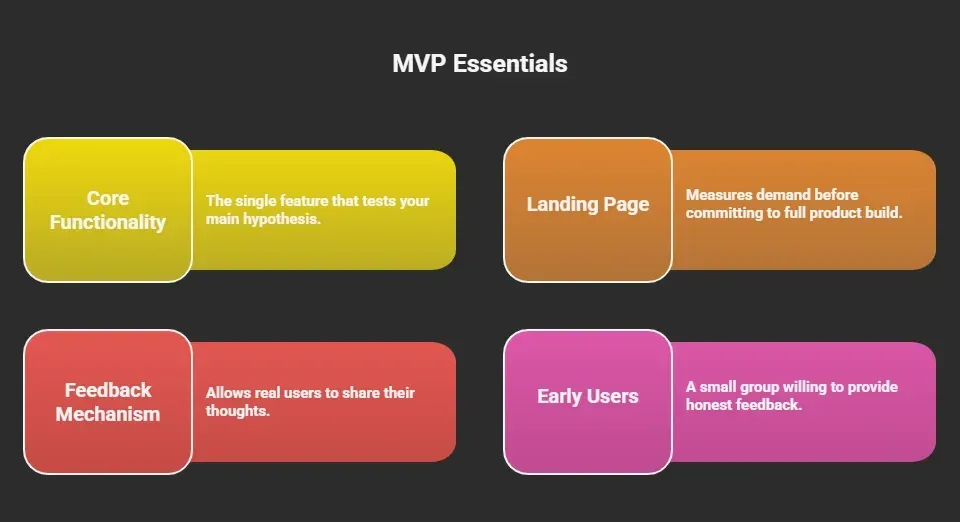
What an MVP Actually Needs
Most founders over-engineer their first MVP before they have even tested whether the core idea holds up with real users.
-
Core functionality: the one feature that directly tests your main hypothesis with your target audience.
-
A landing page: to measure demand before committing resources to the full product build.
-
A feedback mechanism: so real users can tell you what's working and what isn't.
-
Access to a small group of early users: people willing to test it honestly and give you useful feedback.
Notice what's not on that list: complex third-party tooling, polished UI, ten core features, and six months of development. Every one of those things can come after the hypothesis is confirmed - not before.
The validation loop looks like this when you map it out:
Each learning cycle should take days, not months. The faster you loop, the less money you burn on the wrong thing and the more quickly you discover what real users actually care about.
The Real Gap: Intelligence Before the Build
Most AI coding tools Lovable, Bolt, v0 are genuinely fast at building. Describe something and they produce it quickly. But none of them tell you whether what you're building is worth building.
-
They all start at execution, not strategy you still have to figure out what to build somewhere else, and that thinking never travels with you into the build tool.
-
Product managers and non technical founders feel this most acutely: the people closest to the customer problem often don't have the technical resources to test solutions quickly.
-
When they do get access to a builder, none of the research context comes with them - every session starts from scratch.
-
The gap between thinking and building is where useful feedback opportunities get lost.
-
First time founders are most exposed here: with an 18% success rate and no playbook for what good looks like, a slow learning cycle is a survival risk.
"AI just made the oldest startup mistake 10x easier to make. Paul Graham's hardest lesson to teach founders was always this: Build for 10 users. Not 10 million. You can now scaffold a full-stack app in an afternoon. Auth, payments, dashboards, APIs. Production-ready before you've had one real conversation with a real user. The feedback loop that was supposed to save you? Talking to users, doing things manually, staying embarrassingly small. That loop is now easy to skip. Because skipping it looks like velocity." - Raahul Seshadri, LinkedIn, April 2026
Speed without a real gap to close isn't progress. The fastest way to run a learning cycle isn't to build faster - it's to build the right thing faster. And that starts with thinking that stays connected to the build.
Rocket.new: Where the Validation Loop Actually Lives
This is the real gap Rocket.new was built to close. Rocket.new is the world's first Vibe Solutioning platform where you research what to build, build it, and monitor what matters, all inside one workspace with shared compound context.
"Vibe coding solved how to build. It never solved what to build, or why. That's the harder problem - and the one where most products actually fail."- Vishal Virani, LinkedIn, April 2026
Here's how the platform compresses the full validation loop into a single week.
Solve - Your PitchBook Alternative for Product Decisions
Solve is Rocket.new's decision intelligence layer it answers any business question with structured, evidence-backed analysis in minutes.
-
Ask Solve to map your competitive space, identify the core pain point in your market, or define your target audience before a single line of code is written.
-
Scope your core MVP features directly from the research output - no context switching, no copy-pasting between tools.
-
Get output that's presentation-ready immediately: full analysis with findings, evidence, and clear recommendations, exportable as PDF or PPT.
-
The research doesn't sit in a separate document. It lives inside your Rocket project and feeds directly into every build task that follows.
This is what makes Solve a genuine PitchBook alternative for early product decisions - not a financial data subscription, but a thinking tool that connects directly to building.
Build - From Research to Live MVP in Days
Once Solve has shaped your direction, Build turns that context into a working product without requiring you to re-explain anything.
-
Web apps generate in Next.js; mobile apps come out in Flutter with real design systems, dark/light theming, and fluid navigation.
-
Landing pages with conversion-focused structure are ready in minutes - built from your project context so the copy already speaks to your specific customer problem.
-
Most builds generate in 1-3 minutes. Most founders have something live in front of real users within days.
-
Build produces production-grade code, not a mockup or wireframe - something real users can actually interact with and give you genuinely useful feedback on.
-
The 3-5 feature rule keeps scope clean: define the most important core features upfront, and add more through conversation after the first build lands.
Where other AI builders start building the moment you describe something, Rocket.new's Build starts from the thinking that already happened in Solve - so the first generation reflects genuine product direction, not just a prompt.
Intelligence - Watch Competitors While You Build
Running your learning cycle shouldn't mean losing sight of what your competition is doing at the same time.
-
Intelligence monitors every public platform your competitors operate on, continuously not just what changed, but what it means for your product decisions.
-
Signals arrive as daily, weekly, or monthly briefs delivered where your team already works.
-
While you're iterating based on early user feedback, Intelligence tracks competitor launches, pricing moves, and messaging shifts in real time.
-
The result is a roadmap that adjusts to the market rather than one that gets blindsided by it.
Most startups miss competitive shifts not because the information wasn't available, but because tracking it manually doesn't survive contact with a busy build sprint.
Context - The Architecture That Makes the Loop Work
The feature that holds the entire validation loop together is Context Rocket.new's shared compound memory architecture.
-
Research from Solve, build decisions, notes from user feedback sessions, files, and brand guidelines everything added to a Rocket project carries forward into every subsequent task.
-
You never re-explain your context. You never lose a decision between sessions. Everything compounds.
-
Each new task makes the platform smarter about your product: the Solve output that validated your direction becomes the foundation of the build; the feedback from week one informs the scope of week two.
-
Teams working across product, marketing, and sales all operate from the same shared context no version drift, no handoff gaps.
This architecture is the structural gap that Lovable, Bolt, and v0 can't close. They build what you tell them to build. They don't carry forward the intelligence that should shape what you build.
Rocket.new vs. the Alternatives
| Rocket.new | Lovable / Bolt / v0 | PitchBook | |
|---|---|---|---|
| Market Research | Yes (Solve) | No | Yes (investor focus) |
| Competitive Intelligence | Yes (continuous) | No | Limited |
| MVP Build | Yes (production-grade) | Yes | No |
| Shared Context | Yes (compound memory) | No | No |
| Non-technical Friendly | Yes | Partial | No |
| Full Validation Loop | Yes (end-to-end) | Build step only | Research step only |
1.5 million people across 180 countries have tried Rocket.new. The user base isn't primarily people who wanted to build faster - it's people who wanted better answers to the question that comes before the build.
The Validation Loop, Built for Founders Who Can't Afford to Guess
Most startups don't build the wrong thing because of a lack of effort. They build the wrong thing because research and building happen in different places, with different context, on different timelines.
The validation loop that actually works - from a PitchBook alternative to live MVP in a week - requires those two things to be connected. When Solve informs what you build, when Build ships in days instead of months, when early users give you real user feedback inside the same week you had the idea, and when that feedback feeds back into your next build cycle without losing context - that's not just faster MVP development. That's a better way to build a startup.
Rocket.new is where that loop lives.
Table of contents
- -The Gap Between Research and Building That Kills Most Startups
- -Why Most Startups Build the Wrong Thing
- -What an MVP Actually Needs
- -The Real Gap: Intelligence Before the Build
- -Rocket.new: Where the Validation Loop Actually Lives
- -Solve - Your PitchBook Alternative for Product Decisions
- -Build - From Research to Live MVP in Days
- -Intelligence - Watch Competitors While You Build
- -Context - The Architecture That Makes the Loop Work
- -Rocket.new vs. the Alternatives
- -The Validation Loop, Built for Founders Who Can't Afford to Guess