
Modern sales prospecting means targeting the right buyers with the right message at the right moment. This guide covers proven techniques, a five-step repeatable process, and AI-powered tools that help B2B teams build a pipeline full of qualified leads.
Is your pipeline slowing down because your team is targeting the wrong prospects instead of improving the pitch itself?
Reps waste hours chasing contacts who will never buy, while the best-fit buyers sit uncontacted.
According to HubSpot, 71% of prospects prefer to research independently before speaking to a rep, which means your outreach window is narrower than most teams assume. Getting in front of the right people, at the right moment, with a message that speaks to their specific challenges is what separates teams that consistently hit quota from those that miss it quarter after quarter.
This blog walks through the core techniques, a repeatable five-step framework, and the data tools that help modern teams build a pipeline full of qualified leads that actually convert.
What Does Modern Prospecting Actually Look Like?
Prospecting today looks nothing like it did ten years ago. Buyers are better informed, harder to reach, and much faster at filtering out noise. The sales teams winning right now are not just working harder at outreach. They are thinking more carefully about which accounts deserve their time before a single message goes out.
Inbound vs Outbound Prospecting
Inbound prospecting draws potential customers toward your business through content, SEO, and marketing efforts. A prospect discovers a useful article, fills out a form, and signals genuine interest before your sales reps even get involved.
Outbound prospecting works the other direction. Sales reps actively identify potential buyers and initiate contact through cold calls, cold emails, LinkedIn outreach, and other direct channels.
-
Inbound leads: Arrive with context; lower friction at first contact; slower to generate at volume
-
Outbound approach: Reaches target accounts faster; demands deeper research and real personalization to cut through
-
Blended model: The most reliable setup; inbound and outbound methods work together, not against each other
Most high-performing sales teams blend inbound leads with outbound methods to keep their pipeline full year-round, without depending on either channel exclusively. To understand how business workflow automation can support your outbound cadences, it is worth exploring how AI-driven processes reduce manual overhead at scale.
Why the Buyer Journey Changed Everything
Modern buyers complete 60-70% of their own research before a sales rep ever reaches out. That single fact changes what effective outreach looks like entirely. Generic messages that skip a prospect's specific pain points get deleted within seconds of landing in the inbox.
Social media has compounded this shift. Buyers check LinkedIn profiles, read peer reviews, and compare alternatives well before agreeing to a call.
-
Your credibility needs to exist before you ask for someone's time
-
Research by the rep before every outreach is the price of a conversation, not a bonus
-
Personalization at scale is no longer optional for outbound sales teams aiming to convert potential buyers
The implication for every sales team: relevance wins; volume alone does not.
What Makes a Good Sales Prospect?
Three criteria consistently separate a good prospect from a weak one:
-
A real challenge your product or service can address directly
-
Access to the key decision makers who can approve a purchase
-
Timing and budget that align with your current sales cycle
Sales development representatives and business development representatives spend most of their time on this qualification filter. Every minute spent on a poor-fit account is a minute not spent on one that could actually close. Getting this right early is the single biggest lever on close rates.
Which Techniques Consistently Produce Qualified Leads?
No single channel wins every deal. Sales teams generating the most qualified leads run several techniques in parallel and adjust their mix based on what the data shows.
Here is how the main prospecting channels compare:
| Technique | Best Use Case | Channel | Avg. Conversion Lift |
|---|---|---|---|
| Cold calls | High-urgency outreach; real-time qualification | Phone | +42% growth vs email-only |
| Cold emailing | Scale; follow-up sequences; subject line testing | High at volume with personalization | |
| Social selling | LinkedIn relationship-building before a pitch | Social media | Warm leads; faster close |
| Referrals | Warm leads with built-in trust | Network | 70% higher conversion rate |
| Networking events | Industry relationships; face-to-face rapport | In-person / online | Long-term pipeline value |
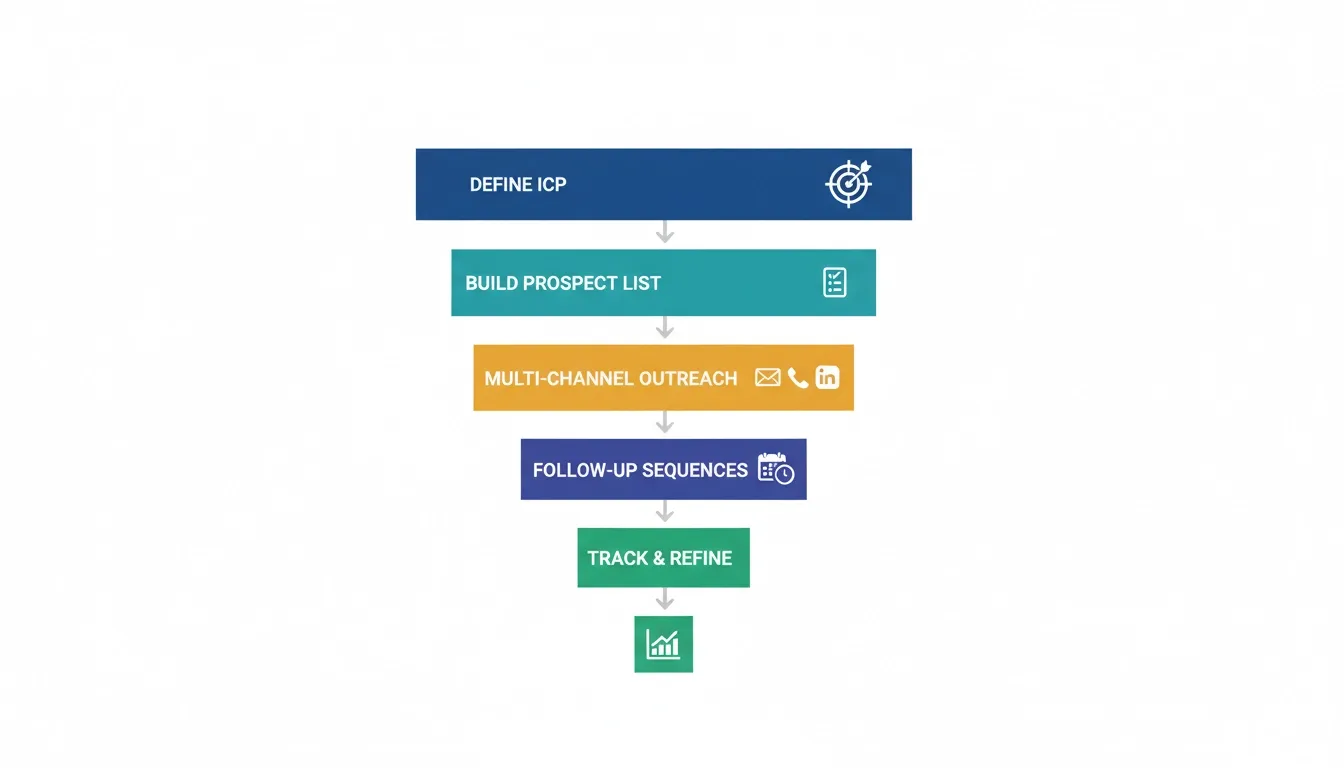 A five-step repeatable sales prospecting process for B2B teams
Cold Calls and Phone Outreach
Cold calling earns its skepticism, but the data consistently supports it. Research from Close.com shows that organizations making cold calls regularly achieve 42% more growth than those relying on email alone. A phone call creates a real-time exchange that written channels simply cannot replicate.
The difference between cold calls that open doors and those that do not comes down to preparation. Sales reps who spend a few minutes researching a prospect's recent situation before dialing get consistently better response rates than those reading from a generic script.
-
Know the prospect's job title and company priorities before the call
-
Open with a specific pain point, not a product feature list
-
Keep calls under five minutes on first contact
-
Ask for a clear next step before ending; never leave the outcome open-ended
Cold calls work best as part of a broader multi-channel sequence, not as a standalone tactic in isolation.
Cold Emailing That Earns a Reply
Cold emailing gives sales teams genuine scale. A structured email sequence reaches hundreds of potential customers without burning individual research time on every contact. The subject line is everything: it determines whether the message gets opened or goes straight to trash.
Practices that consistently lift reply rates:
-
Personalize the subject line with the recipient's company name or a specific trigger event
-
Keep the body under 150 words; busy buyers skim fast
-
Include a single, clear ask: one question, one link, one next step
-
Send follow-up emails on a cadence; most positive replies arrive on the second or third touch
The cold emailing environment is noisier than ever. Real personalization, not just inserting a first name into a template, is what earns attention from potential buyers.
Social Selling on LinkedIn and Other Platforms
LinkedIn is the dominant social media platform for B2B relationship-building before a pitch. Connecting with potential buyers, commenting on their posts, sharing relevant content, and sending thoughtful direct messages all build trust before any formal outreach begins. Social media platforms like LinkedIn give you real-time signal on what a buyer is focused on right now, which makes your message feel timely instead of intrusive.
Tips that consistently work for social selling:
-
Engage with a prospect's content before sending a connection request
-
Share concise, useful posts that demonstrate genuine expertise in their area
-
Use LinkedIn Sales Navigator to build targeted lists by company size, industry, and job title
-
Keep initial messages conversational; no pitch in the opening contact
When done consistently, social selling turns warm connections into qualified conversations before any formal pitch begins. Teams that also track competitive intelligence signals can time their social outreach to coincide with moments when a prospect is most likely evaluating new solutions.
Referrals from Satisfied Customers
"Pipeline is lifeline. Each call, each email, each LinkedIn message is another stage to introduce your team and provide real value to the potential target." — Joe Latchow, Lead Development Manager, via Mailshake
Referrals consistently produce the highest conversion rates in most B2B playbooks. Companies generating regular referrals enjoy 70% higher conversion rates and 69% faster close times compared with cold outreach alone. Satisfied customers who recommend your product pre-sell the conversation before you ever make contact.
-
Build referral asks into your customer success process as a standard, scheduled step
-
Make it simple: give satisfied customers a short message they can forward with minimal effort
-
Follow up on every referral promptly and share the outcome with the referrer
Timing the ask correctly matters. Request introductions right after a customer sees clear results, when enthusiasm is naturally at its peak.
Networking Events and Online Communities
Networking events and industry conferences create face-to-face trust that carries directly into later sales conversations. Online communities such as LinkedIn groups, Slack workspaces, and industry forums follow the same principle.
-
Attend events where your ideal buyers are most likely to be present
-
Focus on giving genuine value in discussions rather than pitching on the spot
-
Follow up with new contacts within 24-48 hours while the conversation is still fresh
-
In online communities, contribute useful knowledge consistently and let your expertise speak first
Direct selling in community spaces backfires almost every time. Consistent, honest contribution does not.
Building a Repeatable Prospecting Process
A strong technique without a repeatable process still produces inconsistent results. The best outcomes come from sales teams running a structured workflow, not from individual reps inventing their own approach from scratch each week.
Step 1: Define Your Ideal Customer Profile
Your ideal customer profile is the foundation of every prospecting decision. It defines the company size, industry, revenue range, and decision maker roles that make a prospect genuinely worth pursuing. Without a clear profile, sales reps waste time on accounts that will never close and struggle to understand why close rates stay flat.
-
List the firmographic traits your top accounts share: industry, company size, geography, growth stage
-
Identify the job titles of the people who championed your product internally
-
Document the specific pain points that led them to start evaluating a solution
The profile should be narrow enough to be precise and concrete enough to filter any new account in under two minutes.
Step 2: Build and Score Your Prospect List
Once you have a clear profile, building a prospect list becomes systematic rather than guesswork. Lead scoring assigns each potential customer a value based on how closely they match your profile combined with the buying intent signals they are showing right now.
A simple scoring approach:
-
Assign points for each profile match: right industry, company size, job title
-
Add points for intent signals: recent funding, relevant hiring, content engagement
-
Prioritize highest-scoring accounts for direct outreach first
-
Move lower-scoring accounts into a longer-term nurture sequence
Update scores regularly. Data decays quickly, and a contact list that is six months old is often full of people who have changed roles or companies.
Step 3: Run Multi-Channel Outreach Campaigns
The best prospecting campaigns combine multiple channels in a coordinated sequence. A typical flow: LinkedIn connection request, then a personalized cold email, then a phone call, then a follow-up email. Each touchpoint references the prior one and moves the conversation forward.
-
Vary the channel at each step to avoid spam filters and inbox fatigue
-
Reference prior interactions to show genuine interest in that specific account
-
Let the prospect's response guide the cadence, not a rigid template built for everyone
Four to six touches over two to three weeks covers most sales cycles without overwhelming the prospect.
Step 4: Follow Up Without Being Pushy
Follow-up is where most deals are actually won or lost. Research shows 80% of successful sales require five or more follow-up contacts. Most reps give up after one or two attempts and leave real revenue on the table.
Give each follow-up a reason to exist. A relevant industry article, a new case study, or a trigger event at the prospect's company turns a simple reminder into something worth opening.
-
Space follow-up emails two to four days apart
-
Always reference the prior interaction to show continuity
-
Include one new piece of value at each touch point
-
Know when to move a prospect to a long-term list rather than continuing active outreach
Persistence without relevance is noise. Relevance with persistence is how you win.
Step 5: Track, Measure, and Refine
A process that is not measured cannot improve. Log every outreach activity in your CRM so you can see which channels produce the most replies, which subject lines drive open rates, and which industries convert at the highest rates.
-
Log every call, email, and LinkedIn touch in your CRM with outcome notes
-
Review reply rates and booked meetings by channel every week
-
Track which industries and job titles respond most to your outreach
-
Share findings with your full sales team so everyone refines from the same data
Account executives and sales managers who do this consistently spot patterns that turn an average process into a reliable pipeline engine for qualified leads.
How Do You Find the Right Accounts and Contacts?
Even the strongest process fails if the underlying account data is wrong. Finding good prospects starts with having accurate, current information on the companies worth targeting.
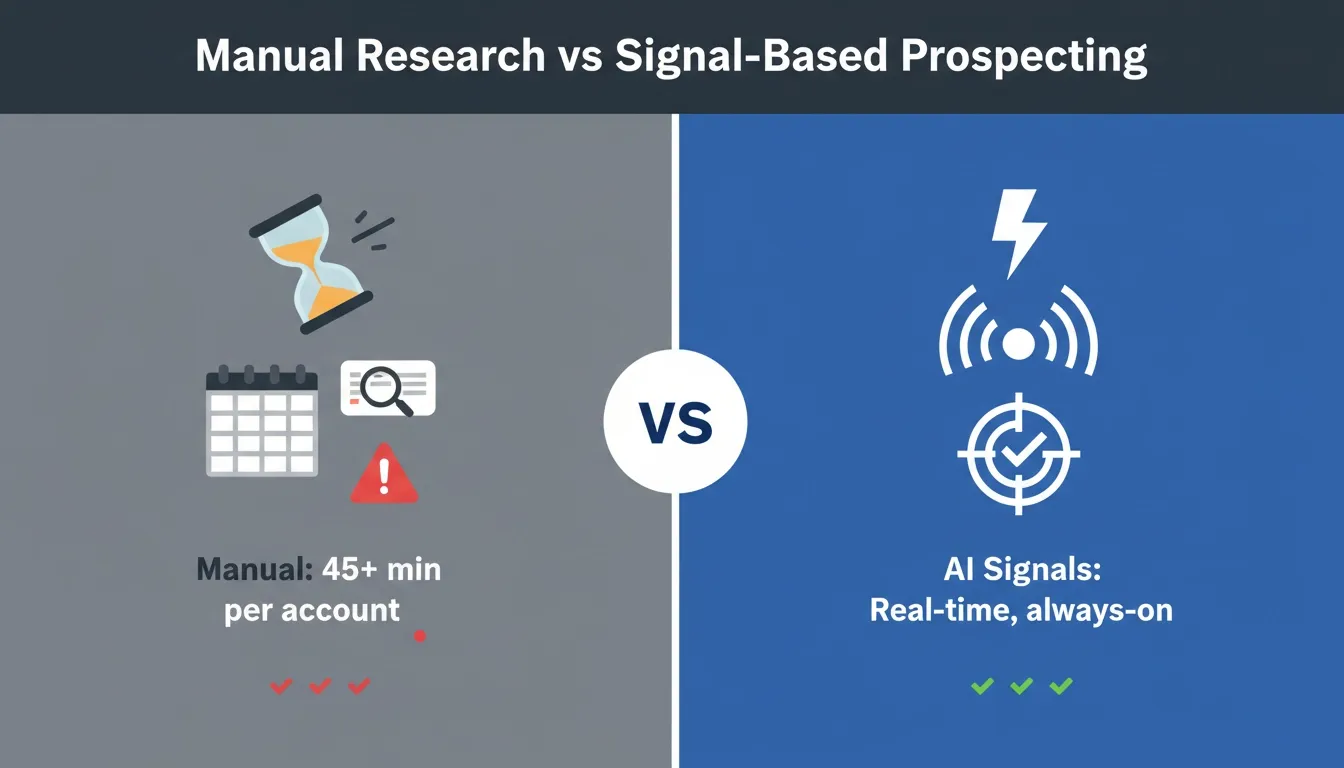 Manual research vs signal-based prospecting: speed and accuracy compared
Firmographic Data and Intent Signals
Firmographic data describes a company from the outside: industry, company size, revenue range, headcount, and geography. Intent signals reveal what that company is doing right now, which topics they are researching, which tools they are evaluating, and which challenges they are actively trying to solve.
The most valuable target accounts match your ideal customer profile on firmographics AND show active buying signals at the same time. That combination is uncommon, which is why teams that identify it reliably close more deals with less wasted effort.
-
Recent funding rounds: strong indicator of spending intent and growth mode
-
Hiring patterns: where a company adds headcount shows where budget is going
-
Competitive tool usage: if they use a category competitor, they already understand the problem
-
Trigger events: leadership changes, product launches, and press releases create timely outreach windows
The best prospect lists combine firmographic precision with intent signal data; either dimension alone misses something important.
Tools That Surface Qualified Prospects
LinkedIn Sales Navigator remains the most widely used tool for locating decision makers at target companies. Filters by company size, industry, job title, and geography let sales teams build targeted lists significantly faster than manual research alone.
-
LinkedIn Sales Navigator: filter by company size, industry, seniority, and keywords
-
Intent data platforms: surface accounts actively researching your category right now
-
CRM enrichment tools: keep contact records accurate as people change roles
-
Competitive intelligence platforms: identify accounts evaluating similar solutions
Data decays quickly. Prospect lists that are not refreshed regularly fill up with stale contacts who have already moved on to different roles or different priorities.
What Separates a Strong List from a Weak One?
A weak list is a long list. A strong list is a precise one. Every account on a strong list has been evaluated against your ideal customer profile and scored for intent before entering the outreach queue.
-
Every account passes the ICP filter before being added
-
Intent scoring places the most active prospects at the top
-
Contact-level data is current: right person, right title, right company status
-
List size is manageable: 50 qualified accounts outperform 500 unscored ones
Sales teams that invest the upfront time in building precise, data-backed lists spend their outreach hours on real opportunities and close at measurably higher rates.
How Rocket Intelligence Builds Your Target List
Most sales intelligence tools show you who exists. Rocket Intelligence shows you who is moving, and connects that movement to your pipeline right now.
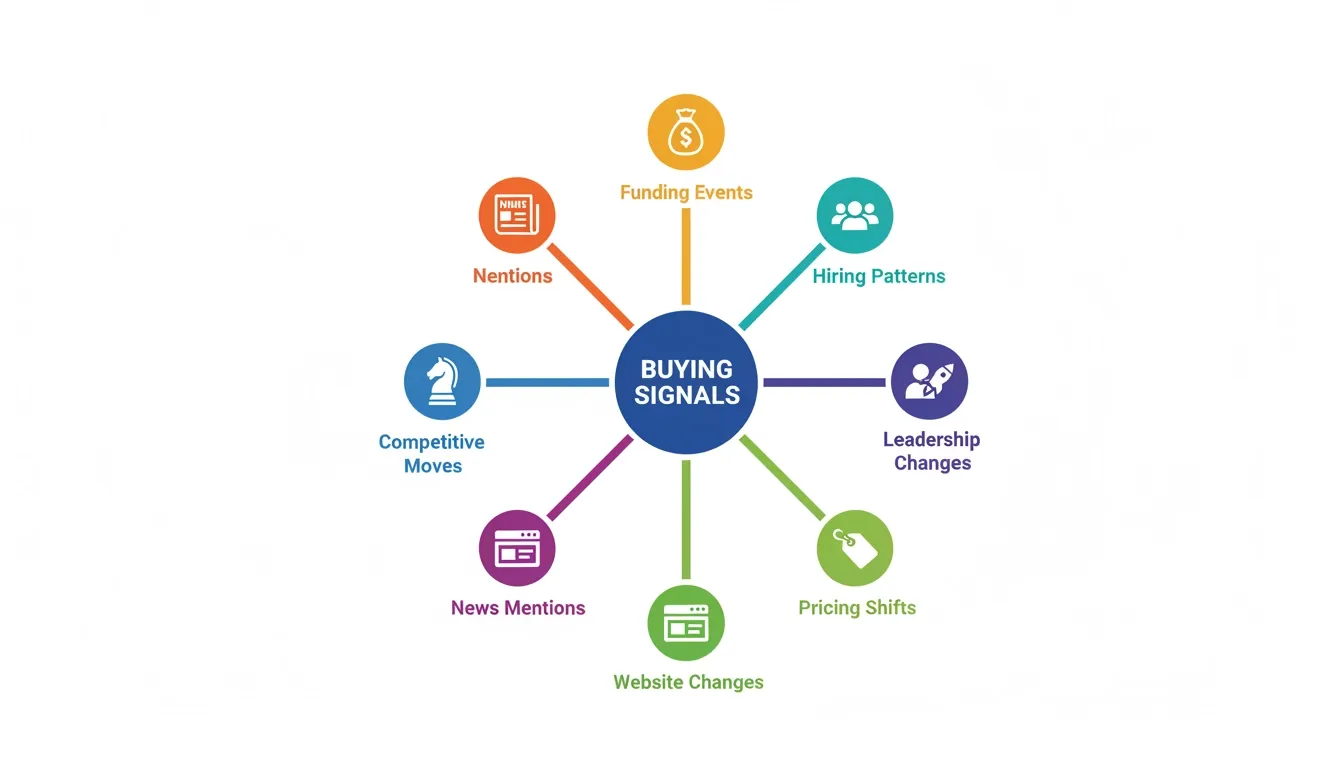 Rocket Intelligence: eight signal types converging into actionable sales insights
Why Manual Research Slows Your Sales Team Down
Manual account research burns time that sales reps should spend on conversations. Checking press releases, monitoring job boards, reviewing LinkedIn profiles, and updating spreadsheets one account at a time is slow, inconsistent, and impossible to sustain at scale.
-
A typical rep spends 40-60 minutes researching one account before making contact
-
Signals like funding announcements or leadership changes go unnoticed without continuous monitoring
-
Contact lists go stale as people change roles and the sales team finds out weeks later
The result: outreach happens too late, targets the wrong person, or misses the buying window entirely. That gap is where Rocket Intelligence operates.
Always-On Account Monitoring
Rocket Intelligence monitors your target companies continuously across nine signal types: product changes, pricing shifts, hiring patterns, social media activity, news mentions, website changes, funding events, leadership changes, and competitive moves. When a signal fires, Rocket connects it to the accounts on your radar and surfaces only the ones relevant to your role and goals.
Competing tools like Apollo.io and LinkedIn Sales Navigator require manual search refreshes on a schedule you set. Rocket runs in the background and sends the insight when it becomes actionable, not when you happen to log in.
-
Monitor any company: competitors, prospects, or strategic partners
-
Receive daily briefs highlighting the most significant moves from the past 24 hours
-
Filter signals by relevance so your sales team sees what matters, not everything at once
The result is a signal-aware sales team that acts on intelligence rather than hunting for it.
Surfacing Buying Signals Before Competitors Do
A prospect suddenly hiring five account executives is a buying signal. A competitor cutting prices is a signal. A target account announcing a new product line is a signal. Rocket connects these data points and delivers actionable context rather than raw data your team has to interpret manually.
Sales reps do not have time to monitor every press release, every job board, and every LinkedIn post. Rocket does that continuously and sends conclusions, so your team spends time on sales meetings and meaningful conversations rather than research time.
-
Leadership changes at target accounts that trigger new evaluation cycles
-
Product launches from competitors that shift your positioning opportunity
-
Funding announcements indicating a prospect has moved into active growth mode
-
Hiring patterns showing where a company is investing budget right now
Speed matters: the team that identifies and acts on a buying signal first has a meaningful advantage over teams still manually monitoring.
From Signal to Outreach in Minutes
Once a relevant signal appears, Rocket Solve turns it into a research-backed outreach brief in minutes. You get context on what changed, why it matters to that specific account, and the angle most likely to open a meaningful conversation.
-
Context brief on what changed: the trigger, the account, the timing
-
Account-specific framing: why this signal matters for your role and goals
-
Outreach starting points: the angle, the message direction, the ask
-
A workflow that scales across your entire sales team without adding headcount
Manual alternatives take 45 minutes or more per account. Rocket compresses that into a repeatable process your team can run at scale.
Your Pipeline Starts with the Right Prospecting Playbook
Good prospecting comes down to who you target, not just how hard you work. The techniques, the process, and the data tools you build around them all compound over time. A sales team that consistently goes after the right accounts, mixes channels intelligently, and follows up with patience and precision will always outperform one that relies on volume alone.
The tools have changed significantly, but the underlying principle has not. Start with a precise ideal customer profile, stay sharp on the signals that indicate real buying intent, and make every outreach interaction count toward building a relationship rather than just booking a calendar slot.
Teams that want to move faster can explore how sales app development is reshaping the way modern revenue teams operate, or dive into how CRM app development can give your team a purpose-built system for tracking every prospect interaction.
Ready to stop guessing and start prospecting with real buying signals? Rocket gives your sales team always-on account monitoring, daily intelligence briefs, and outreach context that turns signals into pipeline. Start building with Rocket.new and see how fast your qualified pipeline grows.
Table of contents
- -What Does Modern Prospecting Actually Look Like?
- -Inbound vs Outbound Prospecting
- -Why the Buyer Journey Changed Everything
- -What Makes a Good Sales Prospect?
- -Which Techniques Consistently Produce Qualified Leads?
- -Cold Calls and Phone Outreach
- -Cold Emailing That Earns a Reply
- -Social Selling on LinkedIn and Other Platforms
- -Referrals from Satisfied Customers
- -Networking Events and Online Communities
- -Building a Repeatable Prospecting Process
- -Step 1: Define Your Ideal Customer Profile
- -Step 2: Build and Score Your Prospect List
- -Step 3: Run Multi-Channel Outreach Campaigns
- -Step 4: Follow Up Without Being Pushy
- -Step 5: Track, Measure, and Refine
- -How Do You Find the Right Accounts and Contacts?
- -Firmographic Data and Intent Signals
- -Tools That Surface Qualified Prospects
- -What Separates a Strong List from a Weak One?
- -How Rocket Intelligence Builds Your Target List
- -Why Manual Research Slows Your Sales Team Down
- -Always-On Account Monitoring
- -Surfacing Buying Signals Before Competitors Do
- -From Signal to Outreach in Minutes
- -Your Pipeline Starts with the Right Prospecting Playbook