
A working competitive intelligence framework needs defined inputs, a clear cadence, named owners, and outputs people actually use. Most teams react to competitors instead of tracking them systematically. The four-pillar approach in this guide gives any team a repeatable CI habit they can start this week.
What if competitive intelligence ran itself?
Most companies want good CI but run it reactively. A pricing update gets spotted by accident, a product change lands in a Slack message nobody acts on, and suddenly the team is playing catch-up.
According to Crayon's 2025 State of Competitive Intelligence report, sellers face direct competition in 68% of deals, yet the average team rates itself just 3.8 out of 10 at competitive selling. That number reflects a structural problem, not a motivation gap. The fix is a framework, not a tool.
This blog walks through the four pillars of a working CI program: inputs, cadence, owners, and outputs. You will also find a starter template you can run this week.
What a Good CI Program Actually Includes
What Should Every CI Setup Cover?
A well-built CI program starts with scope and ends with distribution. Most fail somewhere in between. Before picking tools, define what you are tracking and who gets the output.
-
Define scope first: Track direct competitors, adjacent players, and emerging market threats, not every company in the industry
-
Layer your sources: Combine primary research (win/loss interviews, sales calls) with secondary sources (review sites, job postings, press releases) for depth and breadth
-
Choose analysis models that fit your questions: SWOT for broad positioning, Porter's Five Forces for industry dynamics, PEST for macro factors
-
Match outputs to audiences: Sales teams need battlecards, leadership needs trend summaries, product teams need feature comparisons. One format does not serve all three
| Component | What It Covers | Why It Matters |
|---|---|---|
| Intelligence scope | Which competitors, markets, and signals to track | Focuses effort on decision-relevant competitive intelligence data |
| Data sources | Primary research, secondary sources, automated feeds | Covers breadth and improves accuracy |
| Analysis models | SWOT analysis, Five Forces, battlecard templates | Turns raw data into actionable insights |
| Cadence | Daily, weekly, monthly, quarterly rhythms | Keeps competitive intel current and consistent |
| Owner assignment | Who collects, analyzes, and distributes | Removes ambiguity and coverage gaps |
| Output formats | Reports, battlecards, dashboards | Matches format to the audience's decision needs |
Scope and distribution are the two components most CI programs skip entirely. Getting both right before adding tools or sources is what separates programs that run from programs that collapse.
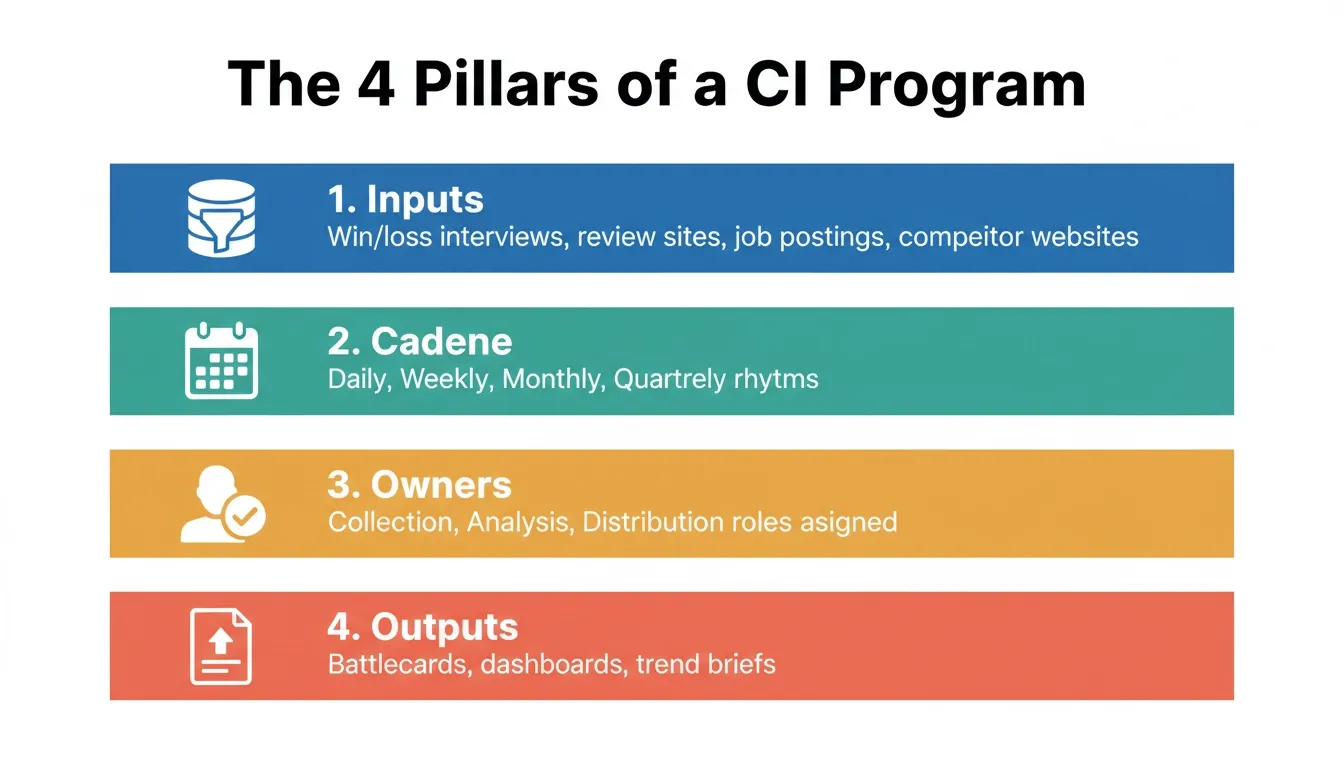 The four pillars every operational CI program needs. Each one depends on the one above it being clearly defined.
What Does the Intelligence Cycle Actually Look Like?
The intelligence cycle is a continuous loop, not a one-time project. Every round of collection produces better questions, which drives sharper analysis the next time around.
-
Collect: Pull competitive intelligence data from competitor websites, job postings, review platforms, social media, and primary research sources
-
Process: Filter noise, organize signals by competitor and topic, and flag time-sensitive items for immediate distribution
-
Analyze: Apply your chosen model to synthesize findings into actionable competitive insights
-
Distribute: Push formatted outputs to the right stakeholder at the right cadence and in the right format
-
Act: Decisions get made, sales teams use the intel, and the loop generates new questions for the next cycle
For a foundational definition of competitive intelligence and how it differs from market research, Investopedia's overview covers the key distinctions clearly.
The cycle compounds over time. The longer you run it, the sharper your analysis becomes. A CI program running for six months consistently outperforms a fresh one, even with identical tools.
The Four Pillars: Inputs, Cadence, Owners, and Outputs
What Goes In: Inputs and Sources
Most CI programs lean too hard on secondary research because it is easier to set up. Primary research, meaning direct conversations with buyers and sellers, is consistently the higher-signal source.
-
Win/loss interviews reveal the real evaluation criteria buyers used, in their own words
-
Sales call reviews surface competitor mentions, objections, and positioning patterns that live in recordings but rarely make it into a CI doc
-
Secondary sources (G2, Gartner, competitor websites, press releases, financial statements, job postings) provide the scale that primary research cannot match alone
-
Google Alerts serve as a lightweight, zero-cost first layer for news monitoring before adding dedicated competitive intelligence platforms
-
The strongest programs combine both: secondary data spots the signal, primary research confirms what it means
Gathering competitive intelligence from both primary and secondary streams produces outputs more actionable than relying on either alone. Start with the sources already available, then layer automation on top.
For a deeper look at how CI connects to product strategy decisions, see the guide on competitive intelligence software for product teams.
How Often Should You Run CI Activities?
Cadence is where most CI programs break down. Teams run it once and call it a project, or check in so rarely that the data is stale before anyone uses it.
| Frequency | Activity | Owner |
|---|---|---|
| Daily | Monitor news mentions, social media, job listings | CI analyst or marketing ops |
| Weekly | Review price changes, product updates, ad copy shifts | Product marketing manager |
| Monthly | Compile win loss analysis summary, update battlecards | Product marketing plus sales team |
| Quarterly | Full competitor analysis refresh, strategic positioning review | Cross-functional team |
-
Daily rhythm catches fast-moving signals like news, hiring announcements, and social activity before they go stale
-
Weekly reviews track competitor moves that directly affect positioning: pricing updates, ad copy changes, new feature releases
-
Monthly cycles compile win/loss analysis summaries, refresh battlecards, and update competitive analysis docs for sales teams
-
Quarterly refreshes are the strategic reset: landscape scans, positioning reviews, and CI program health checks
In a fast-moving market, quarterly analysis alone is too slow to catch pricing and positioning changes. Monthly is the practical floor for most B2B teams.
Understanding how to track competitor repositioning early is one of the highest-value skills a CI program can develop.
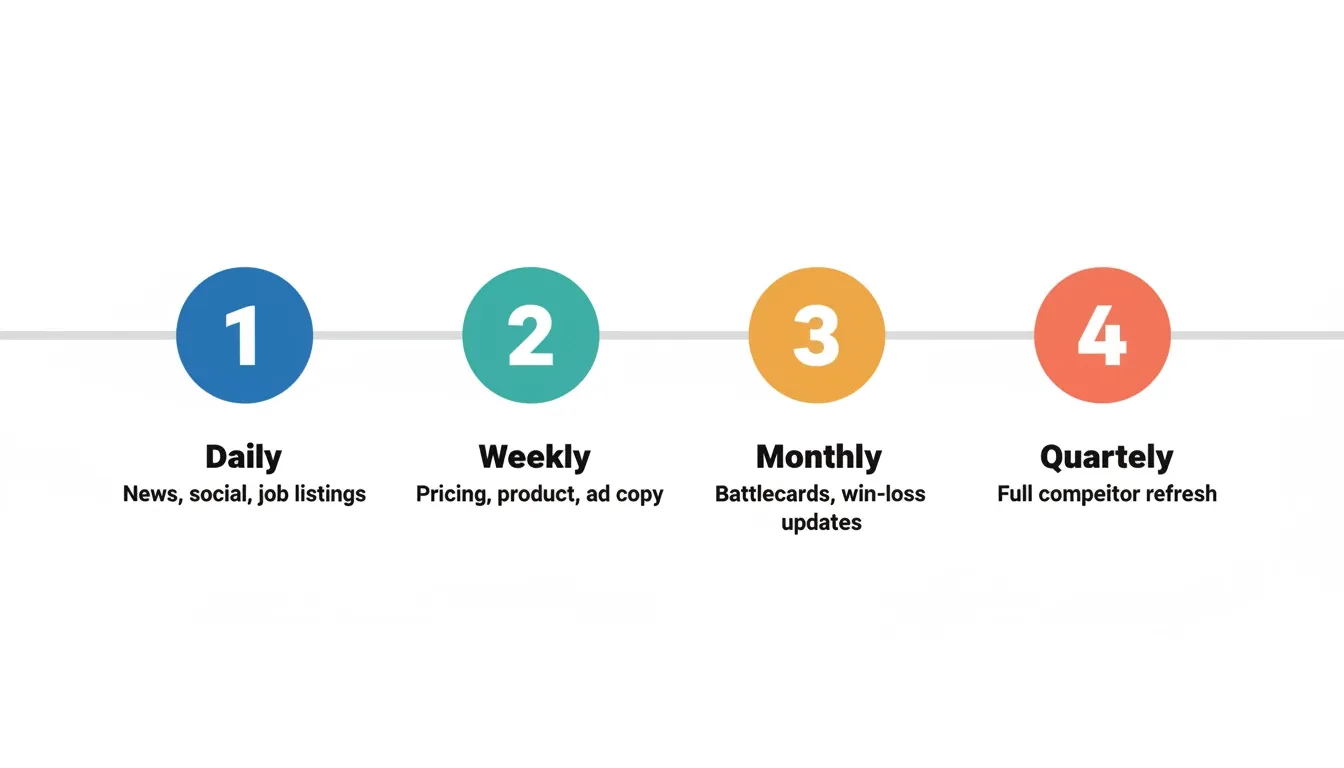 A structured cadence keeps competitive intelligence current. Without it, even great sources produce stale output.
Who Owns What in a CI Program?
Without named owners, tasks sit in "team responsibility," which is another way of saying nobody is doing them. A working CI program assigns ownership at three distinct levels.
-
Collection owners manage source maintenance, monitoring setup, and raw data gathering, typically product marketing or a CI analyst
-
Analysis owners translate raw competitive intelligence data into competitor strategies, insights, and talk tracks, typically product managers or senior product marketers
-
Distribution owners format and deliver outputs to each stakeholder group at the defined cadence, typically CI leads or sales operations
-
Sales teams serve as the feedback loop: reporting what is working and failing in competitive deals closes the gap between the CI doc and real market dynamics
-
Key stakeholders (leadership, product, sales) should each receive outputs tailored to their specific decision-making needs
Win/loss analysis is the highest-signal CI input most programs leave unowned. Assign a named owner for it in the first week of any CI program.
How Do You Pick the Right Tools for Your CI Program?
There is no shortage of competitive intelligence tools. Buying monitoring software without planning for analysis or distribution is the most common mistake. Most CI tech stacks need three layers working together.
-
Collection and monitoring tools (Google Alerts, Crayon, Klue, Semrush) track competitor websites, social media channels, job listings, and pricing pages at scale
-
Analysis and synthesis tools (CRM wikis, spreadsheets, battlecard platforms) help teams process competitive intelligence data and turn it into usable content for sales teams
-
Distribution tools (Slack channels, CRM-connected battlecards, CI platforms with sharing features) deliver insights to the people who need them at the moment they need them
-
Advanced analytics and machine learning features are now standard in top-tier competitive intelligence platforms, useful for processing large data volumes and surfacing patterns across markets
-
The right tool is the one your team actually uses, not the most feature-rich option available
| Team Stage | Recommended Stack | Cost Range |
|---|---|---|
| Early-stage (1-2 people) | Google Alerts plus spreadsheets plus Notion | Free to low |
| Growing (3-10 people) | Klue or Crayon plus CRM-connected wiki | Mid-range |
| Scaled CI program | Full competitive intelligence platforms plus AI analysis | Higher |
Plan the full three-layer stack (collection, analysis, distribution) before committing to any tool. Buying collection software without a distribution plan is the most common CI tooling mistake.
Tracking social media monitoring is one of the most underused inputs in early-stage CI programs, yet it surfaces competitor messaging shifts faster than almost any other source.
A Starter CI Template You Can Use Today
No intelligence framework is worth anything if it lives in a slide deck. This five-pillar template maps to the operational questions every CI program needs to answer before it can run.
| Pillar | Source | Owner | Frequency | Output |
|---|---|---|---|---|
| Inputs | Competitor sites, G2 reviews, job postings, customer calls | Product marketing | Daily and weekly monitoring | Signals log |
| Cadence | CI calendar with review checkpoints | CI lead and product marketing | Weekly, monthly, quarterly | Meeting agenda plus status report |
| Analysis | SWOT, win loss analysis, feature matrices | Product manager plus marketing | Monthly | Competitive analysis doc |
| Distribution | Battlecards, Slack updates, leadership briefing | CI lead plus sales operations | Ongoing and quarterly refresh | Battlecards and trend brief |
| Measurement | Win rate by segment, sales team adoption, source quality | CI lead plus sales operations | Quarterly | ROI report |
-
Match cadence to market velocity: Fast-moving markets need monthly analysis minimum; slower markets can sustain quarterly
-
Start with three direct competitors: Depth beats breadth in the first quarter; add more only after the process is running
-
Run one full cycle before adjusting: Collect, analyze, distribute, then let what stakeholders actually use guide every refinement
-
Treat the template as a starting point: Your version will look different based on team size, market dynamics, and competitive intensity
According to Klue's 2026 AI in Competitive Intelligence Report, 97% of CI teams are actively building or planning AI workflows, with the top use case being summarizing competitor activity and moves.
That is the output a functional CI program produces: regularly refreshed competitive intelligence that sales reps actually open. Start simple, run one cycle, and adjust from there.
For teams building CI into their product roadmap process, the guide on competitive intelligence roadmap planning covers how to connect market signals directly to sprint priorities.
Where Your Program Meets the Machine: Rocket Intelligence
The hardest part of running a CI program is not building the structure. It is keeping it running week after week. Manual competitive intelligence collapses the moment your team gets busy with other priorities.
-
Pricing and product changes: Automatic monitoring of competitor websites for updates to pricing pages, feature sets, and announcements
-
Hiring signals: Job posting patterns that reveal where competitors are investing resources and where their strategy is heading
-
News and announcements: Press coverage, funding rounds, and partnership news surfaced in real time
-
Social media activity: What competitors are saying publicly and what their customers are saying about them
-
Market trends: Broader signals affecting your competitive position, market share, and industry dynamics
| Activity | Manual Process | Rocket Intelligence |
|---|---|---|
| Competitor website monitoring | 3-5 hours per week per competitor | Automated and continuous |
| Pricing change detection | Reactive, spotted by chance | Real-time alerts |
| News monitoring | Google Alerts plus manual reading | Curated, role-specific feed |
| Win loss signal tracking | Separate tools, manual tagging | Connected to your workflow |
| Distributing insights to sales teams | Manual email or doc | Delivered directly to your team |
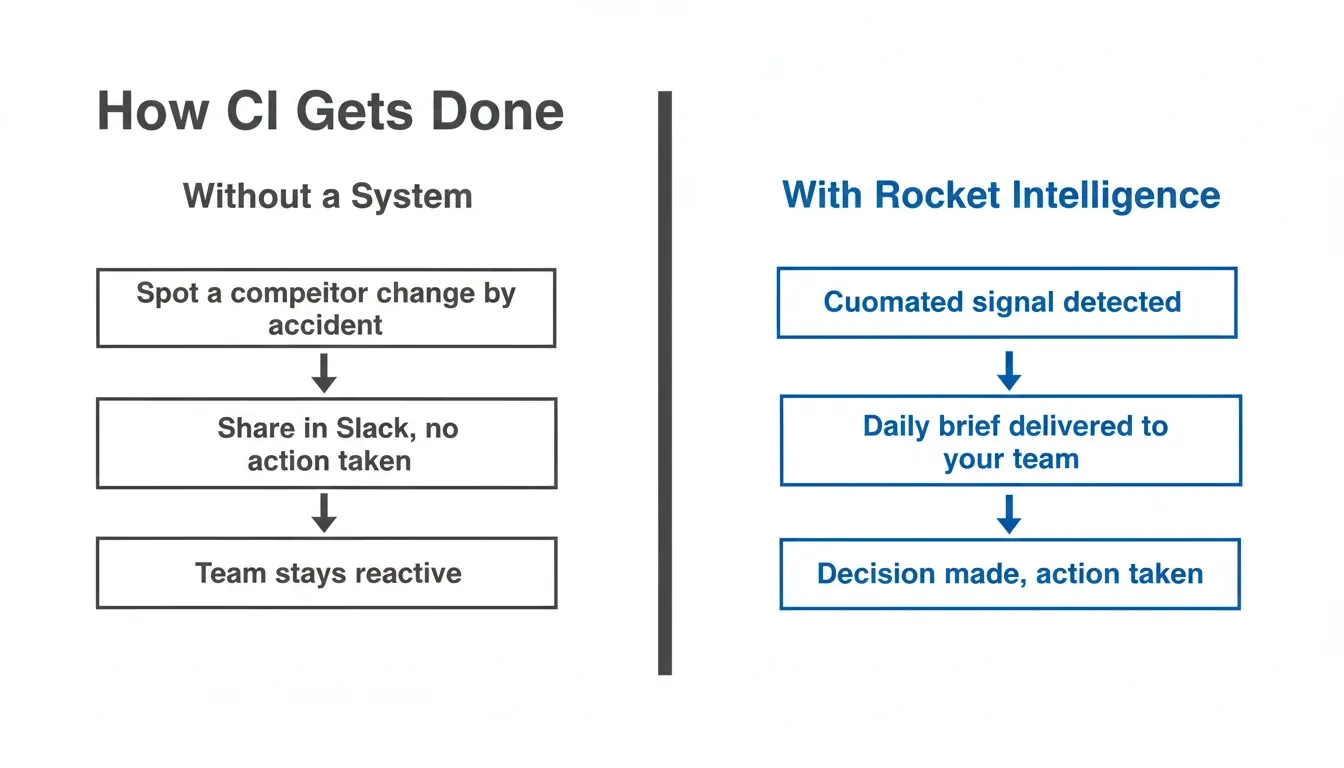 Manual CI is reactive by design. Rocket Intelligence replaces the monitoring layer so your team focuses on decisions, not data collection.
-
Sales teams get battlecard-ready competitive insights tailored to their role and active deals
-
Product teams get feature gap alerts and competitor announcement summaries
-
Leadership gets market shift summaries and positioning signals
The pillars you define (inputs, cadence, owners, outputs) run automatically once Rocket Intelligence is set up. Build your CI program the right way, then let Rocket keep it running.
Teams scaling CI across sales, marketing, and product will find the breakdown of Rocket Intelligence for enterprise sales teams particularly useful for structuring role-specific output formats.
Turning a Program Into a Habit
A CI program is a living system. It gets better the more consistently you run it. Start small: pick two or three direct competitors, assign one owner, and build a simple cadence. Run one full cycle first, then let what your stakeholders actually use guide every adjustment after that.
The companies that win competitive deals consistently do not have more data. They have better systems for turning the competitive intelligence they do have into informed decisions. Accurate and timely intel beats comprehensive but late intelligence every time. Your CI program will change as your business grows, but what stays constant is the loop: collect, analyze, distribute, act.
Ready to stop running CI manually? Rocket Intelligence monitors every public platform your competitors operate on, continuously, and delivers daily briefs your team actually opens. Start free with Rocket and have your first competitor profile live today.
Table of contents
- -What a Good CI Program Actually Includes
- -What Should Every CI Setup Cover?
- -What Does the Intelligence Cycle Actually Look Like?
- -The Four Pillars: Inputs, Cadence, Owners, and Outputs
- -What Goes In: Inputs and Sources
- -How Often Should You Run CI Activities?
- -Who Owns What in a CI Program?
- -How Do You Pick the Right Tools for Your CI Program?
- -A Starter CI Template You Can Use Today
- -Where Your Program Meets the Machine: Rocket Intelligence
- -Turning a Program Into a Habit