
Rocket.new stands apart by transforming information into decisions, not just answers. This shift empowers users to act with clarity, reduce ambiguity, and make smarter, faster choices in complex situations.
Most AI tools stop at answers.
They respond fast, but they don’t help you move forward. The difference comes down to how the system thinks.
The idea is simple. Platforms like Rocket.new focus on decision-making, not just responses. They connect data, context, and direction so teams can act, not just read outputs.
According to Statista, AI adoption can lead to measurable productivity gains, including around 2.9% annual labor productivity growth in the U.S., showing how consistent, data-backed decision-making improves performance over time.
So, the shift from answers to decisions is not just nice to have. It defines the AI industry today. This blog will help you understand that shift and show how to build with more clarity and confidence.
The Core Problem With Most AI Tools
Most teams rely on tools that give quick answers.
You ask something, you get a reply.
Simple.
But when it comes to actually building something meaningful, that speed doesn’t always help. The real issue starts when those answers fail to connect with your bigger goal.
Here’s where things start to break:
-
No context connection: Answers don’t link with your idea, your data, or your ongoing projects.
-
Repeated tasks: Teams keep doing the same task again, running search, collecting insights, and trying to build from scratch.
-
No memory in the system: There’s no continuity. The system forgets everything after each interaction.
-
Lack of direction: You get output, but you still have to think and figure out what to do next.
-
Rise of vibe coding: To move faster, people started relying on instinct. Quick prompts, quick code, minimal research.
-
Speed over clarity: While vibe coding solved speed, it didn’t solve clarity, which leads to confusion later.
So, the gap becomes clear. Most tools help you respond faster, but they don’t help you move forward with confidence. That’s where the real problem lies.
From Answers to Decision Making
Getting answers is easy.
Every AI tool does that. But moving from answers to real decisions takes a different approach. It requires more than just quick responses. It needs structure, clarity, and direction that actually helps you act.
Here’s what changes in this shift:
-
From answers to action: It’s not just about output. It’s about what you do next.
-
Use of evidence and data: Decision-making depends on real inputs, not just generated responses.
-
Structured context over blank prompt: You don’t start empty. You work with connected information.
-
Clear direction: Instead of random output, you get guidance that fits your business and strategy.
-
System-driven thinking: The system helps you think through the problem, not just reply to it.
-
Different approach from competitor tools: Most platforms generate answers. Systems like Rocket focus on helping you solve.
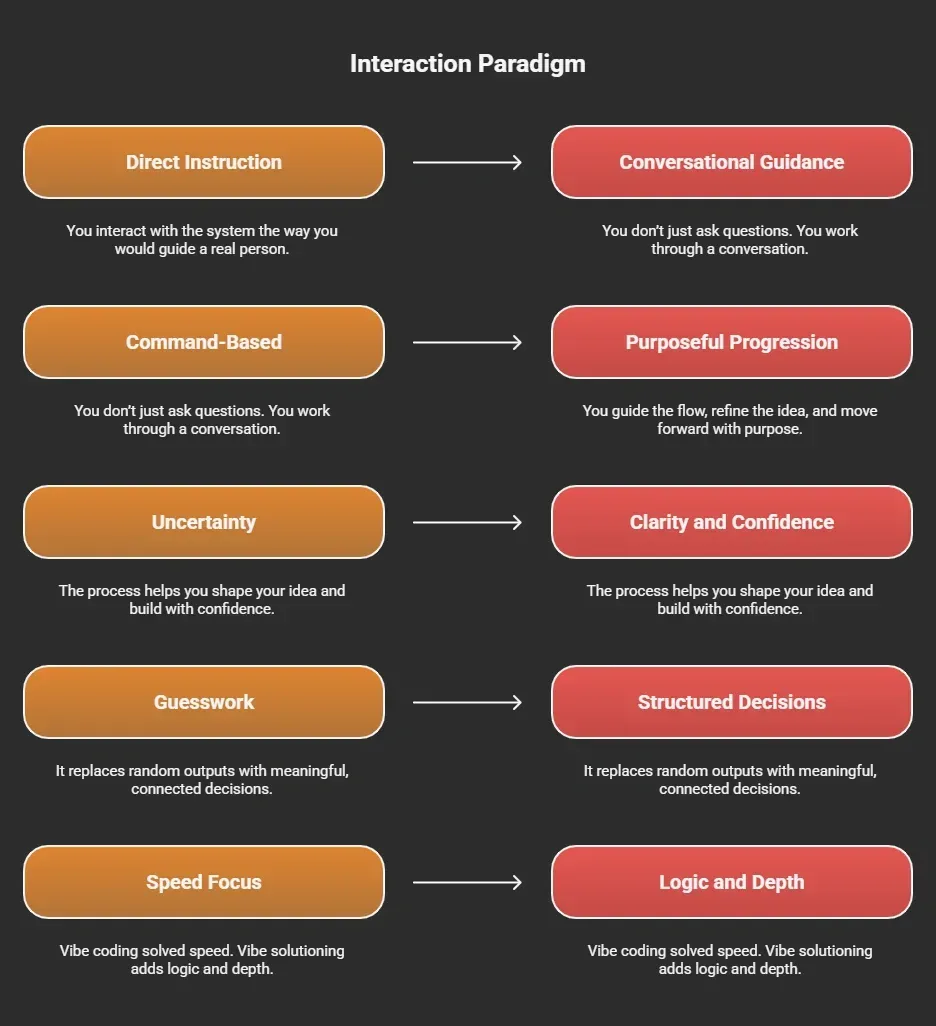 This is where the real shift happens. From simply responding to actually moving forward with clarity.
What is Vibe Solutioning?
So what exactly is vibe solutioning?
It’s a smarter way to solve problems where the system understands your intent, your data, and your goals. It moves beyond random prompts and helps you work with clarity and direction.
Here’s how it works:
-
Guided like a real person: You interact with the system the way you would guide a real person.
-
Conversation over commands: You don’t just ask questions. You work through a conversation.
-
Clear direction at every step: You guide the flow, refine the idea, and move forward with purpose.
-
From idea to build clarity: The process helps you shape your idea and build with confidence.
-
Structured thinking over guesswork: It replaces random outputs with meaningful, connected decisions.
-
Evolution of vibe coding: Vibe coding solved speed. Vibe solutioning adds logic and depth.
So, the shift is simple. From guessing your way through tasks to solving with structure and clarity.
A Quick Look at Traditional Tools vs Rocket
Here’s a simple comparison to understand the shift.
| Aspect | Most Tools | Rocket 1.0 |
|---|---|---|
| Output | Answers | Decisions |
| Context | Limited | Connected |
| Workflow | Fragmented | One system |
| Data Usage | Surface level | Deep research |
| Execution | Manual | Guided |
| Build Flow | Disconnected | Continuous |
This table shows one thing clearly. Most tools give answers. Rocket 1.0 helps you solve.
Rocket 1.0 and the Shift in the AI Industry
Rocket 1.0 is not just another new entrant. It represents a clear shift in how the AI industry approaches problem-solving.
Instead of focusing only on generation, Rocket focuses on solving and execution together in one system.
Here’s what makes this shift clear:
-
From generation to execution: Rocket 1.0 does not stop at output. It helps teams move into real execution.
-
Solve + build in one flow: It connects solving with the build layer, so your idea moves forward without breaks.
-
Everything stays connected: Your data, files, and projects remain in one place with full context.
-
Intelligence that improves over time: With every session, the system learns patterns and improves output quality.
-
One system for the team: The team works together without switching between tools.
-
No context loss: You don’t lose direction between steps. Everything stays aligned.
So, this is not just a feature change. It is a shift in how platforms help teams actually solve problems and build with clarity.
How does Rocket Work?
Let’s break it down in a simple way based on Rocket’s build, solve, and intelligence layers. Rocket 1.0 works through a connected flow where solving, thinking, and building happen together.
Here’s how the system operates:
-
Start with solve: You begin with solving the problem. The system understands your idea, intent, and goal.
-
Use structured context: It works with your data, inputs, and past work instead of a blank prompt.
-
Move into the build layer: Once direction is clear, you move into build without restarting.
-
Connected search and research: You can search across projects, use research, and pull insights in real time.
-
Generate and refine code: The system helps you create and improve code based on context.
-
Support for web and mobile apps: You can build both web apps and mobile apps in the same flow.
-
Intelligence layer working in the background: The system keeps learning from your sessions and improves over time.
-
Consistent context across tasks: Every task stays connected, so you don’t lose direction.
So instead of jumping between tools, everything happens in one session. This reduces confusion and removes the gap between thinking and execution.
Features That Define Rocket 1.0
Rocket 1.0 stands out because it focuses on solving, not just responding. It brings together multiple layers into one platform.
Here are the key features:
-
Context Driven System: Rocket 1.0 keeps your context active across every task, idea, and output. Nothing gets lost between steps.
-
Solve Layer First: It starts with solving before building. This helps teams move with clarity instead of guesswork.
-
Decision Focus: This is the important feature. The system focuses on decision making, not just answers.
-
Continuous Build Flow: You don’t restart from scratch. You continue building on previous work with connected context.
-
Intelligence Layer: The intelligence layer improves results over time. It learns from data, sessions, and patterns.
-
Team Alignment: The team works in one system, which keeps everyone aligned and reduces confusion.
-
Data + Code Connection: Your data directly influences your code. This improves confidence and reduces errors.
-
Reduced Risks Through Research: Built-in research and structured flow reduce risks in projects.
-
Clear Direction at Every Step: You always know the next step. The system guides your direction instead of leaving you stuck.
These sections show one clear idea. Rocket 1.0 is not just another platform. It connects solving, thinking, and building into one system so teams can move with clarity and confidence.
Why Rocket Feels Different
Now let’s bring it all together. Solving on Rocket feels different because it focuses on outcomes, not just responses. It’s not about getting answers. It’s about moving forward with clarity.
Here’s what creates that difference:
-
Focus on outcomes: It aims for results, not just output.
-
Answers vs decisions: Most competitor platforms generate answers. Rocket helps you reach a decision.
-
Less overthinking: Answers still need extra thinking to act on them.
-
Faster with confidence: Decisions help you move quickly with clarity.
-
From output to action: You don’t just read. You act.
-
From answers to direction: You get a clear path instead of scattered output.
So, the shift is simple. From answers to direction, and from thinking to action.
Why This Matters for Most Teams
Most teams don’t struggle with code. They struggle with direction. They often get stuck figuring out what to build, how to approach it, and whether their idea is even worth building.
The real challenge is in strategy and thinking. Without clear direction, teams rely on guesswork. That creates a gap between effort and outcome, even when the tools and skills are there.
That’s where Rocket helps. It brings together research, data, and execution into one platform, so business decisions are based on real evidence instead of assumptions.
Why Rocket Produces Decisions
Most products rely on answers. They generate output, but they don’t guide decision making. This leads to confusion, delays, and weak execution. Teams often struggle to move from thinking to action because there is no clear direction. The gap between idea and execution keeps growing, even when the tools are fast.
Rocket 1.0 changes this by focusing on vibe solutioning. It connects data, context, and tasks in one system, helping teams act with clarity. Solve on Rocket.new Produces Decisions and Not Just Answers because everything works in one flow, reducing the gap and leading to stronger, more meaningful results.
Table of contents
- -The Core Problem With Most AI Tools
- -From Answers to Decision Making
- -What is Vibe Solutioning?
- -A Quick Look at Traditional Tools vs Rocket
- -Rocket 1.0 and the Shift in the AI Industry
- -How does Rocket Work?
- -Features That Define Rocket 1.0
- -Why Rocket Feels Different
- -Why This Matters for Most Teams
- -Why Rocket Produces Decisions