
This blog compares five leading AI Competitor Tracker platforms: Crayon, Klue, Semrush, Similarweb, and Rocket, covering features, pricing, and real-time competitive intelligence capabilities to help you choose the right tool.
Why do most sales teams still rate their competitive readiness at just 3 out of 10?
According to Crayon's 2025 State of Competitive Intelligence Report, nearly 7 in 10 deals are head-to-head against a competitor. Yet organizations still struggle to connect competitive data to the teams that need it most.
The gap between collecting competitor data and acting on it costs companies millions in lost deals every year. AI-powered competitor analysis tools now automate what used to take entire teams weeks to accomplish.
This blog breaks down five platforms that handle competitor monitoring differently, what each does well, and where each falls short.
What Should You Look for in an AI Competitor Tracker?
Before selecting any competitive intelligence platform, your team needs clarity on what separates a useful tool from an expensive dashboard nobody opens.
-
Real-time change detection: The platform should flag competitor website changes, pricing page updates, and messaging shifts within hours, not days
-
Signal interpretation: The difference between a monitoring tool and an intelligence tool is whether it tells you what changed or what it means
-
Coverage breadth: Look for competitor monitoring across websites, social media, reviews, news, hiring signals, and advertising
-
Sales enablement integration: Competitive intelligence only works if it reaches sales teams inside their existing workflows
-
Absence detection: The best platforms also flag when a competitor goes quiet — a slowdown can signal a strategic shift just as much as a spike
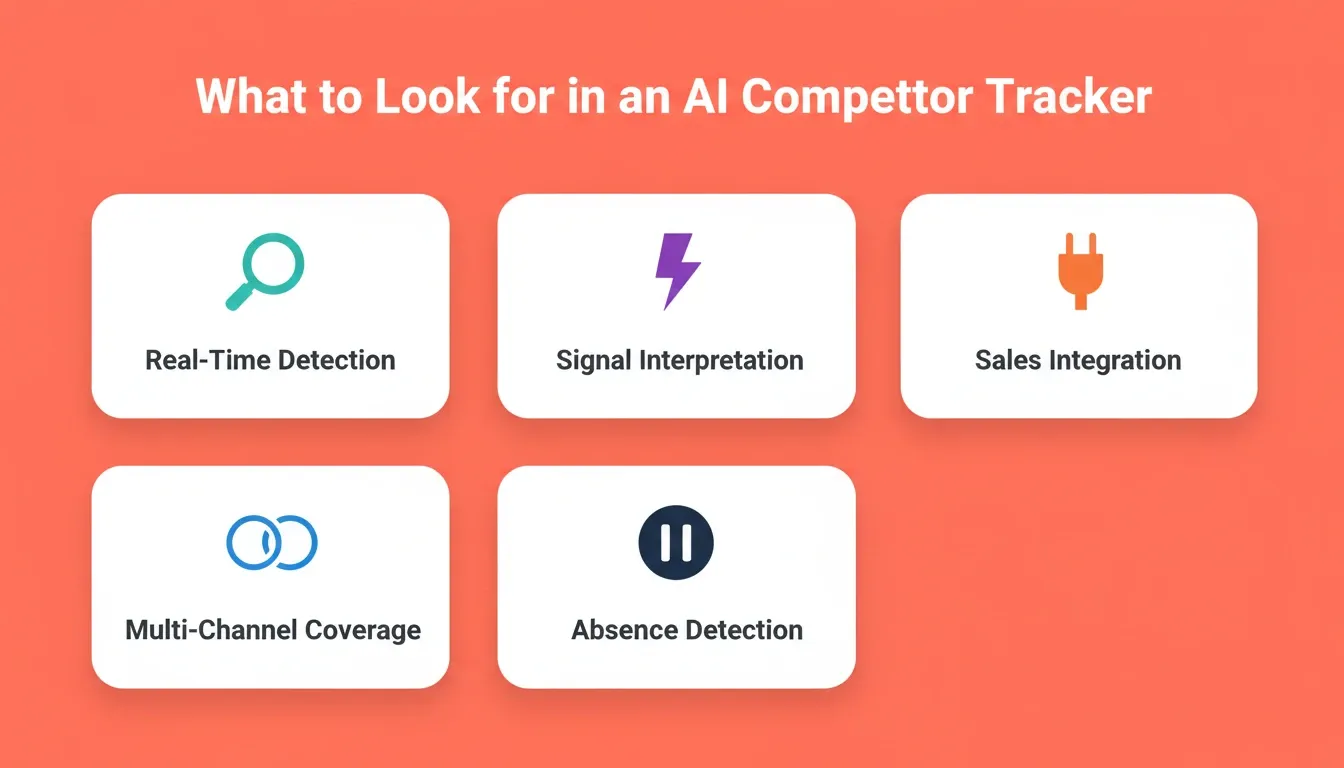
Five criteria that separate a useful AI Competitor Tracker from a dashboard nobody opens
AI Competitor Tracker: Feature Comparison at a Glance
| Feature | Crayon | Klue | Semrush | Similarweb | Rocket Intelligence |
|---|---|---|---|---|---|
| Website change detection | Yes | Limited | No | No | Yes |
| Social media monitoring | Limited | Limited | Limited | No | Yes |
| Review sentiment tracking | No | No | No | No | Yes |
| Ad monitoring | No | No | Yes (PPC) | Yes (Display) | Yes |
| AI-generated briefs | Yes | Yes | No | No | Yes |
| Sales enablement / battlecards | Yes | Yes | No | No | Coming soon |
| SEO / backlink analysis | No | No | Yes | Limited | No |
| Traffic estimates | No | No | Yes | Yes | Yes |
| Win-loss analysis | No | Yes | No | No | No |
| Hiring / people signals | Limited | No | No | No | Yes |
| News and media monitoring | Limited | No | No | No | Yes |
| GTM / pricing signals | Limited | Limited | Limited | No | Yes |
| Business and finance signals | No | No | No | No | Yes |
| Absence detection | No | No | No | No | Yes |
| Built-in research and build | No | No | No | No | Yes |
| Free to start | No | No | Limited | Limited | Yes |
Crayon: Website Change Detection and Sales Enablement
Crayon is a competitive intelligence platform focused on tracking changes on competitors' websites and distributing insights to sales enablement teams.
Crayon excels at website change detection. It automatically captures updates to competitor pricing pages, homepage messaging, product pages, and feature lists. The platform uses AI to summarize what changed, why it matters, and what sales teams should do about it. Competitor activity feeds generate daily or weekly briefs, keeping sales reps current without manual research.
Battlecards, talk tracks, and competitive content tools push directly into Salesforce, Slack, and other sales workflows. Crayon also monitors job postings, review sites, and news alongside website changes, giving sales teams a fuller picture before competitive deals.
Where it falls short: Crayon offers limited data on competitor traffic, backlink analysis, and search marketing. It does not cover hiring velocity, business and finance signals, or cross-platform advertising in depth. Custom pricing means smaller teams may find it out of reach without requesting a demo, and there is no free tier.
Best for: Mid-market to enterprise organizations whose primary use case is feeding competitor data directly into sales conversations. Teams that also need SEO or advertising intelligence will likely need additional tools alongside it.
Klue: Win-Loss Analysis and Competitive Research
Klue positions itself as a competitive intelligence platform focused on win-loss analysis combined with competitor research and sales enablement.
Klue connects CRM data to competitive outcomes. It helps teams understand which competitors appear in which deals and why opportunities are won or lost. The platform creates and updates battlecards based on competitor insights gathered from public sources, internal knowledge, and buyer feedback.
Product marketing teams use Klue to track competitor messaging shifts, product launches, and structured competitive research across industries. Revenue attribution is a notable strength: sales teams can connect competitive intelligence directly to revenue impact through win rate analysis and deal outcome tracking.
Where it falls short: Klue focuses heavily on the sales cycle. It does not offer deep SEO intelligence, traffic analysis, or automated competitor website monitoring at the same depth as dedicated tools. Coverage of hiring signals, social media activity, and advertising intelligence is also limited. Pricing is enterprise-focused and not accessible for startups or small teams.
Best for: Marketing teams and sales organizations at growth-stage companies where understanding why you win or lose deals matters more than tracking every competitor website change in real time.
Semrush: SEO Intelligence and Traffic Analysis
Semrush started as an SEO tool and has grown into a digital marketing platform with significant competitive analysis capabilities built on search marketing data.
Semrush provides deep keyword and backlink analysis for tracking competitor keyword rankings, backlink profiles, and organic traffic estimates across any competitor domain. You can analyze traffic sources, bounce rates, engagement metrics, and geographic distribution. PPC intelligence lets you monitor competitor ad spend, ad copy variations, and keyword targeting across Google Ads.
Content gap analysis identifies keyword opportunities where competitors rank but you do not. It also surfaces which content strategies resonate with shared audiences. Years of indexed data make historical trend analysis more reliable than newer platforms.
Where it falls short: Semrush is primarily an SEO and search marketing tool. It does not track competitor pricing pages for content changes, monitor social media in depth, or provide sales enablement features like battlecards. There are no hiring signals, review sentiment monitoring, or advertising creative intelligence beyond PPC. It surfaces data but leaves analysis to the user.
Best for: Digital marketers and SEO teams focused on search visibility, organic traffic, and paid advertising performance. It is not designed for the broader competitive intelligence that sales teams or product managers need.
Similarweb: Traffic Estimates and Market Positioning
Similarweb is a competitive intelligence platform focused on website traffic analysis, audience insights, and digital market positioning across industries.
Similarweb provides traffic estimates, referral sources, and engagement metrics for virtually any competitor website without requiring data access or installed tracking. You can compare market share against competitors within specific industries, identify market trends, and discover emerging competitors gaining ground. For companies competing in mobile, Similarweb tracks app downloads, usage patterns, and competitor app performance.
Industry benchmarking is a genuine differentiator. It is useful for understanding your relative position in a market category, not just head-to-head comparisons. No other tool on this list matches it for that specific use case.
Where it falls short: Traffic estimates carry inherent accuracy limitations compared to first-party analytics. The platform does not monitor competitor content changes, pricing updates, messaging pivots, or hiring signals. There is no AI-generated brief or interpretation layer — you get data, not decisions. Enterprise plans with full data access require custom pricing.
Best for: Marketing intelligence teams at enterprise organizations who need competitive research based on traffic patterns, market trends, and audience behavior rather than real-time competitor monitoring signals.
Competitors App: Real-Time Monitoring and Social Tracking
Competitors App is a dedicated AI Competitor Tracker focused on ongoing monitoring of competitor websites and social media activity for small teams and startups.
The platform tracks competitor website updates — including pricing pages, product launches, and homepage messaging changes — with screenshot comparisons. It monitors competitor posts across social platforms, tracking engagement rates and content strategies. Email and newsletter tracking captures competitor campaigns, giving marketing teams visibility into messaging frequency and content themes.
Affordable entry point is its clearest advantage. Unlike enterprise-priced platforms, Competitors App offers accessible pricing for startups beginning their competitive intelligence programs. Setup is straightforward, so teams can start monitoring quickly without a lengthy onboarding process.
Where it falls short: AI capabilities are limited compared to enterprise-grade platforms. Analysis relies more on raw monitoring than interpreted recommendations. There are no hiring signals, business and finance intelligence, or advertising creative monitoring. Reporting depth is basic, and there is no integration with sales workflows or product planning.
Best for: Small teams and individual users who need basic competitor monitoring without the complexity or cost of enterprise software.
Competitors App Pricing
| Plan | Monthly Price | Annual Price (per month) | Competitors Tracked |
|---|---|---|---|
| Starter | $19 | $15 | Up to 3 |
| Basic | $39 | $29 | Up to 10 |
| Professional | $89 | $69 | Up to 20 |
| Enterprise | Custom | Custom | Unlimited |
Why Rocket Intelligence Replaces Your Entire CI Stack
Most competitor analysis tools solve one piece of the puzzle. One tracks websites. Another handles SEO. A third covers social monitoring. Before long, your team is juggling four or five tools, spending hours switching between dashboards and manually connecting dots that should connect themselves.
Rocket Intelligence takes a different approach. Rather than monitoring one channel, it watches companies across nine signal pillars simultaneously and interprets what those signals mean for your business specifically.
The Nine Signal Pillars
Rocket Intelligence monitors every company you follow across nine distinct data pillars, automatically, from the moment you add them:
-
Website Intelligence — tech stack changes, copy updates, pricing page diffs, new product pages
-
Social Media — positioning shifts, executive voice, content themes, engagement patterns
-
News and Media — press coverage, partnership announcements, media mentions
-
GTM (Go-to-Market) — pricing changes, packaging updates, sales motion signals
-
Product and Technology — feature launches, changelog activity, roadmap signals
-
People and Hiring — leadership changes, hiring velocity, department growth, key exits
-
Business and Finance — funding rounds, revenue signals, partnership activity
-
Reviews and Community — G2 ratings, app store sentiment, community forum activity
-
Traffic — growth, decline, and channel mix shifts across competitor web properties
No other AI Competitor Tracker on this list covers all nine. Most cover two or three. To understand how these signals connect to specific decisions, see how Rocket Intelligence informs pricing decisions.
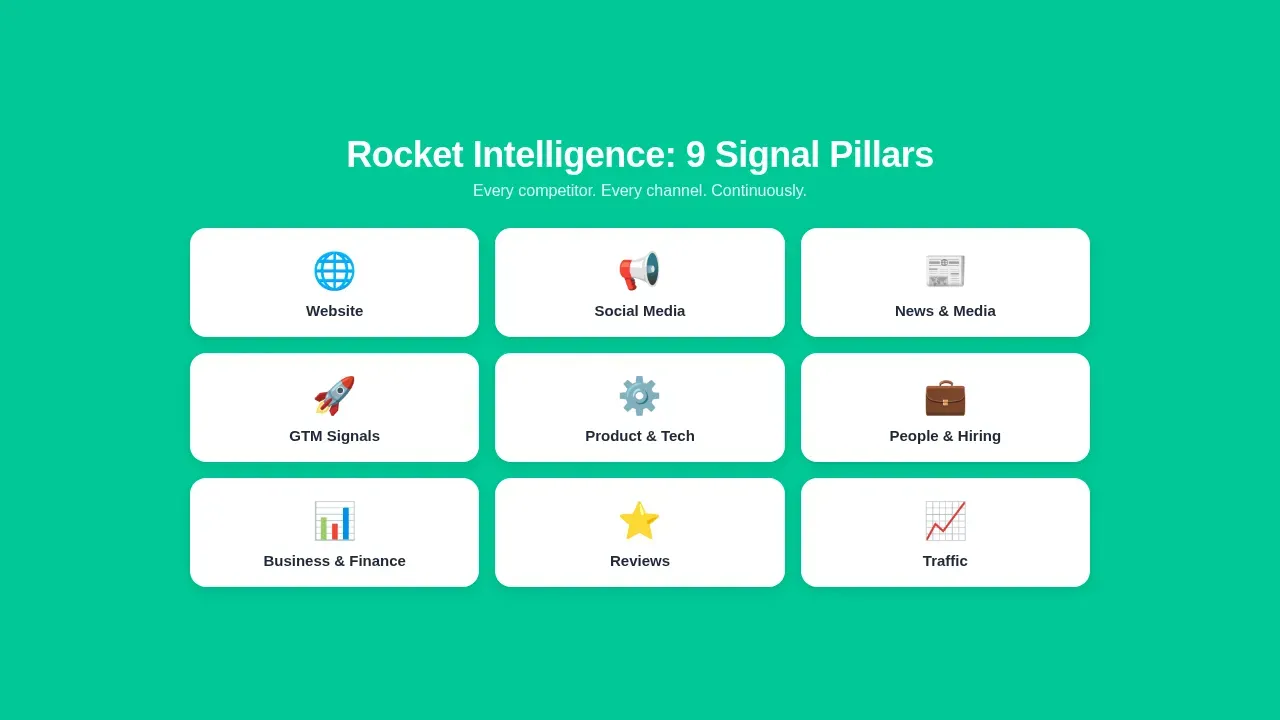
Rocket Intelligence monitors nine signal pillars for every company you follow, automatically, from day one
Intel Cards: Not Alerts, Interpretations
Every signal Rocket surfaces is packaged as an Intel Card. Each card includes what happened, what it means for your business, and a magnitude rating — High, Medium, or Low — so you know where to focus first.
This is the core difference between an alerting tool and an intelligence tool. A monitoring tool tells you a competitor changed their pricing page. An intelligence tool tells you what that change means for your next sales call.
Absence Detection: When Silence Is the Signal
One capability that separates Rocket Intelligence from every other tool on this list is absence detection. When a competitor that normally posts three times a week goes quiet, when a company that was hiring aggressively stops posting jobs, when a brand that ran ads every month suddenly disappears — Rocket flags that silence as a signal.
Absence can mean a strategic pivot, a funding crunch, an internal reorganization, or a product delay. Most monitoring tools only tell you when something happens. Rocket also tells you when something stops.
For a deeper look at how to read these signals, see why the best competitive intelligence is predictive.
Personalized by Role
Rocket Intelligence personalizes what surfaces in your feed based on your role. As a result, the same competitor signal reaches different people with different context:
-
Founders see market moves and strategic signals ranked first
-
Product managers see product launches, hiring implications, and feature signals
-
Sales leaders see pricing moves, positioning changes, and deal-relevant intelligence
-
Marketing leaders see messaging shifts, campaign themes, and content gaps
Watchlists: Intelligence Scoped to a Strategic Question
Instead of browsing individual company feeds, Rocket's Watchlist feature lets you define a strategic question — a "lens" — and receive Intel scoped specifically to answer it.
Examples of lenses teams use:
-
"Which competitors are expanding internationally this quarter?"
-
"Who is launching AI features in my market?"
-
"What pricing moves are happening across my competitive set?"
You can create unlimited Watchlists, each with its own lens, companies, and delivery frequency. Intel is delivered via email today, with WhatsApp and Slack delivery coming soon. For teams that want to extend this into social media competitive analysis, that channel is already covered within the Social Media pillar.
How Rocket Intelligence Compares to Standalone Tools
What sets Rocket apart from standalone tools is that Intelligence is one pillar of a three-pillar platform. The intelligence that surfaces a competitor pricing change on Monday can trigger a Solve research task on Tuesday and inform the landing page you ship on Wednesday. No exporting, no context switching, no manual work connecting disparate tools.
According to industry research, only 11.4% of companies employ dedicated competitive intelligence teams. Nearly 78.6% rely on professionals like product marketers who split their time between competitive research and other responsibilities. AI-powered tools bridge this gap by automating the collection and analysis that previously required full-time headcount.
Rocket Intelligence Pricing
| Plan | Pricing | Companies Tracked | Notes |
|---|---|---|---|
| Free | $0 | Up to 10 | Included in Rocket plan, no credit card required |
| Per competitor | $100/month (500 credits) | Per additional company | Billed via Stripe if over plan limit |
How AI Transforms Competitor Tracking Workflows
The shift from manual research to AI-powered competitive intelligence is not incremental. It represents a complete change in how organizations collect, process, and act on competitor data.
From nine data pillars through AI analysis and personalization to role-specific Intel Cards
Here is what that shift looks like in practice:
-
Speed of detection: AI tools process competitor website changes, social posts, and news mentions within hours. Manual research teams, by contrast, often discover changes days or even weeks later.
-
Cross-pillar intelligence: The most advanced AI competitor trackers correlate signals across multiple pillars. A hiring spike combined with a pricing page change and a new GTM post can reveal a product launch before it is announced.
-
Natural language summaries: Instead of raw data dumps, AI competitor analysis tools generate human-readable summaries. They explain what happened, why it matters, and what to do next.
-
Automated distribution: AI tools route insights directly to sales workflows, product managers, and marketing teams through existing channels. No manual report creation required.
The difference between finding out about a competitor's pricing change in hours versus weeks can determine whether your sales teams win or lose that quarter. Enterprise organizations that previously relied on quarterly competitive reports now receive real-time data every day.
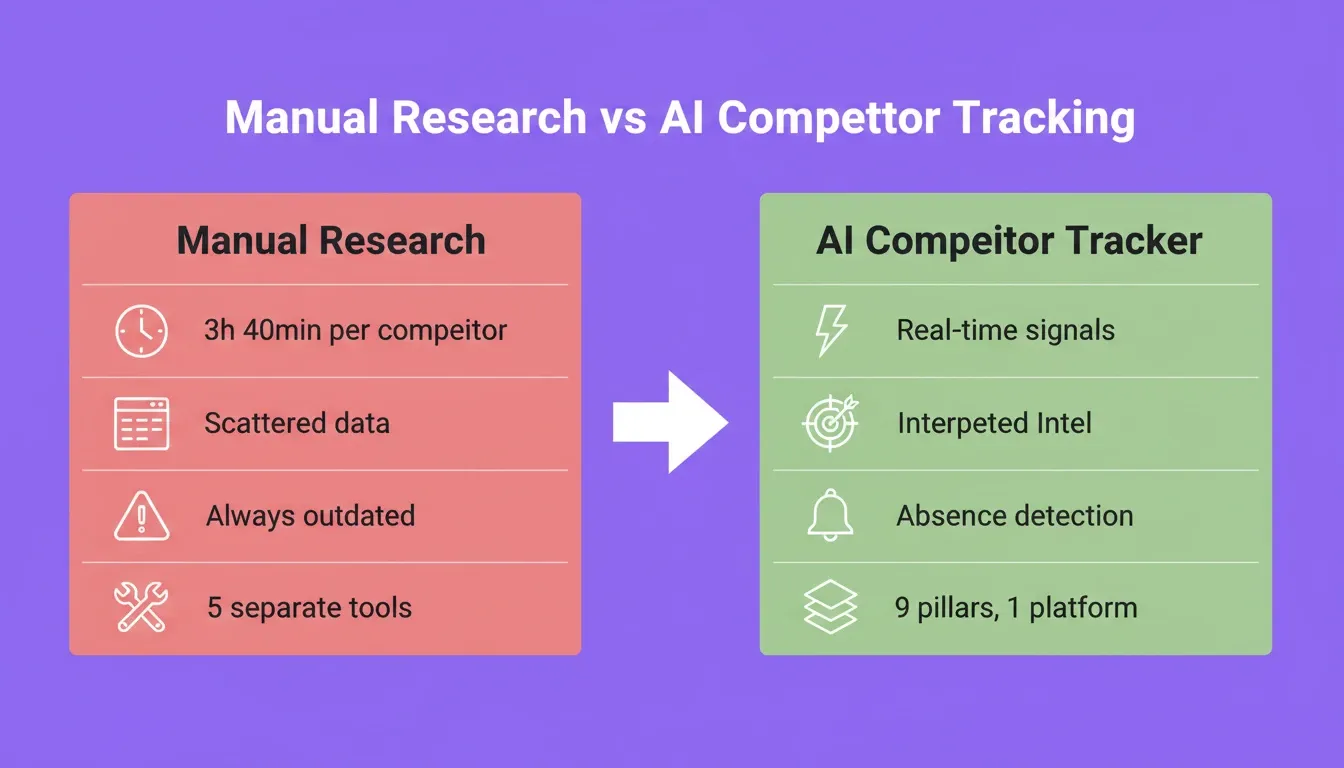
Manual research takes roughly 3 hours and 40 minutes per competitor per week. AI competitor trackers replace that with continuous, interpreted signals.
How to Choose the Right AI Competitor Tracker
Your primary use case determines which tool fits. Here is a practical starting point:
| Your primary need | Best starting point |
|---|---|
| Sales battlecards and deal prep | Crayon or Klue |
| SEO and paid search intelligence | Semrush |
| Traffic and market share analysis | Similarweb |
| Basic monitoring on a budget | Competitors App |
| Full-spectrum intelligence across all channels | Rocket Intelligence |
| Intelligence connected to research and building | Rocket Intelligence |
For a deeper comparison of how Rocket Intelligence differs from Crayon and Klue specifically, see Rocket vs Crayon vs Klue: Monitoring vs Decision Intelligence.
Getting started with Rocket Intelligence takes minutes:
-
Create a free account at Rocket.new — no credit card required
-
Complete the three-step setup wizard: enter your business URL, select your role, and follow your first companies
-
Rocket begins collecting signals across all nine pillars immediately
-
Your For You feed starts surfacing personalized Intel within hours
-
Create a Watchlist with a strategic question to get scoped intelligence delivered to your inbox
Intelligence is included in your Rocket plan at no additional credit cost. You can follow up to 10 companies across your account.
The Future of Competitive Intelligence Is Continuous
The competitive intelligence tools market is growing at 12.6% annually because quarterly reports and manual research can no longer keep pace with how fast markets move. The AI Competitor Tracker category is shifting from alerting to interpreting — from telling you what changed to telling you what it means and what to do next.
The five platforms reviewed here each serve a different part of that problem. The right choice depends on whether your primary need is SEO data, sales enablement, website monitoring, or full-spectrum competitor tracking. What every team shares is the same underlying need: faster signal, clearer meaning, less manual work.
Start monitoring your competitors today. Sign up for Rocket.new set up takes minutes, covers every public channel your competitors operate on, and delivers AI-interpreted Intel so your team always knows what changed and what to do next.
Table of contents
- -What Should You Look for in an AI Competitor Tracker?
- -AI Competitor Tracker: Feature Comparison at a Glance
- -Crayon: Website Change Detection and Sales Enablement
- -Klue: Win-Loss Analysis and Competitive Research
- -Semrush: SEO Intelligence and Traffic Analysis
- -Similarweb: Traffic Estimates and Market Positioning
- -Competitors App: Real-Time Monitoring and Social Tracking
- -Competitors App Pricing
- -Why Rocket Intelligence Replaces Your Entire CI Stack
- -The Nine Signal Pillars
- -Intel Cards: Not Alerts, Interpretations
- -Absence Detection: When Silence Is the Signal
- -Personalized by Role
- -Watchlists: Intelligence Scoped to a Strategic Question
- -How Rocket Intelligence Compares to Standalone Tools
- -Rocket Intelligence Pricing
- -How AI Transforms Competitor Tracking Workflows
- -How to Choose the Right AI Competitor Tracker
- -The Future of Competitive Intelligence Is Continuous