20 AI prompts organized across 6 GTM categories: market research, ICP validation, messaging, pricing, sales enablement, and channel strategy. Each prompt produces a structured deliverable. Chain them in order for a complete, research-backed go-to-market plan.
How long does it take your team to build a go-to-market plan from scratch?
For most companies, the answer is weeks of stakeholder debates, scattered spreadsheets, and recycled assumptions from last quarter's playbook.
That timeline is collapsing. Companies using AI in their GTM process achieve 5X revenue growth and 89% higher profits compared to those relying on traditional methods alone, according to ZoomInfo's 2026 GTM AI report. The difference is not just speed; it is the quality of thinking that goes into each decision before a single dollar gets spent.
This post breaks down 20 battle-tested prompts organized across six GTM categories. From TAM sizing to risk mitigation, each prompt is designed to extract structured, actionable strategy from AI tools you already have access to.
Before you start: Have these ready before running any prompt: your company name, a one-sentence product description, your primary ICP hypothesis, two or three competitor names, and your approximate budget range.
All 20 Prompts by Category
| Category | Prompts | Output |
|---|---|---|
| Market Research and TAM | 1 to 5 | Market sizing, competitor landscape, timing, pain points, adjacent markets |
| ICP and Buyer Intelligence | 6 to 10 | ICP scoring, personas, buying committee, anti-ICP, signal validation |
| Messaging and Positioning | 11, 12, 15 | Positioning statements, value prop stress test, messaging matrix |
| Pricing Strategy | 13 | Three pricing model options with structure, anchoring, and risks |
| Sales Enablement | 14 | Objection-response matrix by funnel stage |
| Channel Strategy and Launch | 16 to 20 | Channel ranking, 90-day plan, KPIs, budget allocation, risk register |
What Makes a Strong Prompt for GTM Strategy?
Not all prompts produce useful output. The difference between a generic response and a board-ready strategy section comes down to how you structure your request.
-
Role assignment matters. Start every prompt by telling the AI who to be. "Act as a VP of Growth with SaaS experience" produces sharper results than a bare question.
-
Context loading is non-negotiable. Feed your company details, funding stage, team size, and constraints before asking for strategy.
-
Specificity beats breadth. A prompt asking for "a complete go-to-market strategy" returns generic paragraphs. A prompt asking for "the top 3 industries by revenue potential for a B2B invoicing tool targeting SMBs in Southeast Asia" returns something you can act on.
-
Output formatting shapes usability. Requesting markdown tables, numbered lists, or MECE frameworks forces the model to organize its thinking rather than ramble.
-
Iterative chaining builds depth. The strongest GTM work comes from feeding the output of one prompt into the next.
With these principles locked in, the prompts that follow will make more sense. Each one is built for a specific stage of the go-to-market planning process and designed to chain into the next.
Category 1: Market Research and TAM
Market research sets the foundation for every decision that follows. These five prompts extract structured intelligence about your total addressable market, competitor positioning, and industry dynamics. Run them in order; each output sharpens the input for the next.
Before running these prompts, take time to validate your market assumptions so the inputs you feed each prompt reflect real signals rather than internal assumptions.
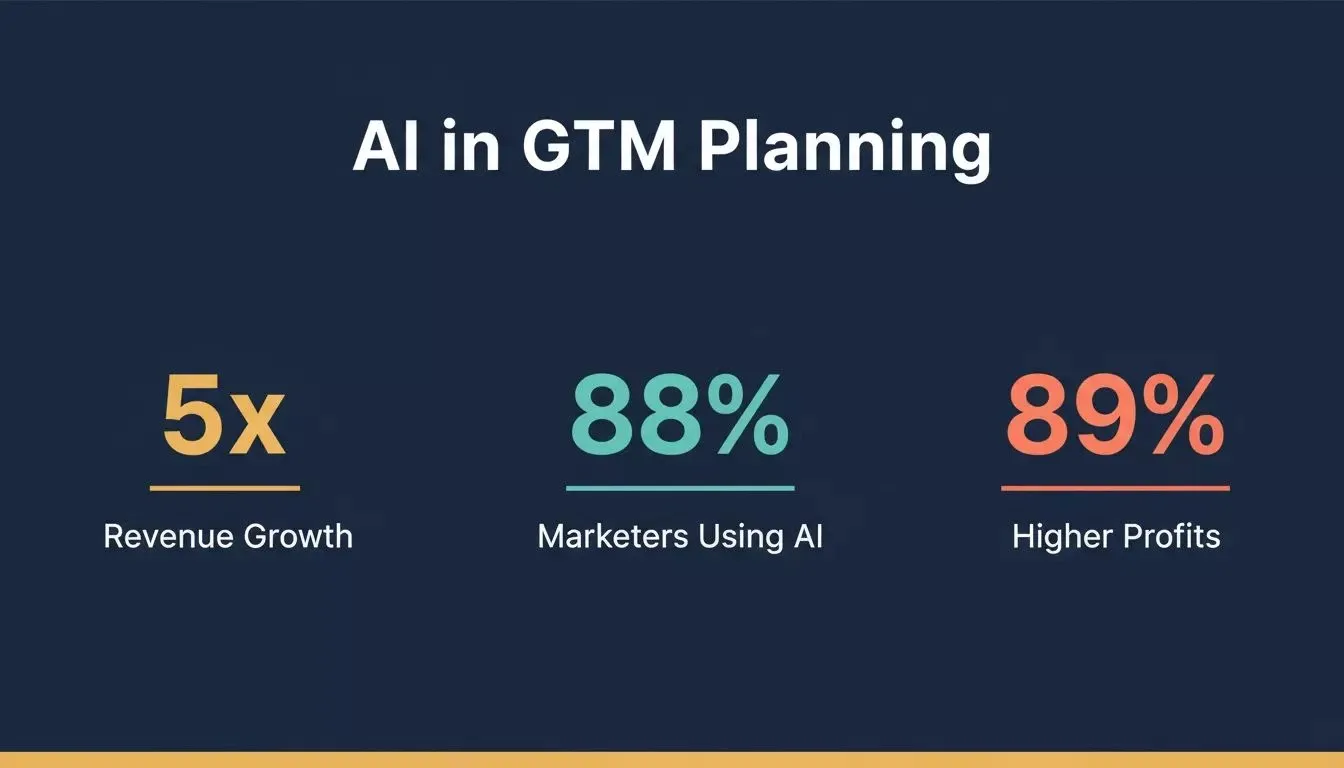
Key stats behind AI-driven GTM planning
Prompt 1: Total Addressable Market Mapping
"Act as a seasoned VP of Growth. Analyze [Company Name]'s product offering and map the Total Addressable Market by identifying the top 5 industries we can serve, their market size in USD, annual growth rate, and technology adoption maturity. Format the output as a markdown table sorted by opportunity score."
What it produces: A ranked market sizing table you can drop directly into a board deck or investor brief.
Prompt 2: Competitor Landscape Analysis
"You are a competitive intelligence analyst. For the [industry] space, identify the top 7 direct competitors to [Company Name]. For each, list their primary positioning, pricing model, estimated ARR range, key weakness, and one opportunity we could exploit. Present as a comparison table."
What it produces: A competitive matrix that surfaces differentiation gaps before you write a single positioning line.
Prompt 3: Market Timing Assessment
"Evaluate market readiness for [product description] in [target geography]. Consider the regulatory environment, buyer behavior trends, existing solutions, and switching costs. Rate market readiness from 1-10 and explain your reasoning for each factor."
What it produces: A readiness scorecard that tells you whether to accelerate, wait, or pivot entry geography.
Prompt 4: Industry Pain Point Discovery
"Research the top 10 operational pain points for [job title] at [company size] companies in [industry]. Rank them by severity and frequency. For each pain point, note whether existing solutions address it adequately or leave a gap we could fill."
What it produces: A priority-ranked pain point list that directly informs your messaging and ICP scoring.
Prompt 5: Adjacent Market Identification
"Based on [Company Name]'s core capabilities in [primary market], identify 3 adjacent markets where our technology or methodology could create value. For each, estimate market size, competitive density, and time-to-revenue. Recommend which to pursue first and why."
What it produces: An expansion opportunity brief with a clear first-move recommendation.
| Prompt | GTM Stage | Output Type | Decision It Informs |
|---|---|---|---|
| TAM Mapping | Discovery | Market sizing table | Where to compete |
| Competitor Analysis | Discovery | Comparison matrix | How to differentiate |
| Market Timing | Validation | Readiness scorecard | When to launch |
| Pain Point Research | Validation | Priority-ranked list | What messaging to use |
| Adjacent Markets | Expansion | Opportunity brief | Where to grow next |
Research from Heinz Marketing shows that 88% of marketers already use AI in planning, with the strongest results coming from those who pair it with strategic judgment rather than taking outputs at face value.
Category 2: ICP and Buyer Intelligence
After market research narrows the playing field, the next step is defining exactly who you are selling to. These five prompts validate your Ideal Customer Profile and map every persona involved in the buying decision.
Use a structured ICP guide with template alongside these prompts to ensure your scoring criteria are grounded in real customer data rather than assumptions.
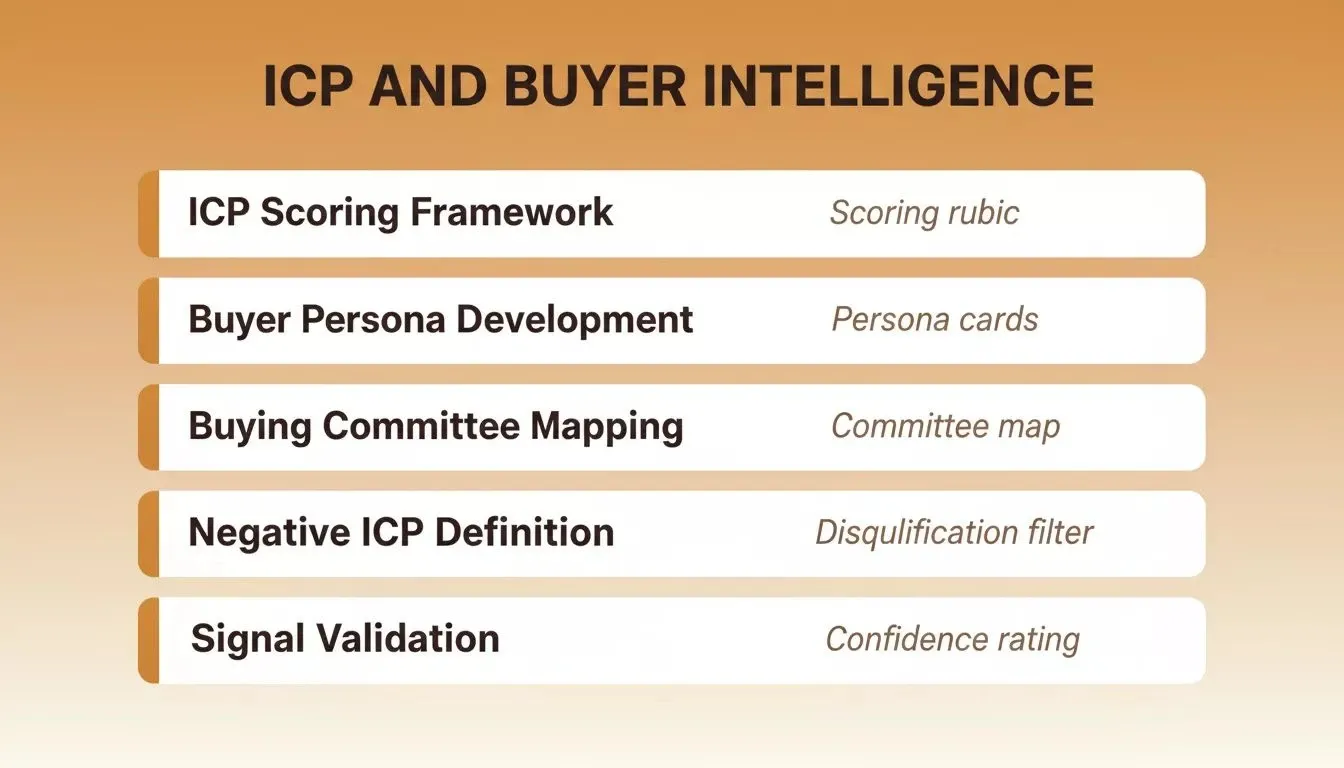
Five ICP and buyer intelligence prompts and the deliverables they produce
Prompt 6: ICP Scoring Framework
"Based on [Company Name]'s best-performing customers in the last 12 months, develop an Ideal Customer Profile scoring framework. Include firmographic criteria (industry, company size, revenue, geography), technographic signals (current tools, tech maturity), and behavioral indicators (hiring patterns, funding events). Score each criterion by predictive strength."
What it produces: A weighted ICP rubric your sales team can use to qualify leads in under five minutes.
Prompt 7: Buyer Persona Development
"For our ICP of [description], identify the 3 key personas involved in the buying decision. For each persona, outline their job title, daily responsibilities, top 3 pain points, success metrics, preferred content formats, and the objections they are most likely to raise during evaluation."
What it produces: Three persona cards that feed directly into your messaging matrix and content calendar.
Prompt 8: Buying Committee Mapping
"Map the typical buying committee for a [deal size] purchase of [product category] at a [company size] organization. Identify the champion, economic buyer, technical evaluator, and blocker. For each role, describe what they care about and how to win their support."
What it produces: A committee map that tells your AEs exactly who to engage at each deal stage.
Prompt 9: Negative ICP Definition
"Define our anti-ICP: the customer profiles we should actively avoid targeting. Based on [Company Name]'s churn data showing [churn characteristics], identify the 5 firmographic and behavioral signals that predict poor fit. Explain why each signal matters and how to filter them out of prospecting lists."
What it produces: A disqualification filter that protects pipeline quality and reduces churn before it starts.
Prompt 10: ICP Validation Through Signal Analysis
"Using intent signals and hiring data, validate whether [target ICP segment] is actively seeking solutions like ours. Look for signals including job postings mentioning [relevant keywords], content consumption patterns, technology adoption events, and competitive tool evaluations. Rate confidence level and suggest next steps."
What it produces: A confidence-rated validation that tells you whether your ICP hypothesis is backed by real market behavior.
Category 3: Messaging and Positioning
With your market defined and ICPs validated, these prompts focus on what you say and how you say it. This is where most GTM plans either click or collapse; generic language kills conversion before a prospect ever reaches sales.
A well-structured value proposition canvas can sharpen your inputs for Prompts 11 and 12, ensuring your positioning is grounded in real customer jobs-to-be-done rather than internal assumptions.
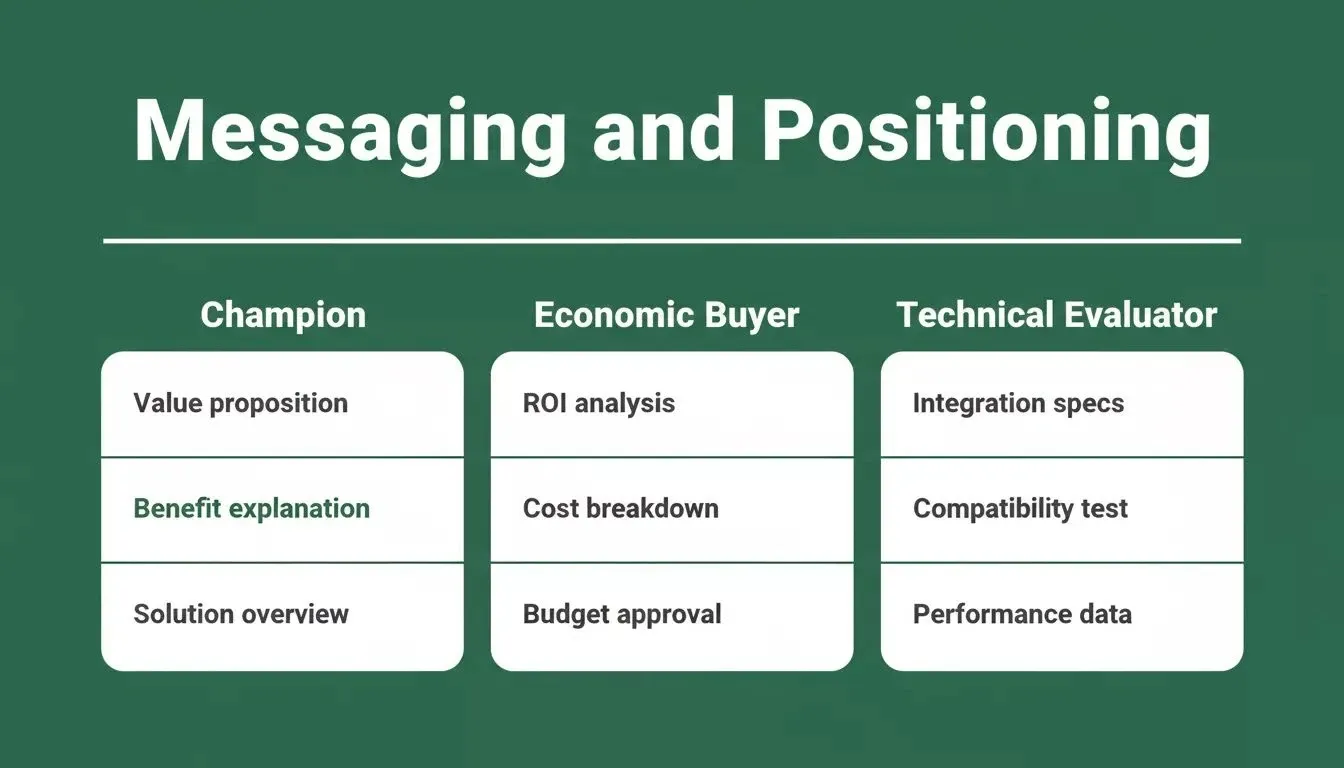
The messaging matrix structure, Prompt 15, produces
Prompt 11: Positioning Statement Generator
"Create 3 positioning statement variations for [Company Name] targeting [ICP]. Use the format: For [target customer] who [situation/need], [product] is a [category] that [key benefit]. Unlike [primary competitor], we [key differentiator]. Rank them by clarity and defensibility."
What it produces: Three positioning variants ranked by strength, run Prompt 12 on the winner to stress-test it.
Prompt 12: Value Proposition Stress Test
"Take this value proposition: [insert current value prop]. Stress-test it against our top 3 competitors. Where is it strongest? Where is it weakest? Suggest 2 refined versions that address the weaknesses while maintaining the core truth of what we deliver."
What it produces: A battle-tested value proposition with documented weak points addressed before they surface in sales calls.
Prompt 15: Messaging Framework by Persona
"Build a messaging matrix for [Company Name] with columns for each buyer persona (Champion, Economic Buyer, Technical Evaluator) and rows for each funnel stage (Awareness, Consideration, Decision). In each cell, write the primary message and the proof point that supports it."
What it produces: A complete messaging matrix your content, demand gen, and sales teams can all pull from.
Pairing strong prompt engineering best practices with these GTM-specific templates produces positioning that holds up under competitive scrutiny.
Category 4: Pricing Strategy
Pricing is the most consequential GTM decision most teams make too quickly. This prompt forces a structured comparison of models before you commit to one.
Understanding how competitor pricing signals strategic intent gives you the context to make Prompt 13 outputs more defensible and market-aware.
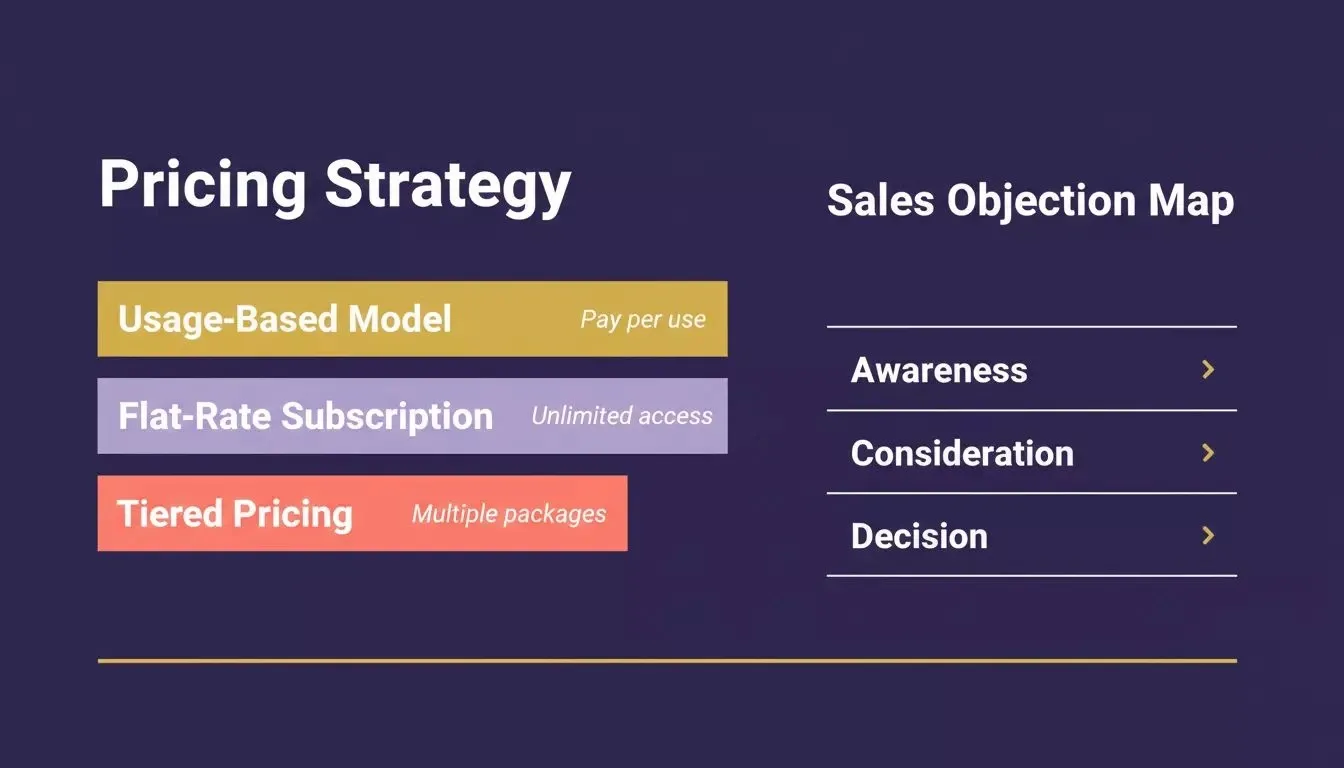
Pricing model options and the objection map structure these prompts produce
Prompt 13: Pricing Model Exploration
"Propose 3 pricing models for [product] targeting [ICP] at [ACV range]. For each model, outline the structure, psychological anchoring strategy, expansion triggers, and risks. Consider what competitors charge and what buyers in this segment expect to pay. Include a recommendation with reasoning."
What it produces: Three fully structured pricing options with expansion mechanics, risk flags, and a recommended starting point, enough to run a pricing committee meeting without additional research.
"AI does 90% of our initial GTM strategy formulation all in just these 6 prompts. This has been a MASSIVE unlock for speed to winning GTM for our diverse client base." — Christian Plascencia on LinkedIn (940+ reactions)
Category 5: Sales Enablement
Positioning and pricing only convert if your sales team can handle the objections that come back. This prompt maps every likely pushback before your first rep gets on a call.
Prompt 14: Sales Objection Mapping
"For our product [description] sold to [buyer persona], list the 10 most likely sales objections organized by funnel stage (awareness, consideration, decision). For each objection, write a 2-sentence response that acknowledges the concern and redirects to our strength."
What it produces: A 10-objection response matrix organized by funnel stage, paste it directly into your sales playbook or onboarding materials.
Category 6: Channel Strategy and Launch
A brilliant strategy means nothing without a clear path to market. These five prompts cover the full operational layer: which channels to use, how to sequence your launch, what to measure, how to allocate budget, and where the plan is most likely to break.
Tracking the right leading indicators before launch gives you the benchmarks Prompt 18 needs to produce meaningful red/yellow/green thresholds rather than generic industry averages.
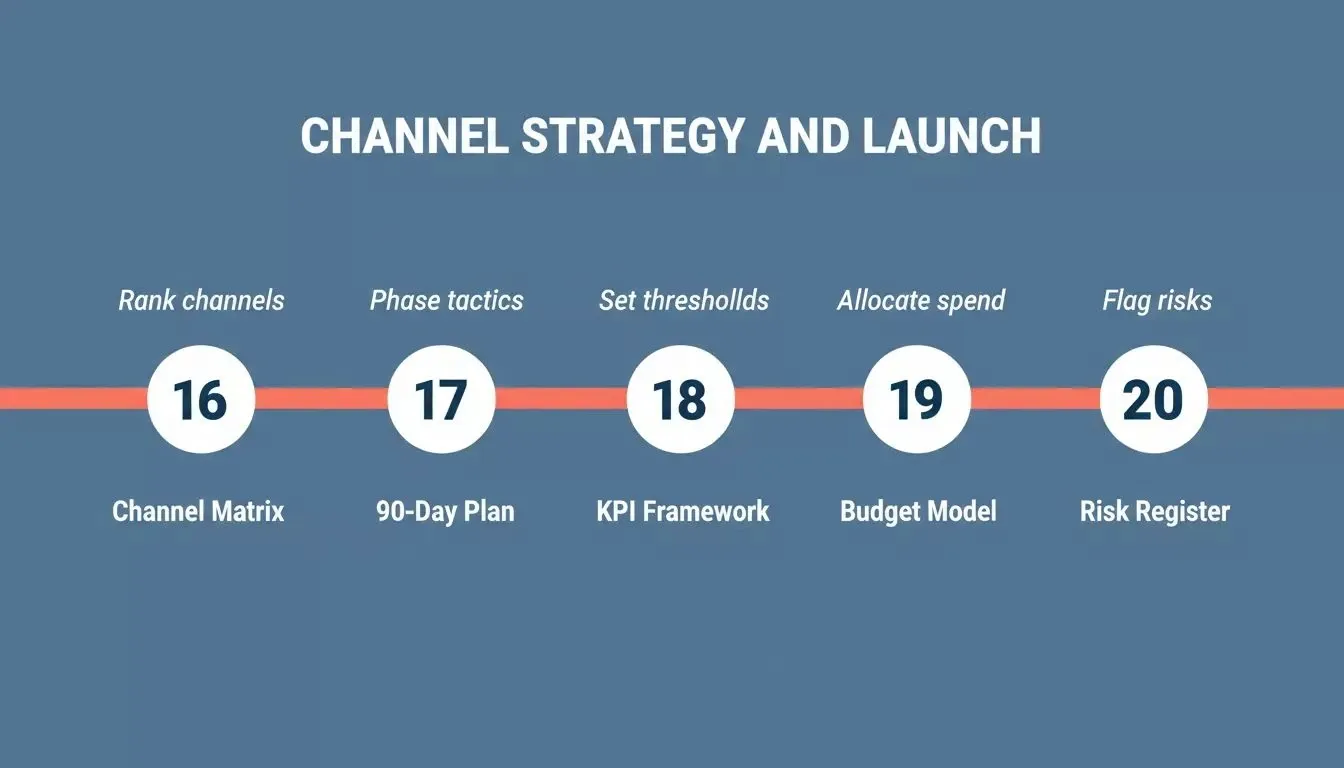
The five Channel Strategy and Launch prompts, and what each one produces
Prompt 16: Channel Prioritization Matrix
"For [Company Name] targeting [ICP] with a [budget range] marketing budget and a team of [size], recommend the top 5 go-to-market channels. For each channel, estimate cost per lead, time to first results, scalability ceiling, and fit with our ICP's buying behavior. Rank by ROI potential."
What it produces: A ranked channel list with cost, timeline, and ceiling estimates, enough to make a budget allocation decision without a media agency.
Prompt 17: 90-Day Launch Sequence
"Create a 90-day launch plan for [product] entering [market]. Break it into 3 phases: Pre-launch (awareness building), Launch (conversion activation), and Post-launch (feedback and optimization). For each phase, list specific tactics, responsible roles, success metrics, and dependencies on prior phases.”
What it produces: A phased 90-day plan with owners, metrics, and dependencies — ready to drop into a project management tool.
Prompt 18: KPI Framework Design
"Design a KPI dashboard for tracking our go-to-market performance across marketing, sales, and product. Include leading indicators (pipeline creation rate, content engagement, trial activations) and lagging indicators (revenue, CAC, LTV). For each KPI, set a benchmark based on [industry] averages and define the red/yellow/green thresholds."
What it produces: A complete KPI spec with thresholds; hand it to your analytics team or use it to configure a dashboard directly.
Prompt 19: Budget Allocation Model
"Given a total GTM budget of [amount] for Q1, recommend the allocation across paid acquisition, content marketing, events, partnerships, and sales enablement. Base recommendations on our ICP [description], average deal size [amount], and target of [number] customers in the first quarter. Show expected ROI per channel."
What it produces: A budget breakdown with per-channel ROI projections, built from your actual ICP and deal size, not industry averages.
Prompt 20: Risk Mitigation Playbook
"Identify the top 5 risks that could derail our go-to-market launch for [product] in [market]. For each risk, assign a probability (high/medium/low), potential impact, early warning signal, and a specific mitigation action. Format as a risk register with owners and review dates."
What it produces: A five-row risk register with early warning signals and mitigation owners, the document most teams wish they had written before launch.
How Rocket Turns a Single Conversation Into a Complete GTM Strategy
Individual prompts produce individual answers. But a real go-to-market strategy requires all six categories connected: market research flowing into ICP, ICP flowing into messaging, messaging flowing into channel selection. Most teams spend weeks stitching these outputs together manually.
Rocket is a vibe solutioning platform with three interconnected capabilities: Solve for structured research and decision intelligence, Build for production-ready apps and landing pages, and Intelligence for continuous competitive monitoring. Instead of running 20 separate prompts across multiple sessions, you describe your product, market, and constraints in a single Solve task. Rocket then produces a complete, structured go-to-market report covering every dimension: market sizing, competitive landscape, ICP validation, positioning, channel recommendations, pricing models, and launch timelines.
Cross-task context makes this possible. Reference any previous Solve task in a new one using @-mentions and Rocket picks up exactly where the thinking left off. The PRD generated by Solve is present when you open the Build task. The competitive brief is present when the landing page is written. Every task makes the next one smarter.
Where standalone AI tools give you fragments, Rocket gives you the system:
-
Solve runs structured market analysis, competitive teardowns, pricing strategy, and ICP validation, each as a structured, evidence-backed report with an executive summary, supporting data, and actionable recommendations
-
Intelligence tracks competitors continuously across nine signal pillars, including People and Hiring (hiring velocity, functions, seniority, leadership moves, and team growth patterns) and Product and Technology (release velocity, feature analysis, API changes, and tech stack evolution)
-
Build turns those plans into live tools: KPI dashboards, campaign pages, and internal portals for team alignment
Traditional prompt-by-prompt workflows require you to be the integration layer. You copy-paste between sessions, re-explain context, and manually connect insights. Rocket eliminates that coordination tax.
Your GTM Strategy Starts With the Right Question
The gap between companies that launch successfully and those that stall is rarely about the product itself. It is about the quality of thinking that happens before the first campaign goes live. These 20 prompts, organized across six categories, give your team a structured path from raw market data to a launch-ready plan, compressing weeks of manual work into focused AI sessions.
The prompts work best when they chain together category by category, each output feeding the next with increasing specificity. For teams that want the entire chain handled in a single conversation with connected context and automatic intelligence, the fastest path is to start at the platform level rather than the prompt level.
Rocket is the only platform that connects market research, competitive intelligence, ICP validation, and product building in one continuous workflow. Start free, no credit card needed.
Start building on Rocket.new and compress your go-to-market timeline from weeks to hours.
Table of contents
- -All 20 Prompts by Category
- -What Makes a Strong Prompt for GTM Strategy?
- -Category 1: Market Research and TAM
- -Prompt 1: Total Addressable Market Mapping
- -Prompt 2: Competitor Landscape Analysis
- -Prompt 3: Market Timing Assessment
- -Prompt 4: Industry Pain Point Discovery
- -Prompt 5: Adjacent Market Identification
- -Category 2: ICP and Buyer Intelligence
- -Prompt 6: ICP Scoring Framework
- -Prompt 7: Buyer Persona Development
- -Prompt 8: Buying Committee Mapping
- -Prompt 9: Negative ICP Definition
- -Prompt 10: ICP Validation Through Signal Analysis
- -Category 3: Messaging and Positioning
- -Prompt 11: Positioning Statement Generator
- -Prompt 12: Value Proposition Stress Test
- -Prompt 15: Messaging Framework by Persona
- -Category 4: Pricing Strategy
- -Prompt 13: Pricing Model Exploration
- -Category 5: Sales Enablement
- -Prompt 14: Sales Objection Mapping
- -Category 6: Channel Strategy and Launch
- -Prompt 16: Channel Prioritization Matrix
- -Prompt 17: 90-Day Launch Sequence
- -Prompt 18: KPI Framework Design
- -Prompt 19: Budget Allocation Model
- -Prompt 20: Risk Mitigation Playbook
- -How Rocket Turns a Single Conversation Into a Complete GTM Strategy
- -Your GTM Strategy Starts With the Right Question