
Most product teams collect valuable signals but fail to turn them into roadmap decisions fast enough. Rocket.new transforms competitor tracking, customer feedback, and usage data into structured weekly briefs that guide product planning. By combining intelligence, research, and code generation in one workspace, teams can move from signal detection to shipped features within the same sprint.
What Happens When Product Signals Sit Unused?
What happens when the findings your team gathered five days ago never reach the roadmap session?
The plan gets made without them.
According to Pendo, 75% of product managers say information matters for their choices, but only 30% are satisfied with their access to it. That gap between collecting and acting is where priorities go wrong, features get mispriced, and competitors gain ground.
The real challenge for most product teams is not access to information. It is the speed at which findings become action.
The Shift from Quarterly Reports to Weekly Signals
Why Quarterly Cycles Are Too Slow
-
Most product teams operate on a quarterly planning model, running competitive research once every 90 days and treating it as finished.
-
A competitor can update their pricing page, launch a feature, or shift messaging in the time it takes to schedule that next review.
-
Real competitive signals come from continuous monitoring, not from one-time research sprints before a planning session.
-
By the time a quarterly report reaches the team, the context has already moved on. The team is solving the same task with outdated information.
What a Weekly Cadence Looks Like
-
Monday: the system surfaces what changed over the past weeks of competitor activity, filtered to only what you track.
-
Tuesday: everyone reads a structured brief with prioritized signals, not a raw data dump.
-
Wednesday: the roadmap session uses that brief as a starting point, not last quarter's model of the market.
-
Friday: new signals feed into next week's plan. The AI system resets and starts scanning for changes again.
This shift from periodic to continuous changes how a product team thinks about direction. The roadmap stops being a static document and becomes a model that responds to what the market does right now.
How Automated Monitors Handle the Heavy Lifting
Pulling Information Together from Multiple Sources
-
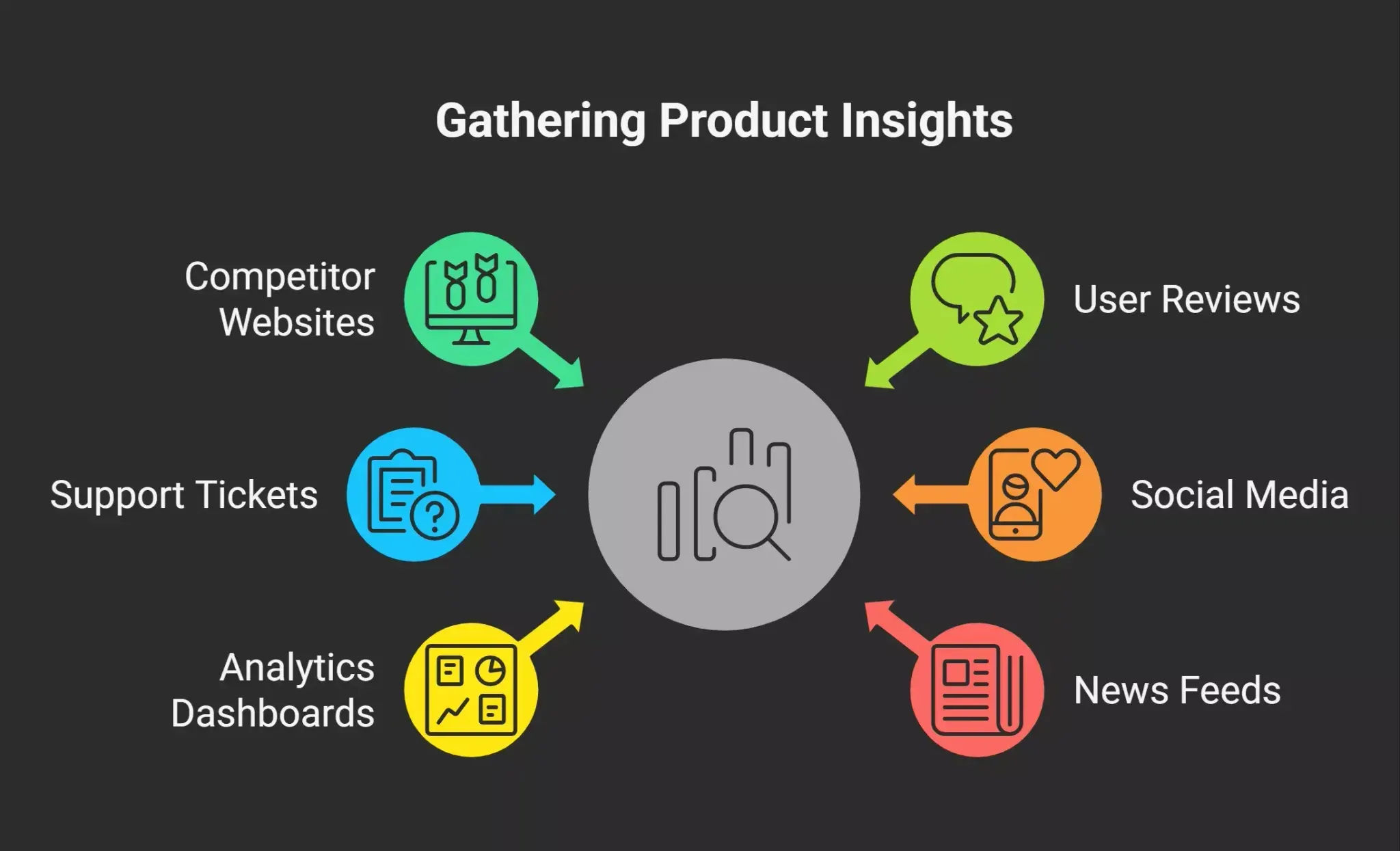
Product organizations pull findings from competitor websites, user reviews, support tickets, social media, analytics dashboards, and news feeds.
-
The problem is not access. It is structured. Ten tabs of raw data do not give you the background to plan.
-
Without AI tools doing the heavy lifting, someone has to spend hours each week reading competitor blogs, scanning landing pages, and summarizing tickets into a format the rest of the organization can use.
-
That person is usually a product manager who already has a full schedule, and the process is manual, repetitive, and easy to skip.
What AI Agents Do Differently
-
AI agents scan a competitor's website daily, flag changes to their pricing model or feature set, and compare those changes to the previous version.
-
They read user sentiment from multiple sources and find patterns that individual complaints miss.
-
They structure findings into a format you can act on without re-reading every source.
-
The result: everyone walks into a roadmap session with a full picture of what moved, what matters, and what to do.
Businesses using AI across their workflows report 25 to 30 percent productivity gains when they pair AI tools with end-to-end process redesign, according to the Bain Technology Report 2025. Data-driven organizations that ship the right feature at the right moment start with collecting data faster and getting it to the people making the plan.
| Signal Type | Without Automation | With Automated Monitoring |
|---|---|---|
| Competitor pricing model changes | Manual check, weekly at best | Detected within hours |
| User sentiment synthesis | PM reads tickets one by one | Patterns flagged automatically |
| Feature launch detection | Found randomly, maybe | Tracked across sources |
| Roadmap impact assessment | Discussed next quarter | Structured brief, same week |
Turning Last Week's Signals into This Week's Roadmap
Customer Feedback Patterns That Redirect the Plan
-
Customer feedback patterns are more valuable than individual support tickets. A single complaint about onboarding is noise. Forty complaints about the same onboarding step in two weeks is a signal.
-
Agents synthesize customer feedback from tickets, NPS surveys, and app reviews into a single view.
-
That view tells product managers where user pain is concentrated, which helps the roadmap plan shift toward features that solve problems users have right now.
Competitor Moves That Force a Direction Change
-
Last week's findings might show a competitor launched a feature you had scheduled for Q3.
-
Or the findings might show a competitor dropped a product line, opening a gap you can fill.
-
Companies that track competitor feature launches in real time can modify ongoing development cycles instead of waiting for the next planning session.
-
Rocket's Intelligence monitors these moves continuously and connects them to your existing project, so you never start the analysis from scratch.
Product Usage Metrics as a Leading Indicator
-
Product usage data shows which features users value and which they ignore.
-
A feature with declining engagement two weeks in a row is an early warning sign, not a footnote for the quarterly review.
-
Prompt engineering and prompt writing become more effective when your tools already have a background in recent decisions. When the system knows what was decided last week, the output quality is higher, and the workflow is faster.
-
Insights synthesized from the previous week help generate next steps without needing to reiterate business goals every session.
The Signals to Roadmap Workflow
Preparing the Background for the Call
-
Before a roadmap session, synthesize competitor signals, user input, and usage data into a structured document.
-
This document is not a decorative background slide or a passive summary. It answers: what changed, what matters, and what to do.
-
Without this step, the meeting becomes a conversation about opinions rather than evidence.
During the Session: Where Signals Meet the Plan
-
Review each signal and ask: Does this change our roadmap plan?
-
A competitor's pricing shift might not affect the current sprint, but it could change the positioning model for the next launch.
-
Findings about competitor marketing or messaging changes can influence adjustments in landing page copy and advertising strategies.
-
The point of the session is not to react to every signal. It is to identify the two or three that matter and adjust the plan on those.
After the Session: Updating the Project
-
The roadmap updates go into the project management system immediately.
-
New tasks get assigned. The workflow reflects the new plan.
-
The automation that collected last week's signals is already collecting this week's, so the cycle continues without anyone restarting it.
What People Are Saying
Marketing teams and product professionals are increasingly turning competitor findings into something they can use the same week.
"I'll really use that to get a general sense of the market landscape and of competitive trends and then hone in on specific use cases there." - Bryn Harrington, Product Marketing Lead at Ōura
That approach, starting broad and narrowing to specific use cases, matches what data-driven product organizations do with weekly signals. The moment is not about collecting everything. It is about focusing on what changes the plan.
How Rocket.new Turns Signals into Weekly Decisions
Rocket.new is the only vibe solutioning platform where market research, building, and competitor tracking live in one place. Most organizations juggle multiple tools for competitive intelligence, code generation, and roadmap planning.
The platform combines all three under one shared workspace, so a signal from last week flows directly into the task you create this week. Nothing gets lost between tools like standalone trackers and separate code editors. The operating model stays consistent because the memory of what was decided, and why, carries forward across every project.
The platform monitors competitors continuously and surfaces changes to a persistent dashboard. When a competitor shifts their positioning or launches a feature, you see it in a daily brief without running a manual search.
The architecture of the platform, with Solve, Build, and Intelligence sharing one workspace, means you work from one source of knowledge instead of stitching findings together from across multiple disconnected applications.
Here is what the platform includes:
-
Vibe solutioning platform that connects research, building, and competitor tracking
-
25,000+ templates library, free to use
-
Supports Flutter for mobile apps and Next.js for web apps
-
Collaboration features built in for organization-level workflows
-
3 Products, One platform: Solve (research and recommendations), Build (production-grade code), and Intelligence (continuous competitor monitoring)
Use Cases That Connect Signals to Action
-
A product team notices a competitor has just added a feature they had deprioritized. They open a Solve task to research how users responded, then move to Build to create their own version. No re-explaining the context to a different tool. The model of the problem carries forward.
-
A marketing group receives a daily brief showing that a competitor has changed their homepage messaging. They update their own landing page copy the same day using Build, with the competitive data already in the workspace.
-
A team lead prepares for the roadmap session by pulling structured findings from the dashboard. The plan updates during the meeting, and engineering picks up the new code tasks the next morning.
-
A product group uses the platform to track support tickets and user sentiment. When a pattern appears, they create a Solve task to validate the opportunity, then move to Build. The workflow stays inside one platform from planning to code deployment, giving every team member the ability to see the task data in context.
Making Signals the Starting Point for Every Roadmap Plan
The real advantage of weekly signals is speed. When competitor findings, user input, and product data reach the roadmap session the same week they are collected, the group stops guessing and starts building from evidence.
The future of roadmap planning is not quarterly research sprints. It is continuous monitoring, feeding directly into every sprint. That model of planning, where last week's findings shape this week's shipped code, turns a roadmap from a static wish list into a structure that responds to the market as it moves.
-
If your process runs slowly because signals sit in one tool while decisions happen in another, the platform eliminates that gap.
-
Start with the setup wizard. Add your competitors. The system handles the automation from there.
-
Your first brief arrives within 24 hours, and the signals it surfaces are already structured for your roadmap plan.
Visit Rocket.new, sign up, and start for free.
Table of contents
- -What Happens When Product Signals Sit Unused?
- -The Shift from Quarterly Reports to Weekly Signals
- -Why Quarterly Cycles Are Too Slow
- -What a Weekly Cadence Looks Like
- -How Automated Monitors Handle the Heavy Lifting
- -Pulling Information Together from Multiple Sources
- -What AI Agents Do Differently
- -Turning Last Week's Signals into This Week's Roadmap
- -Customer Feedback Patterns That Redirect the Plan
- -Competitor Moves That Force a Direction Change
- -Product Usage Metrics as a Leading Indicator
- -The Signals to Roadmap Workflow
- -Preparing the Background for the Call
- -During the Session: Where Signals Meet the Plan
- -After the Session: Updating the Project
- -What People Are Saying
- -How Rocket.new Turns Signals into Weekly Decisions
- -Use Cases That Connect Signals to Action
- -Making Signals the Starting Point for Every Roadmap Plan