
Rocket.new and Emergent both enable non-technical founders to build apps using AI, but their workflows differ significantly. Rocket.new offers a simpler, faster path with mobile support, visual editing, and predictable pricing. For founders who want to launch production-ready apps without coding, Rocket.new is the better choice.
What separates a vibe coding platform that helps you ship from one that leaves you stuck in a billing loop?
That is the real question. Not which one has more features on paper, but which one takes you from idea to live product without deep coding knowledge. According to a 2025 vibe coding survey, 44% of non-technical founders now build their prototypes using AI coding tools rather than hiring developers. The shift is real, and it is accelerating.
Rocket and Emergent.sh are two of the most discussed names in the vibe coding space. This breakdown directly compares mobile apps, web apps, backend logic, pricing, code quality, and what happens when something breaks mid-build.
The short answer: Rocket.new is the stronger choice for non-technical users who need production-ready apps fast.
What is Vibe Coding?
Vibe coding is how non-developers build working software now. You describe what you want using natural language, and the platform turns that into functional code. No environment setup. No boilerplate code. No syntax to learn.
The term came from AI researcher Andrej Karpathy in early 2025 and quickly entered the mainstream software development conversation. The vibe coding market is valued at $4.7 billion and is projected to reach $12.3 billion by 2027, growing at a 38% compound annual growth rate.
There are two main categories of vibe coding tools:
- Full-stack vibe coding platforms handle frontend, backend setup, data layer, hosting, and deployment end-to-end. You use natural language prompts and get a live app.
- AI-native code editors, on the other hand, assist developers already writing code and still require deep coding knowledge to operate effectively.
Rocket.new and Emergent are both full-stack vibe coding platforms. They approach the same problem very differently. Most vibe coding tools offer a free plan or free tier, allowing users to test before committing to paid plans.
Understanding the Two Platforms
Rocket.new
Rocket.new is an AI-powered vibe solutioning platform built for founders, small teams, and agencies who want production-ready apps without traditional coding. The platform helps users design and launch full-stack applications quickly using natural language. It is built around a simple four-step loop: describe, build, refine, and ship.
It reached $4.5M ARR and 400,000 users across 180 countries within three months of launch, backed by $15 million from Salesforce Ventures and Accel. Around 80% of users are building apps with real backend systems, not simple landing pages.
For non-technical users looking to move from idea to working software without manual coding, Rocket.new offers one of the most accessible on-ramps available today.
Emergent
Emergent is a full-stack, AI-powered vibe coding platform that generates complete web applications from natural language prompts. It uses specialized AI agents, Builder, Designer, Quality, and Deploy, working in parallel to generate and validate code.
The platform produces production-ready code in React, Next.js, and Node.js, includes GitHub sync, and aims to act as a CTO in a box for non-technical founders handling complex projects.
Feature Comparison
| Feature | Rocket.new | Emergent |
|---|---|---|
| Mobile apps (Flutter) | Yes | No |
| Web apps (Next.js) | Yes | Yes |
| Natural language prompts | Yes | Yes |
| GitHub sync | Yes | Yes |
| Custom domains | Included | Paid only |
| Visual drag-and-drop editor | Yes | No |
| Figma-to-code import | Yes | No |
| Code export | Yes | Yes |
| User authentication | Auto-generated | Auto-generated |
| Pricing model | Token-based | Credit-based |
| Free tier (no card required) | Yes | 10 credits only |
| Templates library | 25,000+ | Limited |
| Trustpilot score | 3.3 | 2.8 |
Key Features of Rocket.new
One Prompt. Full Stack. No Manual Coding Required.
Rocket.new converts a natural language description into a complete full-stack web application in one pass. You type what you want in plain English, and the platform generates the frontend, backend logic, database integration, and API endpoints together. No separate environment setup. No switching between multiple platforms. For non-developers, this means going from idea to functional code without writing a single line.
Mobile Apps and Web Apps from a Single Platform
Rocket.new generates Flutter for native iOS and Android builds and Next.js for web apps. One founder, one AI-powered platform, one prompt workflow covers both web and mobile apps in the same build session. This is a capability Emergent does not offer.
Founders who want to publish mobile apps to app stores must use a separate tool with Emergent, adding cost and complexity. With Rocket.new, that problem does not exist.
Figma-to-Code Conversion for Faster Prototyping
Rocket.new includes direct Figma plugin integration, making rapid prototyping significantly faster for teams with existing design assets. Designers and founders with visual mockups can import them directly and receive production-grade code back. The conversion handles responsiveness accurately without requiring the user to re-describe the design using natural language all over again. Emergent.sh has no Figma import feature.
Built-In Visual Editor for UI Components
Rocket.new includes a visual edit feature for adjusting UI components after generation. Founders move, resize, and modify elements directly without rewriting prompts or touching code. Emergent has no equivalent visual editor. Every interface change requires a new natural language prompt or a direct code edit, which slows iteration speed considerably for non-technical users.
Rocket Chat Editor: Build Your App in Plain Language
Rocket's built-in chat editor lets you describe changes in plain language and the AI writes production code instantly, updating your live preview after every message. No coding knowledge needed.
What you can do:
- Add pages, features, or components
- Adjust layouts, colors, and typography
- Fix bugs
- Connect integrations like Stripe, Supabase, or Resend
- Ask Rocket to explain or refactor existing code.
Attach images, PDFs, CSVs, or spreadsheets to give Rocket a visual reference, and use slash and @ commands on the web for faster, targeted edits across the full editor experience, including visual edit mode, version history, image generation, and direct code access.
25,000+ Templates with Up to 80% Token Savings
Rocket.new provides access to over 25,000+ Templates at no extra cost, covering landing pages, dashboards, mobile builds, internal tools, e-commerce setups, and full-stack web projects. Starting from a template instead of a blank prompt reduces token consumption and speeds up code generation dramatically. The platform saves up to 80% on tokens compared to other vibe coding tools, making cost efficiency a real advantage across all paid plans.
Real Code, Full Ownership, No Lock-In
Rocket.new gives you clean, human-readable, framework-standard code from the first build, whether that is React, Next.js, or Flutter, depending on project type. Code export works from day one. You can self-host, hand the project to a developer, or extend it outside the platform at any point without losing your work. Rocket.new also offers one-click database integration and connections to tools like Stripe, Supabase, and Google Sheets, so backend setup stays simple even as your product grows.
GitHub Sync and Version Control Built In
For small teams building software together, version control matters from the start. Rocket.new includes built-in GitHub sync that connects every project to a version control repository automatically. Teams track changes, revert builds, and collaborate on the same codebase without any separate setup. This is a feature most vibe coding tools either charge extra for or require manual configuration to enable.
AI Suggestions for SEO and UX
Beyond code generation, Rocket.new includes AI assistance for SEO tools and UX decisions directly in the build workflow. This means non-technical founders get AI-powered guidance on product decisions beyond just the codebase, helping them build complete web applications that are not just functional but also optimized for real users from day one.
Dedicated Support That Keeps Builds Moving
For non-developers who hit errors they cannot solve alone, responsive AI support keeps build moving. Several Trustpilot reviewers name the support team as the reason they stayed on Rocket after trying other AI coding tools. This kind of dedicated support is rare in the vibe coding space and matters most precisely when something goes wrong mid-build.
Where Emergent Falls Short
Emergent is a capable platform, particularly for technical teams who can navigate its architecture. But for non-technical founders, there are real friction points that add up fast.
- Credit-based pricing burns budgets quickly:
Every action, planning, coding, testing, and deploying consumes credits. The free tier gives only 10 credits, and deployment alone costs 50 credits per month. That means no live app on the free plan.
- Non-technical users consistently report credits running out before meaningful features ship:
This makes cost efficiency unpredictable and frustrating for founders without a technical background to debug failures efficiently.
- No mobile app support :
Emergent does not support Flutter or native mobile output. Founders who want to publish to app stores must use a separate platform, adding cost and complexity that Rocket.new eliminates entirely.
- No visual editor or Figma import:
Every interface change requires a new prompt or a direct code edit. For non-developers, this adds friction at every iteration cycle and slows down the path to working software.
- Python-only backend:
Emergent runs its backend in Python exclusively, which limits hiring flexibility and compatibility with standard frontend tooling used in most web applications today.
Stability issues cost money. Some users report build failures and prompt-response inconsistencies. When builds fail, credits are still consumed. For non-technical users who cannot quickly diagnose failures, debugging becomes a direct financial cost. Several reviews also flag inconsistent AI support and delayed responses to billing issues, which compounds the problem when users are already stuck.
Why Rocket.new Wins for Non-Technical Founders
Rocket.new is built for the workflow a non-technical founder actually uses. You describe what the app should do in plain language, and Rocket.new handles the full stack from there. No juggling coding assistants. No multiple platforms. No complex backend setup.
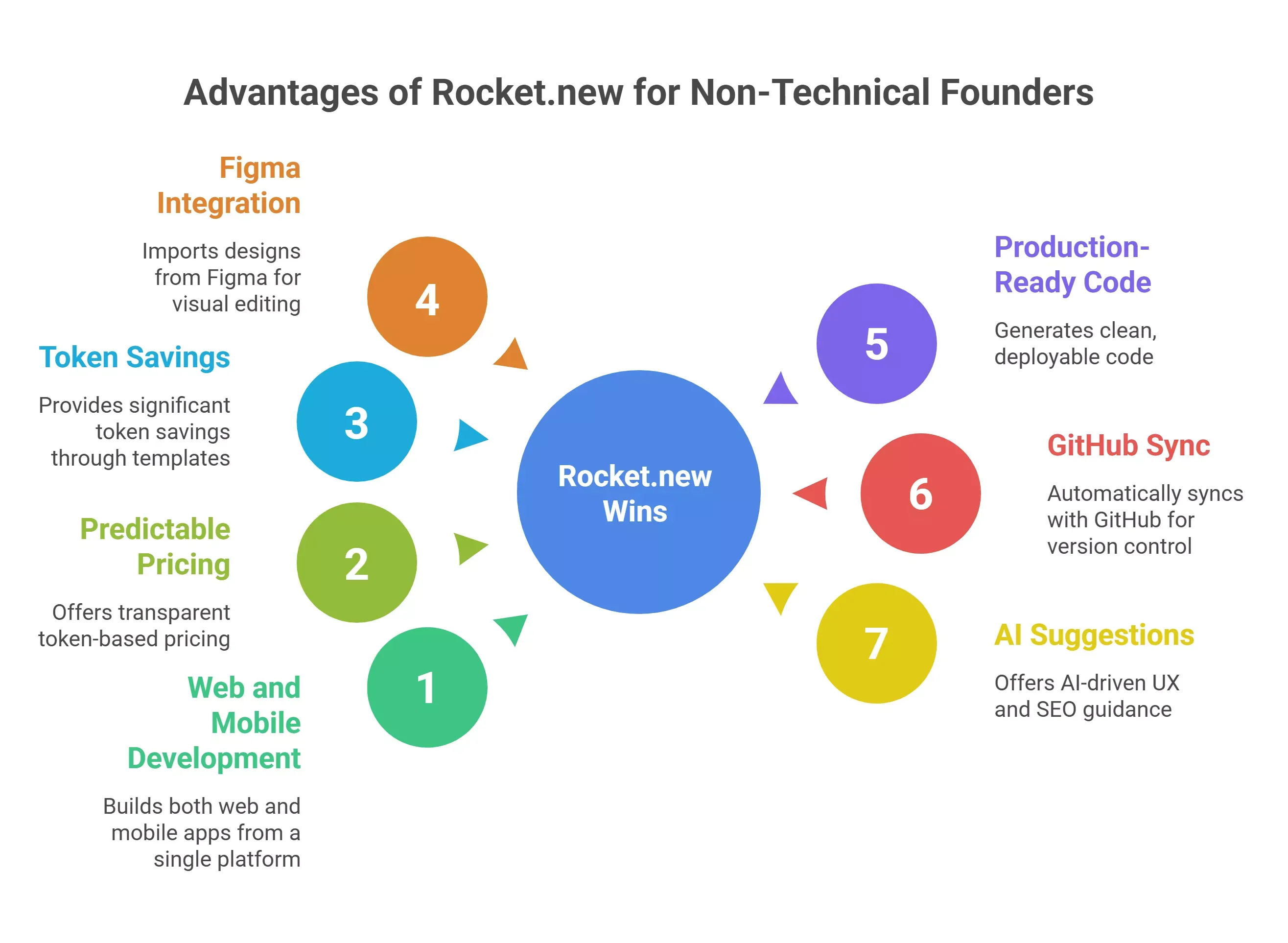
Here is where it pulls ahead clearly:
- Web and mobile from one AI-powered platform. No second tool required to build and publish native mobile apps to app stores.
- Predictable token-based pricing. Far more transparent than credit-per-action billing, with no mid-build surprises.
- Up to 80% token savings from 25,000+ templates, meaning more done per dollar across all paid plans.
- Figma import and a full visual editor cut the iteration cycles that other vibe coding tools add friction to.
- Production-ready applications on the first pass. Clean, exportable code that deploys directly and hands off smoothly to any developer who joins later.
- GitHub sync included. Version control connects automatically, so small teams track changes and roll back builds without separate setup.
- AI suggestions for UX and SEO are built into the workflow, guiding product decisions beyond just the generated code.
For non-technical users who need to go from plain English to production apps fast, Rocket.new removes every friction point that usually blocks them. Also, Rocket.new is particularly strong for founders with specific design ideas or those needing to build internal business tools.
Alternatives Worth Knowing
-
Cursor is an AI-powered code editor for developers who already know how to write code. Strong for teams with technical members, but adds significant friction for non-technical founders building solo. It is a coding assistant, not a full-stack vibe coding platform.
-
Lovable builds complete web applications from natural language prompts, with a strong focus on frontend speed and quick UI prototypes. It hits its ceiling quickly when projects need deep backend logic or complex business logic beyond simple landing pages.
-
Windsurf is an AI-powered development environment targeting developers more than non-developers. Backend setup still requires some technical background to operate, making it less suited for founders without a development background.
The development environment built to enhance coding productivity through intelligent assistance, automation, and integrated collaboration tools.
-
Firebase is Google Cloud's comprehensive backend-as-a-service platform for user authentication, real-time databases, and backend infrastructure. It is not a vibe coding tool, does not generate frontend code, and requires traditional coding to build anything user-facing. It works best as a backend complement to a frontend platform, not as a standalone AI coding tool.
None of these match Rocket.new's combination of mobile apps, web apps, AI-powered build efficiency, and non-developer accessibility inside a single platform.
The Future of Vibe Coding
Vibe coding tools are becoming a standard part of modern software development workflows, especially for rapid prototyping, building internal tools, and automating the repetitive parts of software creation.
The future of the vibe coding space is moving toward more autonomy, with AI agents expected to handle increasingly complex development tasks triggered entirely by natural language prompts.
Platforms that combine full-stack support, strong AI assistance, clean code generation, and genuine cost efficiency will define the next phase of building software without traditional coding. Rocket.new is already positioned at the front of that curve.
The Final Verdict: Vibe Coding Platform for Non-Developers
Non-technical founders need a vibe coding tool that removes barriers, not one that adds new cost traps.
Emergent has strengths, especially its multi-agent architecture and large context window for complex, long-running projects using natural language. But credit-based pricing, no mobile output, no visual editor, no Figma import, a Python-only backend, and inconsistent ai support create friction at every stage for founders who are not technical.
Rocket.new removes those friction points. It covers mobile and web builds from one workflow. It delivers real code with full ownership and no lock-in. Its token-based pricing is more predictable. Its 25,000+ templates cut build time and cost. Its AI suggestions guide decisions beyond just code. And its dedicated support responds when founders need it most.
Building as a non-technical founder is hard enough without a platform that charges per debugging attempt.
No credit card required.
Table of contents
- -What is Vibe Coding?
- -Understanding the Two Platforms
- -Rocket.new
- -Emergent
- -Feature Comparison
- -Key Features of Rocket.new
- -One Prompt. Full Stack. No Manual Coding Required.
- -Mobile Apps and Web Apps from a Single Platform
- -Figma-to-Code Conversion for Faster Prototyping
- -Built-In Visual Editor for UI Components
- -Rocket Chat Editor: Build Your App in Plain Language
- -25,000+ Templates with Up to 80% Token Savings
- -Real Code, Full Ownership, No Lock-In
- -GitHub Sync and Version Control Built In
- -AI Suggestions for SEO and UX
- -Dedicated Support That Keeps Builds Moving
- -Where Emergent Falls Short
- -Why Rocket.new Wins for Non-Technical Founders
- -Alternatives Worth Knowing
- -The Future of Vibe Coding
- -The Final Verdict: Vibe Coding Platform for Non-Developers