Rocket.new and Rork AI both use credit-based pricing, but Rocket.new offers non-expiring credits, automatic Supabase backend generation, web and mobile app support, and 25,000+ templates. Rork excels at native mobile apps, while Rocket.new delivers a stronger overall value for full-stack app development.
Rocket.new vs Rork AI Pricing: Which Offers Better Value?
Which AI app builder gives you the most for your money? The direct answer: Rocket.new.
At $25/month, you get 100 credits that never expire, an automatic Supabase backend, 25,000-plus templates, and support for both web and mobile apps.
According to Fortune Business Insights, the no-code AI platform market was worth $6.56 billion in 2025 and is set to reach $75.14 billion by 2034. Picking the right tool matters.
What Are These AI App Builders?
Not all AI app builders are built the same. Knowing what each platform does before comparing pricing saves money.
Rocket.new is a vibe-solutioning platform. Describe your app in one prompt, and it generates a full-stack web app, mobile app, and Supabase backend together.
Rork is a mobile-first tool. Describe your idea, and Rork generates a React Native prototype you can test on a device in minutes.
Both platforms target non-technical users who want to turn ideas into working apps without coding skills.
The core split: Rocket.new covers web and mobile. Rork covers native mobile apps only.
Rork AI: Fast Mobile App Creation
Rork is a distinctive AI tool specializing in the creation of production-ready mobile applications. Type your app idea, and Rork produces a working native app from a text description.
Rork helps lower barriers typically associated with mobile app development by providing a no-coding approach. Rork AI can be faster for mobile app development. and its AI's value is maximized by detailed and comprehensive prompts.
Rork generates Expo, Android (Kotlin + Compose), and web apps from a single prompt. Users watch their app appear by scanning a QR code with Expo Go. No manual sync required. Rork supports video apps, ecommerce, education, fitness, and social app categories.
Rork Max is a separate $200/month product for native Swift apps covering iOS, iPad, Apple Watch, and Vision Pro. Rork enables 2-click app publishing to app stores on paid subscriptions.
For simple app ideas and quick prototypes, Rork is one of the fastest AI app builders in the category.
Rork AI Pricing Plans
Rork uses a credit-based model. Each prompt costs one credit. Credits reset monthly with no rollover.
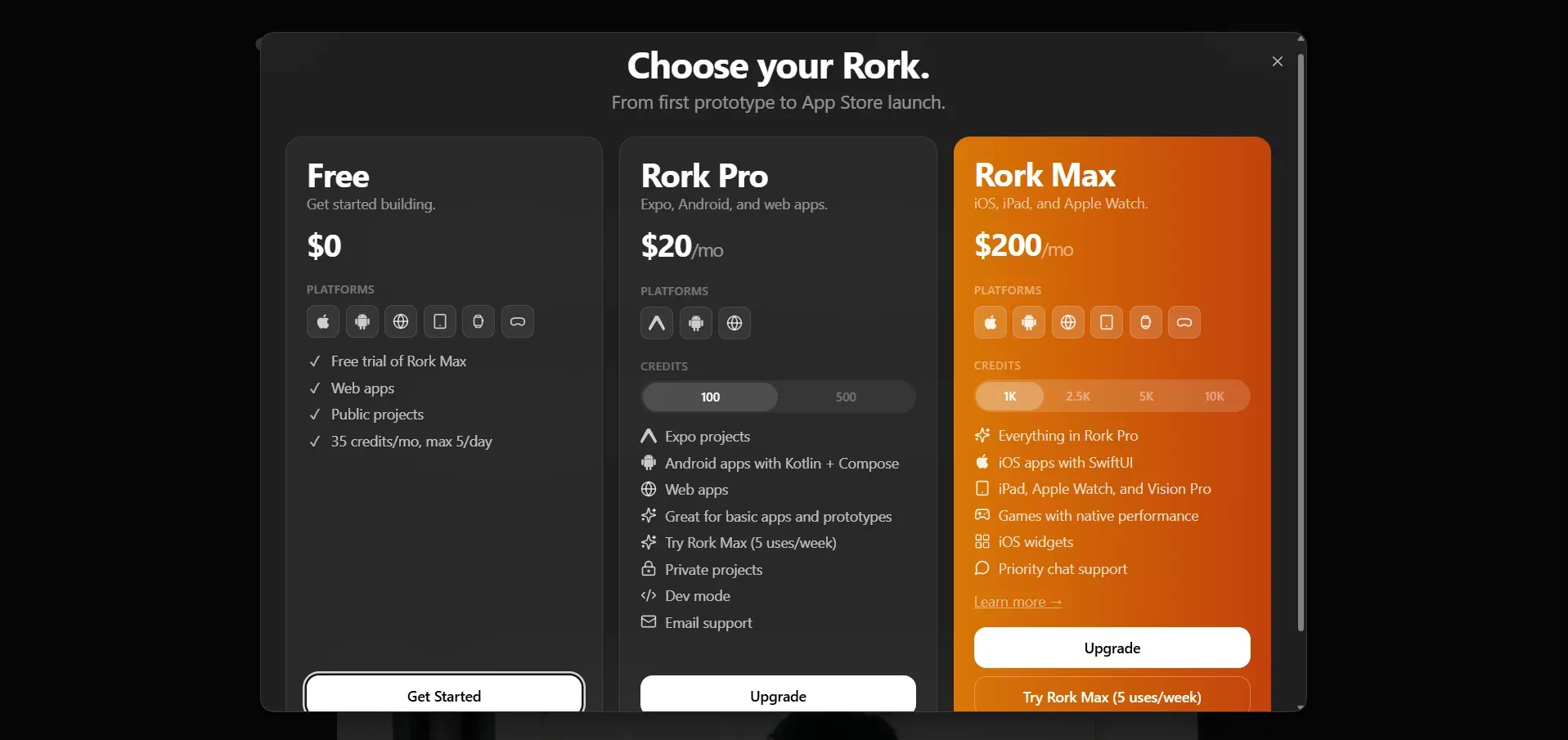
| Plan | Price | Credits |
|---|---|---|
| Free | $0 | 35/mo, max 5/day |
| Rork Pro | $20/month | 100 (up to 500) |
| Rork Max | $200/month | 1K, 2.5K, 5K, or 10K |
Key facts about Rork:
- Free projects are public.
- Code export and app store access require a paid subscription starting at $20/month.
- Rork Pro includes a free trial of Rork Max (5 uses/week).
- Rork Max covers iOS with SwiftUI, iPad, Apple Watch, Vision Pro, games, and iOS widgets.
Rocket.new: The Full-Stack Vibe-Solutioning Platform
Rocket.new is a vibe-solutioning platform for both technical and non-technical users who want production-ready app output. Rocket.new is designed for full-stack web applications, landing pages, internal tools, dashboards, mobile builds, and SaaS products from one prompt.
- Rocket.new allows users to build real, ready-to-use apps simply by describing their needs without any coding skills.
- Rocket.new includes a Figma-to-code converter for users with existing designs.
- Rocket.new offers a code download feature, allowing developers to move away from the platform.
Rocket.new has 1.5 million users across 180 countries, backed by $15 million from Salesforce Ventures, Accel, and Together Fund. Enterprise clients include Meta, PayPal, KPMG, and PwC.
Rocket.new Pricing Plans
Rocket.new uses a credit-based model. Credits power every AI app interaction, from generation to error fixes. Credits never expire on any plan.
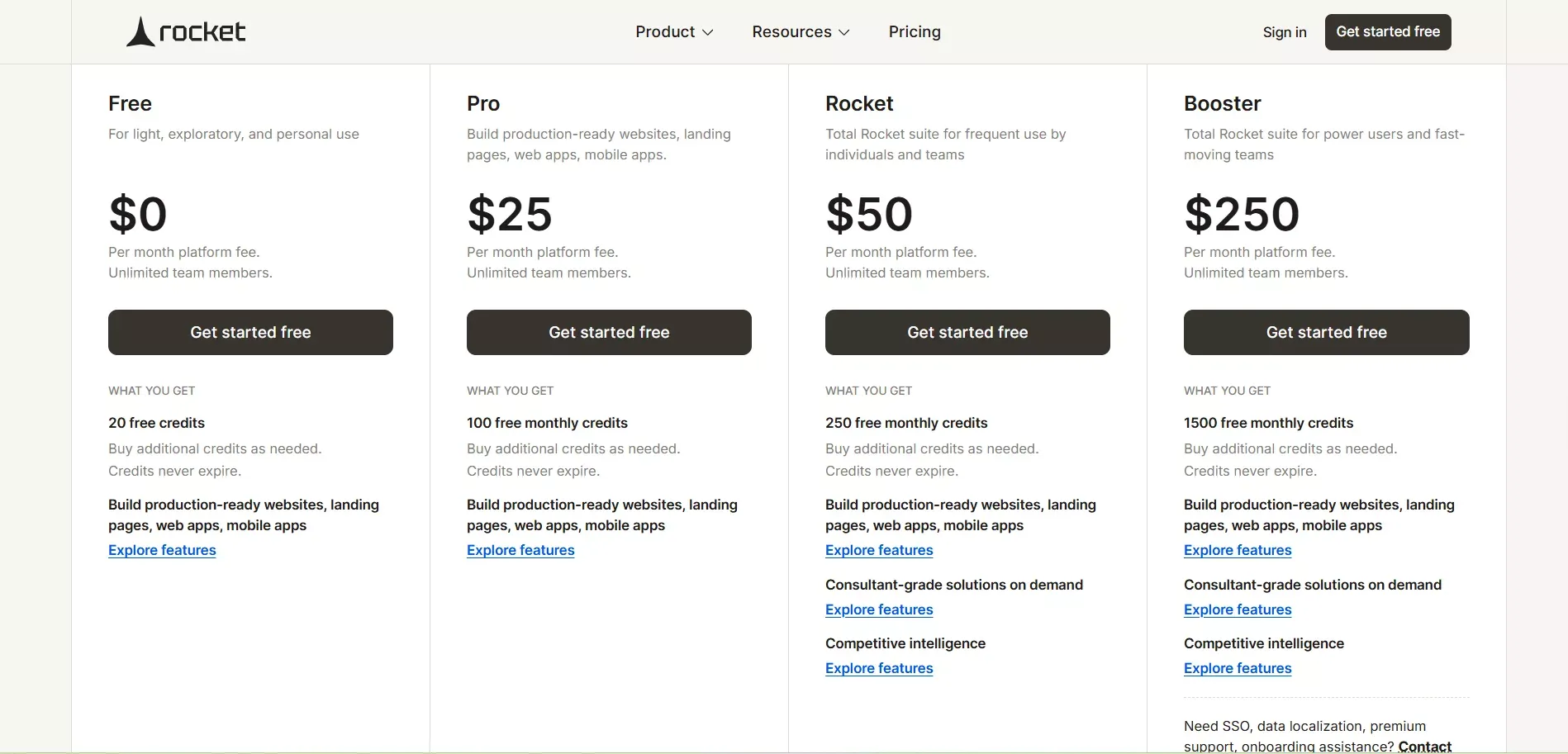
| Plan | Price | Credits |
|---|---|---|
| Free | $0 | 20 credits (buy more as needed) |
| Pro | $25/month | 100 credits/month |
| Rocket | $50/month | 250 credits/month |
| Booster | $250/month | 1,500 credits/month |
Key facts about Rocket.new:
- Credits never expire on any plan, unused credits carry forward.
- Download access, private projects, and unlimited domains come with paid plans.
- The 25,000-plus template library cuts token usage significantly, boosting productivity on every plan.
- The free tier is the most generous among AI app builders available today.
Side-by-Side: Rocket.new vs Rork AI Pricing
Here is how these two AI app builders compare on features and price at the same entry point:
| Feature | Rocket.new Pro | Rork Pro |
|---|---|---|
| Monthly Cost | $25 | $20 |
| Usage Unit | 100 credits | 100 credits (up to 500) |
| Credits Expire | Never | Monthly |
| Free Tier | 20 credits, no daily cap | 35 credits, 5/day cap |
| Code Export | Yes | Yes via GitHub |
| App Stores | Yes | Yes |
| Backend | Supabase (automatic) | Firebase (manual) |
| Mobile Output | Flutter | Expo / React Native |
| Web App Support | Yes (Next.js) | Yes |
| Template Library | 25,000-plus | None |
| Collaboration | Yes | Limited |
Credits vs Tokens: The Real Cost of Your Ideas
The pricing model shapes how far your app projects go before you hit a wall.
At $25/month, Rocket.new gives 100 credits that never expire. Rork Pro at $20/month gives 100 credits (scalable to 500) that reset monthly. Every error fix, design tweak, and new feature addition costs one credit on either platform. The key difference: Rocket.new credits roll over; Rork credits vanish each month.
Free Plan Face-Off
Rork free plan: 35 credits/month, 5 per day. Public projects only. No downloads, no app store access. Includes a free trial of Rork Max.
Rocket.new free tier: 20 credits with no daily cap. No credit card required. Full access to the 25,000-plus template library. Buy additional credits as needed, and they never expire.
On the free tier, Rocket.new lets you test auth, watch features appear, and evaluate real output before spending. Rork's free plan is enough to see a basic prototype, not enough to ship.
Code Access, App Stores, and Ownership
Both platforms give source access on paid plans. Here is what each tool gives you.
Rork exports React Native/Expo output via GitHub and supports 2-click publishing to app stores. Rork Max adds native Swift output for iOS, iPad, Apple Watch, and Vision Pro at $200/month. Rocket.new exports Flutter and Next.js code on all paid plans, with no vendor lock-in.
Backend: The Hidden Value Difference
The server-side layer is where the value gap between AI app builders becomes obvious.
Rork does not include a built-in backend. Firebase requires manual setup, adding friction for non-technical users. With Rocket.new, describe your app and get a fully functional product with Supabase handling database integration, auth, and real-time data sync automatically.
Rocket.new: Built for Real App Ideas
Type one prompt and watch the full-stack app appear: web app, mobile app build, and Supabase backend in one pass. No menus. No manual setup. That is the vibe-solutioning platform in action.
Top features:
- 25K-plus templates cut app credit usage significantly, the highest savings in this category.
- Flutter and Next.js app generation for mobile and web from a single prompt.
- Supabase with automatic auth, data sync, and database integration out of the box.
- Figma-to-code for teams with existing design files.
- Credits never expire for a predictable monthly cost.
- Built-in collaboration tool for small teams.
Who gets the most value from Rocket.new:
- Founders who need a full SaaS app MVP with Supabase and auth from one prompt.
- Non-technical users who want production-ready apps across web and mobile.
- Small teams that need to build, ship app output, and export code without hiring developers.
What Builders Say
The fundamental choice between the two platforms comes down to this: Rocket-style credit pricing vs. Rork's per-message model, and web vs. mobile focus.
On pure pricing value:
Rocket.new wins on accessibility, it has a free tier and credits that never expire. But credit burn in fix-loops can make it expensive; it's all about the learning curve.
"You need to figure out the prompt engineering. There's a learning curve: You waste a few credits getting the swing of things, and you do need a lot more than 5 million credits to make a full app. I would say 50 million would be perfect for an incredibly high-end functional app." - Trustpilot
Rork wins on predictability; you know exactly how many interactions you get. But no free trial with Rork Pro is a real barrier.
"Rork's message-based pricing and iOS-native app make it ideal for professional teams who need reliable, high-quality output, but it's priced for professionals, not experimenters." - NoCode MBA
Who Should Use Which Platform
Not every builder has the same goals.
Use Rork if you: Need native mobile apps in app stores fast, with no web requirement. Have simple app ideas that fit within 100 credits per month. Need Rork Max for native Swift apps on iOS, iPad, Apple Watch, or Vision Pro.
Use Rocket.new if you: Want production-ready web and mobile builds from one platform. Need an automatic Supabase backend with no technical knowledge required. Want credits that never expire, 25,000-plus templates, and the biggest free tier among AI app builders.
Making the Call: Value and Pricing
When it comes to Rocket.new vs Rork AI pricing: which offers better value, the answer is clear. At $25/month, Rocket.new delivers 100 non-expiring credits, automatic Supabase, Flutter, and Next.js code exports, 25,000-plus templates, and all the features you need for your app across web and mobile.
Rork Pro at $20/month delivers 100 credits (scalable to 500) focused on native mobile app builds, but credits reset monthly with no rollover.
Among AI app builders at this price point, the value gap is clear. Pick Rork for native mobile speed and iOS depth. Pick Rocket.new for the full scope.
Table of contents
- -What Are These AI App Builders?
- -Rork AI: Fast Mobile App Creation
- -Rork AI Pricing Plans
- -Rocket.new: The Full-Stack Vibe-Solutioning Platform
- -Rocket.new Pricing Plans
- -Side-by-Side: Rocket.new vs Rork AI Pricing
- -Credits vs Tokens: The Real Cost of Your Ideas
- -Free Plan Face-Off
- -Code Access, App Stores, and Ownership
- -Backend: The Hidden Value Difference
- -Rocket.new: Built for Real App Ideas
- -What Builders Say
- -Who Should Use Which Platform
- -Making the Call: Value and Pricing