
Rocket.new and v0 are both capable AI app builders, but they solve different problems. v0 is built for fast execution inside the Vercel ecosystem. Rocket is built for the full arc: research, build, monitor, and improve, all in one place.
Which AI app builder is better in 2026, Rocket.new or v0?
It depends on where your biggest problem lives. If your problem is execution speed inside the Vercel ecosystem, v0 is a strong tool. If your problem starts before the first line of code, with what to build, why to build it, and whether the market is ready, Rocket is in a different category entirely.
According to the Stack Overflow 2024 Developer Survey, 76% of developers are already using or planning to use AI tools in their workflow.
This blog gives you a complete, side-by-side breakdown so you can make the right call.
What is v0 by Vercel?
v0 is an AI-powered development platform built and maintained by Vercel. It converts natural language prompts into production-ready, full-stack web applications using Next.js, React, TypeScript, Tailwind CSS, and shadcn/ui. Deployment connects directly to Vercel's global infrastructure with a single click.
Launched originally as a UI component generator, v0 has matured into a full-stack builder. Its February 2026 update introduced Git integration, a VS Code-style in-browser editor, Projects and Folders for workspace organization, and production-accurate live previews powered by Vercel Sandbox.
What v0 Builds
- Conversion-focused landing pages
- Analytics dashboards and admin panels
- E-commerce storefronts
- Data visualization tools
- Internal business tools
- Mobile-responsive web apps
- AI-powered web applications
v0 Strengths
v0 excels at speed-to-prototype for developers who already live inside the Vercel ecosystem. Its GitHub integration is tight, its deployment pipeline is seamless, and the shadcn/ui component library produces clean, consistent UI out of the box. For teams that know exactly what they want to build and need to move fast, v0 executes reliably.
v0 Pricing (2026)
| Plan | Monthly Price | Key Limits | Best For |
|---|---|---|---|
| Free | $0 | $5 monthly credits, 7 messages/day | Exploration and prototyping |
| Team | $30/user | $30 credits/user, collaboration features | Small dev teams |
| Business | $100/user | Training opt-out by default, privacy controls | Privacy-sensitive teams |
| Enterprise | Custom | SSO, RBAC, SLAs | Large organizations |
Important: The full v0 experience requires a connected Vercel account. Environment variables, production deployments, and live previews are all tied to Vercel infrastructure. You can export code and deploy elsewhere, but the platform is architected for Vercel-first workflows.
v0 Limitations to Know
- Web-only: no native mobile app generation
- No pre-build research or market validation layer
- No persistent shared memory across sessions
- No redesign capability for existing live sites
- WCAG and GDPR compliance not built in by default
- Deep platform dependency on Vercel for full functionality
- No built-in competitive intelligence
What is Rocket?
Rocket is the world's first Vibe Solutioning platform, the first AI platform where business thinking and building happen in the same place, connected through a shared context architecture that makes every decision smarter than the last.
While AI coding tools address how to build faster, Rocket addresses what to build and why, with Solve for strategic business intelligence, Intelligence for continuous competitive monitoring, and Build for production-grade product generation, all connected so the thinking before the build and the build itself happen in the same workspace.
1.5 million people have tried Rocket across 180 countries, from solo founders validating their first idea to enterprise teams running strategy and execution on the same platform.
The Seven Pillars of Rocket
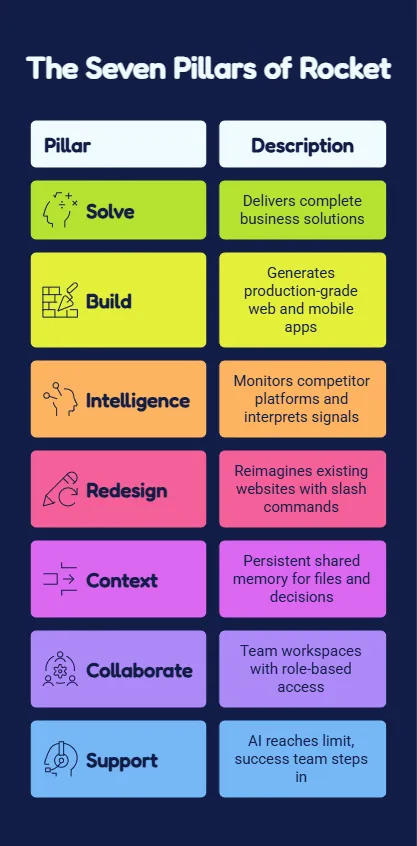
Solve: Takes any business question and delivers a complete, structured solution with findings, evidence, and clear recommendations. Export as PDF or PPT. Used by founders, product teams, marketers, sales leaders, and executives.
Build: Generates production-grade web apps (Next.js), mobile apps (Flutter for iOS and Android), landing pages, multi-page websites, internal tools, customer portals, compliance systems, and business infrastructure. Every build ships with SEO-ready structure, WCAG accessibility compliance, GDPR coverage, and performance optimization by default.
Intelligence: Monitors every public platform a competitor operates on, continuously, and interprets what signals mean for your business. Delivers daily, weekly, and monthly briefs. Not just what changed, but what it means.
Redesign: Eight slash commands across three categories to reimagine any existing website without starting from scratch.
Context: Persistent shared memory. Files, research, and decisions added once carry into every task. Everything remembered, every time.
Collaborate: Team workspaces with three-level role-based access (Admin, Creator, Viewer), inline comments, per-user credit allocation, and unified billing.
Support: Rocket's Success team steps in inside the platform when the AI reaches its limit, with user permission. No tickets. No email chains.
What Rocket Builds
- Web apps: SaaS platforms, dashboards, internal tools, marketplaces, AI-powered apps
- Mobile apps: iOS and Android from a single Flutter codebase, ready for App Store and Google Play
- Landing pages and multi-page websites
- E-commerce stores with payment integrations
- Internal dashboards: OKR trackers, customer health monitors, compliance tools
- Customer portals and onboarding systems
- Investor data rooms and sales enablement platforms
- ROI calculators, research portals, press/media pages
Rocket's 25+ Native Integrations
Stripe, Google Analytics, AdSense, Supabase, OpenAI, Anthropic, Gemini, Perplexity, PayPal, Cal.com, Linear, Notion, Airtable, Mailchimp, Mixpanel, Typeform, Strapi, Directus, Tally, Brevo, Calendly, MailerLite, SendGrid, Twilio, Resend. Authenticate once; they flow into every build.
Rocket.new vs v0: Complete Feature Comparison
| Feature | Rocket | v0 (Vercel) |
|---|---|---|
| Web app generation | Next.js (production-grade) | Next.js (production-grade) |
| Mobile app generation | Flutter (iOS + Android) | Not available (web-only) |
| Pre-build research | Solve (decision intelligence) | Not available |
| Competitive monitoring | Intelligence (continuous, real-time) | Not available |
| Shared team memory | Context (persistent across all tasks) | Session-based only |
| Redesign existing sites | 8 slash commands, 3 categories | Not available |
| GitHub integration | Two-way sync | Full integration |
| Figma import | Yes (preserves spacing, typography, hierarchy) | Yes |
| Built-in analytics | Visitors, conversions, Core Web Vitals | Via Vercel dashboard |
| Deployment | Netlify or custom domain (no lock-in) | Vercel (required for full features) |
| Native integrations | 25+ (Stripe, Supabase, OpenAI, Mixpanel, more) | Via external APIs |
| WCAG accessibility | Built in by default | Not by default |
| GDPR compliance | Built in by default | Not by default |
| SEO-ready output | Built in by default | Partial |
| Human support inside platform | Yes (Success team, no tickets) | Via Vercel support tickets |
| Staging environments | Yes, with one-click rollback | Via Vercel |
| Version history | Full version history | Via Git |
| Free tier | Yes | Yes ($5 credits/month) |
| Platform lock-in | None (export anytime) | Vercel-dependent |
The Structural Gap: A Category Difference, Not a Feature List
This is the most important thing to understand about Rocket.new vs v0. The difference is not a list of missing features. It is a fundamentally different starting point.
v0 starts at execution. You arrive with an idea, describe it, and v0 builds it. The tool has no opinion on whether the idea is worth building. The quality of what comes out depends entirely on the quality of what you brought in. That is not a criticism; it is how the tool was designed, and it does that job well.
Rocket starts before execution. The founding thesis: the most expensive mistake in any business is not a bad execution. It is a good execution of the wrong thing. A product nobody wanted. A feature that moved no metric.
Rocket's Solve capability researches whether the direction is right before a single line of code is written. Intelligence monitors competitors continuously. Context carries all of that thinking into every build.
The GitHub Octoverse 2024 report found 98% year-over-year growth in generative AI projects on GitHub, with over 70,000 new projects created in 2024 alone. The gap between tools that generate code and platforms that connect thinking to building will only widen.
Vibe Coding vs Vibe Solutioning
Vibe coding answers: "How do I build this?"
Vibe Solutioning answers: "What should I build, and is it worth building?"
v0 is a vibe coding tool. It is excellent at the build step.
Rocket is the world's first Vibe Solutioning platform. It solves the step before, and connects it to the build.
| Dimension | Vibe Coding (v0) | Vibe Solutioning (Rocket) |
|---|---|---|
| Where it starts | At the prompt | Before the first prompt |
| What it assumes | Direction is already decided | Direction needs to be earned |
| Market intelligence | You bring it | Built in and continuous |
| Memory across sessions | Starts fresh each time | Compounds across every task |
| Output quality driver | Quality of your prompt | Quality of accumulated context |
| Who manages the platform | You | Rocket |
Understanding what Vibe Solutioning means for product teams helps clarify why the category distinction matters in practice.
How Each Platform Approaches the Build Process
v0 workflow:
User idea > Write prompt > Generate code > Preview > Iterate > Deploy to Vercel
Rocket workflow:
User idea > Solve (research and validate direction) > Intelligence (map competitive landscape) > Context (carry all decisions forward) > Build (generate production app from informed foundation) > Deploy (Netlify or custom domain)
The practical consequence: Rocket users consistently report that the first generation is closer to what they actually needed, because the build starts from a foundation of research rather than a blank prompt.
Design Quality: Why It Matters for Real Products
Every AI builder on the market, including v0, can produce output that looks like AI made it. Generic cards. Predictable grids. Layouts that announce themselves as generated.
Rocket generates output that looks like a senior design team touched it. The design decisions are intentional: considered typography, real visual hierarchy, identity specific to the product, not pulled from a template library. Nothing reads as AI-made.
Design quality is a business outcome, not an aesthetic preference. A landing page that looks like a template costs conversions. An app that looks generated in five minutes costs trust.
Rocket's Build capability uses real design systems for mobile apps: dark/light theming, fluid navigation, staggered animations, and domain-specific data density, production quality from the first generation.
Real-World Use Cases: When to Choose Each Tool
Use Cases Where Rocket Wins
Founders validating a new product idea
A founder building a SaaS tool for legal teams uses Solve to research the market, map competitors, and validate the direction before writing a single prompt. The first build reflects that research. The result is a first version that addresses real user needs rather than assumed ones.
Teams building mobile apps
A startup needs iOS and Android apps from a single codebase. v0 cannot do this. Rocket generates Flutter apps with real design systems, ready for App Store and Google Play submission.
Agencies redesigning client websites
An agency uses Rocket's Redesign capability to point at a client's underperforming site, apply the "Fix Conversion Issues" slash command, and deliver a redesigned version in hours rather than weeks.
Enterprise teams replacing tool sprawl
A product team uses Rocket to consolidate: Solve replaces the research consultant, Intelligence replaces the competitive monitoring tool, Build replaces the development agency, and Context means nothing is re-explained between sessions.
Compliance-sensitive builds
A healthcare startup needs WCAG accessibility and GDPR compliance by default. Rocket ships these as baseline requirements on every build. v0 does not.
Use Cases Where v0 Wins
Developers deep in the Vercel ecosystem
A team already deploying to Vercel with an established Next.js codebase finds v0's GitHub integration and Vercel deployment pipeline genuinely excellent. The workflow is tight and familiar.
Rapid UI component generation
A developer needs React component variants quickly for a design review. v0 started as a UI tool and it shows: fast, clean, consistent component output.
Teams with a clear, validated direction
If the research is done and the direction is decided, v0 executes well. The tool does not need to know why you are building; it just needs to know what.
Prototyping for developer review
A technical team needs a working prototype to show stakeholders before committing to a full build. v0 produces clean, exportable code that developers can extend.
For a deeper look at what production-grade AI building looks like across use cases, the guide on building a full-stack app with AI covers the process in detail.
Rocket's Redesign Capability: No Equivalent in v0
Redesign has no direct equivalent in v0 or most other AI builders. Point Rocket at any live website URL, your own, a competitor's, or a client's, and tell it what kind of change you need using slash commands.
Rocket reads the site structurally: content, layout logic, design language (colors, typography, spacing, component patterns, information hierarchy), not as a screenshot. The output is a redesign built from structural understanding, not a template applied to content.
The Eight Redesign Commands
Reimagine:
- Reimagine Website Design: modern look, all existing content preserved
- Full Website Makeover: completely new look, layout, and copy
- Mobile-First Redesign: rebuilt and optimized for mobile devices first
Insight-Driven:
- Redesign from Heatmap: upload a heatmap; user behavior data becomes the brief
- Fix Conversion Issues: analyze bounce or drop-off problems and redesign to improve conversions
- Fix Visual Hierarchy: identify CTA and layout visibility issues and redesign to fix them
Brand and Consistency:
- Redesign Like Competitor: apply the design style of one site to the content of yours
- Generate Brand-Matched Page: generate a new page that matches your existing brand completely
v0 generates from scratch. It cannot read an existing site, understand what is working, and selectively improve it. For businesses with underperforming or outdated sites, this is a meaningful gap.
Teams looking to understand how Rocket approaches website rebuilding can read more about how Rocket taught AI to see websites and rebuild them from scratch.
Pricing: Full Comparison
| Dimension | Rocket | v0 (Vercel) |
|---|---|---|
| Free tier | Yes | Yes ($5 credits/month) |
| Paid entry point | Individual plans | $30/user/month |
| Business tier | Team plans | $100/user/month |
| Enterprise | Yes (custom) | Yes (custom) |
| Mobile app building | Included | Not available |
| Pre-build intelligence | Included | Not available |
| Competitive monitoring | Included | Not available |
| WCAG/GDPR compliance | Included by default | Not included by default |
| Human support inside platform | Included | Via Vercel support |
| Platform lock-in cost | None | Vercel infrastructure dependency |
v0's Team plan at $30/user/month covers code generation only. Rocket's plans include Solve (research), Intelligence (competitive monitoring), Build (generation), Redesign, Context, and Support, capabilities that would otherwise require separate tools and subscriptions.
Who Should Use v0
v0 is the right choice when:
- You are already building on Vercel and want tight deployment integration
- Your team is developer-led and comfortable with Next.js and React
- You need fast UI component generation or rapid prototyping
- The direction is clear, validated, and decided before you open the tool
- You want full code ownership and GitHub-based version control
- Your project is web-only and mobile is not a requirement
v0 is not the right choice when:
- You need to validate the direction before building
- You need mobile apps (iOS and Android)
- You need continuous competitive intelligence
- You need to redesign an existing site
- You need WCAG/GDPR compliance by default
- You want shared context that compounds across your team over time
Who Should Use Rocket
Rocket is the right choice when:
- You need to research and validate what to build before committing to a direction
- You need mobile apps (Flutter for iOS and Android) alongside web
- You need continuous competitive monitoring, not one-off research
- You want production-ready output with WCAG, GDPR, and SEO built in
- You need to redesign an existing underperforming site
- You want a platform where accumulated context makes every build smarter
- You are consolidating multiple tools into one workspace
- You need human support inside the platform when AI reaches its limit
For a broader view of the AI builder landscape, the best AI app builder comparison covers the full category.
The Vibe Coding Movement: Where Both Tools Fit
Both Rocket and v0 sit within the broader vibe coding movement, the shift toward building software through natural language rather than manual code. The category is growing fast and both tools are serious players.
The difference is scope. v0 solves the build step: fast, clean, well-integrated execution. Rocket's category, Vibe Solutioning, covers the full arc: what to build, why to build it, how to build it, and what to monitor after it ships.
As Vishal Virani, Rocket's co-founder, framed it: "Vibe coding is Day 1. Vibe Solutioning is Day 0 through Day 2."
Developers curious about how vibe coding is reshaping engineering roles can explore how vibe coding is changing modern development workflowsThe Future of AI App Building
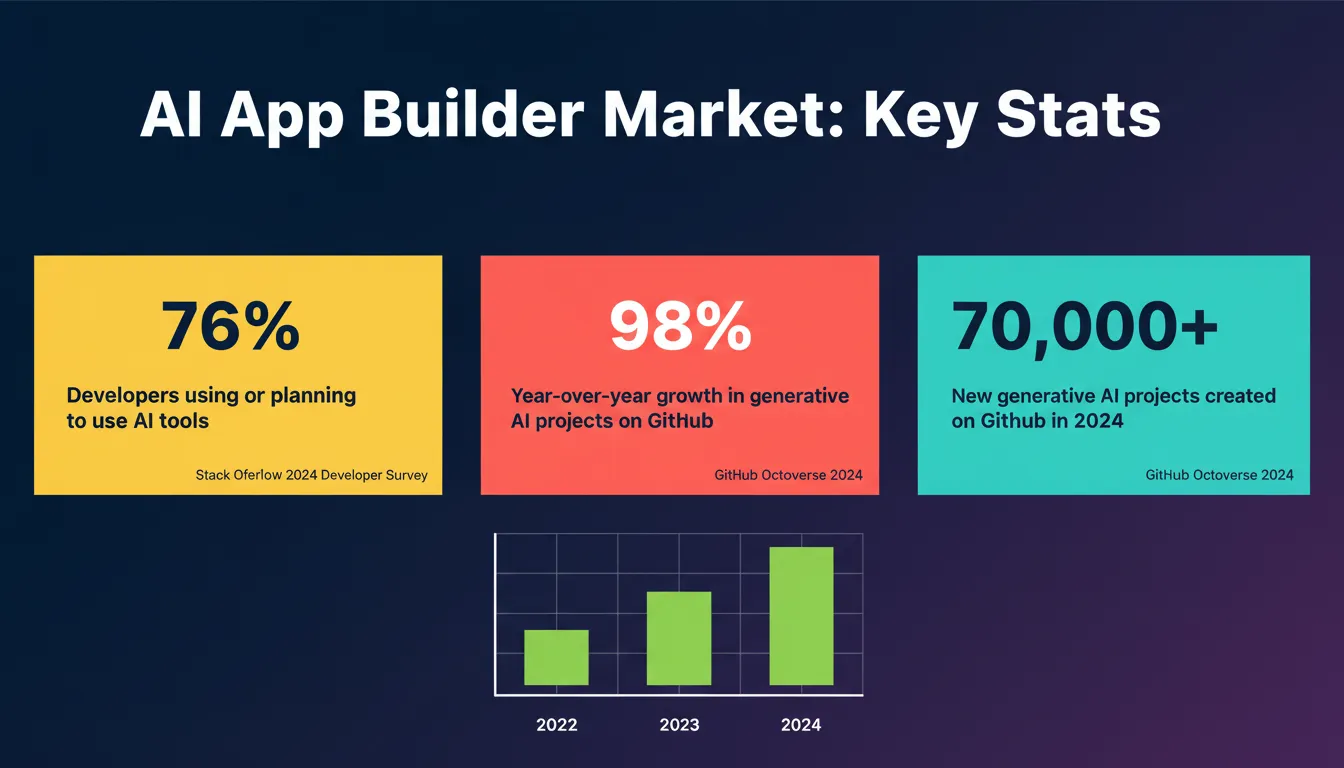
The AI app builder market is moving fast. The GitHub Octoverse 2024 report documented 98% year-over-year growth in generative AI projects, with over 70,000 new projects created in 2024 alone.
The next competitive frontier is not faster code generation. Most tools are already fast enough. The frontier is intelligence: platforms that know what you are building, why you are building it, what the market looks like, and that carry all of that context forward automatically.
Vibe Solutioning as a category did not exist before Rocket defined it. The tools that win the next phase of this market will not just generate code faster; they will make the decisions that precede the code smarter.
The Verdict: Rocket.new vs v0 in 2026
Both tools are genuinely capable. The question is not which one is better in absolute terms; it is which one is better for where your problem actually lives.
Choose v0 if: You are a developer already in the Vercel ecosystem, you know exactly what you want to build, and you need fast, clean execution with tight GitHub integration.
Choose Rocket if: You need to think before you build, you need mobile apps, you need continuous competitive intelligence, you need compliance defaults, or you want a platform where accumulated context makes every decision and every build smarter over time.
The fundamental difference: v0 and most AI builders start at execution and go fast from there. Rocket starts before the first prompt, with the strategic and competitive intelligence that determines whether what you build is worth building at all.
Build Smarter: Start with Rocket
The real question is not which tool generates code faster. It is which platform gives your product the best foundation.
v0 is a capable tool for developers who know what they want to build and work inside the Vercel ecosystem. It executes well.
Rocket is for everyone who wants to build right, not just build fast. For founders who need to validate before they commit. For teams who need mobile alongside web. For businesses that need compliance defaults, competitive intelligence, and a platform where accumulated thinking makes every build better than the last.
The work is only as good as the thinking before it. Start building with Rocket and see what happens when the research and the build happen in the same place.
Table of contents
- -What is v0 by Vercel?
- -What v0 Builds
- -v0 Strengths
- -v0 Pricing (2026)
- -v0 Limitations to Know
- -What is Rocket?
- -The Seven Pillars of Rocket
- -What Rocket Builds
- -Rocket's 25+ Native Integrations
- -Rocket.new vs v0: Complete Feature Comparison
- -The Structural Gap: A Category Difference, Not a Feature List
- -Vibe Coding vs Vibe Solutioning
- -How Each Platform Approaches the Build Process
- -Design Quality: Why It Matters for Real Products
- -Real-World Use Cases: When to Choose Each Tool
- -Use Cases Where Rocket Wins
- -Use Cases Where v0 Wins
- -Rocket's Redesign Capability: No Equivalent in v0
- -The Eight Redesign Commands
- -Pricing: Full Comparison
- -Who Should Use v0
- -Who Should Use Rocket
- -The Vibe Coding Movement: Where Both Tools Fit
- -The Verdict: Rocket.new vs v0 in 2026
- -Build Smarter: Start with Rocket