
Solve on Rocket.new generates a complete geographic expansion plan in under 90 minutes. It combines market research, c ompetitive intelligence, and risk analysis into one structured report. You get board-ready outputs without the time and cost of traditional consulting firms.
Is a geographic expansion plan something your team keeps pushing back because the budget for a strategy consulting firm isn’t there?
Good news: Solve on Rocket.new can produce not only a structured, evidence-backed, and board-ready plan, but also a robust business case for geographic expansion, supporting decision-making and justifying the potential value of new markets, without the six-figure price tag or the six-week wait. In 60 to 90 minutes, Solve queries 150+ sources simultaneously and delivers a full strategic plan built on real data.
According to Future Market Insights, the global AI consulting services market is set to grow from USD 11.07 billion in 2025 to USD 90.99 billion by 2035 - a 26.2% CAGR that reflects how quickly businesses are shifting their approach to strategic work.
What Makes Geographic Expansion So Hard to Plan Well
Geographic expansion fails most of the time - and not because the new market isn’t worth entering. According to Lokalise’s analysis of international expansion, companies like eBay, Disney, Starbucks, Walmart, and Coca-Cola all stumbled when entering new markets, primarily because they assumed what worked at home would carry over. They skipped the market research that would have told them otherwise.
Most teams run into the same trap. They look at a new market, size up the opportunity, and start planning logistics before they’ve done the hard problem-solving that a geographic expansion actually demands.
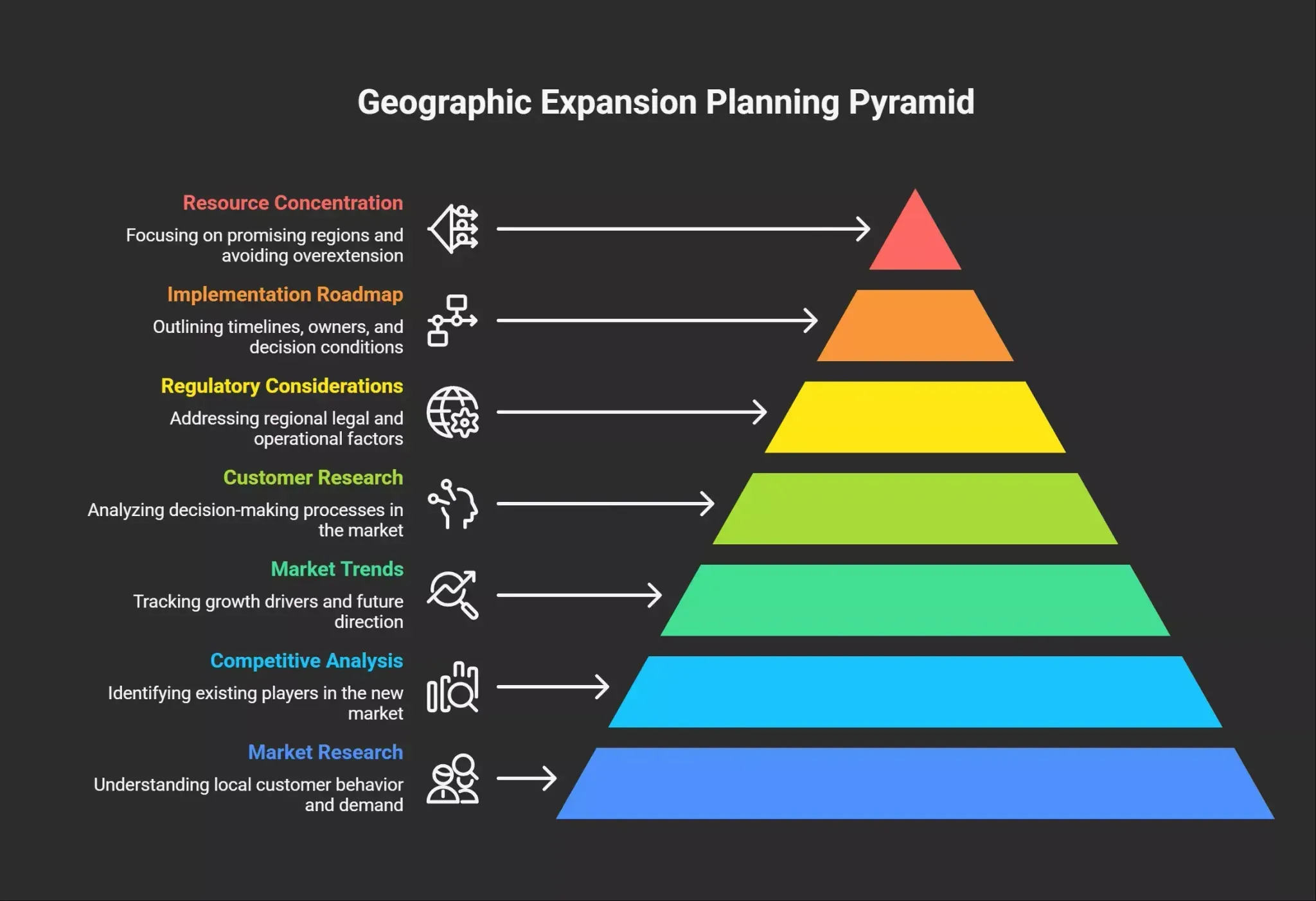 A solid plan requires more than gut instinct. Here is what it actually takes:
-
Market research on local customer behavior, demand signals, and growth drivers
-
A review of the competitive landscape to understand who’s already operating there
-
Market trends data showing where the target geography is heading
-
Customer research on how decision-making works in that market
-
Regulatory and operational considerations by region
-
An implementation roadmap with timelines, owners, and decision conditions
-
A clear focus on concentrating resources on the most promising regions, avoiding overextension, and eliminating unsuccessful markets
Gathering data across all of these dimensions used to mean months of internal work or a large check written to a strategy consulting firm. AI tools have started changing that equation.
The Real Cost of Hiring a Strategy Consulting Firm
Understanding Strategic Business Plans vs. Growth Plans
A strategic business plan serves as a comprehensive guide for the overall direction of a firm, focusing on aligning the company's mission, vision, and long-term goals with its day-to-day operations. Growth plans are narrower in scope but focused on expansion, defining concrete goals for client acquisition, market penetration, or operational scale within a specific time frame.
Strategic business plans and growth plans are not mutually exclusive; they often work in tandem, with strategic plans providing a foundation and growth plans accelerating revenue and market expansion.
What Consulting Firms Charge, and How Long It Takes
Strategy consulting firms produce rigorous work. They also charge for it. According to SME Strategy, strategic planning projects range from $15,000 on the low end to well over $150,000 for comprehensive engagements.
For larger organizations working with top-tier firms, a single geographic expansion project can run $50,000 to $500,000 or more. And before the finished strategic plan lands in your inbox, four to twelve weeks will likely have passed.
Why This Model Doesn't Work for Most Founders
For most founders and small business teams, that’s simply not a viable path. The budget isn’t available, the timeline doesn’t work, and by the time the consulting firm delivers the plan, the market has often already shifted.
Where AI Tools Step In
This is exactly the gap that good AI tools now fill. The consulting firm model was built for a world where research took weeks. Solve on Rocket.new was built for a world where the same research quality can be produced in a single session.
So, let's find out, can Solve on Rocket.new produce a board-ready geographic expansion plan without a strategy consulting firm?
How to Solve on Rocket.new Approaches to Geographic Expansion
Solve is Rocket.new’s decision intelligence engine. You describe your situation the way you’d explain it to a smart colleague - in plain language, no formatting required. From that single prompt, Solve frames the full scope of the problem, identifies every research dimension worth covering, and runs thousands of queries across 150+ sources at the same time.
What Solve Output Covers for the Geographic Expansion Question
A geographic expansion strategy typically involves four main steps: target research and prioritization, business model research, scoring and prioritizing target geographies, and developing a comprehensive expansion plan.
For a geographic expansion question, the structured output that comes back typically covers 8 to 12 sections:
-
A verdict - the direct recommendation - at the top of the report
-
Market research covering local demand, customer segments, and growth drivers
-
Competitive intelligence on who’s operating in the target geography and what their positioning looks like
-
A market trends analysis showing where the region is heading
-
Market share data and saturation analysis
-
A risk matrix covering regulatory, operational, and financial risks
-
An implementation roadmap with timelines, owners, and gate conditions
-
Data inventory showing source quality and signal strength for every finding
For example, a recent Solve output for a SaaS company expanding into Southeast Asia included a decision matrix comparing market entry options, a summary of local regulatory hurdles, and a step-by-step implementation plan tailored to the region.
Each finding is tagged HIGH, MEDIUM, or LOW confidence. Conflicting signals are surfaced explicitly - Solve doesn’t smooth over the parts that create uncertainty. If there’s a regulatory deadline or a competitor move that changes the picture, it appears in the output with a clear explanation of why it matters.
The structured output exports as a comprehensive PDF or a full presentation deck. That’s a format ready to put in front of a board or leadership team without additional production work.
Solve vs. a Strategy Consulting Firm
| Factor | Strategy Consulting Firm | Solve on Rocket.new |
|---|---|---|
| Time to Deliver | 4-12 weeks | 60-90 minutes |
| Cost | $15,000 to $500,000+ | Covered in the platform plan |
| Sources Researched | Proprietary databases + interviews | 150+ sources simultaneously |
| Output Format | PDF deck/slide presentation | PDF, PPT, structured report |
| Customization | Back-and-forth over weeks | Real-time follow-up in chat |
| Team Access | One firm, one deliverable | Shared across the whole team |
| Context Retention | New engagement starts fresh | Carries into every next step |
👉Build your next market expansion plan faster, try Solve on Rocket.new today.
From Gathering Data to a Complete Strategic Plan
How Solve Handles the Research Process
One thing that sets Solve apart from most AI tools is how it handles the research process. When you type a geographic expansion question into Solve, you’re not triggering a single search. You’re triggering a decomposition process - the question breaks into every relevant research dimension, each one runs as an independent agent simultaneously, and the outputs merge into a single cohesive report.
This process creates a sense of how all the research dimensions connect, providing a logical foundation for decision-making.
Compressing Weeks of Manual Research Into One Session
This is the kind of research architecture most teams can’t replicate on their own. Gathering data manually across competitive research, customer research, market share analysis, and regulatory review would take a team member weeks of focused work. Solve compresses it into one session.
Continuing the Analysis Through Follow-Up
After the report is generated, follow-up questions continue in chat. Go deeper on a specific finding, reframe the analysis for a different audience, or pressure-test the recommendation. Each follow-up builds on the full conversation context - no re-explaining required. The output quality stays high across every iteration because the full research context carries forward.
Combining External Intelligence With Your Internal Data
Users can also upload internal files - financial models, board decks, customer research documents - and Solve reads them structurally. Every formula, cell reference, and cross-sheet dependency in an Excel file is mapped and understood. This means the strategic plan Solve produces reflects both the external market intelligence and the internal reality of your business, not just one side of the picture.
New Market Research, Market Trends, and the Competitive Landscape
The big picture view of a new market matters as much as the granular data points. Solve builds that view automatically.
What's Different About Competing in a New Geography
For geographic expansion specifically, the competitive landscape in a new market almost always looks different from what a team has faced at home.
Local players have different positioning, different pricing structures, and often deeper relationships with distribution channels or regulators. Market trends shift differently by region. Customer research patterns don’t carry over cleanly.
To win in a new market, value proposition strength is critical for successful expansion attempts, regardless of the tools used.
How Solve Treats Competitive Intelligence
Solve treats competitive intelligence and competitive analysis as core research categories, not afterthoughts. Relying on separate tools for gathering market insights often leads to fragmented information, context loss, and inefficiencies in strategic decision-making during product development.
A geographic expansion Solve output includes a full review of local competitors, who hold market share, how they’re positioned, what their growth signals look like, and where the gaps are that a new entrant can realistically win.
Reading Market Trends Beyond the Top-Line Numbers
The market trends analysis layer is equally important. A target geography might show strong overall demand signals but cooling growth in the specific customer segment you’re targeting. Solve those distinctions rather than burying them in aggregate data.
Where DIY Research Falls Short
This is where most teams get into trouble with DIY research—they read the positive top-line numbers and miss the nuances that change the strategic plan entirely. A strategy consulting firm would flag those nuances. So does Solve—in the same session, within the same structured output, at a fraction of the time and cost.
What Most Teams Are Saying
On LinkedIn, growth strategist Michael Lovegrove put it directly:
“87% of companies fail when entering new markets. Market size isn’t the problem. Your ‘proven’ strategy is. Companies rush into new markets thinking their success will translate.”
This framing captures the core problem exactly. The failure isn’t in execution - it’s in the thinking that happens before execution starts. Teams build momentum around the idea of a new market, create a plan based on what worked before, and skip the customer research and competitive research that would have told them the situation is different here.
Most people assume their existing strategy will work in new markets, overlooking the unique challenges and differences each market presents.
How Rocket AI Fits Into Your Geographic Expansion Strategy
Rocket.new is the world’s first vibe solutioning platform - the place where strategic thinking and building happen in the same system, with shared context connecting every step.
Vibe solutioning is not the same as vibe coding. Vibe coding starts at execution and assumes someone has already thought. Teams often write code before fully understanding the problem, which can result in features that are unnecessary or misaligned with user needs.
Vibe solutioning starts before the first prompt, with the intelligence that tells you whether the direction is worth pursuing and what the full picture looks like. For geographic expansion, that distinction matters: most teams jump to execution before the foundation is solid. Vibe solutioning flips that order.
Here is how Rocket AI supports the full geographic expansion process - not just the initial plan:
-
Solve for the strategic plan: Any business question related to geographic expansion - market entry, competitive assessment, regulatory research, pricing strategy by region - produces a complete structured output ready to act on, present to leadership, or build from. This is the core feature for teams replacing what a consulting firm would traditionally produce.
-
Intelligence for ongoing competitive monitoring: After the initial geographic expansion plan is set, Rocket.new’s Intelligence feature monitors every public channel where competitors in the target market operate. Market trends shift, competitor moves happen, and new signals surface - all automatically tracked and summarized, so the strategic plan stays current rather than going stale the week after it was created.
-
Context across the whole team: Every team member working inside the same project shares the same accumulated context. The Solve output from today’s geographic expansion research is present when someone opens a build task next week. When the team moves from planning to creating the market-entry landing page or the investor materials, nothing needs to be re-explained. The operational scale of the project grows without the coordination friction that kills most expansion timelines.
-
One platform from research to build: Solve on Rocket.new keeps strategy and execution in a single platform, maintaining connectivity and consistency between product logic and implementation. The same platform that produced the geographic expansion plan can generate the market-entry landing page, the competitive tracking dashboard, the investor data room, or the onboarding system for the new region - all in the same project using the Build feature, with the same shared context, producing operational efficiencies that cut weeks off a typical expansion timeline.
Code generation, web apps, and internal tools all follow from the same project context. Geographic expansion stops being a strategy document and becomes the foundation for everything the team builds next. There is a free tier to try Solve before committing. No code knowledge required. No consulting firm needed.
The Geographic Expansion Plan That Doesn't Need a Consulting Firm
Most founders and strategy teams run into the same wall when planning a geographic expansion: the research required to do it right is expensive, slow, and spread across too many sources for any one person to synthesize into a strategic plan that holds up in a board meeting.
Strategy consulting firms have been the default answer to that problem for decades. They solve it - but at a cost in time and money that most growing businesses can’t absorb. Can Solve on Rocket.new Produce a Board-Ready Geographic Expansion Plan Without a Consulting Firm?
Yes - and the output goes further than most expect. The structured report is board-presentable, export-ready, and built on evidence drawn from 150+ sources. It also includes a clear call to action section to guide next steps and facilitate decision-making.
The context stays alive inside the project, so every next step starts from the foundation that the Solve output created. The consulting firm had its role. Rocket.new changes the question of whether you need one.
Table of contents
- -What Makes Geographic Expansion So Hard to Plan Well
- -The Real Cost of Hiring a Strategy Consulting Firm
- -Understanding Strategic Business Plans vs. Growth Plans
- -What Consulting Firms Charge, and How Long It Takes
- -Why This Model Doesn't Work for Most Founders
- -Where AI Tools Step In
- -How to Solve on Rocket.new Approaches to Geographic Expansion
- -What Solve Output Covers for the Geographic Expansion Question
- -Solve vs. a Strategy Consulting Firm
- -From Gathering Data to a Complete Strategic Plan
- -How Solve Handles the Research Process
- -Compressing Weeks of Manual Research Into One Session
- -Continuing the Analysis Through Follow-Up
- -Combining External Intelligence With Your Internal Data
- -New Market Research, Market Trends, and the Competitive Landscape
- -What's Different About Competing in a New Geography
- -How Solve Treats Competitive Intelligence
- -Reading Market Trends Beyond the Top-Line Numbers
- -Where DIY Research Falls Short
- -What Most Teams Are Saying
- -How Rocket AI Fits Into Your Geographic Expansion Strategy
- -The Geographic Expansion Plan That Doesn't Need a Consulting Firm