
AI deployment takes a trained model from prototype to a live system users can interact with. Success depends on clean data, strong security, compliance with GDPR and CCPA, continuous monitoring, and the right tooling at every stage.
What does it actually take to move an AI model from a notebook to production?
AI deployment is the process of taking AI models from concept or prototype to fully functional systems that users can interact with. It covers everything from data preparation and security to monitoring and maintenance. In short, it is not just the technical handoff. It is every decision that keeps the system reliable after launch.
AI deployment is distinct from AI training. Training builds the model. Deployment makes it live, connects it to real users and real data, and keeps it performing correctly over time. According to McKinsey's 2025 Global Survey, nearly 88% of organizations now use AI. About 78% report adoption of AI tools across business functions, signaling broad adoption by 2026.
Yet deployment failure rates remain high. Most failures trace back to planning and data preparation, not the model itself. Understanding how to integrate AI into an app correctly from the start is what separates teams that ship stable systems from those that spend months firefighting in production.
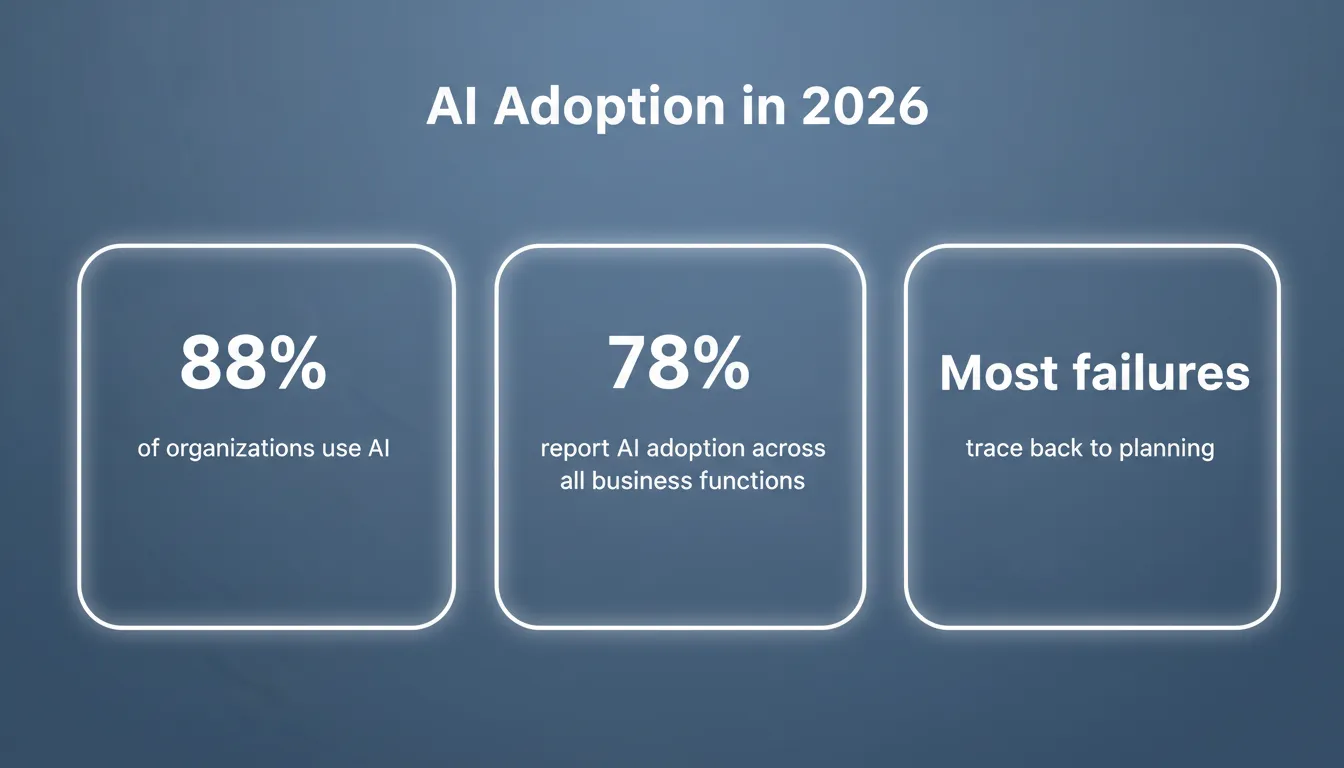
AI adoption is near-universal, but deployment failure rates remain high. Most failures trace back to planning and data preparation, not the model itself.
| Concept | What It Means |
|---|---|
| AI Training | Teaching the model using historical data |
| AI Testing | Validating model accuracy before release |
| AI Deployment | Making the model live and accessible to users |
| AI Monitoring | Tracking performance and catching issues post-launch |
| MLOps | Managing the full ML lifecycle in production |
Steps to Nail AI Deployment
Deploying AI is not just throwing a model at users and hoping it works. These steps are your roadmap: a mix of planning, data preparation, security, and ongoing monitoring.
Think of it like assembling IKEA furniture. Follow the instructions, and you will not end up with a chair that collapses when someone sits on it.
Step 1: Planning AI Deployment With Security in Mind
Good AI deployment starts with planning. Call it the blueprint phase.
Include everyone who touches personal data: engineers, product managers, data controllers, legal, and security teams. They help identify data security risks and governance requirements.
Ask questions like:
- What problem is the AI solving?
- What sensitive data is needed?
- Which security threats are likely?
- What does success look like, and how will it be measured?
This step also ensures compliance with laws like the General Data Protection Regulation (GDPR) and the California Consumer Privacy Act (CCPA) for California residents. GDPR fines reach up to 20 million euros or 4% of global annual turnover. CCPA penalties reach up to $7,988 per intentional violation. A well-planned deployment gives teams greater control and helps prevent costly data breaches.
Step 2: Preparing Data for AI Deployment
Next is data prep. This is arguably the stage where AI teams cry the most.
Clean, well-structured data matters more than a fancy algorithm.
Your checklist should include:
- Identify all storage devices and data sources (cloud, on-prem, databases)
- Fix missing values, errors, and duplicates
- Apply data masking for sensitive information like credit card data or passport numbers
- Set strong access controls and document who can access what
- Establish data lineage so you can trace every input back to its source
A little extra care here prevents data theft, human error, and data breaches later. If you work with health insurance information or financial information, consider data erasure plans for obsolete records.
Step 3: Model Training and AI System Setup
Once data is ready, it is time for the fun stuff: training AI models.
Training involves running iterations on training data, testing results, and refining models. Split your data into training, validation, and test sets to avoid skewed results.
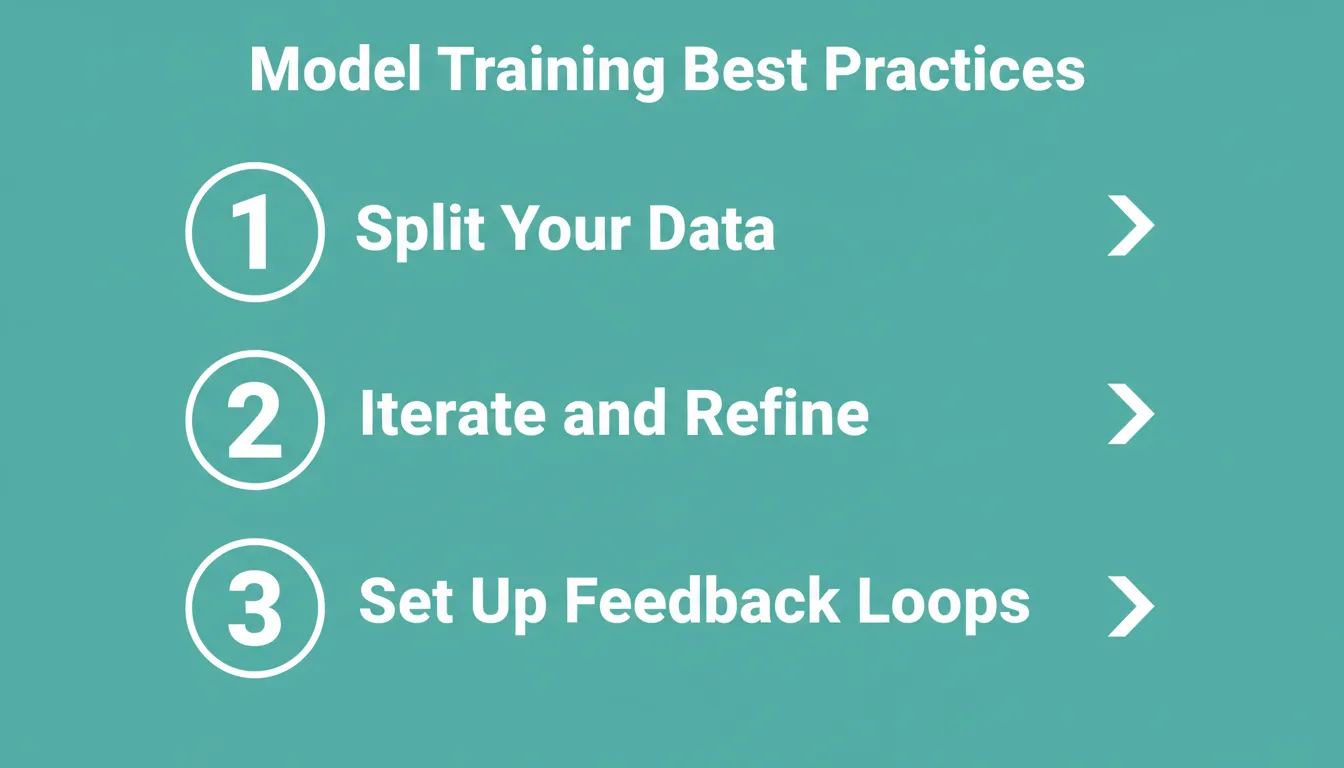
Even if your model performs well in testing, deployment may reveal new behaviors when exposed to real users. That is where feedback loops and monitoring come in handy.
Step 4: Rigorous Testing Before Deployment
Testing is where you break things on purpose, so they do not break in production.
Key areas to test:
- Edge cases and unexpected inputs
- Model bias and fairness across demographic groups
- Pipeline errors and integration failures
- Vulnerability to adversarial inputs and security threats
- Performance under high traffic loads
Simulate high traffic and unusual scenarios. You want the model to handle anything thrown at it, including user errors. Document all issues so fixes are trackable and team accountability stays clear.
Step 5: Applying Data Security Measures in AI Deployment
Security is not optional. Your AI might interact with personal data, financial information, sensitive personal information, or medical information. This is where reasonable security procedures save the day.
Security measures to consider:
- Strong access controls and role-based permissions
- Encryption for stored and in-transit data
- Continuous monitoring for anomalies
- Security policies aligned with data privacy laws
- Response plans for data breaches or data theft
- Regular third-party security audits
Even minor human errors can lead to serious financial losses or data theft. Following web application security best practices from the start is far less expensive than retrofitting compliance after launch.
Step 6: Deployment Environments for AI Models
Deploying AI is like picking the right launchpad for a rocket.
Considerations:
- On-premises vs cloud services vs hybrid
- Network, API, and gateway configuration
- Auto-scaling and load balancing
- Role-based access controls
- Data resiliency and backup strategies
Hybrid environments are popular. Sensitive data remains on-premises, while compute-intensive tasks run in the cloud. This approach balances security with performance.
Step 7: Monitoring and Maintaining Your Deployed Model
Going live is just the beginning. Continuous monitoring is key.
Model drift occurs when real-world data shifts away from the training data distribution. As a result, the model makes increasingly inaccurate predictions. Without proper tracking, drift goes undetected until it causes real damage.
Watch for:
- Performance dips and accuracy degradation
- Unexpected user behavior
- Security anomalies and human errors in data entry
- Data distribution shifts that affect model predictions
Collect user feedback, analyze it, and feed it into model updates. Keep data privacy in mind at all times, especially when handling sensitive data or health insurance information.
AI Deployment Workflow
AI deployment lifecycle: from planning and data preparation through model training, security review, live launch, and continuous monitoring.
Common AI Deployment Challenges
Even well-resourced teams run into the same obstacles. Knowing them in advance is half the battle.
1. Data quality problems Garbage in, garbage out. Inconsistent labeling, missing values, and biased training sets are the most common root cause of failed deployments.
2. Model drift The world changes. A model trained on last year's data may perform poorly on today's inputs. Without monitoring, drift goes undetected until it causes real damage.
3. Integration complexity AI models rarely live in isolation. Connecting them to existing databases, APIs, and workflows introduces latency, authentication issues, and version conflicts.
4. Compliance gaps Teams often treat GDPR and CCPA as a legal checkbox rather than an engineering requirement. Retrofitting compliance after deployment is significantly more expensive than building it in from the start.
5. Lack of rollback planning When a deployed model behaves unexpectedly, teams without a rollback plan face extended downtime. Version control and staged rollouts are non-negotiable.
6. Underestimating monitoring needs Many teams invest heavily in deployment and almost nothing in post-launch monitoring. Production AI systems require ongoing attention. They are not set-and-forget.
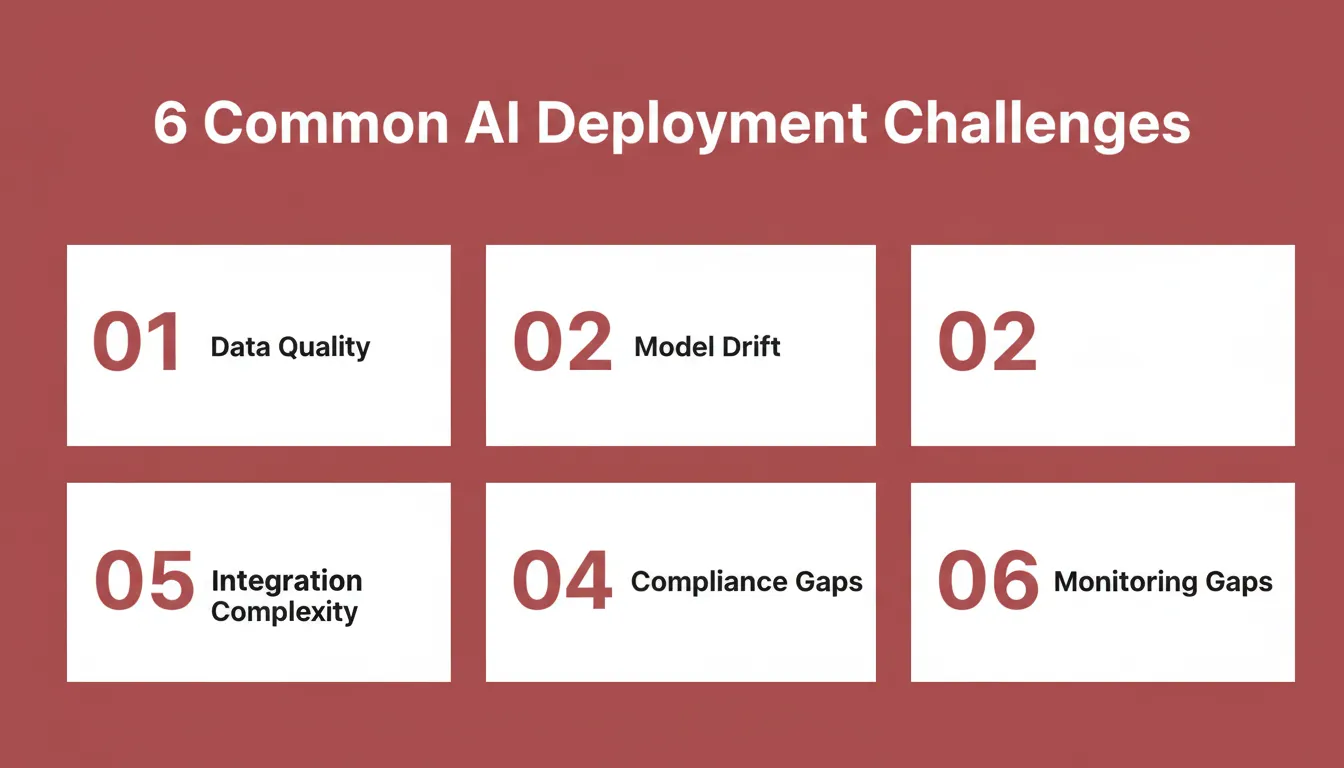
The six challenges that derail most AI deployments. Compliance gaps and the absence of rollback planning are the two most preventable and the two most commonly overlooked.
AI Deployment Checklist
This is your go-to cheat sheet for AI deployment. Follow each step, check off the boxes, and you will avoid messy surprises along the way.
| Step | Focus | Actions |
|---|---|---|
| Planning | AI deployment blueprint | Identify stakeholders, define goals, check compliance |
| Data Prep | Clean and secure | Fix missing values, apply data masking, set access controls |
| Model Training | AI model readiness | Version control, training data logging, feedback loop setup |
| Testing | Performance and security | Edge cases, bias, security threats, stress tests |
| Security | Protect sensitive info | Encryption, continuous monitoring, policy enforcement |
| Deployment | Live launch | API config, cloud/on-prem, scaling, rollback plans |
| Monitoring | Maintain AI | Track metrics, user feedback, update deployed model |
This table is your playbook for keeping AI deployment smooth, secure, and predictable. Check off each step, pay attention to sensitive data, and your deployed model will run like a well-oiled machine.
Real-World AI Deployment Examples by Industry
Understanding how AI deployment works in practice helps teams apply the right approach for their context. For example, application deployment automation looks different depending on the industry, the data involved, and the compliance requirements in play.
| Industry | AI Deployment Use Case | Key Compliance Concern |
|---|---|---|
| Healthcare | Diagnostic imaging models, patient risk scoring | HIPAA, data minimization |
| Financial Services | Fraud detection, credit scoring, trading algorithms | GDPR, CCPA, model explainability |
| Retail | Recommendation engines, demand forecasting | CCPA, cookie consent |
| HR and Recruiting | Resume screening, candidate ranking | Bias audits, GDPR |
| Customer Support | Chatbots, ticket classification | Data retention policies |
| Manufacturing | Predictive maintenance, quality control | On-premises preferred for IP protection |
AI Deployment Tools: What Teams Actually Use
Choosing the right tooling reduces manual work at every stage of the deployment pipeline.
| Tool Category | Purpose | Examples |
|---|---|---|
| Model training frameworks | Build and train models | TensorFlow, PyTorch, scikit-learn |
| MLOps platforms | Manage the full ML lifecycle | MLflow, Kubeflow, Weights and Biases |
| Model serving | Deploy models as APIs | TensorFlow Serving, Triton, BentoML |
| Monitoring | Track model performance in production | Evidently AI, Arize, WhyLabs |
| Data pipelines | Prepare and move data | Apache Airflow, dbt, Fivetran |
| App building | Build interfaces that connect to AI systems | Rocket, Vercel, Netlify |
| Compliance | GDPR/CCPA consent management | OneTrust, Cookiebot |
For a deeper look at what is available, the best AI app deployment tools guide covers platforms suited to different team sizes and deployment needs.
Community Insight: AI Deployment Lessons
From Reddit, a discussion in the r/VibeCodeDevs community:
"Rocket just getting great feedback and 400k users in just 16 weeks. Salesforce Accel Ventures just did their seed round."
This shows teams need realistic expectations when using AI deployment tools. Early platforms save time, but you still need governance and data security measures in place.
How Rocket Supports AI Deployment
Rocket.new is a vibe solutioning platform that combines strategic research, AI app building, and competitive intelligence into a single product. 1.5 million people have tried Rocket across 180 countries, from solopreneurs to enterprise teams.
For teams deploying AI, Rocket addresses a specific problem: building the production-ready interfaces, dashboards, and backend scaffolding that connect to AI systems takes weeks when done manually. Rocket reduces that to hours.
Rocket's three pillars work together across the deployment cycle:
- Solve validates ideas, runs market research, and produces structured reports. Teams understand what they are building before a single line of code is written.
- Build generates production-grade Next.js web apps and Flutter mobile apps from natural language prompts or Figma designs. Every build ships with GDPR coverage, WCAG accessibility compliance, SEO-ready structure, and performance optimization by default.
- Intelligence monitors competitors continuously, including pricing changes, product updates, and hiring signals. Teams can adapt their AI products as the market shifts.
Building a secure AI platform requires compliance to be built in, not bolted on. Rocket handles GDPR consent banners, cookie categorization, and privacy policy pages on request. It also provides staging and production environments with full version history and one-click rollback.
Rocket Build: What It Produces for AI Teams
| Capability | What It Means for AI Deployment |
|---|---|
| Next.js web apps | Production-grade interfaces for AI tools, dashboards, and portals |
| Flutter mobile apps | iOS and Android apps that connect to AI backends |
| Supabase integration | Backend schema, auth, and queries handled automatically |
| GDPR/CCPA compliance | Cookie consent, policy pages, geo-based consent flows built in |
| 25+ integrations | OpenAI, Anthropic, Gemini, Stripe, and more authenticate once and flow into every build |
| One-click deployment | Staging and production with version history and rollback |
| Built-in analytics | Visitors, conversions, and Core Web Vitals tracked from day one |
Rocket accelerates AI deployment by handling backend scaffolding, frontend generation, and integrations from a single prompt. Keep an eye on token use and data security, and it becomes a practical tool for prototyping and shipping AI-powered workflows.
Why AI Deployment Matters
Many teams rush to deployment without proper planning. As a result, they leave sensitive data exposed or create faulty models. Follow the step-by-step plan: prepare data, train models, test thoroughly, apply reasonable security procedures, and monitor continuously.
With careful execution, teams get stable, secure, and valuable AI systems. Doing AI deployment right protects sensitive personal information, reduces data security risks, and keeps your business operations running smoothly.
The cost of getting it wrong is high. GDPR fines reach up to 20 million euros or 4% of global annual turnover. CCPA penalties reach up to $7,988 per intentional violation. Beyond fines, a poorly deployed AI model that mishandles personal data or produces biased outputs can cause reputational damage that no fine can fully capture.
Ship AI-Powered Products That Are Built to Last
AI deployment is not a one-time event. It is an ongoing practice. The teams that get it right plan before they build, treat compliance as an engineering requirement, and monitor continuously after launch.
As AI systems become more embedded in business operations, the gap between teams that deploy thoughtfully and those that do not will widen. Every stage of ai deployment, from data preparation to post-launch monitoring, shapes whether the system earns trust or erodes it.
Rocket turns the full deployment cycle, including research, build, and monitoring, into a single connected workflow. Describe what you need, and Rocket generates production-ready apps with GDPR coverage, WCAG compliance, and 25+ integrations built in from day one. Start building with Rocket and ship AI-powered products that are built to last.
Table of contents
- -Steps to Nail AI Deployment
- -Step 1: Planning AI Deployment With Security in Mind
- -Step 2: Preparing Data for AI Deployment
- -Step 3: Model Training and AI System Setup
- -Step 4: Rigorous Testing Before Deployment
- -Step 5: Applying Data Security Measures in AI Deployment
- -Step 6: Deployment Environments for AI Models
- -Step 7: Monitoring and Maintaining Your Deployed Model
- -AI Deployment Workflow
- -Common AI Deployment Challenges
- -AI Deployment Checklist
- -Real-World AI Deployment Examples by Industry
- -AI Deployment Tools: What Teams Actually Use
- -Community Insight: AI Deployment Lessons
- -How Rocket Supports AI Deployment
- -Rocket Build: What It Produces for AI Teams
- -Why AI Deployment Matters
- -Ship AI-Powered Products That Are Built to Last