Most consultants have already built the asset. The methodology is proven, the outcomes are repeatable, and the intellectual property is mature. What is missing is the packaging that turns it into a paid digital service.
Why do the sharpest consultants still give away their most profitable thinking for free?
The answer is packaging, not quality. The global management consulting market reached $357.85 billion in 2025, growing at 4.70% CAGR. Yet most practitioners remain stuck billing by the hour for frameworks they have already perfected and delivered a dozen times over.
Methodologies buried inside slide decks and PDFs cannot be sold, scaled, or experienced independently.
This blog breaks down the economics, the structure, and the technology behind turning repeatable consulting methods into paid, interactive digital products.
Why Selling Your Hours Costs More Than You Think
Most consultants price their work by the hour or the engagement. That model places a hard ceiling on earnings, because revenue stops the moment work stops.
-
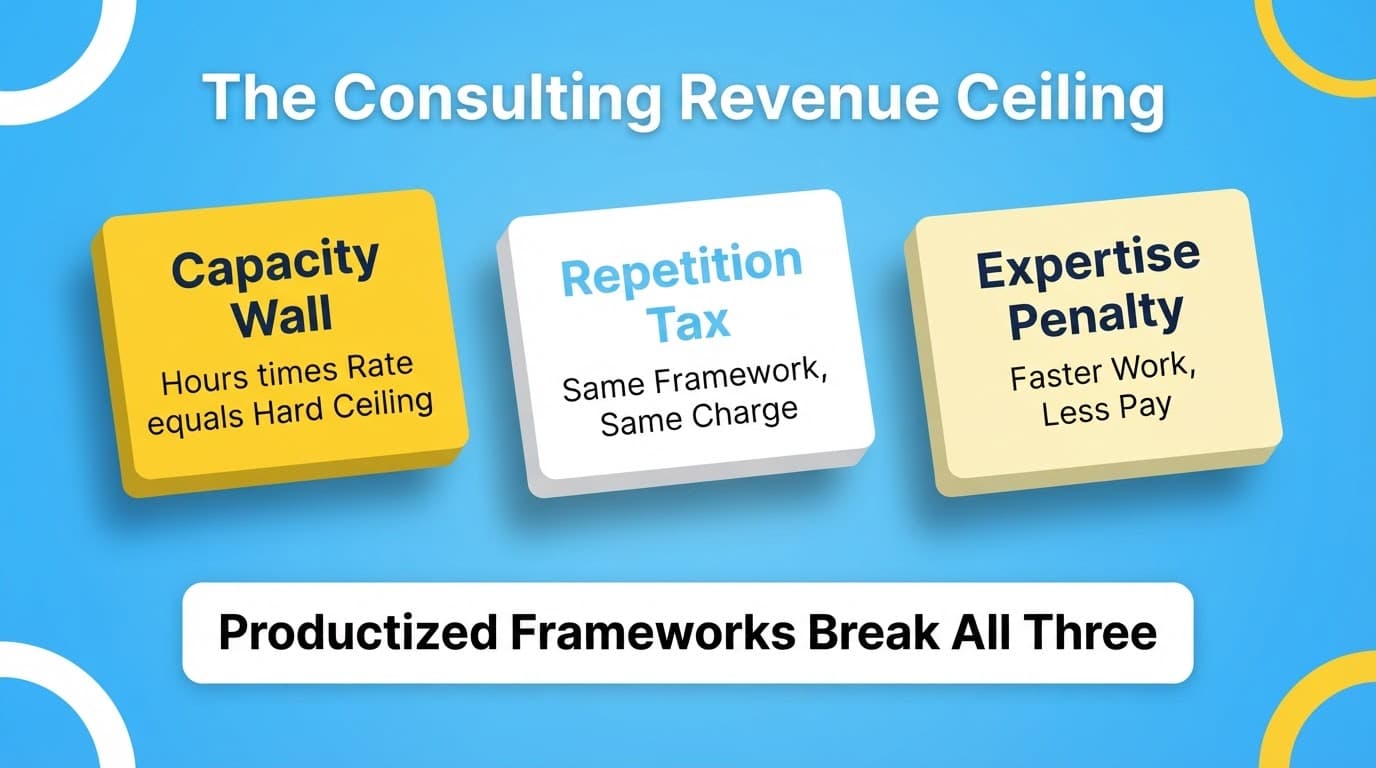
Revenue has a built-in cap. A consultant billing $250 per hour for 30 billable hours a week maxes out around $390,000 per year before expenses. Scaling past that requires hiring, which adds overhead rather than profit.
-
The same framework ships on repeat. Running the same strategic planning process for fifteen clients means charging for repetition, not invention. The intellectual property is already mature.
-
Time-based pricing punishes expertise. The faster a problem gets solved, the fewer hours it takes. That means earning less for doing better work.
-
Productized frameworks earn while offline. A gated digital version of that planning process can serve hundreds of clients at once, with no scheduling conflicts and no capacity walls.
The shift is not about abandoning consulting work. It is about adding a second revenue layer that compounds over time.
Who Should Consider Productizing Their Framework
Not every consulting methodology is ready to become a digital product. The ones that are share a specific set of characteristics.
You have delivered it at least five times with consistent results. Repetition proves replicability. When the same process produces the same category of outcome across different clients, it can be structured for self-service.
The process has clear inputs and defined stages. A methodology with a discovery checklist, an analysis phase, and a recommendation template is ready. One with fuzzy entry points and judgment-heavy steps at every turn is not.
The outcome is measurable. Clients need to know what they are buying. "Strategic clarity" is not a product. "A 90-day market-entry roadmap with competitive positioning and a prioritized action list" is a product.
The client can do most of the work. The best digital consulting products guide clients through a structured process. They produce outputs based on the client's own inputs, not the consultant's live presence.
Before building anything, use Solve to validate whether your framework addresses a real market need. This step helps scope the opportunity before investing time in production.
What Separates an Interactive Playbook From a Static PDF?
Calling something a "digital product" does not mean saving a Word document as a PDF and charging for the download. The difference between static and interactive content determines whether clients actually finish the process.
| Feature | Static Playbook (PDF) | Interactive Playbook (Web App) |
|---|---|---|
| Client experience | Read once, shelve forever | Step-through guided flow |
| Data capture | None | Intake forms collect client inputs |
| Personalization | Generic advice for all | Tailored outputs based on inputs |
| Progress tracking | Not possible | Built-in milestones and dashboards |
| Access control | Email attachment, easily shared | Role-based login, tiered access |
| Updates | Re-send the file manually | Push changes live instantly |
Static formats trade convenience for zero engagement data. Interactive formats show exactly where clients drop off, which modules they revisit, and what decisions they make. That data makes every iteration of the product sharper.
How To Build a Paid Consulting Framework Step by Step
Turning a consulting methodology into a paid digital product follows a repeatable path. The process requires more structure than technical skill.
-
Identify your most repeatable framework. Pick the methodology delivered at least five times with consistent results. It should have clear inputs, defined stages, and a measurable outcome.
-
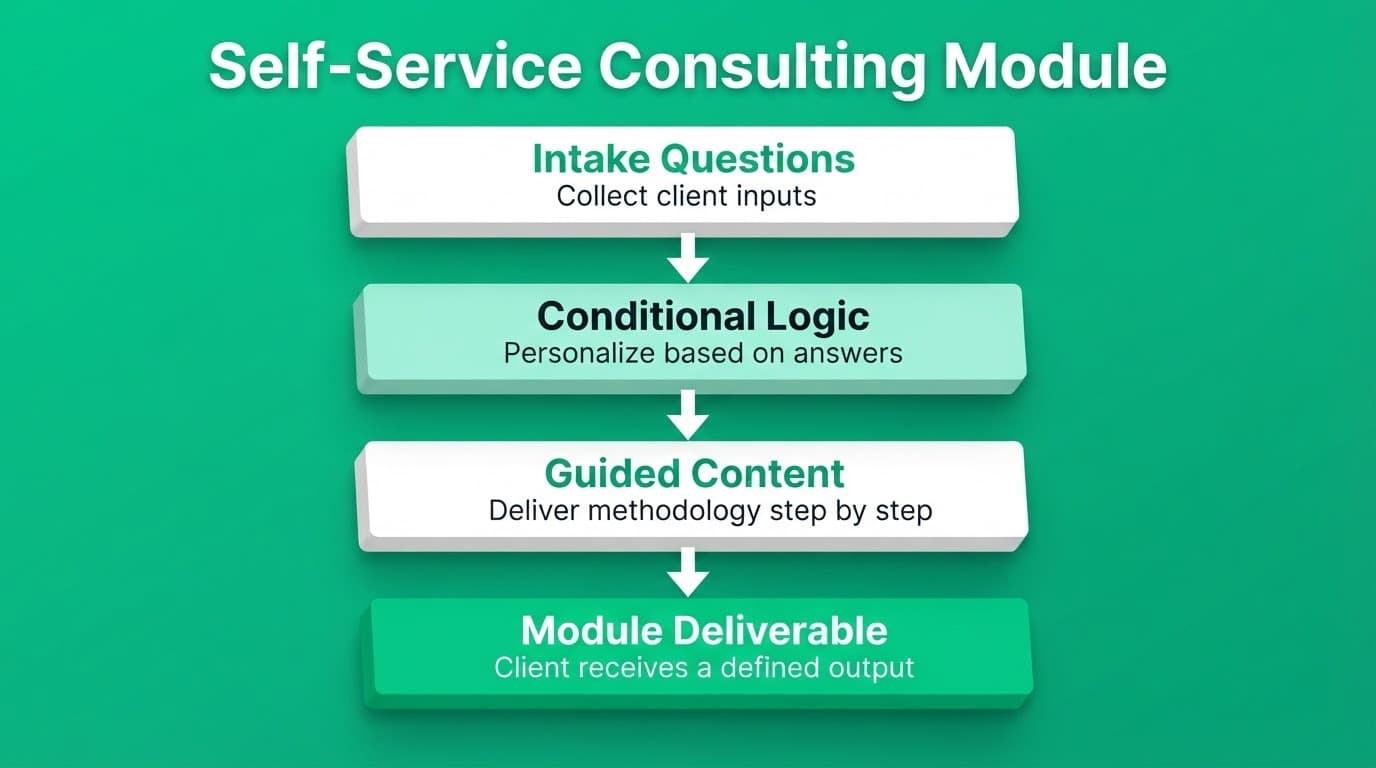
Break it into self-service modules. Each module maps to one phase of the consulting engagement: discovery, analysis, recommendation, and execution. Clients move through them at their own pace.
-
Add intake flows and decision logic. Forms, branching questions, and conditional steps replace the back-and-forth emails that slow traditional engagements. This layer is what separates a sellable product from a static document.
According to TechRT's creator economy research, digital products like courses and templates generate 70% to 90% profit margins for creators. Consulting frameworks structured as gated digital services fall into the same category. They carry even stronger pricing power because the underlying methodology comes from a practitioner with a verified track record.
Four-phase process: Document, Structure, Build, and Launch a productized consulting framework
Pricing and Gating Models That Actually Convert
Getting the framework built is half the challenge. Getting the pricing right determines whether the product generates meaningful revenue or sits behind a login page collecting dust.
One-time access works for standalone assessments. Think of a market-entry readiness audit, a pricing strategy workbook, or a competitive positioning analysis. The client pays once, works through the process, and receives the deliverable.
Tiered access fits multi-phase methodologies where different clients need different levels of support. A three-tier structure works well for most consulting frameworks.
| Tier | What Is Included | Typical Price Range |
|---|---|---|
| Preview | Module 1 only, no deliverable | No charge |
| Self-guided | Full framework, automated outputs | $497 to $997 |
| Premium | Full framework plus async review session | $1,500 to $3,000 |
Subscription models suit ongoing advisory frameworks. Compliance checklists, competitive monitoring dashboards, and quarterly strategy refreshes all fit naturally into monthly or annual billing cycles. Recurring revenue is the single biggest financial advantage of productized consulting.
Gating should match the value curve. Open the first module to build trust. Require login for subsequent steps to capture the lead. Then require payment for the outputs. This mirrors the natural sales conversation consultants already have, but automates it entirely.
For more on what types of productized services are gaining traction, see new SaaS ideas that are actually buildable. Many of the patterns there apply directly to consulting frameworks.
Common Mistakes That Kill Productized Consulting Launches
Most productized consulting products that fail do so for one of five reasons. Knowing them in advance saves months of rework.
Productizing too early. A framework delivered twice is not ready to be productized. It has not been tested enough to reveal where clients get stuck or what outputs they actually need. Deliver it at least five times before building the digital version.
Building for the wrong buyer. The self-service version of a framework serves a different buyer than full engagement clients. They have less budget, less patience for ambiguity, and need the product to be more prescriptive, not less.
Skipping the intake flow. A productized framework without an intake flow is just a course. The intake is what makes the output feel personalized. It also collects the data needed to improve the product over time.
Underpricing to test demand. Pricing a $20,000 methodology at $97 signals low value and attracts the wrong clients. Start at 3 to 5% of the typical engagement fee. A self-service version at $600 to $1,000 is a credible entry point.
Launching without a pilot cohort. Run five clients through the documented process before opening it to the public. The gaps they find are cheap to fix before launch and expensive to fix after.
Building the Platform: What the Technical Layer Looks Like
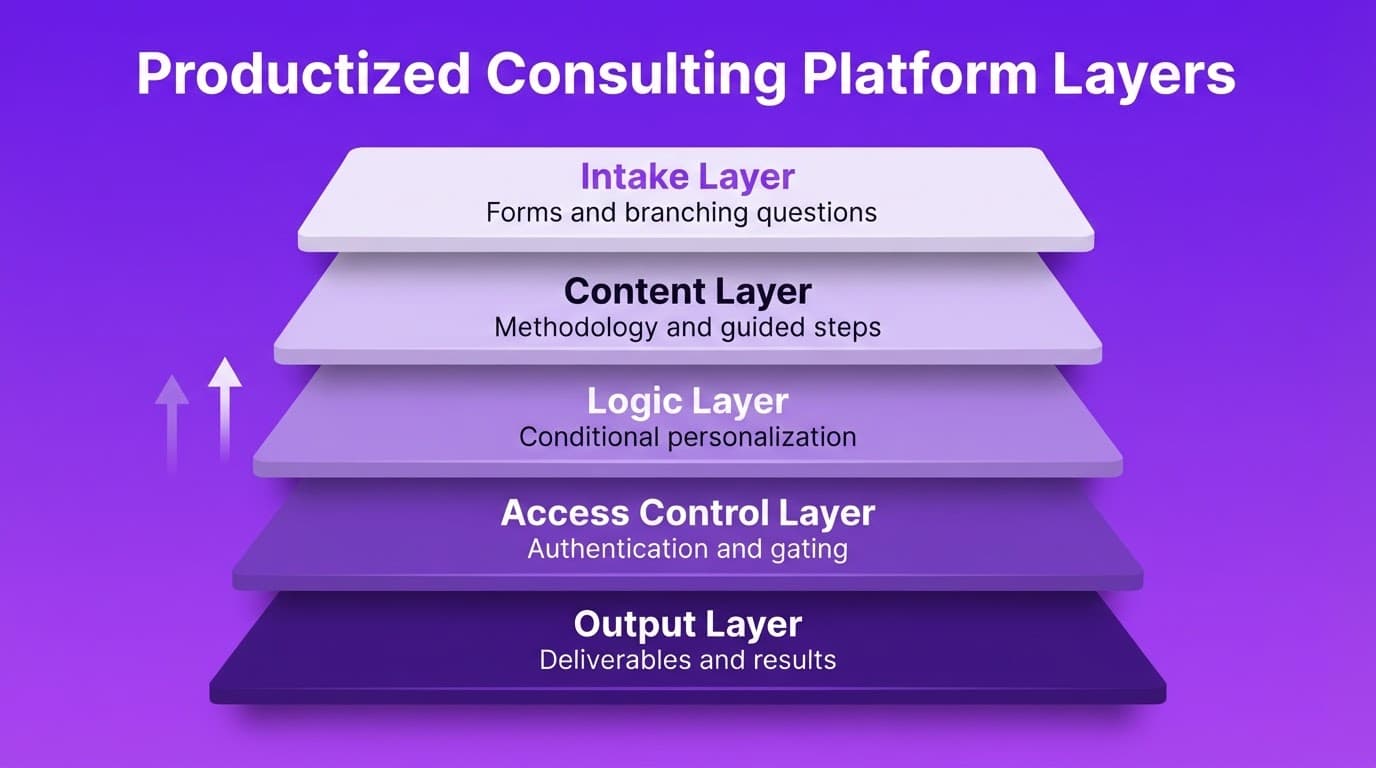
A productized consulting framework platform has five functional layers. Understanding them helps describe the build accurately and get a closer first result.
Intake layer. Forms and branching questions collect client data at the start of each module. The data collected here drives personalization throughout the rest of the process.
Content layer. Guidance, frameworks, templates, and instructions walk the client through each phase. This is the methodology itself, delivered in a structured format.
Logic layer. Conditional rules personalize the experience based on intake data. A client who selects "B2B SaaS" gets different analysis prompts than one who selects "professional services."
Access control layer. Authentication and role-based permissions enforce the gate. Different tiers see different content and different deliverables.
Output layer. Deliverables arrive at the end of each module: completed worksheets, generated strategy documents, and prioritized action lists. These are what the client is paying for.
You describe all of this in plain language. Build generates a production-ready web application with the UI, backend logic, authentication, and payment integration already wired together. Connectors for Stripe, Supabase, Calendly, Resend, and 25 or more other services connect in a single step, with no separate configuration required.
What Consultants Are Saying About This Shift
The move from custom engagements to productized digital services is not theoretical. Consultants across industries are testing, launching, and scaling these models right now.
Mike Koziol, a consultant focused on scaling advisory businesses, shared this on LinkedIn:
"Want to scale and productize your consulting but don't know how? I'm building an inventory of productized playbooks specifically built for specific industries and offers and services." — Mike Koziol on LinkedIn
Consultants are not just thinking about productization. They are building libraries of repeatable, sellable frameworks. The ones who move first claim the positioning in their niche before competitors catch on.
The economics back up the timing. With over 200 million content creators globally and digital education hitting $32.36 billion in 2025, the buyer behavior and infrastructure already exist. Consulting frameworks carry more authority than a typical online course because they come from practitioners with verified track records.
Once a productized framework is live, the work does not stop at launch. Use Intelligence to monitor how competitors in your niche are positioning their own frameworks. Catch pricing shifts, new feature releases, and messaging changes before they affect your positioning.
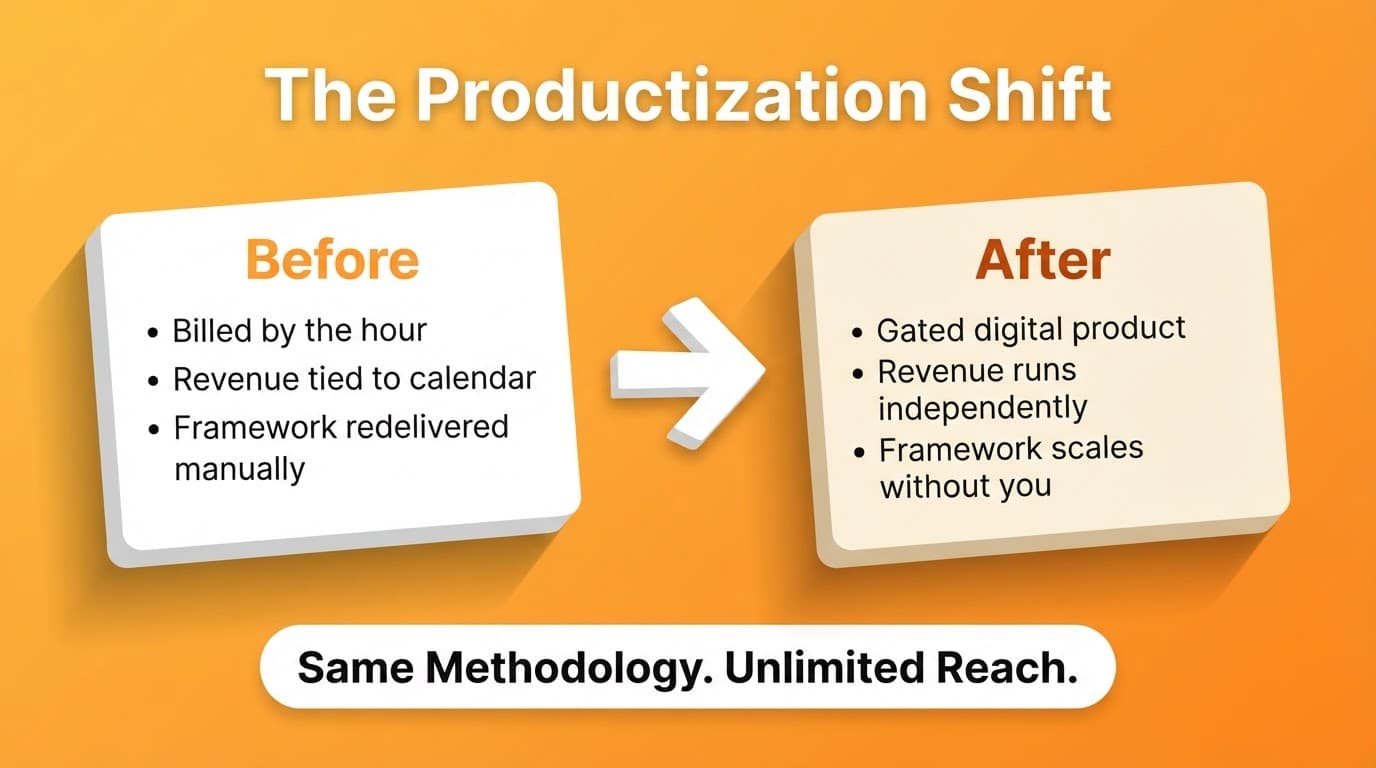
Your Framework Already Has a Price Tag on It
The methodologies sitting inside client folders were built through years of iteration, testing, and real-world feedback. They already carry value that clients would pay to access on their own timeline, without waiting for a calendar to open.
The tools, the buyer behavior, and the pricing models all exist today. Consultants who structure their frameworks as interactive, gated digital products capture revenue from clients they would never have time to serve individually. The question is not whether this model works. It is whether you package yours before someone else in your niche does.
The Future of Consultant Playbooks as Paid Digital Services
Turning consultant playbooks into a paid digital service is no longer a niche experiment. It is the next logical step for any practitioner with a proven methodology. As AI-powered platforms continue to lower the technical barrier to building, the competitive advantage shifts entirely to the quality of the underlying framework and the speed of execution.
The consultants who act now will own the positioning in their niche before it becomes crowded. Describe your methodology, deploy your platform, and start generating revenue from work you have already done. Sign up for Rocket.new and go from documented framework to live product.
Table of contents
- -Why Selling Your Hours Costs More Than You Think
- -Who Should Consider Productizing Their Framework
- -What Separates an Interactive Playbook From a Static PDF?
- -How To Build a Paid Consulting Framework Step by Step
- -Pricing and Gating Models That Actually Convert
- -Common Mistakes That Kill Productized Consulting Launches
- -Building the Platform: What the Technical Layer Looks Like
- -What Consultants Are Saying About This Shift
- -Your Framework Already Has a Price Tag on It
- -The Future of Consultant Playbooks as Paid Digital Services