These 15 structured AI prompts help you build an AI email assistant that can triage, draft, and personalize at scale. They cover inbox management, auto-replies, follow-ups, and campaign scheduling.
How much of your workday disappears into your inbox?
For most professionals, the answer is uncomfortable. A Forbes Advisor survey found that 61% of companies already use AI to optimize email workflows. The gap between those teams and everyone else keeps growing.
The problem is not a lack of AI tools. It is a lack of the right instructions. A vague prompt produces vague output. A specific, structured prompt turns the same model into something that genuinely saves hours.
This blog gives you 15 prompts you can copy today, a framework for writing your own, and a clear path to turning all 15 into one working email assistant.
What is an AI Email Assistant?
An AI email assistant is a system powered by a large language model. It automates inbox tasks like sorting messages, drafting replies, generating follow-up sequences, and scheduling campaigns.
The simplest version is a prompt you paste into ChatGPT. The most capable version is a deployed application connected to your actual inbox. It runs logic automatically without you triggering each step.
An AI email assistant can handle:
-
Triage and categorize incoming messages by urgency
-
Draft first-touch replies, follow-ups, and objection responses
-
Summarize long threads into brief, actionable notes
-
Generate personalized outreach at scale
-
Schedule campaigns based on open-rate and reply-rate data
-
Re-engage dormant subscribers with win-back sequences
Which AI Model Works Best for Email Tasks?
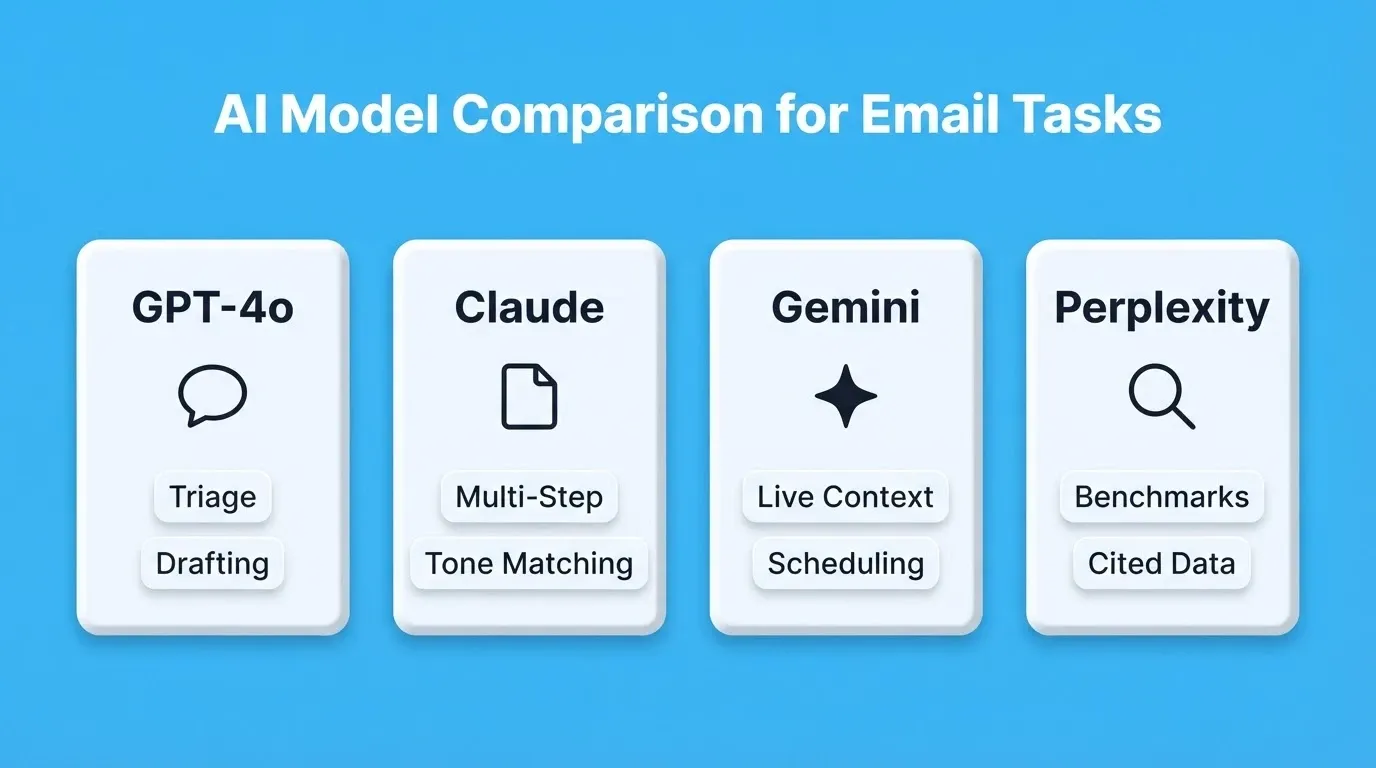
Before picking prompts, pick the right model. Each one handles email tasks differently.
| AI Model | Best Email Use Cases | Key Strength | Watch Out For |
|---|---|---|---|
| OpenAI GPT-4o | Triage, drafting, follow-ups, A/B tests | Broadest task range, reliable formatting | Can be verbose without word-limit constraints |
| Anthropic Claude | Long-form replies, multi-step instructions | Follows complex rules precisely, natural tone | Slower on high-volume batch tasks |
| Google Gemini | Drafts with real-time context | Strong at integrating live data | Less consistent on tone matching |
| Perplexity | Prompts needing cited benchmarks | Fact-based answers with sources | Not ideal for pure drafting tasks |
Start with GPT-4o for most tasks. Switch to Claude when you need replies that follow complex multi-step rules. Use Perplexity when your prompt needs real-time industry data.
What Makes a Great Prompt for an AI Email Tool?
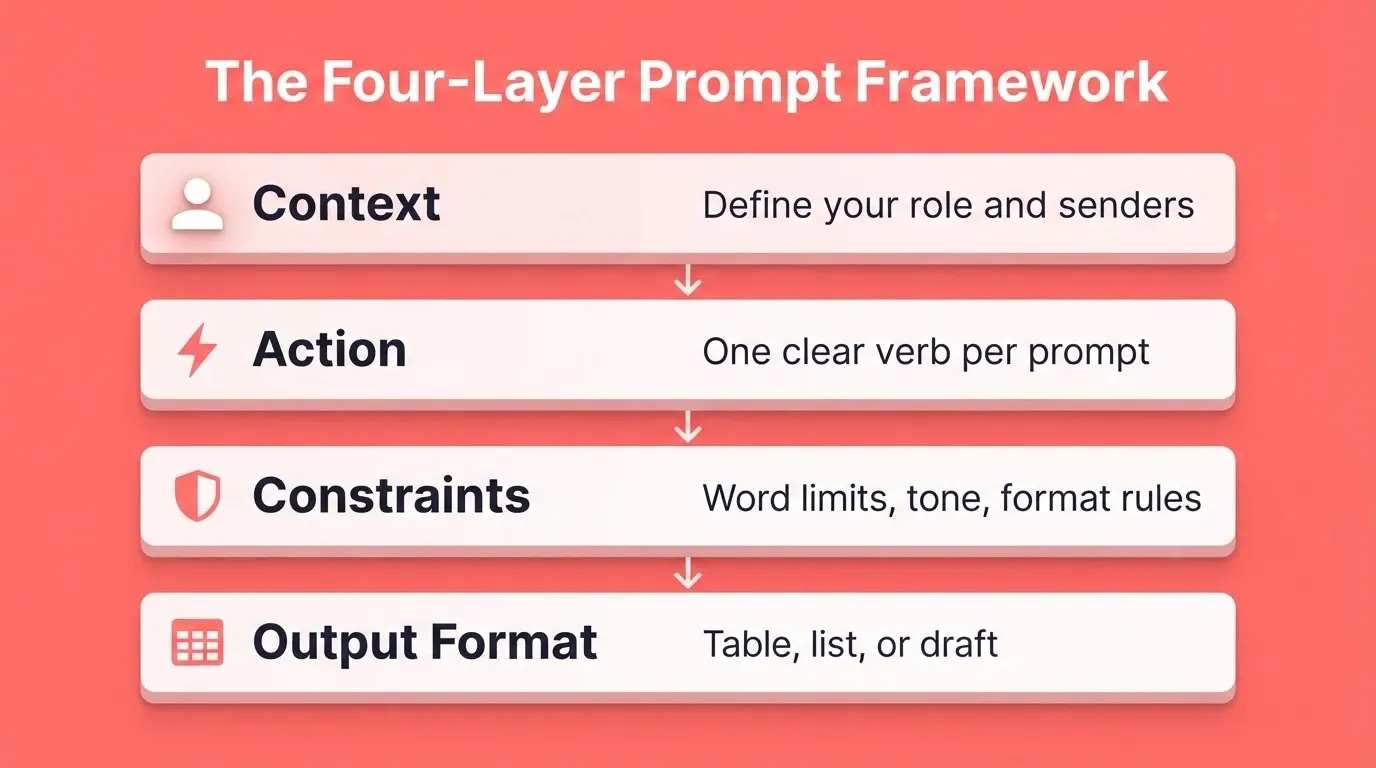
Most weak prompts skip one of four layers. Stack all four and your prompts start producing results instead of just generating text.
-
Context sets the stage. Telling the AI "I am a B2B sales rep handling 100+ emails per day" gives it a working frame. Without context, outputs stay generic.
-
Action names the task. Sort, draft, summarize, flag, schedule. One verb per prompt keeps outputs focused.
-
Constraints add guardrails. Word limits, tone preferences, and formatting rules prevent the AI from rambling or striking the wrong tone.
-
Output format defines shape. A table, numbered list, or draft email gives the AI a target structure instead of free-form paragraphs.
For a deeper look at structuring prompts for complex tasks, see prompt engineering best practices for accurate AI results.
Inbox Organization and Priority Management Prompts
These five prompts handle the most common inbox bottleneck: figuring out what matters. Each one targets a different scenario, so pick the ones that match your workflow.
Prompt 1: Priority Triage Engine
I am a [your role] who receives [volume] emails daily across [types of senders]. Scan my unread inbox and categorize every message into three tiers: Urgent (needs a response within 4 hours), Important (needs a response this week), and Low (informational, no response needed). Output a table with columns for Sender, Subject Line, Tier, and Recommended Next Action. Sort by tier, with Urgent at the top.
Why it works: The role context stops the AI from treating a newsletter the same as a client escalation. The table format makes the output scannable in seconds.
Prompt 2: Newsletter and Subscription Audit
Review all marketing emails, automated notifications, and newsletter subscriptions in my inbox from the past 14 days. Group them by sender. For each sender, show: how many emails they sent, whether I opened any of them, and a recommendation of Keep, Digest (batch into weekly summary), or Unsubscribe. Present the results as a ranked table, with Unsubscribe recommendations at the top.
Pro tip: Run this prompt monthly. Most people accumulate 3 to 5 new subscriptions per month without realizing it.
Prompt 3: Pre-Meeting Intelligence Briefing
I have a meeting about [topic] with [attendees] on [date]. Pull every email thread from the past 3 weeks that involves any of these people or references this topic. Summarize the key discussion points, any unresolved questions, decisions already made, and my outstanding action items. Format the output as a one-page briefing I can read in under 5 minutes, with a section for each category.
Why it works: The attendee list and topic filter stops the AI from pulling irrelevant threads. The 5-minute constraint forces conciseness.
Prompt 4: Client Relationship Timeline
Build a complete email timeline with [client name] for the past 60 days. For each exchange, capture: the date, who initiated the message, a one-sentence summary of the content, and whether any commitment or deadline was mentioned. Flag any commitments I made but have not yet fulfilled. End with a Relationship Health summary noting average response time, communication frequency, and any red flags.
Prompt 5: End-of-Day Executive Summary
It is 5:30 PM. Review every email I received today and produce a 10-item bullet summary of the most important messages. For each item, include the sender, a one-line summary, and whether it needs action before tomorrow 9 AM. Group actionable items first, then informational items. If fewer than 10 messages are notable, do not pad the list.
Pro tip: Add "If nothing requires action before tomorrow, say so explicitly" to avoid false urgency.
These sorting prompts can recover hours each week. HubSpot's research shows that email marketing ROI ranges from 10:1 to 36:1. Keeping revenue-related threads visible directly protects the conversations that drive results.
Further Reading: A Practical Guide to Natural Language Prompts
Can You Automate Email Replies and Drafts?
Yes. These five prompts cover the reply scenarios that eat the most time. Each one includes tone and length constraints because most AI-drafted emails fail on voice, not content.
Prompt 6: First-Touch Auto-Acknowledgment
A new contact just emailed me for the first time. Draft a reply that: (1) thanks them by name for reaching out, (2) confirms I received their message, (3) sets the expectation that I will send a detailed response within [timeframe], and (4) includes one line that references something specific from their original email to show it was read, not auto-generated. Keep the total reply under 75 words. Tone: professional, warm, not corporate.
Why it works: The "reference something specific" instruction is the difference between a reply that feels human and one that feels templated.
Prompt 7: Sales Objection Responder
A prospect replied to my outreach with this objection: [paste objection]. Draft a response that: (1) acknowledges their concern without being defensive, (2) reframes the objection by connecting it to a specific outcome they care about, (3) includes one brief proof point (customer result, stat, or case reference), and (4) closes with a low-pressure next step. Keep the reply under 120 words. Do not use the word 'just' or start any sentence with 'I understand.'
Pro tip: Swap the closing CTA between "quick call," "short video walkthrough," and "case study link" across different prospects to avoid sounding robotic.
Prompt 8: Three-Part Follow-Up Sequence
A prospect opened my initial email but did not reply. Create a 3-email follow-up sequence spaced 3 business days apart. Email 1: Share one insight or data point relevant to their industry without asking for anything. Email 2: Reference a specific result from a similar company (use [case study details] if available). Email 3: Offer a clear exit, either a 15-minute call or a polite close that leaves the door open. Each email must be under 100 words and have a different subject line.
Prompt 9: Empathetic Refund Handler
A customer emailed requesting a refund for [product/service]. Here is their message: [paste message]. Draft a response that: (1) leads with empathy, not policy, (2) clearly explains their options based on our [refund policy summary], (3) provides the exact next steps they need to take, and (4) offers one alternative if they are eligible (credit, exchange, extended trial). Tone: calm, clear, solution-oriented. Avoid corporate language. Under 150 words.
Prompt 10: Weekly Team Status Update
Draft my weekly status update email for [team/manager name]. Structure it with three sections: Completed This Week (bullet list of 3 to 5 items with one-line descriptions), Focus for Next Week (2 to 3 priorities), and Blockers or Help Needed (list any, or write 'None this week'). Use my notes: [paste rough notes]. Keep the total email under 200 words. Tone: direct, no filler.
Why it works: Feeding rough notes into the prompt means the AI structures your thinking rather than inventing content from scratch.
These drafting prompts work with any major language model. For teams building marketing automation workflows around email, the same four-layer framework applies across every prompt type.
Ready to turn these 10 prompts into a working email tool? Describe your assistant to Rocket and it builds the full application for you. No code needed. Start building on Rocket
Which Prompts Work for Scheduling and Personalization?
The final five prompts address the two areas where most email workflows fall apart at scale: sending at the wrong time and sounding like everyone else. HubSpot's data shows 93% of marketers say personalization improves leads or purchases, but only 13% use advanced techniques.
Prompt 11: Send-Time Optimizer
Analyze my outbound email performance from the past 90 days. Identify patterns in open rates and reply rates by: day of week, time of day (morning, midday, afternoon, evening), and recipient time zone. Present the results as a recommended weekly send schedule, broken down by day and time slot, with a confidence note for each slot (high, medium, low based on data volume).
Why it works: The confidence note stops you from over-indexing on slots with tiny sample sizes.
Prompt 12: Hyper-Personalized Outreach
I am reaching out to [name], [title] at [company]. Here is what I know about them: [paste LinkedIn summary, recent post, company news, or mutual connection]. Draft a cold email under 100 words that: (1) opens with a specific reference to their recent work or a challenge their role typically faces, (2) connects that challenge to one thing I can help with, and (3) ends with a question, not a pitch. Subject line: 6 words or fewer. Do not use the words 'reaching out,' 'hope this finds you well,' or 'I'd love to.'
Pro tip: Feed the AI a different data point for each prospect. A LinkedIn post, a podcast appearance, a company press release. The specificity of the input determines the specificity of the output.
Prompt 13: Quarterly Campaign Calendar
Create an email campaign calendar for Q[number] [year] targeting [audience]. For each week, suggest: the campaign type (educational, promotional, engagement, or re-activation), a one-sentence subject line concept, the best send day based on industry benchmarks for [industry], and any relevant holidays, conferences, or seasonal events to tie into. Output as a table with columns for Week, Campaign Type, Subject Line Concept, Suggested Send Day, and Tie-In Event.
Prompt 14: Win-Back Re-Engagement Series
Build a 3-email re-engagement sequence for subscribers who have not opened any emails in 60 or more days. Email 1 (Day 0): Ask a direct, personal question that reconnects to why they originally signed up. Email 2 (Day 4): Offer a specific, named free resource that delivers immediate value. Email 3 (Day 8): Be transparent. Tell them you will remove them from the list in 7 days unless they click, and make that click effortless. Each email under 80 words. Subject lines must be curiosity-driven, not desperate.
Why it works: The "not desperate" constraint stops the AI from generating needy subject lines like "We miss you!" that tank open rates.
Prompt 15: A/B Test Architect
Design a complete A/B test for my next email campaign to [audience] about [topic]. Create two versions: Version A uses a question-based subject line and opens with a statistic. Version B uses a benefit-driven subject line and opens with a micro-story. For each version, write the subject line, preview text (under 40 characters), and first two paragraphs. Then define: the success metric, minimum sample size for significance, and the test duration. Present everything in a side-by-side comparison table.
If you are also building a social media scheduler alongside your email assistant, many of these same prompt patterns apply directly to scheduling and outreach workflows.
Further Reading: Best Prompts for App Building
Prompt Category Comparison at a Glance
Here is a quick reference for deciding which prompts to start with based on your biggest bottleneck.
| Category | Prompts | Best For | Who Benefits Most | Difficulty | Daily Time Saved |
|---|---|---|---|---|---|
| Inbox Organization | 1 to 5 | Sorting, filtering, summarizing threads | Everyone with 50 or more daily emails | Beginner | 30 to 60 min |
| Auto-Reply and Drafts | 6 to 10 | Responding, following up, internal updates | Sales reps, support teams, managers | Intermediate | 45 to 90 min |
| Scheduling and Personalization | 11 to 15 | Timed outreach, custom messaging, A/B tests | Marketers, founders, growth teams | Advanced | 60 to 120 min |
Here is a decision flowchart for choosing where to start.
From 15 Separate Prompts to One Working Email App
Copying prompts into a chat window one at a time, every day, does not scale. You lose context between sessions. You also cannot connect the triage output to the auto-reply drafter. None of it actually sends or receives real email.
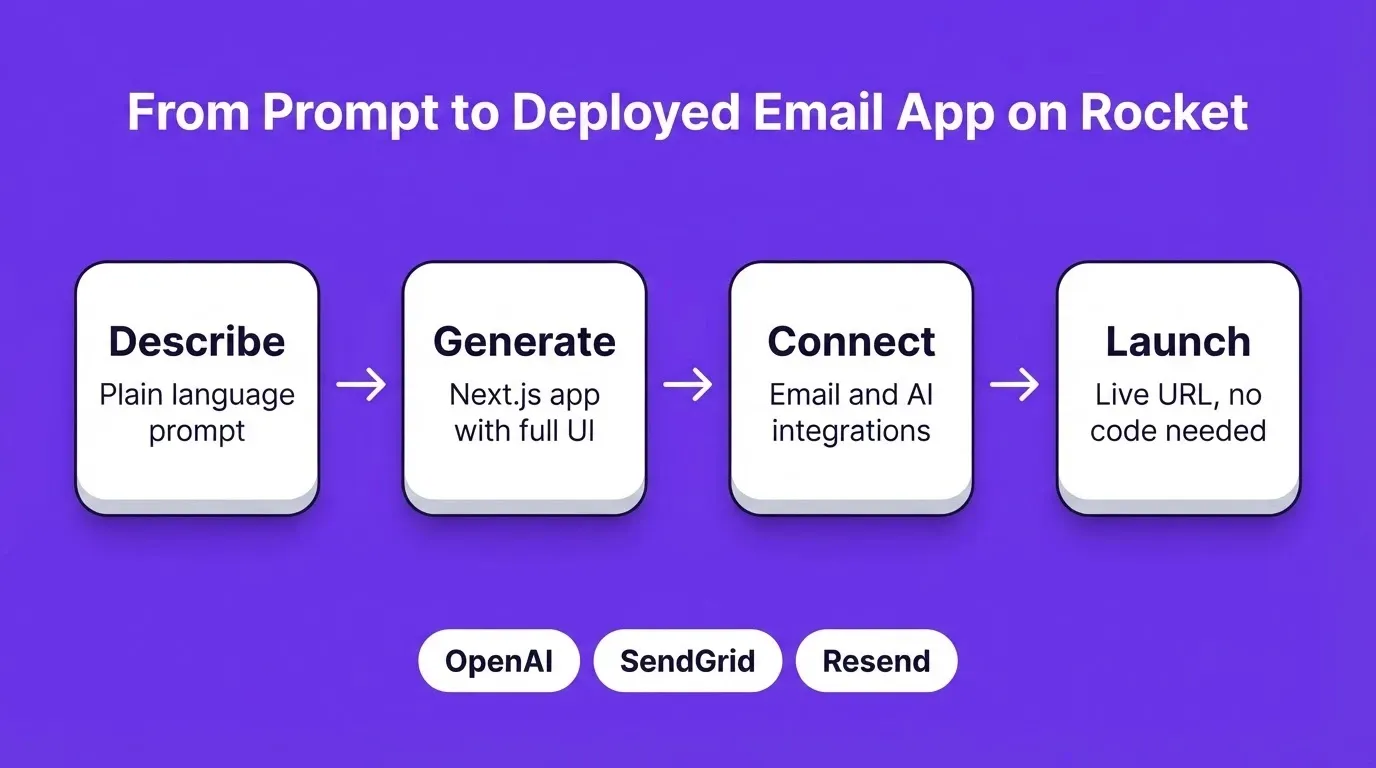
Rocket is a vibe solutioning platform that combines AI app building, strategic research, and competitive intelligence. Its Build capability lets you describe the full assistant in plain language. You receive a deployed, production-ready application in return.
Instead of managing 15 prompts across separate chat windows, describe the whole assistant once:
Build me an email tool that triages my inbox every morning, auto-drafts first-touch replies for new contacts, creates a 3-email follow-up when prospects go quiet, and sends me a daily digest at 5:30 PM.
Rocket turns that description into a working Next.js web application with a real interface. It connects to your email provider and AI model of choice.
What Rocket Builds
When you describe your email assistant, Rocket generates:
-
A full UI with inbox dashboard, triage views, draft review screens, and campaign calendar
-
Production-ready Next.js code deployed instantly with a shareable URL
-
Connected integrations with AI models (OpenAI, Anthropic, Gemini, Perplexity) and email services (SendGrid, Resend, Mailchimp, Twilio, Brevo, MailerLite)
-
SEO-ready structure, WCAG accessibility compliance, and GDPR coverage shipped by default
Rocket Plans
| Plan | Price | Monthly Credits | Includes |
|---|---|---|---|
| Free | $0 | 20 (one-time) | Build and Light Solve |
| Pro | $25/month | 100 | Build and Light Solve |
| Rocket | $50/month | 250 | Build, Full Solve, and Intelligence |
| Booster | $250/month | 1,500 | Build, Full Solve, Intelligence, and Priority Support |
Rocket's three pillars, Solve for research, Build for app creation, and Intelligence for competitive monitoring, share context and feed into each other. Research informs what you build. Intelligence surfaces what to change next.
You refine through conversation, not rebuilding. After the first version, say "Change the auto-reply tone to casual for internal teammates" or "Add a campaign calendar view." The app updates in place.
When Prompts Stop Working: Troubleshooting Common Failures
Before wrapping up, here are the most common reasons email prompts produce weak output. Each one has a clear fix.
1. Too little context. If the AI keeps generating generic replies, add more about your role, industry, and typical senders. The fix is almost always to tell it more about who you are and who you are writing to.
2. No output format specified. If responses come back as long paragraphs when you wanted a table, add a line like "Output as a markdown table" or "Use numbered steps." The AI defaults to prose unless told otherwise.
3. Prompt is doing too many things. If the output feels scattered, split the prompt into two. One prompt to analyze, another to draft. Chaining two sharp prompts beats one overloaded one every time.
4. Wrong model for the task. If replies feel off-tone or miss nuance, try switching models. GPT-4o handles volume well. Claude handles complex multi-step instructions better. Match the model to the task type using the comparison table above.
5. No iteration. The first output is a starting point, not a final draft. Paste the result back and say "Make this 30% shorter and remove any corporate phrases." One round of refinement typically closes the gap.
Build Smarter: Your AI Email Assistant Starts Here
The 15 AI prompts to create an AI email assistant in this guide cover every stage of inbox work. They span triage, drafting, personalization, and A/B testing. As AI models improve and email workflows grow more complex, teams that build structured, connected systems will consistently outperform those running prompts in isolation.
The next step is straightforward. Describe what your email assistant should do, and let Rocket build it. Start with Rocket.new, describe your ideal assistant in plain language, and deploy a production-ready tool. No code, no manual wiring, no daily copy-paste routine.
Table of contents
- -What is an AI Email Assistant?
- -Which AI Model Works Best for Email Tasks?
- -What Makes a Great Prompt for an AI Email Tool?
- -Inbox Organization and Priority Management Prompts
- -Can You Automate Email Replies and Drafts?
- -Which Prompts Work for Scheduling and Personalization?
- -Prompt Category Comparison at a Glance
- -From 15 Separate Prompts to One Working Email App
- -What Rocket Builds
- -Rocket Plans
- -When Prompts Stop Working: Troubleshooting Common Failures
- -Build Smarter: Your AI Email Assistant Starts Here