Rocket.new helps B2B founders go from idea to production-ready app in days using three pillars: Solve for market research, Build for AI-powered app generation, and Intelligence for competitor monitoring, all without switching tools or burning runway.
Building a B2B MVP with Rocket.new means going from idea to production-ready app in days, not months. Rocket.new's three pillars, Solve for market research, Build for AI-powered app generation, and Intelligence for competitor monitoring, give B2B founders everything they need to validate, ship, and iterate without switching tools or burning runway.
What Is a B2B MVP and Why Does It Matter?
A B2B minimum viable product is the simplest version of your software that solves one core problem for a business buyer. It is enough to get into early sales conversations and collect real user feedback without building a finished product first.
Startups that use an MVP approach have a 60% higher success rate than those that launch with fully-featured products. For B2B founders specifically, the MVP stage is where product direction gets set, and where most startups either gain momentum or lose it entirely.
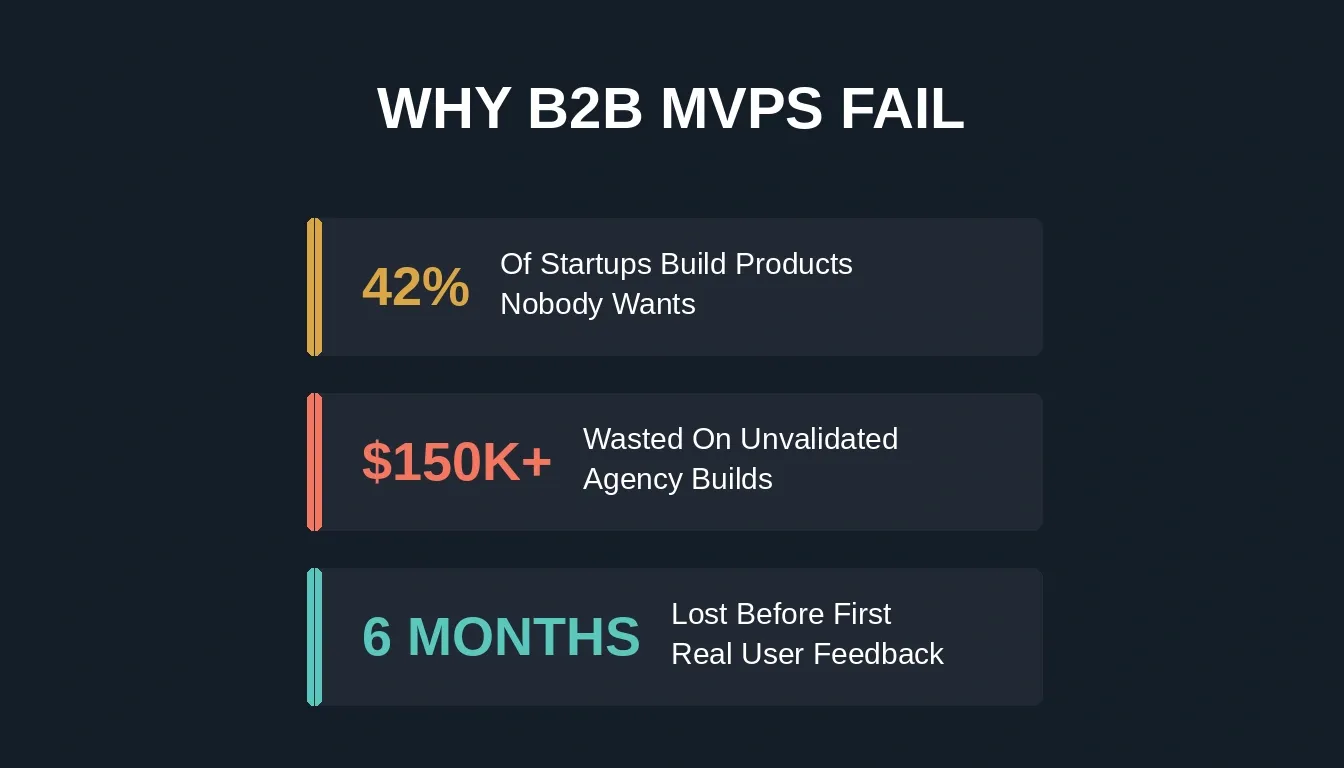
The three root causes that kill B2B MVPs before they reach real users.
What Actually Kills B2B MVPs Before They Launch
Before picking a tool or writing a single line of code, it helps to understand what goes wrong for most B2B founders at the MVP stage.
Overbuilding kills momentum before you get real user feedback. Many founders spend months designing the perfect product, mapping every feature, and hiring a development team, only to discover that real users behave nothing like they expected. The simplest version of your product is almost always the better starting point.
Traditional MVP development burns budget fast. You are paying for designers, developers, QA testers, and project managers across multiple build rounds before you have a single validated signal from a real B2B buyer. For founders working with limited runway, that is a serious exposure.
Most no-code tools leave the hard decisions to you. They help you build faster but still leave you without strategic direction: what to build, whether the market wants it, and how to position it for buyers with long sales cycles and multiple decision-makers.
**42% of startups fail because they build products nobody wants.** In B2B, that risk is amplified because enterprise buyers have procurement requirements, internal stakeholders, and very little patience for products that do not fit their existing workflow from day one.
What a Good B2B MVP Approach Looks Like
The best B2B MVPs are focused experiments designed to answer one question: Will someone pay for this?
Start with the core problem, not the full feature list. A minimum viable product for B2B should be the single feature or workflow that delivers your core value proposition and nothing more. Build that. Ship it. Watch what real users do with it.
Validate demand before you spend serious money. Before writing code or booking a development agency, talk to potential buyers, run a test, and get early sign-ups. Dropbox launched with a demo video and tested real user response before committing to a full build.
Functional apps beat beautiful mockups every time. Enterprise buyers in early conversations are not evaluating design polish. They are checking whether your product solves a real workflow problem they face right now. A working demo wins the room far more often than a Figma prototype.
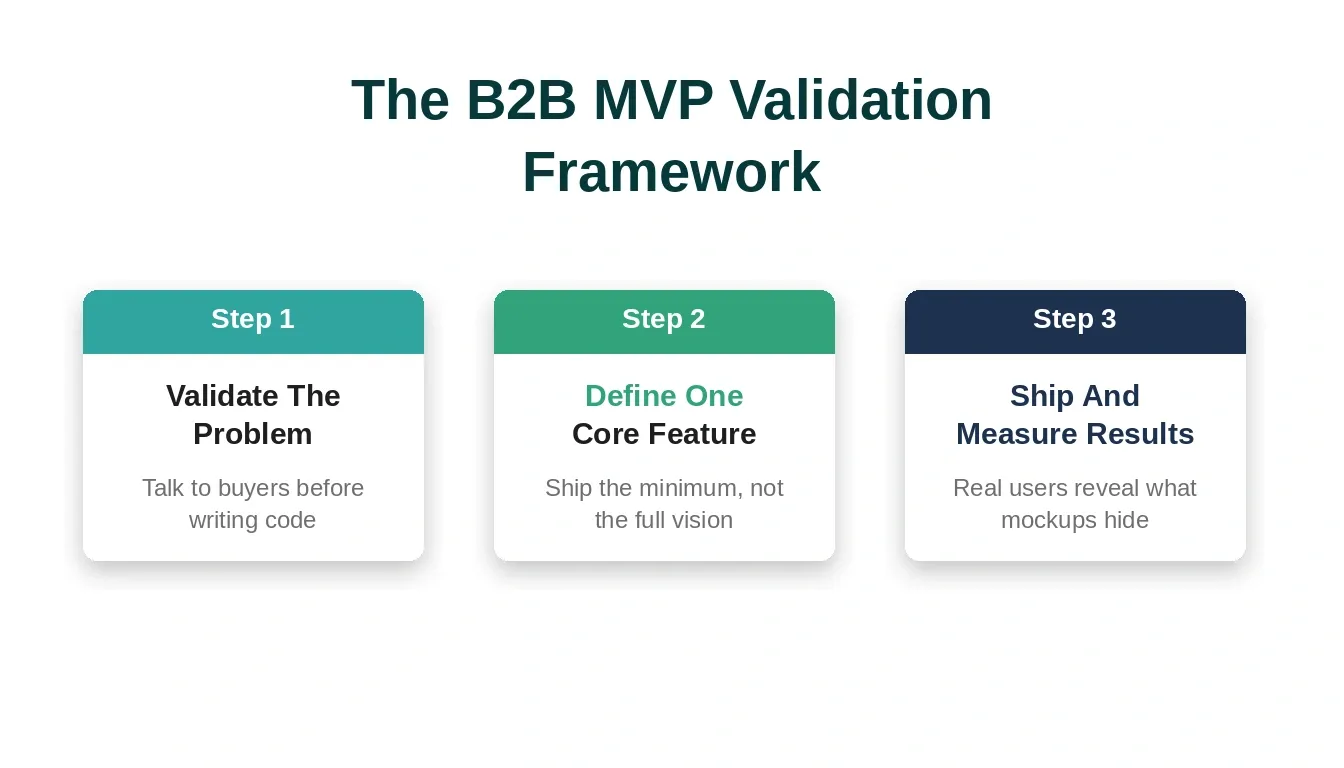
Three steps every B2B founder should complete before writing a single line of code.
Why B2B MVPs Are Harder to Build Than B2C
B2C products can live or die on user experience alone. B2B products face a completely different set of demands from day one, and most tools in the MVP space were not designed with those demands in mind.
The B2B buyer journey is built on complexity. A typical B2B buyer includes an admin, a power user, a decision-maker, and a finance team, each of whom interacts with your product differently. Role-based access, reporting dashboards, user management, and connections to tools like Slack, HubSpot, or Google Workspace are often expected from the very first live demo.
The gap between works in demo and works in practice is painful and expensive. User flows that look clean in Figma break down the moment actual employees with actual business data start using the product. SaaS MVPs in B2B need to handle edge cases, error states, and data persistence in ways that consumer apps simply do not require.
B2B startup MVP development needs structure, not just speed. A fast tool that generates a broken backend or locks you into a proprietary database is not a shortcut. It is a dead end. This is exactly why the tool you choose for B2B SaaS product development matters far more than most founders realize.
How Rocket.new Compares to Other MVP Tools for B2B
Most tools in this space solve part of the problem. Here is how they stack up when the actual goal is a production-ready B2B MVP.
| Tool | Best For | Key B2B Limitation |
|---|---|---|
| Bubble | Complex web apps | Steep learning curve; slow at scale; no owned code |
| Webflow | Marketing sites | Not built for app logic or backend workflows |
| Bolt.new | Quick prototypes | Feature-by-feature prompting; no pre-build research |
| Lovable | UI-focused builds | Limited backend depth; no competitive intelligence |
| Cursor | Technical developers | Requires coding knowledge; no guided build system |
| Rocket.new | Full-stack B2B MVPs | Designed for this exact use case |
The pattern is consistent: other tools handle pieces of the build. Rocket.new is the only platform that takes a B2B founder from market research through a working production app through post-launch competitor monitoring, all without switching tools. See how Rocket.new stacks up against Bubble specifically for B2B use cases.
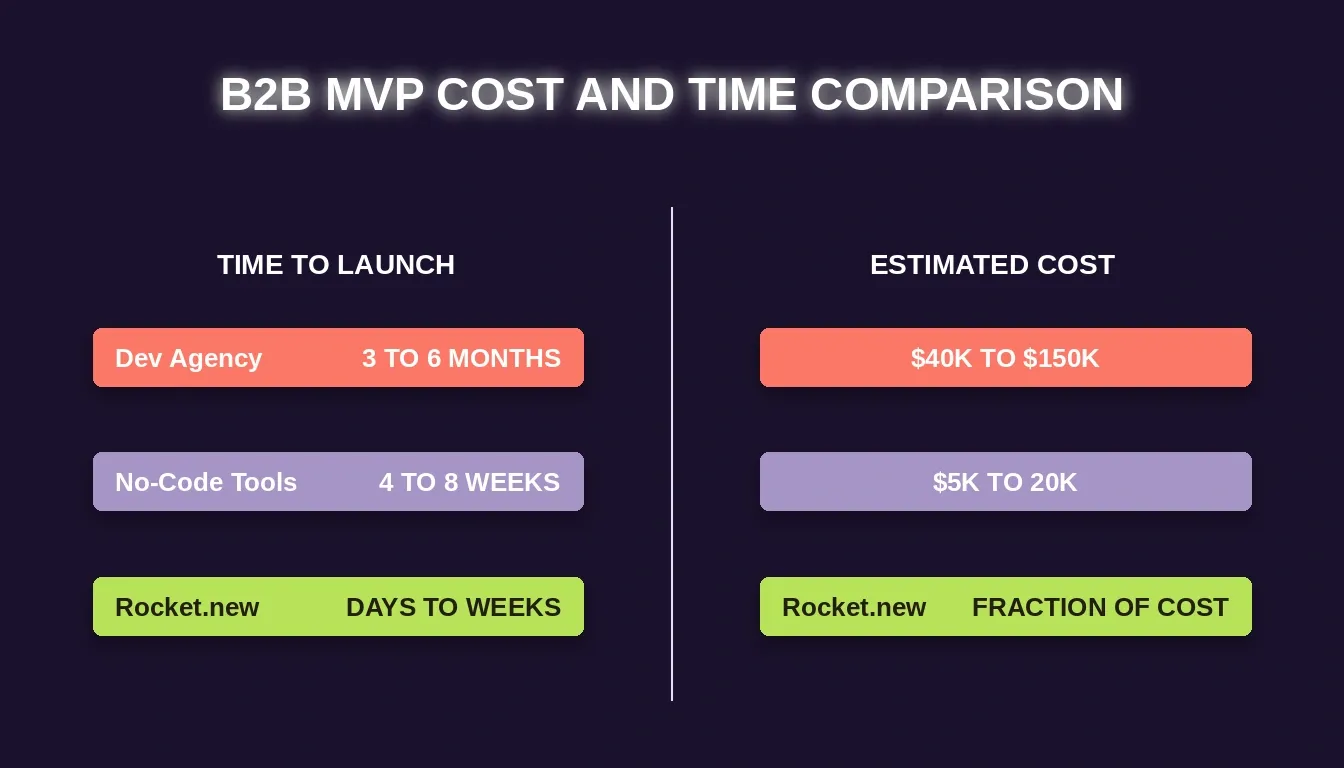
Data-driven comparison of time-to-MVP and estimated cost across three common approaches.
What the Builder Community Is Saying
The shift to AI-powered MVP development is not theoretical. Founders who have moved through multiple tools are now sharing what they found on the other side.
To my surprise, I was shocked. I had never seen a low-code tool build such a complex application with just a single prompt! Tools like Lovable, Cursor, and Bolt.new require separate prompts for each section and feature, but Rocket handled everything in one go. It took less than 15 minutes to generate the application. - Rathod, AI Enthusiast and Builder, Medium
For a B2B founder with a tight budget and a narrow window to validate an idea, that kind of speed is a real competitive advantage that compounds over time.
How Rocket.new Three Pillars Work for B2B MVP Development
Rocket.new describes itself as the world's first Vibe Solutioning platform. Over 1.5 million people across 180 countries have used it to go from idea to working product. The difference from a standard AI app builder starts from the moment you log in, because Rocket.new is structured around three distinct capabilities that work together as a single workflow.
Solve: Research Before You Build
Solve is Rocket.new's research engine. Before writing a single line of code, Solve turns complex business questions into structured, evidence-backed reports covering market sizing, competitive teardowns, pricing strategy, and product direction.
Solve has two modes: Light Solve for fast, conversational research on Free and Pro plans, and Full Solve for deeper, board-ready research on Rocket and Booster plans. Rocket.new routes each query automatically based on the prompt, with no manual mode selector needed. For B2B founders, this means going into the build phase with validated assumptions rather than founder intuition.
Build: Generate Production-Ready Apps from Plain Language
Build is Rocket.new's AI app builder. Describe your B2B product in plain natural language and Rocket.new generates a fully functional app with UI, navigation, logic, and production-ready code.
Build outputs production-ready Next.js web apps and Flutter mobile apps, not prototypes, not mockups, but deployable applications with real backend logic. Key capabilities for B2B founders include 26+ connectors including Supabase, Stripe, HubSpot, GitHub, Notion, Linear, and Google Workspace; Figma import to convert existing designs to production React or Flutter code; two-way GitHub sync; Advisor Agent, a built-in senior architect sub-agent; and custom domain with automatic HTTPS.
Non-technical founders build without writing a single line of code. Technical founders get clean, exportable code they fully own.
Intelligence: Competitor Monitoring After You Ship
Intelligence watches competitors across nine signal pillars, website, social media, news and media, GTM, product and technology, people and hiring, business and finance, reviews and community, and traffic, and delivers Intel cards framed to your role, company, and current strategic questions.
The same signal means something different depending on who you are. A sales leader watching for pricing moves gets a different Intel card than a product leader watching for roadmap signals. Rocket.new knows who you are and why you are watching, and the Intel you receive reflects that.
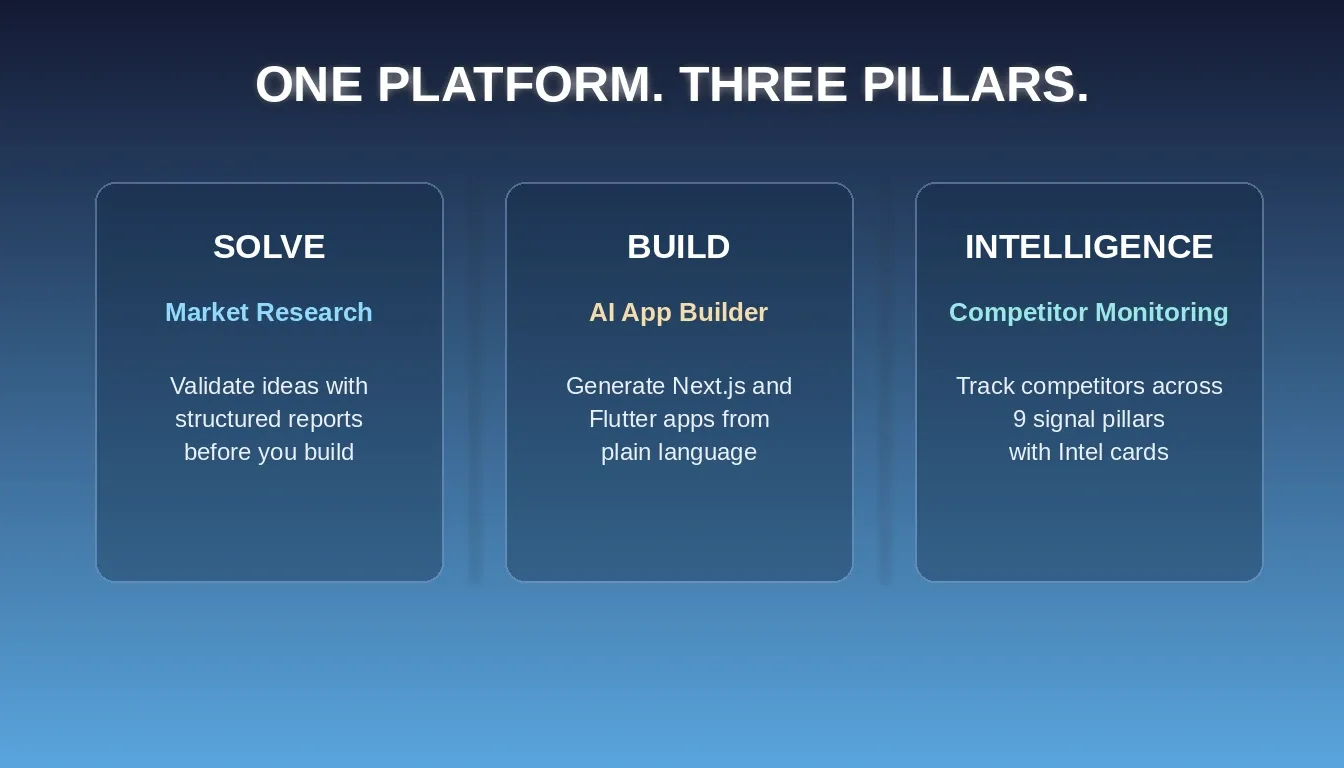
Rocket.new's three-pillar platform designed to take founders from research to launch to scale.
What Both Types of Founders Get From Rocket.new
The common assumption is that AI-powered builders are mainly for founders who cannot code, and that is worth challenging directly. Rocket.new changes the outcome for both types of founders, just in different ways.
Non-technical founders go from idea to demo in a single afternoon. That is fast enough to take into early B2B sales conversations and collect real user feedback before committing any serious development budget to a direction.
Technical founders save weeks of setup and scaffolding work. A working MVP with real backend logic, a Supabase database, and user flows already in place lets technical founders spend their time on hard product decisions rather than writing boilerplate code. Whether you write code daily or have never written a line, the bottleneck in B2B startup MVP development is speed to validated learning.
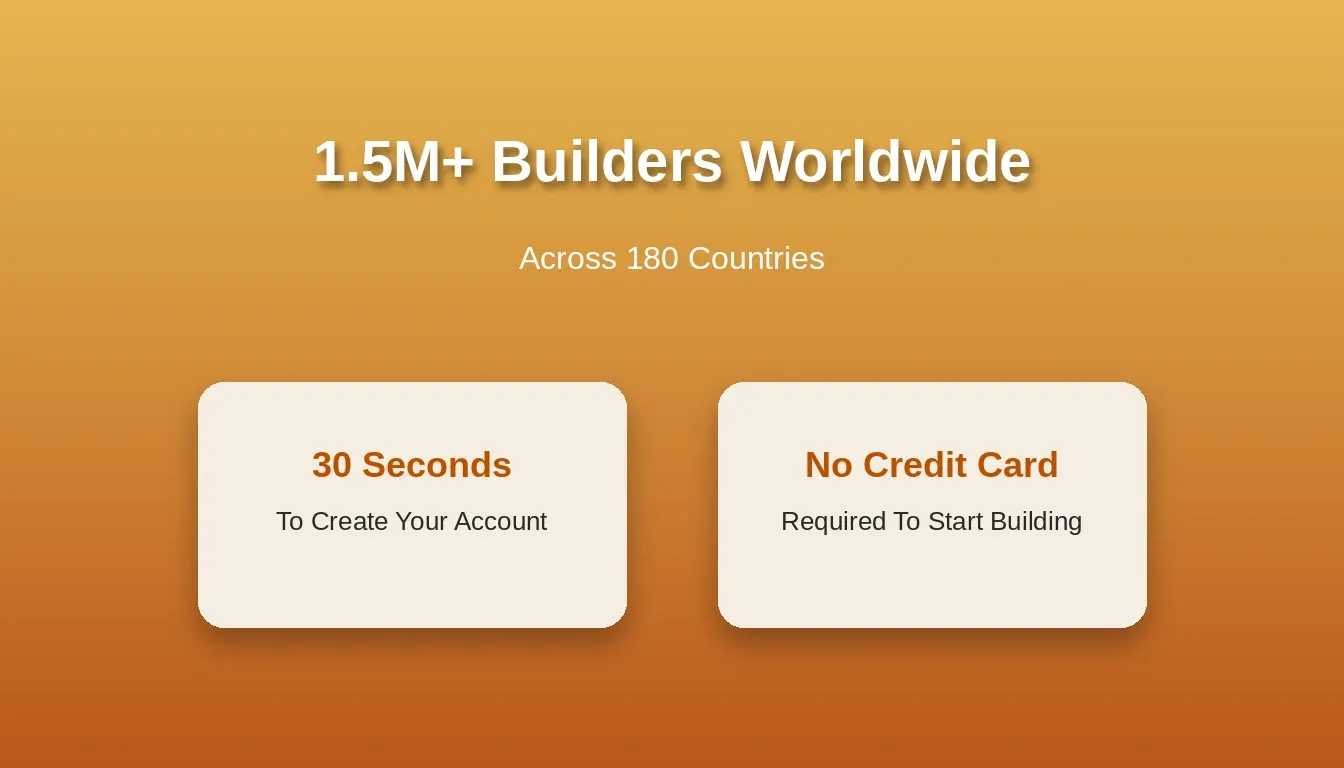
Rocket.new's global builder community, proof that AI-powered development works at scale.
Explore the best AI MVP builders for startups to see how Rocket.new stacks up in a broader comparison. You can also review Rocket.new's pricing plans, from a free tier with no credit card required to Booster for scaling teams.
How Much Does a B2B MVP Cost?
The financial case for AI-powered MVP development is not just about saving money. It is about getting more attempts at product-market fit within the same budget.
The traditional approach spends $40,000 to $150,000 to find out whether your idea works. Rocket.new lets you find that answer first, then spend the bigger budget on a version you already know the market wants.
| Approach | Time to MVP | Estimated Cost | Code Ownership |
|---|---|---|---|
| Traditional dev agency | 3 to 6 months | $40,000 to $150,000 | Yes |
| No-code tools (Bubble, Webflow) | 4 to 8 weeks | $5,000 to $20,000 | No |
| Rocket.new | Days to weeks | Fraction of traditional cost | Yes |
Rocket.new's plans scale from a free tier (no credit card required, account created in 30 seconds) through Pro, Rocket, and Booster, designed to grow with a startup from early validation through a scaling team. You can also see Rocket.new in action before committing to any plan.
Why the MVP Stage Is the Best Time to Start With Rocket.new
If you are already past the MVP stage with a working product, migrating platforms is painful. But if you are still in the build phase, this is exactly the right moment to make the right choice.
Your foundation becomes code you own from the start. Starting with Rocket.new means you are not locking yourself into a no-code platform you will need to migrate away from when your product grows. The code is exportable and yours from day one, production-ready Next.js or Flutter, which supports future development without a painful technical rewrite.
Market research is baked directly into the build process. Solve runs before you write a line of code, so your team goes into product decisions with a shared understanding of the competitive environment and real buyer expectations. Your competitors are building right now, and every week spent in planning meetings is a week someone else is collecting real user feedback and refining their product.
The MVP stage is where product direction gets set. Starting with a tool that gives you speed, owned code, pre-build market research via Solve, and post-launch competitor monitoring via Intelligence means every decision that follows is built on a stronger, more informed foundation.
If you are a B2B founder ready to ship a production-ready minimum viable product without burning your runway on agency fees or no-code lock-in, Rocket.new is built for exactly that. Sign up in 30 seconds, no credit card required, and go from idea to working app in days. Start building on Rocket.new today.
Table of contents
- -What Is a B2B MVP and Why Does It Matter?
- -What Actually Kills B2B MVPs Before They Launch
- -What a Good B2B MVP Approach Looks Like
- -Why B2B MVPs Are Harder to Build Than B2C
- -How Rocket.new Compares to Other MVP Tools for B2B
- -What the Builder Community Is Saying
- -How Rocket.new Three Pillars Work for B2B MVP Development
- -Solve: Research Before You Build
- -Build: Generate Production-Ready Apps from Plain Language
- -Intelligence: Competitor Monitoring After You Ship
- -What Both Types of Founders Get From Rocket.new
- -How Much Does a B2B MVP Cost?
- -Why the MVP Stage Is the Best Time to Start With Rocket.new