
Learn how Rocket.new uses compounding competitive intelligence to track market changes, reveal strategic opportunities, and help teams make faster, data-driven decisions that improve product positioning and long-term growth across competitive markets worldwide.
What does it mean to use competitive intelligence effectively over time?
Most teams treat it as a one-time task: run a competitor analysis, write a report, move on. By next quarter, that report is stale. A competitor has pivoted. A pricing page changed. That snapshot is already out of date.
The global competitive intelligence tools market was valued at $53.2 billion in 2023 and is projected to reach $96 billion by 2030, growing at a CAGR of 8.8%. That growth reflects something real: more businesses are recognizing that monitoring the competitive environment is not optional anymore.
But most competitive intelligence tools still treat intelligence as something you collect and consume, not something that accumulates and improves with time.
That is the gap competitive intelligence that compounds over time is designed to close - and it is why Rocket.new was built with a fundamentally different architecture.
What "Compounding" Actually Means in Competitive Intelligence
Competitive intelligence compounds when small competitor signals are tracked consistently over time instead of being treated as isolated updates. One signal may look unimportant, but repeated patterns reveal what competitors are preparing long before public announcements happen.
-
A pricing page update alone is just a change
-
A new enterprise-sales hire alone is just a job posting
-
A defensive G2 review response alone is just customer support
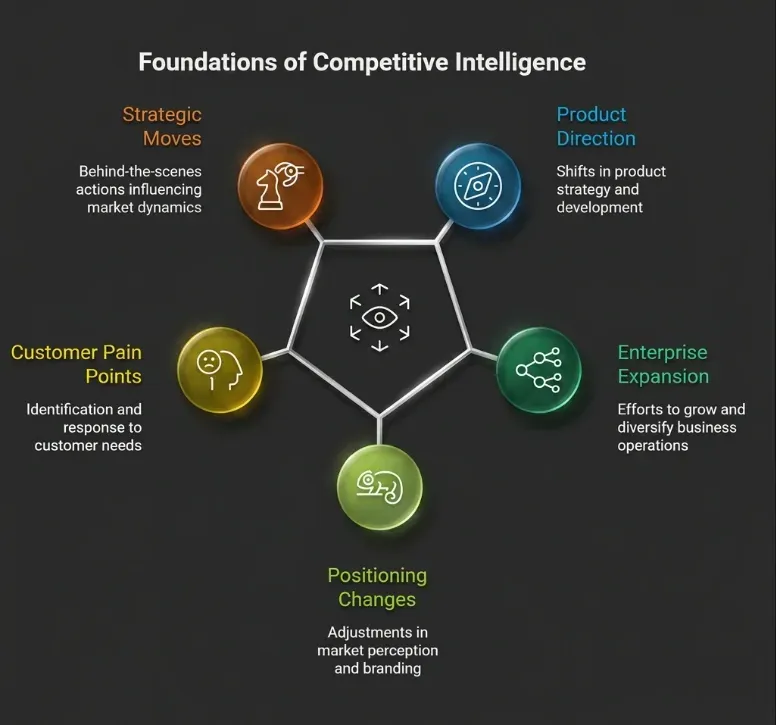 The real value of competitive intelligence is not in collecting more alerts. It is connecting signals over time until scattered updates become strategic insight.
Rocket.new helps teams track signal clusters, build context over time, and turn competitor monitoring into actionable intelligence.
Why Most Competitive Intelligence Programs Fail
A February 2026 report from Info-Tech Research Group put it plainly:
"Competitive intelligence only creates value when it shows up in the moments that matter most, which are competitive sales conversations. Organizations often confuse activity with effectiveness. A quality CI program is defined by its ability to help sellers win more deals against priority competitors, not by how much information it generates."
Joanne Correia, Principal Research Director, Info-Tech Research Group
That quote identifies the core failure mode: most CI programs produce output, not outcomes. They generate reports nobody reads, battle cards that go stale, and raw data that no one has time to analyze. The research found that fragmented ownership, outdated insights, and weak alignment between CI teams and sales functions are limiting win rates and putting revenue at risk.
Three patterns appear repeatedly in organizations where competitive intelligence fails to compound:
-
Intelligence lives in silos: The sales team has one briefing. The product team has another. Marketing runs its own competitor research. Nobody shares what they learn. Every team re-discovers the same things, separately.
-
Reports replace memory: A CI analyst publishes a quarterly update, it gets read once, then archived. The next quarter, the analyst starts fresh. None of that accumulated knowledge carries forward.
-
Tools reset with every session: Most competitive intelligence tools are session-based. You search. You get results. You close the tab. The tool has no memory of you next time.
These are structural problems, not behavioral ones. The people using the tools are not the issue - the tools are.
The Competitive Intelligence Framework That Compounds
For competitive intelligence to compound, three conditions need to hold:
-
Signals must be continuous, not periodic. A monthly competitive analysis is a photograph. Continuous monitoring is a video. Patterns only appear in the video.
-
Context must persist across teams and sessions. Every insight needs to be accessible to the next person who needs it, not buried in a document that may or may not surface.
-
Intelligence must connect to action. The signal that surfaces at 8 AM should be present in the product decision made at 11 AM and the landing page written at 3 PM.
This is the architecture Rocket.new Intelligence is built around. And it changes what competitive intelligence can realistically do for a business.
What Rocket.new Intelligence Actually Tracks?
Rocket.new Intelligence monitors six signal categories across every public surface a competitor operates on:
| Signal Category | What Gets Tracked |
|---|---|
| Website | Pricing changes, messaging shifts, feature announcements, positioning pivots |
| Social Media | Posts, campaigns, engagement patterns across LinkedIn, X, Instagram, Reddit, and more |
| News and Web | Press coverage, blog posts, partnership announcements, executive interviews |
| Reviews and Reputation | G2, Glassdoor, Capterra sentiment shifts and individual review content |
| People | Headcount, hiring velocity, executive activity, open positions by department |
| Performance Marketing | Ad activity across LinkedIn, Meta, and TikTok |
Each competitor added to a Rocket.new project gets full coverage across all six categories automatically. You do not configure what to watch - the system covers everything from day one.
The result is a daily brief for every competitor: a synthesized paragraph connecting everything that moved, patterns worth watching, and a recommendation for what your business should do in response. Not an alert. An interpretation.
How Intelligence Compounds Inside Rocket.new?
This is where Rocket.new's architecture differs from every standalone competitive intelligence tool on the market.
Every signal captured by Intelligence lives inside a Rocket.new project. That project is the shared memory for everything the team does - Solve research, product decisions, landing page copy, sales positioning. When the Intelligence brief from Monday surfaces a competitor pricing shift, that signal is present when the PM opens Solve on Wednesday. When marketing writes the landing page Thursday, the context is already there.
Nothing resets. Nothing needs to be re-explained. The intelligence compounds because it lives in the same place as the work.
This is also why 90% of Fortune 500 companies already use competitive intelligence to gain a competitive advantage - and why teams with centralized intelligence platforms locate market data and relevant insights four times faster than those without one.
Four Teams, One Source of Truth
A common pattern in organizations is four separate competitive intelligence setups: sales has battle cards, marketing has campaign briefs, product has a tracking spreadsheet, strategy has a quarterly report.
Each is maintained separately. Each goes stale separately. Each reflects one team's priorities, not the full picture.
Rocket.new Intelligence serves all four functions from a single shared source:
-
Sales intelligence: Deal-specific competitive briefs, weekly updates on competitor strategies that affect live opportunities, and real-time context for competitive selling conversations that directly support win rates.
-
Marketing intelligence: Campaign differentiation based on current competitor activity, not last quarter's research. When a competitor runs a new ad campaign, you see it and can respond with your own content strategy.
-
Product intelligence: What competitors shipped in the last 90 days, where they are hiring, and what that hiring concentration signals about their roadmap. Patent filings and job postings are often the earliest indicators of product direction.
-
Strategic intelligence: M&A signals, market entry moves, enterprise positioning shifts. Pattern detection months before formal announcements, so strategic decisions are based on forward-looking signals, not historical data.
One shared project. Four functions. Zero duplication of monitoring effort.
Rocket.new vs. Traditional Competitive Intelligence Companies
Most businesses running competitive intelligence today use established competitive intelligence companies - Klue, Crayon, Kompyte - or manual tracking via Google Alerts and spreadsheets.
These tools have real strengths in signal collection. But they share a structural limitation: they are monitoring tools, not memory systems.
| Feature | Traditional CI Tools | Rocket.new Intelligence |
|---|---|---|
| Signal monitoring | Yes | Yes - six categories, automated |
| Daily briefs with interpretation | Some tools | Yes - synthesized with strategic context |
| Connected to product and build workflow | No | Yes - shared project memory |
| Persistent memory across sessions | No - session-based | Yes - every signal stored in project |
| Cross-team knowledge sharing | Limited | Full - all members share the same context |
| Sales enablement built in | Requires separate tool | Native to the same platform |
| Alerting vs. interpretation | Alerting | Interpretation - signal clusters, not single events |
The gap is not feature coverage. It is architecture. Standalone CI tools are designed to surface information. Rocket.new Intelligence is designed to make that information part of how your team thinks and works - permanently, progressively, without manual effort to maintain.
Why This Gets More Valuable Over Time?
Competitive intelligence becomes more valuable when signals are collected continuously and connected over time. The longer the monitoring period, the clearer the patterns become and eventually, those patterns turn into predictive insight.
-
Month one: visibility: Teams gain coverage across competitor websites, social media activity, reviews, hiring signals, and messaging changes.
-
Month three: pattern recognition: Teams begin identifying repeat behaviors such as launch timing, positioning shifts, audience targeting, and sentiment changes after pricing or product updates.
-
Month six: predictive intelligence: Repeated signal sequences start revealing what competitors are likely preparing before announcements become public. A hiring surge, enterprise-focused messaging, and security-related review responses together become an early indicator of a larger strategic move.
-
Strategic advantage: connected context: Intelligence becomes far more useful when it appears inside product planning, positioning discussions, and go-to-market decisions instead of sitting inside disconnected reports that teams rarely revisit.
The real advantage of long-term competitive intelligence is not simply tracking competitors longer. It is building enough context to recognize patterns early, predict likely moves, and make smarter strategic decisions faster.
Rocket.new helps teams transform ongoing competitor monitoring into connected, actionable intelligence that compounds in value over time.
Why Rocket.new Gets Smarter the Longer You Use It?
Most software becomes more familiar with use. Competitive intelligence becomes more valuable when the system continuously builds context around your business, strategy, and market position.
-
Project context: Customer research, strategic decisions, brand guidelines, and past outputs stay connected inside the same workspace.
-
Smarter interpretation: Competitor signals are analyzed relative to your specific business situation instead of generic market activity.
-
Actionable intelligence: A competitor moving upmarket matters far more when your team is targeting enterprise customers and building enterprise-focused features.
-
Continuous accumulation: Teams do not need to repeatedly provide the same context because the system remembers and builds on previous work automatically.
-
Better decision-making: Every new signal becomes sharper and more useful because it is connected to long-term strategic context.
The real advantage of connected intelligence is not storing more information. It is building accumulated business context that makes future competitive interpretation faster, more accurate, and more strategically useful over time.
What Traditional Competitive Intelligence Tools Get Wrong?
TTraditional competitive intelligence tools often treat intelligence as static information instead of a continuously evolving context layer. The result is reports, battle cards, and research documents that lose relevance the moment the market changes.
-
Static reports: Market research briefs become outdated quickly because competitor activity changes continuously.
-
Manual maintenance: Battle cards and competitive summaries require constant updates to remain accurate and useful.
-
Delayed insight: Win-loss analysis often reflects past conditions rather than the current competitive environment.
-
Disconnected intelligence: Most tools surface isolated information without preserving the historical context that gives signals meaning over time.
-
Missing pattern recognition: New competitor signals are treated as replacements for old data instead of additions to a growing intelligence layer.
-
Persistent memory: Long-term competitor activity becomes more valuable because historical signals create the baseline needed to interpret new changes accurately.
The real weakness of traditional competitive intelligence systems is not data collection. It is the inability to preserve context long enough for patterns to emerge.
Rocket.new helps teams build persistent competitive memory where every new signal strengthens long-term strategic understanding instead of replacing previous intelligence.
Build Intelligence That Grows With You
Most businesses collect competitive intelligence, but very few build systems where that intelligence becomes more valuable over time. Reports become outdated, research gets scattered across teams, and important context disappears between projects. The result is repeated work, disconnected insights, and slower strategic decisions.
Competitive intelligence compounds when it becomes part of the way teams operate every day instead of a separate tool checked occasionally. Shared context, historical signals, and continuous monitoring create a growing intelligence layer that improves future decision-making.
Rocket.new helps teams build connected competitive intelligence that grows smarter, sharper, and more actionable with every new signal and strategic decision.
Table of contents
- -What "Compounding" Actually Means in Competitive Intelligence
- -Why Most Competitive Intelligence Programs Fail
- -The Competitive Intelligence Framework That Compounds
- -What Rocket.new Intelligence Actually Tracks?
- -How Intelligence Compounds Inside Rocket.new?
- -Four Teams, One Source of Truth
- -Rocket.new vs. Traditional Competitive Intelligence Companies
- -Why This Gets More Valuable Over Time?
- -Why Rocket.new Gets Smarter the Longer You Use It?
- -What Traditional Competitive Intelligence Tools Get Wrong?
- -Build Intelligence That Grows With You