
AI-powered Backend as a Service platforms auto-generate APIs, databases, and authentication from plain-language prompts, helping teams ship production apps in hours, not weeks, without managing servers or writing infrastructure from scratch.
Why are Teams Still Spending Weeks on Backend Setup?
Most development teams still configure servers, write database schemas, and debug API endpoints by hand. This backend bottleneck costs startups runway and slows agencies down.
According to the Stack Overflow 2024 Developer Survey, 76% of developers now use or plan to use AI tools in their development process, up from 70% just one year prior.
Backend as a Service with AI addresses this directly. It generates the infrastructure layer from your requirements, not from your keystrokes.
What is Backend as a Service?
Backend as a Service (BaaS) is a cloud model that gives developers pre-built, managed server-side infrastructure. This includes databases, authentication, file storage, real-time sync, and serverless functions, all accessible through APIs.
You connect to a BaaS provider and build your frontend on top. The provider handles scaling, uptime, and security patches. When AI is added to this model, those components are no longer just pre-built. They are generated on demand from natural language descriptions.
You describe what your app needs. The platform then creates the database schema, API routes, authentication rules, and storage configuration automatically. That shift from configuration to generation is what separates modern AI-powered BaaS from its predecessors.
The core components every BaaS platform provides:
-
Managed databases — store and retrieve structured data through simple API calls, removing the need for manual configuration or maintenance schedules
-
User authentication — handle login flows, session tokens, and role-based permissions out of the box
-
Serverless functions — run custom business logic in response to events and triggers without provisioning servers
-
Cloud storage — manage file uploads, image processing, and CDN delivery automatically
-
Real-time sync — keep data updated across multiple clients simultaneously, critical for collaborative applications
-
Edge functions — run server-side logic without exposing secret keys to the client
Understanding how to generate a database schema with AI is the first step toward eliminating the most time-consuming part of any new project.
How AI-Powered BaaS Differs from Traditional BaaS
Traditional BaaS platforms still require manual configuration for each feature. AI-powered alternatives generate backend components from plain English descriptions instead.
| Feature | Traditional BaaS | AI-Powered BaaS |
|---|---|---|
| Setup time | Hours to days | Minutes |
| API creation | Manual coding or visual builders | Prompt-based generation |
| Schema design | Hand-crafted by developer | Auto-generated from requirements |
| Authentication | Configure SDK and rules manually | Describe user roles, AI configures |
| Scaling rules | Set thresholds manually | Predictive auto-scaling |
| Error handling | Write custom logic | AI-suggested patterns |
| Code ownership | Varies by platform | Full export, no lock-in |
A traditional backend that takes two weeks to configure can be generated in under an hour when AI handles the scaffolding. This matters most for startups testing ideas quickly, agencies managing multiple client projects, and solo founders building their first product.
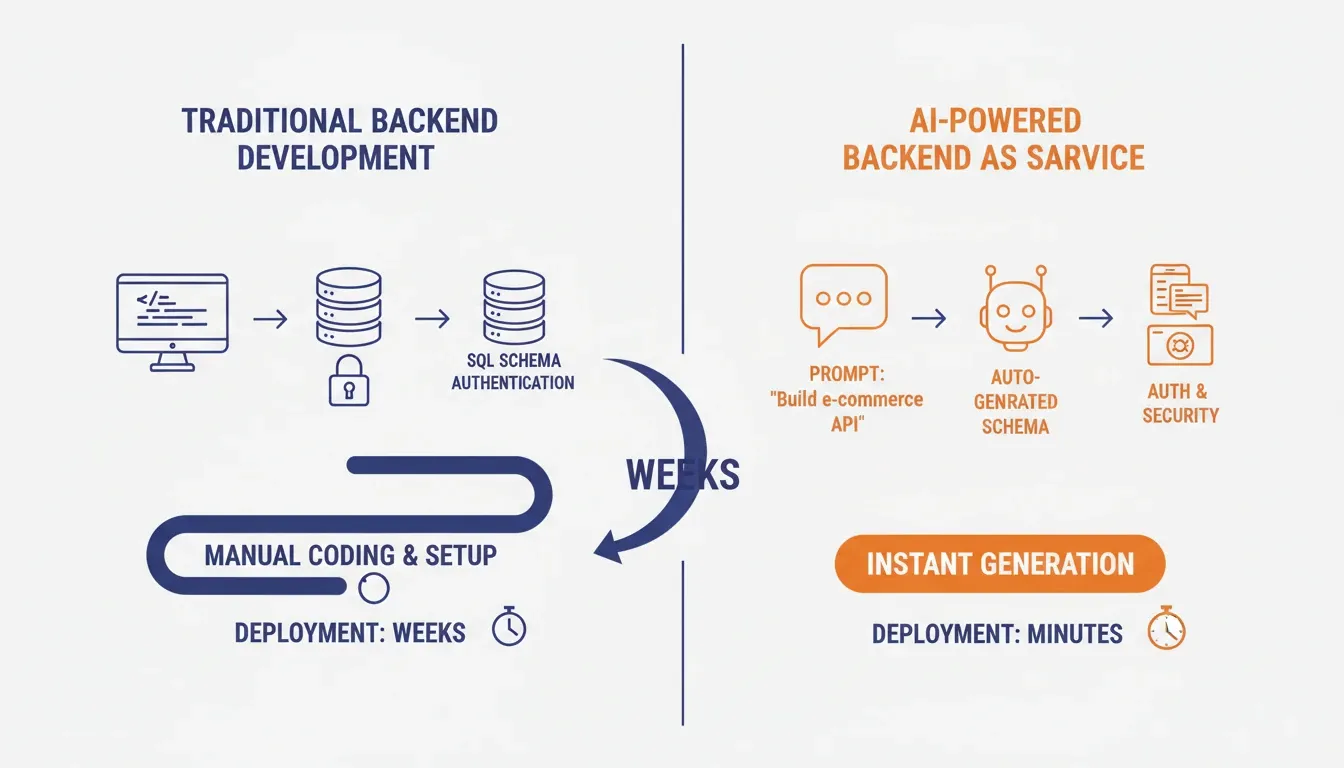
Traditional vs. AI-powered BaaS: setup time and configuration effort compared
Top Features That Define Modern BaaS Platforms
Not all backend services offer the same feature set. The strongest platforms combine traditional managed services with AI-driven capabilities that cut development time significantly.
-
AI-generated API routes — turn plain English descriptions into typed, documented endpoints ready for production use
-
Auto-schema generation — build relational database structures from your data model description, complete with indexes and relationships
-
Smart authentication — configure OAuth, magic links, and multi-factor auth based on your security requirements
-
Row-level security (RLS) — enforce data access rules at the database level so each user sees only permitted data
-
Serverless compute — spin up functions that scale to zero when idle, keeping costs proportional to actual usage
-
Real-time subscriptions — push data changes to connected clients instantly, critical for chat apps, dashboards, and collaborative tools
-
Environment management — separate staging from production with one-click promotion between them
The GitHub 2024 Octoverse report found a 59% surge in contributions to generative AI projects. Developers moved well past experimentation into building AI-powered production applications. As a result, backend platforms that incorporate AI generation are quickly becoming the standard.
The real differentiator is whether the platform generates authenticated API endpoints from descriptions or still requires you to wire everything by hand.
Can AI Generate Your Entire API Layer Automatically?
Yes, and the results are production-ready. Modern AI-powered builders do not just scaffold endpoints. They generate complete CRUD operations, validation rules, and error handling from a single description.
-
Type-safe endpoints with request and response schemas generated directly from your data model
-
Automatic documentation so frontend teams can start consuming APIs immediately after generation
-
Role-based access control baked into each generated route without extra configuration
-
Database migrations created alongside the API to keep schema and endpoints in sync
Teams report cutting API development time by 80% or more when using prompt-based generation.
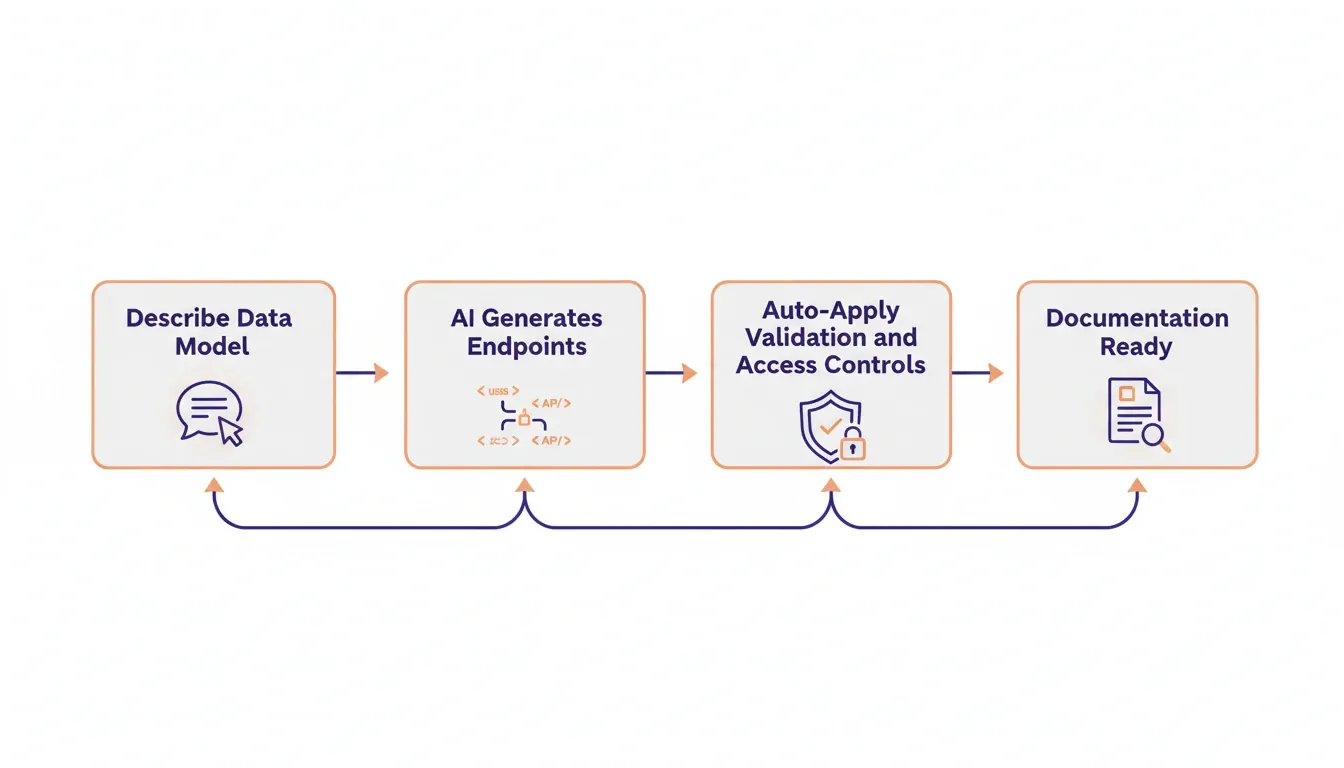
AI-powered API generation: from natural language prompt to production-ready endpoints
BaaS Provider Comparison: Pricing and Plans
Choosing the right BaaS provider depends on your team's technical capacity, budget, and long-term scaling needs. Here is how the leading platforms compare on pricing.
| Provider | Free Tier | Paid Starting Point | Database | Auth Included |
|---|---|---|---|---|
| Supabase | 2 projects, 500 MB DB, 1 GB storage | From $25/month | PostgreSQL | Yes |
| Firebase | Generous Spark plan | Pay-as-you-go (Blaze) | NoSQL (Firestore) | Yes |
| AWS Amplify | 12 months free tier | Pay-as-you-go | DynamoDB or Aurora | Via Cognito |
| Appwrite | Self-hosted (unlimited) | Cloud from $15/month | MariaDB | Yes |
| PocketBase | Self-hosted (unlimited) | Self-hosted only | SQLite | Yes |
Key considerations when choosing:
-
Supabase uses PostgreSQL with native row-level security. It is the strongest choice for relational data models and teams who want full SQL access.
-
Firebase excels at mobile apps and real-time features. It uses a proprietary NoSQL model that can become expensive at scale.
-
AWS Amplify integrates deeply with the AWS ecosystem. However, it adds significant configuration overhead.
-
Appwrite and PocketBase are strong self-hosted options for teams with privacy requirements or budget constraints.
Real-World Use Cases for AI-Driven Backend Services
AI-driven backend services work across industries because they solve a universal problem. Backend setup takes too long relative to the value it delivers.
-
Startup MVP development — Founders describe their product, and the AI generates a working backend with auth, database, and API in one session. No DevOps team required.
-
SaaS platforms — Subscription management, user permissions, and multi-tenant databases are generated from specifications rather than built line by line.
-
Mobile apps — Flutter and React Native teams get a complete backend with push notifications and real-time sync without writing server code.
-
E-commerce stores — Product catalogs, payment processing, and order management APIs are created from product descriptions.
-
Internal tools — Operations teams build admin dashboards connected to live data without waiting in engineering sprint queues.
Liz Jackson, Developer Relations Team Lead at Toast, captured the mindset shift in the Postman 2025 State of the API survey: "Not only has it saved time; it has enabled a massively distributed group of people to act as one team." That same survey found 89% of developers now use AI daily. Yet only 24% design APIs with AI agents in mind.
When to choose AI-powered BaaS for your project
For teams building without a dedicated infrastructure engineer, understanding serverless architecture patterns removes one of the biggest decision bottlenecks before the first line of code.
How Rocket Handles Your Entire Stack from a Single Prompt
Most BaaS providers give you building blocks. Rocket gives you the finished building. Rocket is a Vibe Solutioning platform. It is the first system where strategic research, AI app building, and competitive intelligence work together in one place.
You describe your application. Rocket then generates a complete, production-ready product. This includes a Supabase database with row-level security, a Next.js or Flutter frontend, API routes, authentication, and deployment configuration, all in one session.
Solve validates your idea before you build. Type any business question, such as market sizing, competitive landscape, or product direction, and get a structured, evidence-backed report. The research flows directly into the build, so you never start from a blank prompt.
Build generates production-grade web apps in Next.js and mobile apps in Flutter. Every output ships with WCAG accessibility compliance, GDPR coverage, and SEO-ready structure by default. Connect Supabase via OAuth without managing API keys. Your database, row-level security, and real-time subscriptions are configured automatically.
Intelligence monitors your competitors continuously across every public platform they operate on. Pricing changes, product updates, and hiring signals are all interpreted and delivered as daily briefs. This keeps your product decisions ahead of the market.
Where traditional BaaS requires you to configure each component manually, Rocket generates the entire stack from a single conversation. No stitching services together. No reading through documentation to connect auth to your database.
Additional capabilities that matter:
-
25+ integrations — Stripe, Resend, Mailchimp, OpenAI, Anthropic, Google Analytics, and more connect directly into generation
-
Version history and rollback — changes are tracked so you can revert instantly if something breaks
-
One-click deployment — go from prompt to live application via Netlify without touching server configuration
-
Full code ownership — download your Next.js or Flutter project at any time, with no lock-in
1.5 million people have tried Rocket across 180 countries.
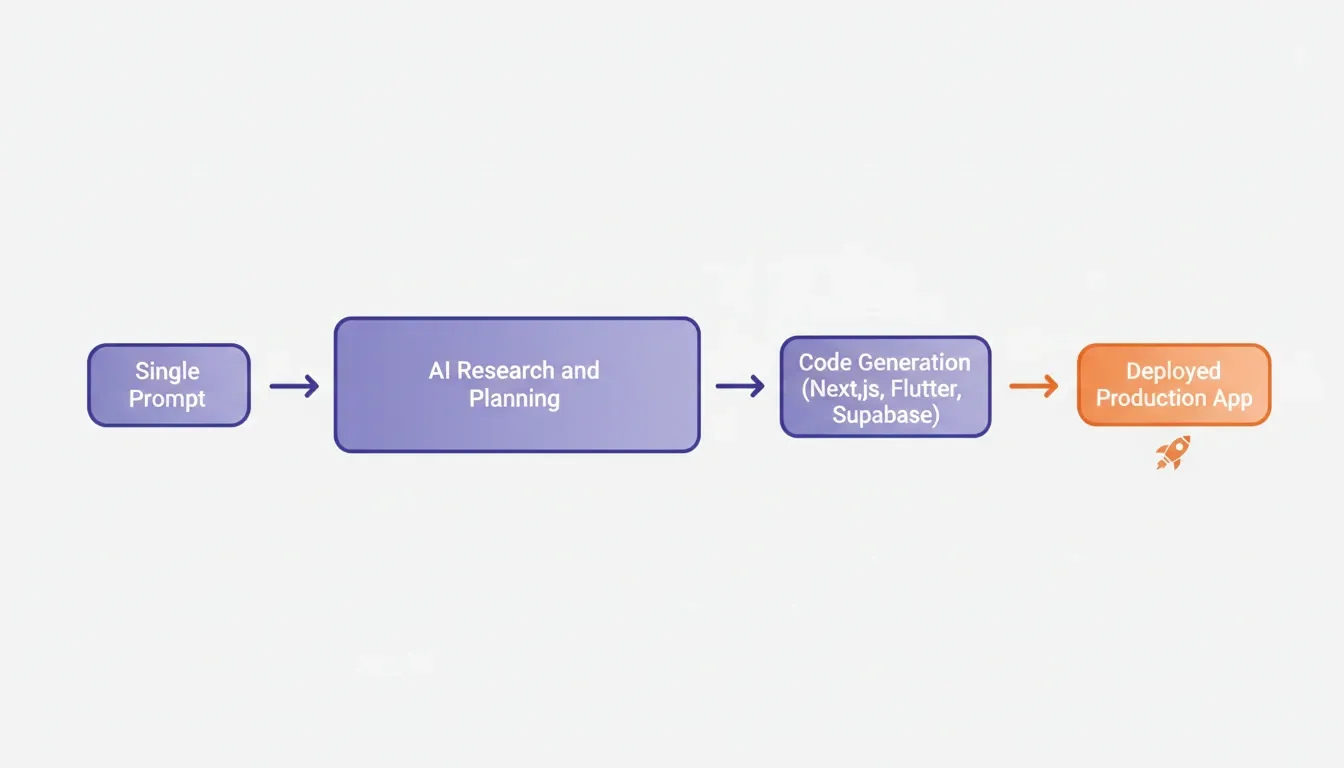
Rocket: from a single prompt to a fully deployed, production-ready full-stack application
How to Choose the Right BaaS Provider
The best platform is the one that lets your team ship this week rather than next quarter. Prioritize speed-to-production and code quality over feature count alone.
When comparing providers, focus on these areas:
-
Code ownership — confirm you can export your codebase and database at any time to avoid lock-in
-
AI capabilities — look for prompt-based generation and smart suggestions rather than manual-only configuration
-
Scalability — choose auto-scaling with pay-per-use pricing over fixed tiers with hard limits
-
Security — row-level security, SOC 2 compliance, and encryption should be standard, not optional
-
Database flexibility — full SQL access and real-time support give you more control as your app grows
-
Deployment speed — one-click deploy and preview environments save significant time during iteration
The Gap Between What AI Can Generate and What Teams Still Build Is Closing Fast
Backend services powered by intelligent generation remove the tedious parts of server-side development. As a result, founders, startups, and product teams can focus on building features users actually want.
Whether you are shipping your first MVP or scaling a SaaS product, the right BaaS platform turns weeks of infrastructure work into a single afternoon. The tools are ready. The only question is how quickly your team adopts them.
The Future of Backend Development Starts Before the First Prompt
Backend as a Service with AI is not a trend. It is the direction the entire development industry is moving. As AI generation matures, the teams that adopt managed, intelligent backends today will ship faster, iterate more confidently, and spend their time on the product decisions that actually matter.
The infrastructure layer is solved. What you build on top of it is the real question.
You have a product idea and a backend to generate. Start building on Rocket and describe what you need. Your database, APIs, auth, and deployment are handled from a single prompt.
Table of contents
- -What is Backend as a Service?
- -How AI-Powered BaaS Differs from Traditional BaaS
- -Top Features That Define Modern BaaS Platforms
- -Can AI Generate Your Entire API Layer Automatically?
- -BaaS Provider Comparison: Pricing and Plans
- -Real-World Use Cases for AI-Driven Backend Services
- -How Rocket Handles Your Entire Stack from a Single Prompt
- -How to Choose the Right BaaS Provider
- -The Gap Between What AI Can Generate and What Teams Still Build Is Closing Fast
- -The Future of Backend Development Starts Before the First Prompt