The best Devin AI alternatives go beyond code generation. They validate ideas, ship production-ready applications, and monitor markets, giving engineering teams the full arc from thinking to building.
Are you searching for a Devin AI alternative that fits your team's workflow and budget?
Devin AI changed what engineering teams expect from autonomous software agents. But with pricing starting at $500 per month and limited availability, most teams are evaluating what else exists.
This blog covers the strongest Devin AI alternatives in 2026, from open-source SWE agents to full-stack platforms, so you can make a grounded decision.
What is Devin AI and Why Are Teams Looking for Alternatives?
Devin AI, built by Cognition, launched in 2024 as the first fully autonomous AI software engineer. It plans multi-step engineering tasks, writes code across entire repositories, runs terminal commands, and debugs its own output without human intervention. It scored 13.86% on SWE-bench, far exceeding the previous best of 1.96%.
So why are engineering teams searching for alternatives?
-
Cost. Devin plans start at $500 per month for limited usage. For startups and smaller teams, that cost is hard to justify.
-
Access. Cognition has controlled access through waitlists since launch. Teams that need an agent today cannot always start on their timeline.
-
Workflow fit. Devin operates inside its own sandboxed environment. Plugging it into an existing editor or CI/CD pipeline requires significant adaptation work.
-
Scope. Devin resolves code issues. It does not validate ideas before you build, handle deployment automatically, or monitor your market after you launch.
These friction points have opened the door for alternatives that compete on pricing, openness, and developer control.
What Makes a Strong AI Coding Agent?
According to the Stack Overflow 2024 Developer Survey, 76% of developers now use or plan to use AI tools in their workflow. With that many teams evaluating options, knowing what to look for matters.
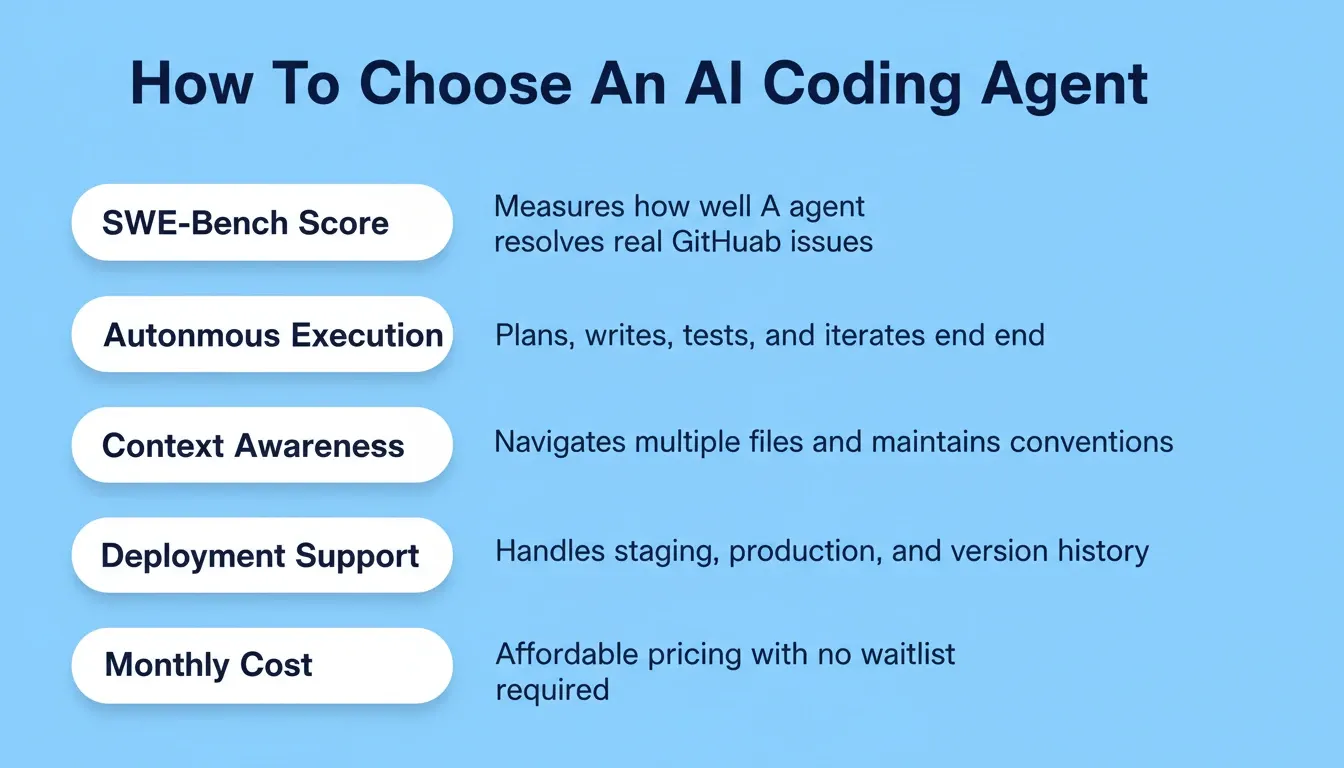
Here are the key dimensions to consider when comparing tools:
-
SWE-bench performance. Can the agent resolve real-world GitHub issues across large codebases? SWE-bench scores show how well an agent handles complex multi-file changes.
-
Autonomous execution. Does the agent plan, write code, test, and iterate without hand-holding? A strong agent handles full tasks from start to finish.
-
Codebase context. Can the agent navigate multiple files and maintain consistency with project conventions?
-
Deployment support. Does the tool stop at code generation, or does it handle staging, production, version history, and rollback?
-
Monthly cost. Is the tool affordable? Teams need to weigh cost against the scope of their engineering work.
Best Open Source Devin AI Alternatives
Open source projects have made remarkable progress in replicating what Devin offers. These alternatives give teams full control over the code, data, and execution environment without monthly subscription costs. For teams exploring how AI coding workflows are evolving, the open source space is moving fast.
1. SWE-Agent by Princeton NLP
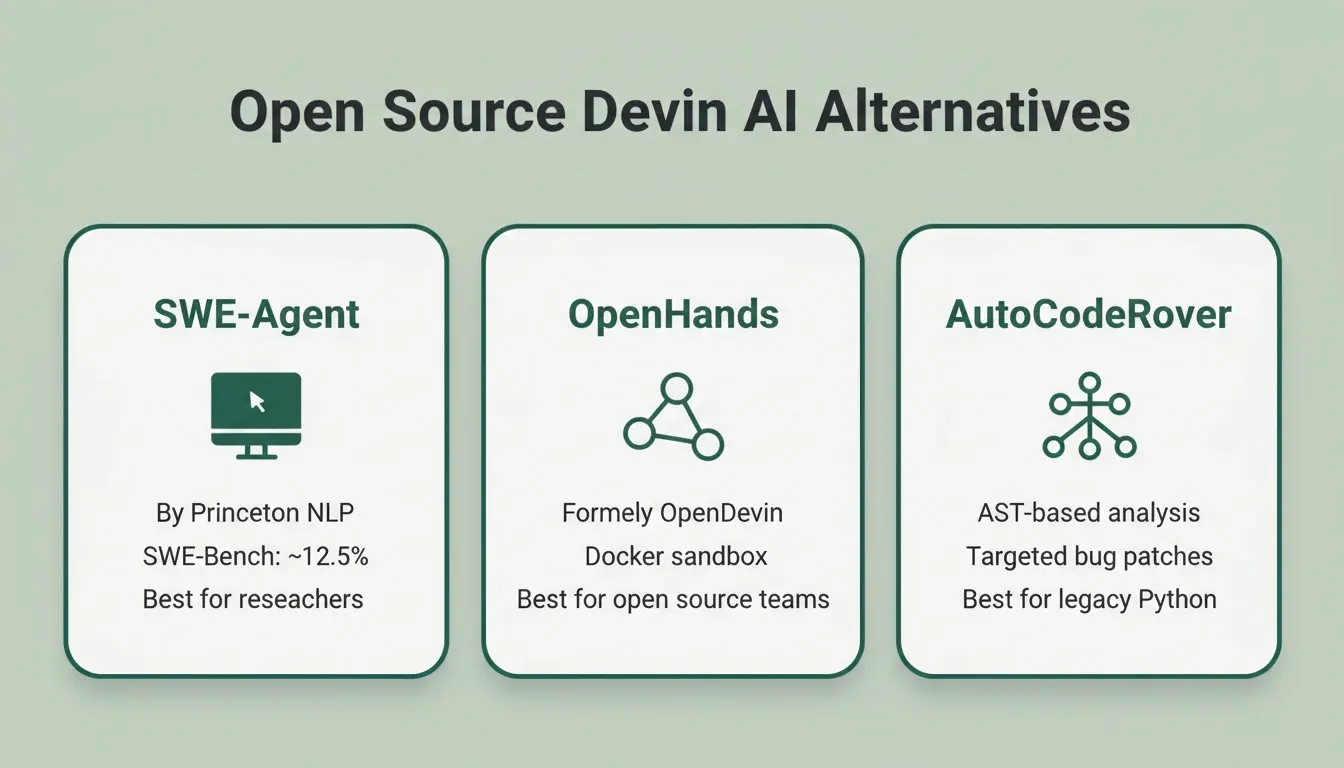
SWE-agent connects a language model to a terminal and code editor. It browses repositories, edits files, and runs commands to resolve GitHub issues autonomously. Researchers at Princeton built it to show that language models can interact with real codebases through a structured terminal interface.
SWE-bench results: SWE-agent scores around 12.5% on the full SWE-bench benchmark. That result is competitive with early Devin results. The architecture supports multiple LLM backends, including GPT-4 and Claude, giving teams model flexibility.
Best for: Researchers and engineering teams who want a transparent, locally-run agent with full control over execution and model choice.
Limitations: Requires local compute resources and setup time. No built-in deployment pipeline. Works best on Python repositories.
Learn more at the SWE-agent project page.
2. OpenHands (Formerly OpenDevin)
OpenHands provides a platform where AI agents collaborate inside a Docker-based sandbox environment. Agents browse the web, write code, execute terminal commands, and interact with APIs across multiple repositories. It started as a community effort to replicate Devin in open source form and has grown into a multi-agent platform.
Multi-agent architecture: Unlike single-agent tools, OpenHands supports workflows where specialized agents handle different parts of a complex engineering task simultaneously.
Best for: Teams who want the open source Devin experience without a monthly subscription.
Limitations: Requires self-hosting and Docker infrastructure. Support is community-driven, not enterprise-grade.
3. AutoCodeRover
AutoCodeRover uses abstract syntax tree (AST) analysis combined with LLM reasoning to localize bugs and generate targeted patches. It navigates code at a structural level rather than treating files as flat text. This approach prevents many common agent hallucination issues.
Best for: Teams dealing with legacy Python repositories who need reliable, targeted bug fixes without full codebase rewrites.
Limitations: Primarily focused on bug-fixing rather than feature development. Not suited for greenfield application development.
| Tool | Pricing | SWE-bench Score | Best For |
|---|---|---|---|
| SWE-agent | Free (open source) | ~12.5% | Researchers, self-hosters |
| OpenHands | Free (open source) | Competitive | Teams wanting open source Devin |
| AutoCodeRover | Free (open source) | Competitive | Bug-fix automation |
Top Commercial AI Coding Agents Worth Considering
If open source setup feels like too much work, these commercial Devin alternatives offer polished experiences with dedicated support and managed infrastructure. Teams evaluating AI coding agents for startups will find several strong options here.
4. GitHub Copilot Workspace
Copilot Workspace takes a GitHub issue, plans the implementation across multiple files, writes code, runs tests, and opens a pull request. It does all of this from a single natural language prompt within the GitHub interface. Deep integration with GitHub means the agent already has context about your codebase and team conventions.
Best for: Teams already built on the GitHub ecosystem who want issue-to-PR automation.
Limitations: Agent mode is still maturing compared to fully autonomous tools. No built-in deployment or production monitoring.
5. Cursor IDE
Cursor's agent plans multi-file editing tasks, executes terminal commands, searches across your entire codebase, and iterates based on feedback. Everything happens within the editor interface without context switching. You can switch between Claude, GPT-4, and other models depending on the task.
Best for: Individual developers who want agentic AI inside their existing workflow.
Limitations: Cursor generates code but does not deploy it. Separate infrastructure is needed for hosting, deployment pipelines, and production monitoring.
6. Amazon Q Developer
Amazon Q Developer is built for large engineering teams who need code generation, transformation, and security scanning at scale. Direct integration with AWS services means generated code can deploy without leaving the platform.
Best for: Enterprise teams already invested in the AWS ecosystem.
Limitations: Deep AWS dependency makes it less suitable for teams outside that ecosystem. Limited model flexibility.
7. Windsurf by Codeium
Windsurf's Cascade feature executes multi-step engineering tasks autonomously. It reads files, writes changes, runs terminal commands, and tracks project context across long coding sessions without losing state. The agent remembers previous sessions and maintains context about your project architecture.
Best for: Developers who want agentic capabilities without leaving a familiar IDE workflow.
Limitations: Like Cursor, Windsurf focuses on code generation and editing. Deployment and post-launch monitoring require separate tools.
| Tool | Starting Price | Autonomy Level | Deploys Apps? |
|---|---|---|---|
| GitHub Copilot Workspace | $19/month | Medium-High | No |
| Cursor IDE | $20/month | Medium-High | No |
| Amazon Q Developer | $19/month | Medium | Partial (AWS only) |
| Windsurf (Codeium) | $15/month | Medium-High | No |
Full-Stack AI Platforms That Ship Complete Applications
Some teams do not just want code generation. They want a platform that handles the entire journey from a plain-language description to a deployed, running application.
8. Replit Agent
Replit Agent turns natural language prompts into running web applications, complete with automatic deployment to a live URL. Describe what you want to build, and the agent writes code, installs packages, configures databases, and deploys. No local environment is needed.
Best for: Rapid prototyping and smaller projects where speed to a live URL matters most.
Limitations: Works best for smaller applications. Complex enterprise codebases still require hands-on engineering. Limited post-launch analytics and monitoring.
9. Tabnine Enterprise
Tabnine runs entirely on your own infrastructure, giving engineering teams full control over where their code data goes. It learns from your private repositories and adapts to your team's coding patterns, naming conventions, and architecture decisions over time.
Best for: Enterprise teams in regulated industries where data privacy and on-premise deployment are non-negotiable.
Limitations: Tabnine is a code assistance tool, not a fully autonomous agent. It does not plan and execute multi-step engineering tasks independently. It does not handle deployment or product research.
| Tool | Starting Price | Deploys Apps? | Research/Validation? |
|---|---|---|---|
| Replit Agent | $25/month | Yes | No |
| Tabnine Enterprise | Custom pricing | No | No |
How Rocket Handles What Other AI Coding Tools Miss
Most AI coding agents generate code. Few ship complete, working applications. None of them validate your idea before you build or monitor your market after you launch.
Rocket is the world's first Vibe Solutioning platform. It covers the full arc: strategic intelligence, production-grade building, and continuous competitive monitoring. All of this happens in one place with shared context. 1.5 million people have tried Rocket across 180 countries.
Here is what that means in practice:
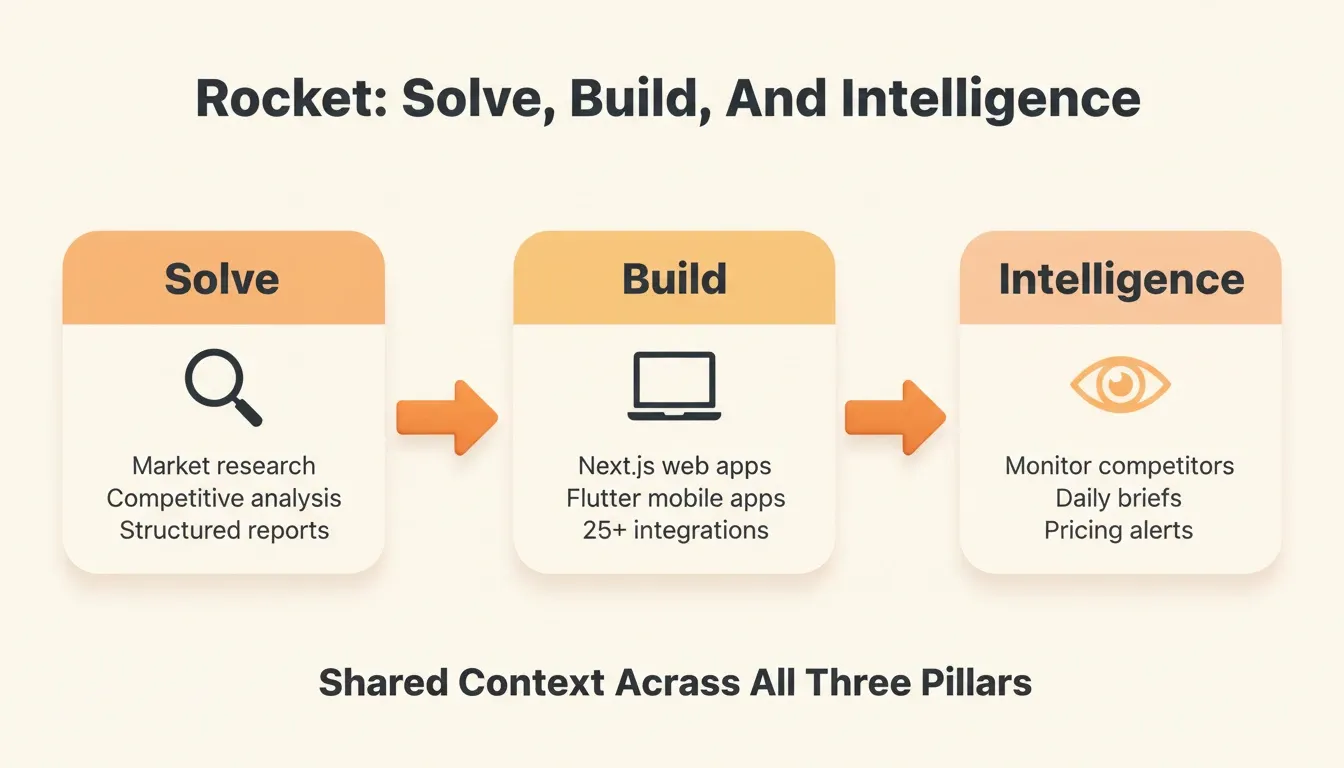
Validate before you build with Solve. Before writing a single line of code, you can run market analysis, competitive teardowns, and pricing strategy research directly inside the platform. Solve turns any business question into a structured, evidence-backed report. No other coding agent offers this.
Ship production-ready applications with Build. Rocket generates production-ready web apps in Next.js and mobile apps in Flutter from a plain-language description. Every build ships with SEO-ready structure, WCAG accessibility compliance, and GDPR coverage by default. Staging and production environments, full version history, and one-click rollback are included. Over 25 integrations, including Stripe, Supabase, OpenAI, Anthropic, Gemini, and Google Analytics, connect once and flow into every project.
Monitor competitors after you ship with Intelligence. Rocket continuously monitors every public platform your competitors operate on. It covers pricing pages, job postings, social media, product updates, and reviews. Daily briefs and alerts keep your team informed. No other coding agent does this.
The context compounds. The research from Solve flows directly into Build. The Intelligence signal from last week informs this week's product decision. Nothing is re-explained. Everything compounds.
"I shipped a full SaaS MVP in a single afternoon using Rocket. No terminal, no config files, just a conversation and a live product at the end." — Developer on X/Twitter
| Platform | Starting Price | Deploys Apps? | Research/Validation? | Competitor Monitoring? |
|---|---|---|---|---|
| Devin (Cognition) | $500/month | No | No | No |
| Replit Agent | $25/month | Yes | No | No |
| Rocket | $25/month (Pro) | Yes | Yes | Yes |
How to Choose the Right Devin AI Alternative for Your Workflow
The decision comes down to how your team works and what you actually need built. Not every project requires a fully autonomous agent. For a deeper look at choosing the right AI tool for your development workflow, the points below are a solid starting point.
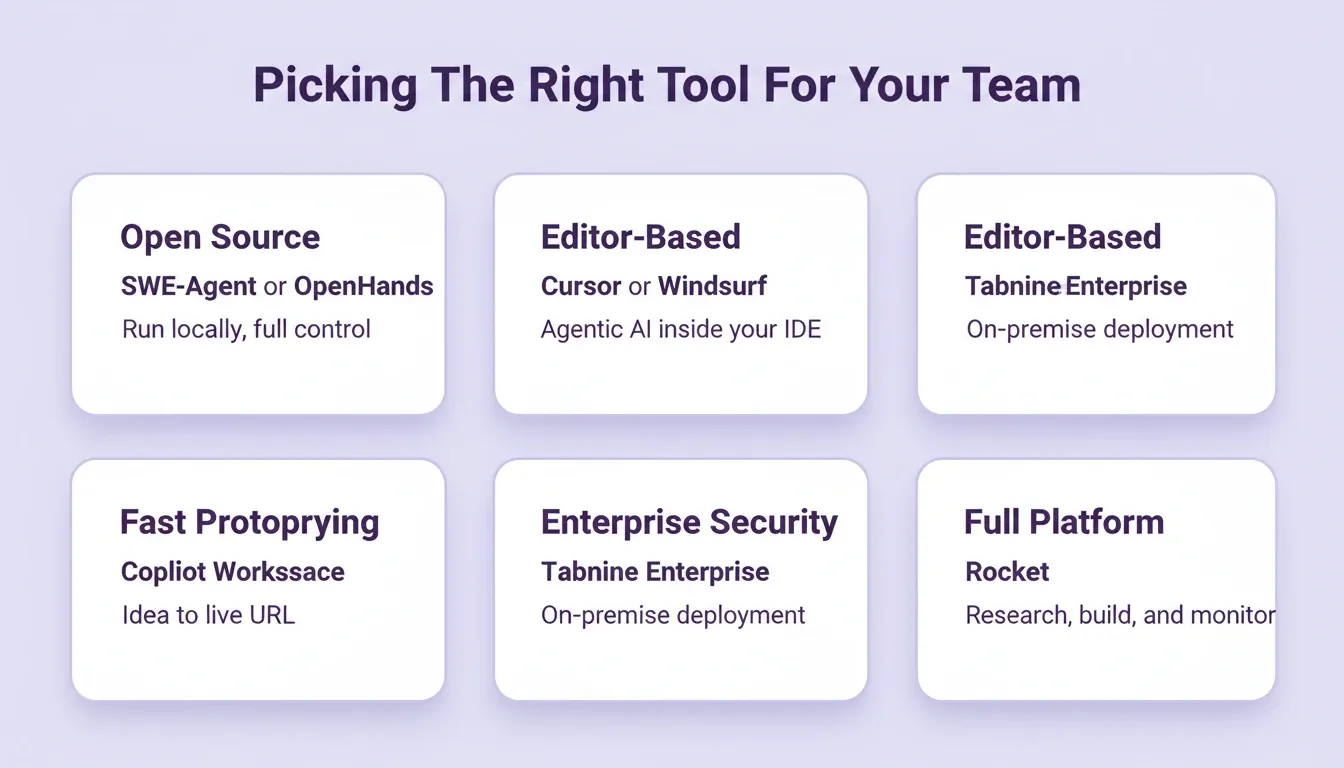
If you want full control and pay nothing: Choose SWE-agent or OpenHands. You manage the infrastructure but own every piece of the workflow and can run it locally.
If you want polished code assistance within your editor: Cursor or Windsurf gives you agentic AI without leaving your familiar development environment.
If your team runs on GitHub and needs task automation: Copilot Workspace integrates directly with your existing pull request and issue workflow.
If you need enterprise security and on-premise deployment: Tabnine is the only option that runs entirely on your own infrastructure with zero data retention.
If you need a complete application shipped fast: Rocket is the choice for teams who want to go beyond code generation. It handles research, design, deployment, analytics, and competitive monitoring in a single platform.
The Right Tool Starts Before the First Line of Code
The market for Devin AI alternatives has matured significantly. Whether you choose an open source agent for maximum control, an editor-based tool for daily coding, or a full platform for shipping complete products, the right choice depends on where your team's actual work begins.
Most tools start after the hardest decision has already been made. Rocket starts before it. As autonomous AI software engineering continues to evolve, the teams that win will be the ones who validate before they build, ship with confidence, and stay ahead of what their market is doing. That is the arc Rocket is built for, from the first question through a product in market.
Type your idea into Rocket and see what the thinking before the build actually produces.
Table of contents
- -What is Devin AI and Why Are Teams Looking for Alternatives?
- -What Makes a Strong AI Coding Agent?
- -Best Open Source Devin AI Alternatives
- -1\. SWE-Agent by Princeton NLP
- -2\. OpenHands (Formerly OpenDevin)
- -3\. AutoCodeRover
- -Top Commercial AI Coding Agents Worth Considering
- -4\. GitHub Copilot Workspace
- -5\. Cursor IDE
- -6\. Amazon Q Developer
- -7\. Windsurf by Codeium
- -Full-Stack AI Platforms That Ship Complete Applications
- -8\. Replit Agent
- -9\. Tabnine Enterprise
- -How Rocket Handles What Other AI Coding Tools Miss
- -How to Choose the Right Devin AI Alternative for Your Workflow
- -The Right Tool Starts Before the First Line of Code