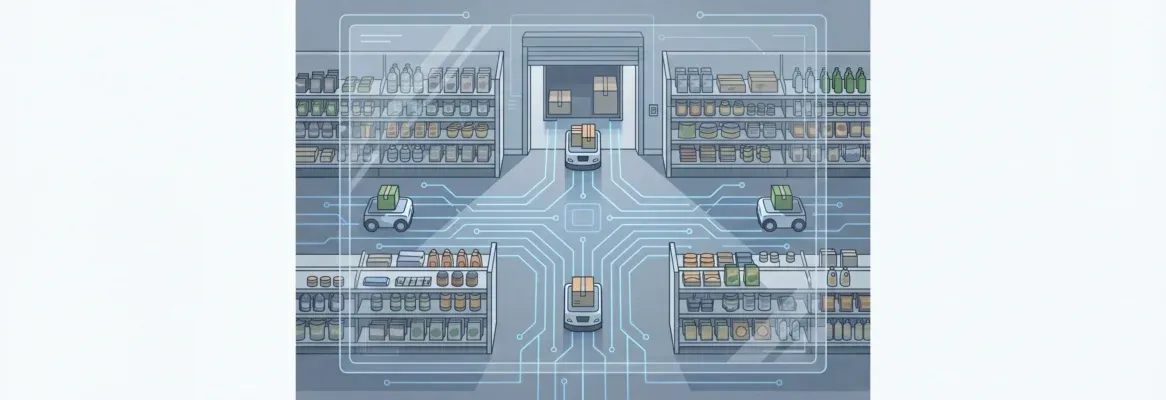
To build a dark store grocery delivery app fast, use Rocket.new to generate a full-stack app from a single prompt with the core systems this model needs: real-time inventory, Google Maps delivery tracking, and SMS/email notifications.
For founders and entrepreneurs validating or launching a dark store grocery delivery business, this guide explains how dark stores work, why quick commerce is growing so fast, which app features matter, how to test the business model, how Rocket.new changes the build process, and what to expect after launch with operations and retention.
Why are grocery brands spending billions on warehouses that no customer will ever walk into?
The answer is speed. Dark stores exist for one purpose: to get groceries from shelf to doorstep in under 30 minutes, and consumers now expect nothing less.
The global dark store market was valued at USD 30.1 billion in 2025, growing at a CAGR of 36.33% through 2034. That kind of surge signals a permanent shift in how people buy groceries, household goods, and everyday products, and a major opportunity for founders who need efficient technology to move quickly.
So how do you actually build the app behind one of these operations?
That is what this guide breaks down, step by step.
What Are Dark Stores and How Do They Operate?
A dark store is a retail-sized fulfillment center that serves only online customers — closed to the public, optimized entirely for picking and packing orders fast. No walk-in customers, no checkout lanes, no wide aisles designed for browsing. Every shelf, every product placement, and every square foot is optimized for one thing: getting groceries from shelf to doorstep in under 30 minutes.
The Concept in Simple Terms
Here is how dark stores operate, step by step, focusing solely on online order fulfillment:
-
A customer places an order through a mobile app or website
-
The system assigns the order to a picker inside the nearest dark store
-
The picker collects items from shelves using an optimized layout
-
Staff pack the groceries into delivery bags
-
A courier delivers the order to the customer's door within 15-30 minutes
The entire process is designed for speed, helping deliver groceries quickly for customers ordering through mobile or web platforms. There is no time spent on merchandising displays, customer service desks, or in-store promotions. Most dark stores function like a well-tuned machine where every second counts.
This model differs from a traditional grocery store, which is designed to attract foot traffic. It also differs from a large warehouse, which stores bulk stock for redistribution rather than individual customer orders. If you are interested in creating a food delivery app, understanding this distinction matters.
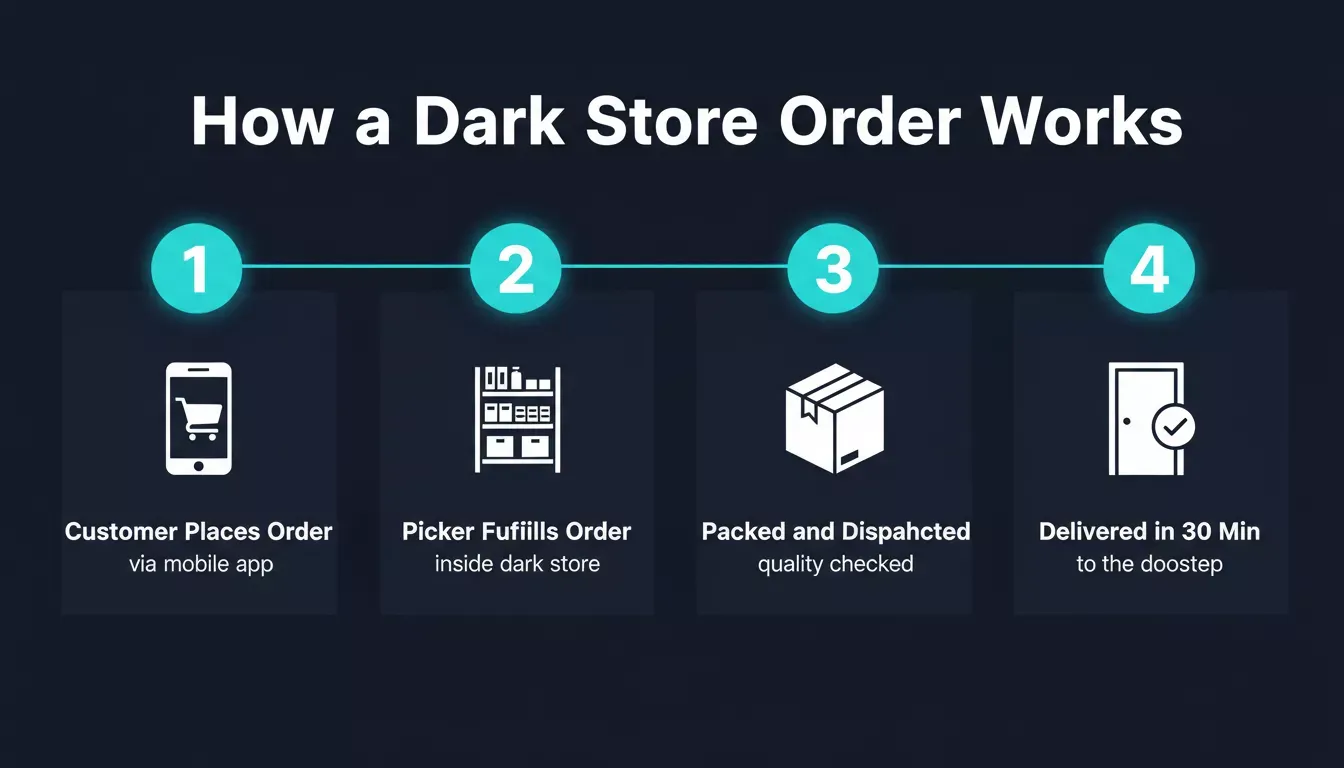
How a dark store processes an order from tap to doorstep
How Dark Stores Differ From Warehouses and Retail
| Feature | Dark Store | Retail Store | Warehouse |
|---|---|---|---|
| Customer Access | Closed to the public | Open to shoppers | Closed to the public |
| Primary Purpose | Picking and packing online orders | In-store browsing and sales | Bulk storage and redistribution |
| Typical Location | Near residential areas, urban | Shopping districts, high traffic | City outskirts, industrial zones |
| Facility Size | 1,000-10,000 sq ft | 2,000-50,000 sq ft | 10,000-100,000+ sq ft |
| Automation Level | High (AI + robotics) | Low (POS systems) | Medium (WMS + conveyors) |
| Delivery Speed | 15-30 minutes | N/A (customer picks up) | 1-3 days (B2B distribution) |
| Inventory Layout | Optimized for picker speed | Optimized for shopper browsing | Optimized for pallet storage |
The key takeaway: a dark store is an efficient dark store setup that combines retail-sized space with warehouse-level efficiency, located close to the customers it serves. In the dark store model, proximity supports hyperlocal fulfillment by placing inventory near residential demand.
Why Is Quick Commerce Gaining Traction Worldwide?
Quick commerce is growing because consumers now treat sub-30-minute grocery delivery as a baseline expectation, not a premium service. The online grocery delivery market reached USD 0.75 trillion in 2025, with quick commerce posting a 28.45% forecast CAGR through 2031.
Some forecasts also project the dark store market to grow from $15.3 billion in 2023 to $129.2 billion by 2030, underscoring how the dark store industry is becoming a fast-expanding logistics segment. Rapid delivery services are expanding fastest in Asian and European capitals, where population density supports high order velocity.
The Numbers Behind the Shift
Key data points driving this growth:
-
More than 6,000 dark stores are now operational globally
-
Blinkit alone operates 1,816 dark stores across 150+ cities in India
-
Quick commerce market share is rising fastest in metro areas where same-day delivery is the baseline expectation
-
Grocery and convenience items account for 41.6% of all dark store revenue
-
Amazon Fresh helped popularize fast grocery fulfillment and influenced how modern dark store networks scale around online demand
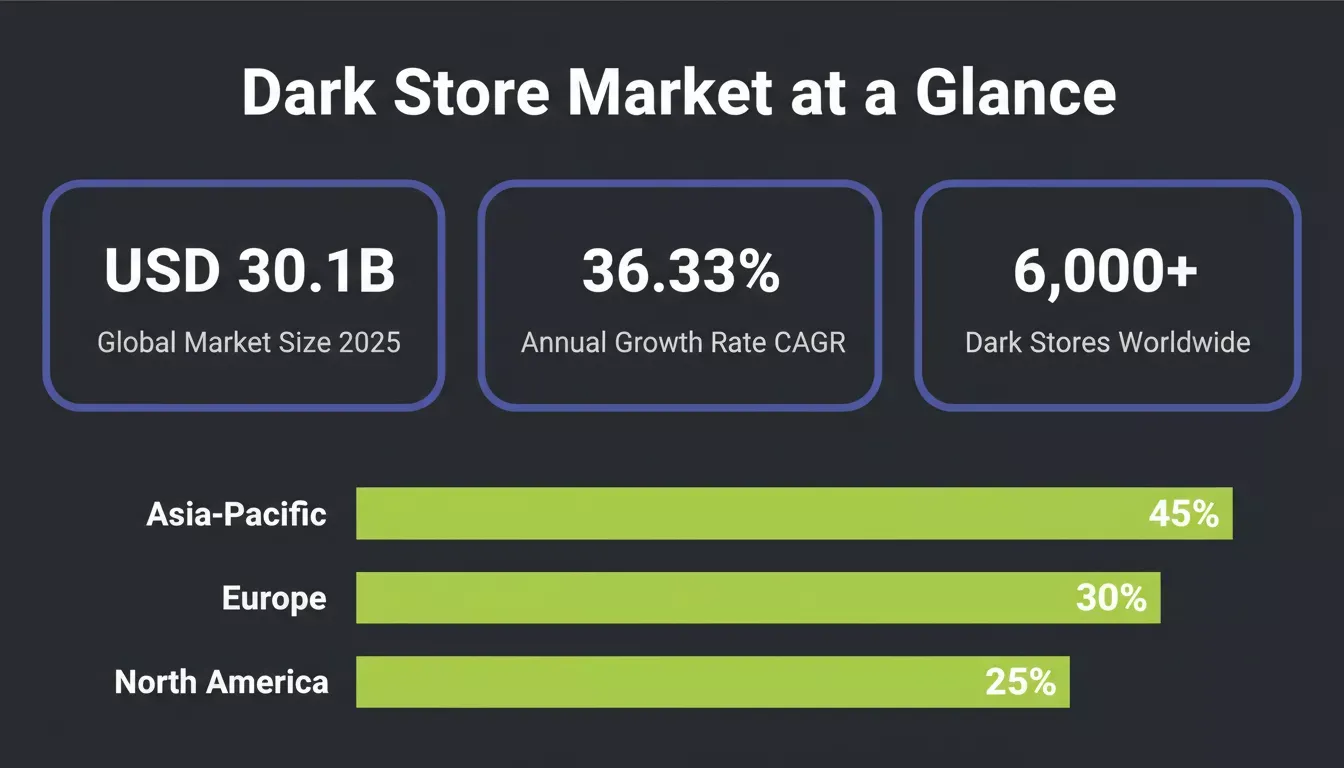
Key market metrics for the global dark store and quick commerce sector
The growing demand is not limited to a single region. North America, Europe, and Asia-Pacific are all experiencing a surge in q-commerce adoption. Consumers who tried rapid delivery during the pandemic never went back to waiting days for groceries.
What Consumers Expect From Grocery Delivery Apps
Today's consumers expect grocery shopping and online shopping to feel equally fast and convenient. Their expectations include:
-
Real-time order tracking from the moment they place an order
-
Delivery time estimates that stay accurate within minutes
-
Same-day or sub-30-minute windows for everyday groceries
-
Product variety comparable to what they find in a physical grocery store
-
SMS and email notifications for order status, promotions, and delivery updates
These expectations define the must-have features of modern grocery delivery apps.
**"Quick commerce is evolving into an infrastructure-first business. The real competitive advantage isn't just the app or pricing, but the density, location strategy, and efficiency of dark store networks." — Pankaj Chaudhary, **LinkedIn
These rising expectations mean that any new grocery delivery app needs a strong technology stack from day one. The question then becomes: what features are non-negotiable?
What Features Does a Dark Store App Need?
The feature set of your grocery delivery app determines whether customers stick around or switch to a competitor. Here is what the technology stack looks like across three layers.
Customer-Facing Features
These are the features your users interact with directly on their mobile apps or web interface, and the customer layer should include both must-have features and advanced features that improve retention:
-
Product catalog with search, filters, and categories for groceries, frozen goods, household goods, and more
-
Real-time order tracking with GPS-based delivery updates
-
Multiple payment gateways (cards, wallets, UPI, cash on delivery)
-
Push notifications alongside SMS and email notifications for order confirmations, delivery ETAs, and promotions that support engagement and repeat use
-
Loyalty programs with points, discounts, and cashback for repeat shoppers
-
User reviews and ratings for products and delivery personnel
-
Scheduled delivery slots alongside on-demand options
Admin Panel and Operations Layer
Behind the scenes, your operations staff and store managers need tools to manage dark store operations:
-
Admin panel for real-time inventory management across multiple locations
-
Barcode scanning integration for stock tracking and accuracy
-
Automated low-stock alerts and reorder triggers
-
Analytics dashboard to monitor analytics, track sales, and identify trends
-
WMS (Warehouse Management System) connectivity for picking and packing workflows
-
CRM integration for managing customer data and retention campaigns
-
Staff scheduling and performance tracking for pickers and delivery personnel
Delivery and Logistics Features
The last-mile delivery layer is where most dark stores live or die, and common technologies here include Node.js, PostgreSQL, and google maps api:
-
Google Maps API for delivery tracking and location-based order assignment
-
Real-time tracking for delivery personnel and couriers
-
Delivery time estimation using AI-based demand forecasting
-
Automated order assignment to the nearest available courier
-
Batch delivery grouping with route optimization to cluster nearby orders and reduce travel time
-
Proof of delivery with photo confirmation
Building all of this from scratch takes months and significant investment. The good news is that the development timeline is shrinking fast for teams using AI-powered builders. You can explore how Rocket.new builds production-ready apps from a single prompt to understand what that looks like in practice.
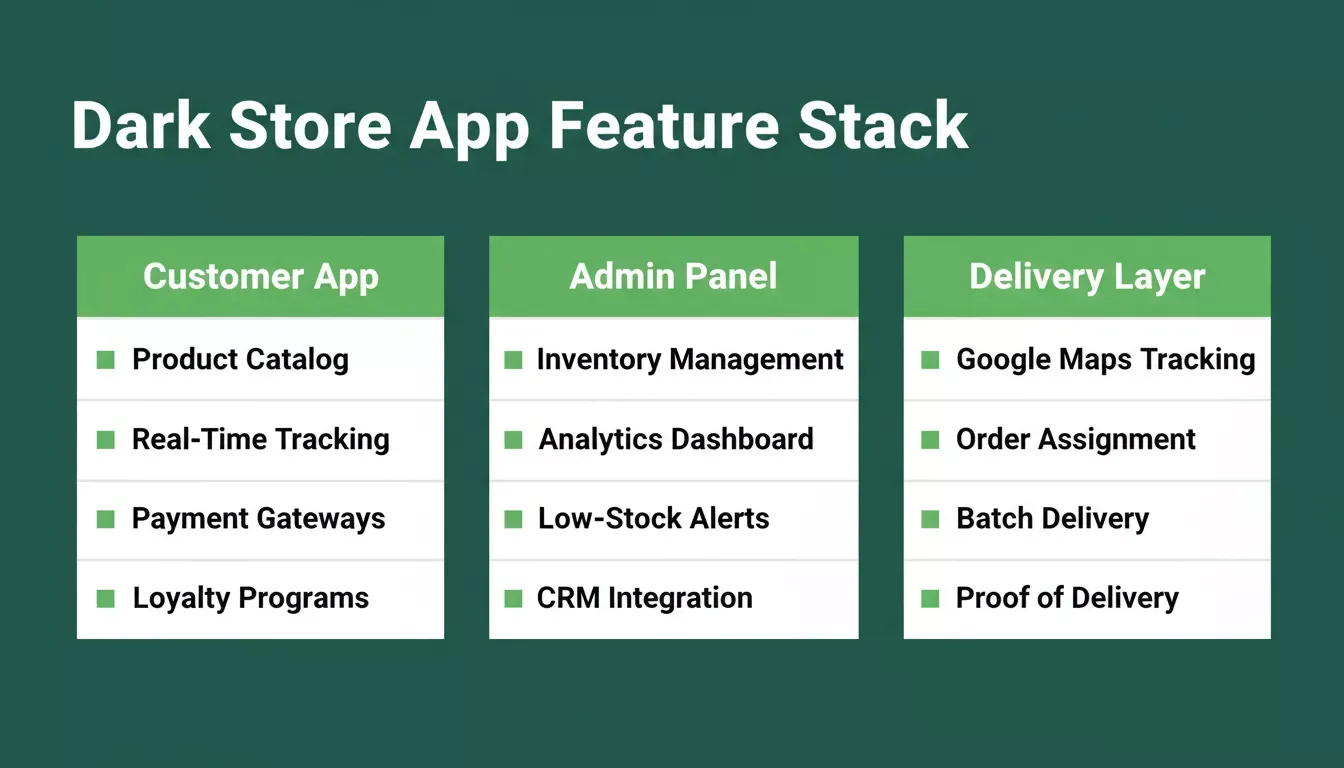
The three-layer feature stack every dark store app needs at launch
How Do You Validate a Dark Store Business Model?
Validate demand in your target area before committing capital to a full dark store build. Skipping this step is how grocery business ventures burn through funding without gaining traction.
Steps to Conduct Market Research
-
Identify demand density: Map residential areas within a 3-5 km radius and estimate potential order volume
-
Analyze local competition: Check which grocery chains, delivery platforms, and dark grocery stores already operate in the area
-
Estimate basket size and frequency: Research what online shoppers in that location spend per order and how often they buy
-
Assess infrastructure costs: Factor in rent, cold storage needs, technology stack, and staff requirements
-
Test with a minimum viable product: Launch a limited catalog in one location before scaling
Using Rocket's Solve for market validation: Rather than running this research manually, founders can use Rocket's Solve engine to get a structured, evidence-backed market analysis report. Ask Solve a question like "What is the demand density for quick commerce grocery delivery in [city]?" and it returns an executive summary, competitive landscape, and sourced recommendations.
Those findings carry directly into your Build task via cross-task context, so your app is built on validated market data from day one.
Choosing Your Location and Product Mix
Location selection can make or break your dark store business model. Here are the factors to consider:
-
Urban density wins early: Most dark stores start in cities where order volume justifies the costs
-
Suburban areas offer less competition: Fewer delivery platforms serve these zones, creating an opening for new players
-
Product mix drives margin: Groceries form the backbone, but adding frozen goods, electronics accessories, and household goods increases average basket value
-
Focus on high-frequency categories first: dairy, produce, snacks, beverages
The validation phase is where most founders either gain confidence or pivot. Once you have data showing demand, the next step is shipping the actual app. A step-by-step mobile app guide can help you plan the technical side while you handle the business model validation.
How Rocket.new Ships Your Dark Store App in Record Time
You have seen what features a dark store app demands and how to validate the market. Now comes the part where most founders get stuck: actually building the software.
Rocket.new is a full-stack AI app builder and part of the vibe solutioning platform alongside Solve (market research) and Intelligence (competitor monitoring). For a dark store grocery delivery app, here is what the Build workflow looks like in practice:
-
Describe your app in plain language, and Rocket generates both web (Next.js) and mobile (Flutter) applications
-
Real-time inventory via Supabase integration: Database, auth, file storage, and edge functions scaffolded from chat, with stock levels updating as pickers fulfill orders
-
Payment gateways connected: Stripe and Razorpay are documented connectors, configured from a single prompt
-
SMS and email notifications via Twilio, Resend, and SendGrid: Order confirmations, delivery updates, and promotional alerts ready to send
-
Admin panel scaffolded from chat: Manage products, track orders, assign couriers, and monitor analytics without building a separate dashboard
-
Google Maps integration for delivery tracking: Location-based order assignment and courier tracking, which you can extend with custom routing logic for your specific delivery zones
The platform handles the full technology stack: database schema, API routes, authentication, UI components, deployment, and core e-commerce workflows like catalog, checkout, and order management. You get production-grade code you own and can customize, downloadable and GitHub-syncable, not a locked-in template.
SEO and AI Search Built Into Every App
One differentiator worth noting for grocery delivery founders building for discoverability: Rocket-built apps ship with clean semantic HTML by default. You can run /Generate SEO Report and /Improve SEO slash commands directly in the Build editor to add optimized meta tags, structured data, and sitemaps. For AI search visibility specifically, /Generate GEO And AEO Report and /Improve GEO And AEO restructure your content for citation in AI-generated answers. Teams using a no-code app builder for startups are launching dark store apps in record time without writing a single line of code themselves.
Rocket.new vs. Other Development Approaches
Not every team should use the same approach. Here is an honest comparison:
| Approach | Typical Cost | Time to MVP | Team Needed | Ongoing Maintenance |
|---|---|---|---|---|
| Rocket.new (AI builder) | Low (subscription) | Same day to 1 week | 1 non-technical founder | Minimal, iterate in chat |
| Freelance developer | $15K-$50K | 6-12 weeks | 1-2 developers | Ongoing hourly rate |
| Agency build | $50K-$150K | 3-6 months | Agency team | Retainer or re-engagement |
| In-house dev team | $200K+/year | 4-8 months | 3-5 engineers | Full salary overhead |
The right choice depends on your stage. Rocket.new is purpose-built for founders who want to validate and ship fast; it collapses the timeline from months to days. Teams with complex custom logistics requirements or large engineering budgets may eventually want to migrate to a bespoke stack, and Rocket's downloadable, GitHub-syncable code makes that transition straightforward.
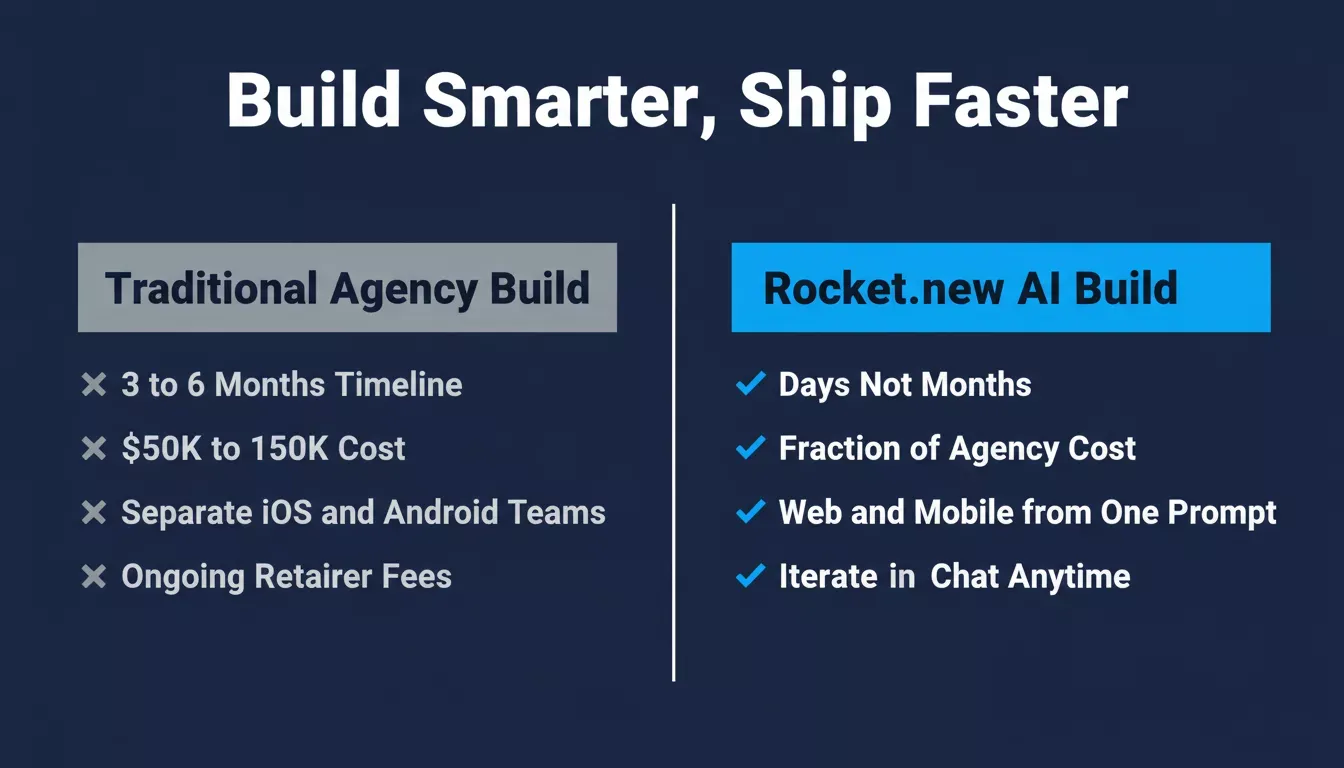
Traditional agency development vs. Rocket.new: what changes when you build with AI
What Challenges Should You Expect After Launch?
Launching is just the beginning. Dark store operations demand constant refinement, and the teams that iterate fastest tend to win their local markets.
Operational Hurdles in Dark Store Operations
Running a dark store at scale introduces several challenges that technology alone cannot fully solve:
-
Delivery personnel management: recruiting, training, and retaining couriers in competitive urban markets where every quick commerce player is hiring from the same pool
-
Cold chain integrity: frozen goods and perishables require temperature-controlled storage zones, adding costs and complexity
-
Stock accuracy and waste: a single miscount creates a failed order, which damages customer experience and drives negative reviews
-
Scaling to multiple locations: expanding into dense neighborhoods often means opening micro fulfillment centers, which requires replicating processes while adapting to each area's demand patterns
-
Maintenance costs compound: technology, real estate, staff, and delivery fleet expenses grow with every new store
Many operators still rely heavily on human labor even when automation is added.
Dark store startup costs range from $250K to $500K for a mid-size center, with monthly operating expenses between $20K and $50K. These figures are consistent with industry benchmarks and corroborated by operator case studies across the US and European markets. Understanding logistics app development costs helps founders plan realistic budgets from day one. As the market matures, hybrid retail models are expected to combine storefronts with dark store operations.
Keeping Customers Coming Back
Customer retention is where long-term profitability lives. Here is how top-performing dark stores keep shoppers loyal:
-
Monitor analytics weekly to spot drops in order frequency, identify popular time slots, and adjust staffing
-
Use SMS and email notifications strategically for re-engagement, not spam
-
Implement loyalty programs with points or cashback that reward repeat purchases
-
Track delivery speed metrics and set alerts when times exceed targets
-
Collect and act on customer feedback through in-app rating prompts
-
Test hybrid models that combine scheduled and on-demand delivery to serve different customer segments
The good news: Rocket.new lets you iterate on features in minutes rather than weeks. When you spot an issue in your customer retention data, you can ship a fix the same day. You can also use Rocket's Intelligence to monitor what competing dark store apps are shipping, so you always know what your rivals are adding before your customers notice.
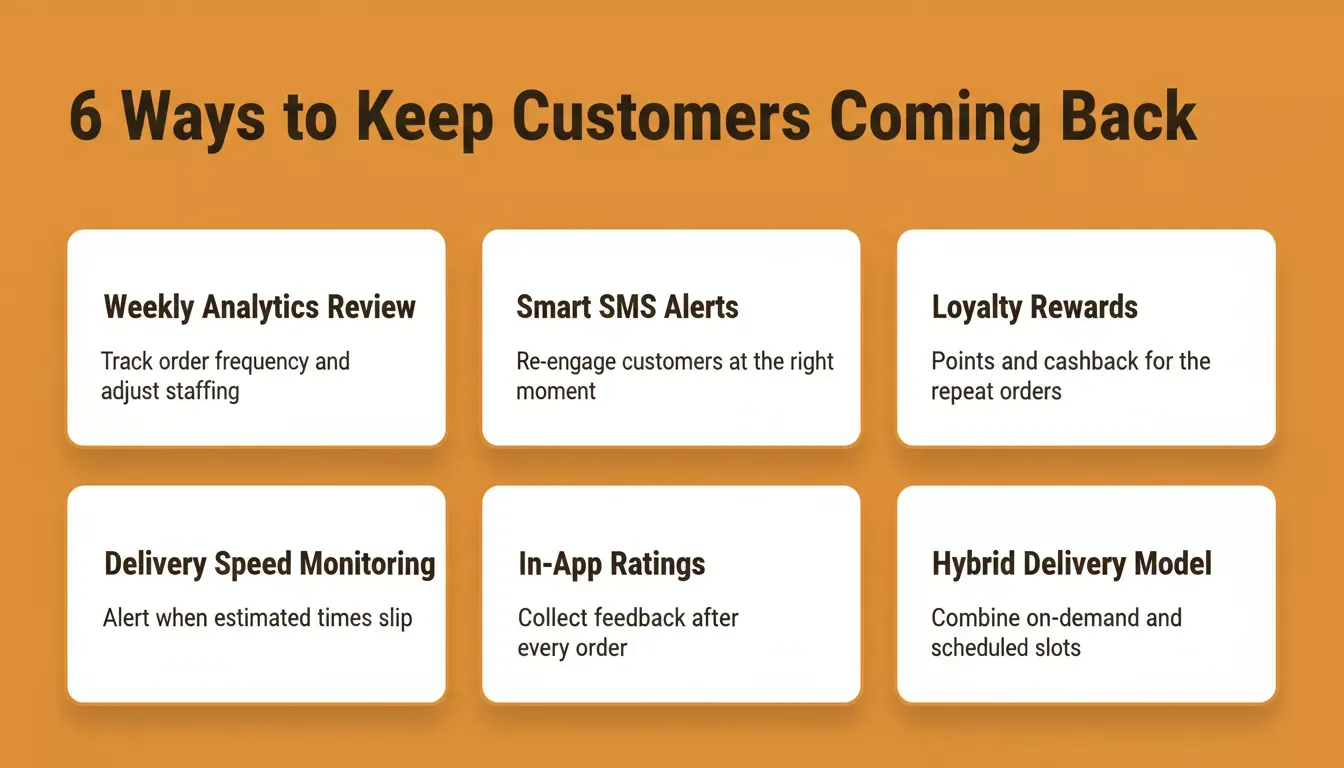
Six proven retention strategies for dark store grocery delivery apps
The Q-Commerce Opportunity Starts With Your First Build
Dark stores are no longer experimental. Grocery delivery apps powered by rapid fulfillment from these facilities are reshaping how consumers in cities and suburban areas worldwide buy their groceries, household goods, and daily products. The market is growing at 36% annually, and the companies winning are those that shipped first.
Whether you are validating a concept in a single neighborhood or ready to launch across multiple locations, the tools exist to move in record time. The gap between the idea and the live app has never been smaller.
Ready to ship your dark store app? Rocket.new turns your idea into a production-grade grocery delivery application, with Supabase-powered inventory, Stripe and Razorpay payments, Google Maps delivery tracking, and SMS and email notifications via Twilio and Resend, all from a single prompt.
Start building on Rocket.new now and go from concept to live app today.
Table of contents
- -What Are Dark Stores and How Do They Operate?
- -The Concept in Simple Terms
- -How Dark Stores Differ From Warehouses and Retail
- -Why Is Quick Commerce Gaining Traction Worldwide?
- -The Numbers Behind the Shift
- -What Consumers Expect From Grocery Delivery Apps
- -What Features Does a Dark Store App Need?
- -Customer-Facing Features
- -Admin Panel and Operations Layer
- -Delivery and Logistics Features
- -How Do You Validate a Dark Store Business Model?
- -Steps to Conduct Market Research
- -Choosing Your Location and Product Mix
- -How Rocket.new Ships Your Dark Store App in Record Time
- -SEO and AI Search Built Into Every App
- -Rocket.new vs. Other Development Approaches
- -What Challenges Should You Expect After Launch?
- -Operational Hurdles in Dark Store Operations
- -Keeping Customers Coming Back
- -The Q-Commerce Opportunity Starts With Your First Build