
M&A deals fail when document access is an afterthought. A role-based document hub assigns permission tiers to every party, versions every file, and logs every action, protecting advisory firms from legal exposure and lost mandates.
Does your deal room actually control who sees what, or does it just hope they don't look?
Global M&A deal value hit $4.6 trillion in 2025, up 49% year-over-year according to LSEG data compiled by Acquisition Stars. Behind each of those transactions sits a document process that most advisory firms still manage through email threads, shared folders, and ad-hoc permissions. The problem is not organization. It is access control.
When five deal parties need different views of the same document set, and none should see each other's files, a folder structure cannot solve the problem. That is a permissions architecture problem, and it requires a purpose-built system.
Why Is Document Control a Deal Risk for M&A Advisors?
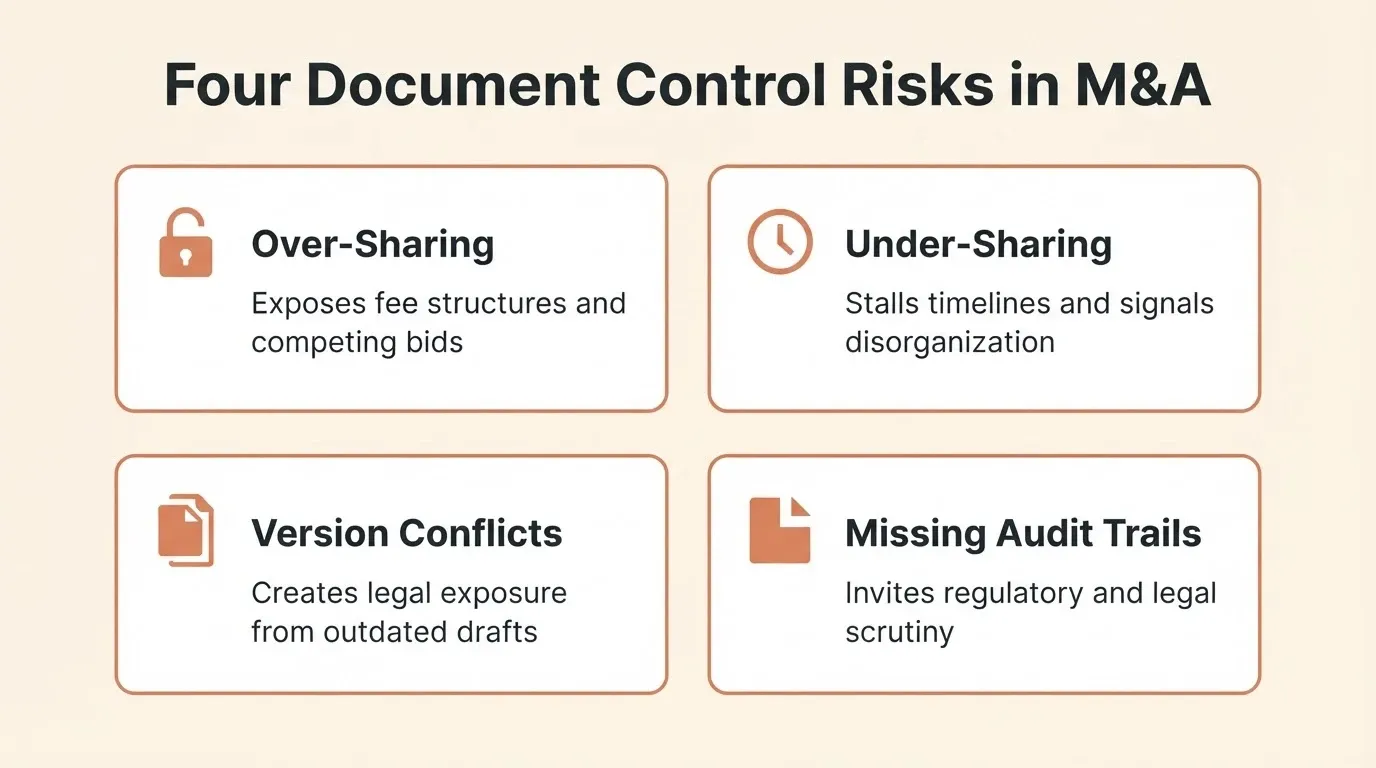
Document control in M&A is not a filing exercise. It is a risk management function that directly affects deal outcomes and advisory reputation.
Advisory teams building deal management platforms for their firms already understand this pain. The document layer is where deal risk actually lives, not in the financial model.
-
Over-sharing kills negotiating leverage. When a buyer sees internal valuation memos meant only for the seller's counsel, the advisory team's position collapses. One wrong permission setting can expose fee structures, competing bid details, or strategic alternatives that were never supposed to leave the sell-side.
-
Under-sharing stalls deal timelines. Buyers waiting three days for a document that should have been available at the start of diligence lose patience. Slow document delivery signals disorganization, and disorganized advisors lose mandates.
-
Version conflicts create legal exposure. When two versions of a share purchase agreement circulate simultaneously because someone downloaded a draft before the latest redline was uploaded, the consequences range from embarrassing to legally actionable.
-
Missing audit trails invite regulatory questions. Regulators and courts increasingly expect a clear record of who accessed which documents and when. If your document system cannot produce that log, you are creating a compliance gap that surfaces at the worst possible moment.
Nearly half of private capital firms spend more than 40 hours researching a single deal, according to Affinity's 2025 survey of 297 professionals. Much of that time burns on finding, validating, and controlling access to documents scattered across disconnected systems.
Why Folder-Level Permissions Always Fail in M&A
Most advisory teams start with folder-level permissions in Google Drive, SharePoint, or Dropbox. This approach breaks at the first complication.
A single financial model may need to be visible to the preferred buyer but not to a second-round bidder still in process. A redlined SPA needs to be visible to both legal teams but not to the buyer's CFO. A management presentation needs to be watermarked for one party and clean for another.
Document-level permissions, enforced at the database layer, are the only architecture that handles these scenarios without manual intervention at every step.
How Does Role-Based Access Map to Deal Party Structures?
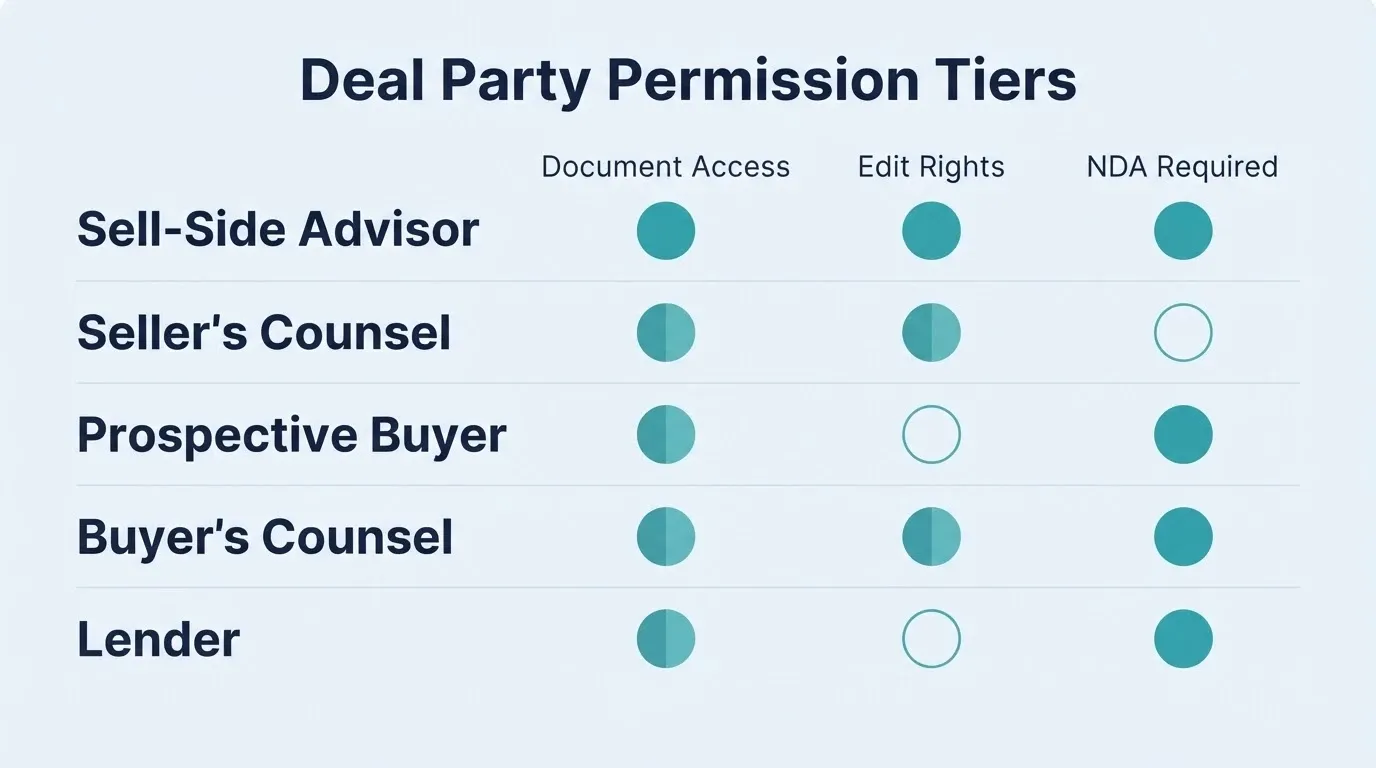
The typical M&A transaction involves at least five distinct party groups. Each one requires a different view of the same document universe. Mapping role-based access to deal party structures is the foundation of any secure document hub.
-
Sell-side advisor team needs full access to every document, every version, and every communication thread. They manage the process and control what gets shared with whom.
-
Seller's legal counsel accesses legal agreements, compliance files, and regulatory filings, but not the advisor's fee arrangements or competing bid analysis.
-
Prospective buyers see marketing materials and the confidential information memorandum (CIM) only after signing an NDA. During diligence, their access expands to financial statements, contracts, and operational data within a defined scope.
-
Buyer's legal counsel reviews transactional documents, the share purchase agreement (SPA), and diligence findings, without visibility into the sell-side's internal discussions or other buyers' activity.
-
Lenders and financing parties receive a subset of financial data relevant to their credit assessment, often with watermarks and download restrictions.
A secure buyer workspace for due diligence is only one piece of this puzzle. The full architecture needs every party mapped to specific permission tiers.
Permission Tiers for Buyers, Sellers, and Counsel
| Role | Document Access | Edit Rights | Audit Visibility | NDA Required |
|---|---|---|---|---|
| Sell-Side Advisor | All documents, all versions | Full | Full audit log | No (internal) |
| Seller's Counsel | Legal, compliance, regulatory | Comment only | Own activity | No (engaged) |
| Prospective Buyer | CIM, financials (post-NDA) | None | None | Yes |
| Buyer's Counsel | SPA, diligence materials | Comment only | Own activity | Yes |
| Lender | Financial subset, watermarked | None | None | Yes |
Each permission tier maps directly to a deal party's role and information rights. When a buyer drops out of the process, their access closes automatically. When a lender enters, their permissions open to exactly the financial subset they need.
What Documents Belong at Each Deal Stage?
Most advisory teams organize files by type. That works for static storage, but M&A deals are not static. They move through stages, and document access should expand and contract with each phase.
Mandate engagement. Engagement letters, NDA templates, and fee agreements live here. Only the internal team and client see these files. The deal has not been announced to the market.
Market outreach. Teasers go out broadly. The CIM is gated behind a signed NDA. This is the first access control checkpoint, and it is where most shared-folder approaches break down. Teaser recipients should not be able to see who else received the teaser.
Due diligence. The full data room opens for the preferred buyer, with granular permissions at the document level. Financial models, contracts, IP filings, HR records, and compliance documents each carry their own access rules. This is the most document-intensive stage, and the one where version control failures create the most legal exposure.
Closing. The SPA, closing checklists, and funds flow memos are shared between legal teams on both sides. Access narrows again to the parties directly involved in execution. Post-signing, the data room transitions to a closing archive with read-only access for record retention.
| Deal Stage | Key Documents | Who Gets Access | Access Trigger |
|---|---|---|---|
| Mandate Engagement | Engagement letter, NDA templates | Internal team, client | Signed mandate |
| Market Outreach | Teaser, CIM (gated) | Counterparties (post-NDA) | Executed NDA |
| Due Diligence | Full data room (financial, legal, operational) | Preferred buyer, buyer's counsel | LOI signed |
| Closing | SPA, closing checklist, funds flow | Legal teams both sides | Final bid accepted |
The document hub should enforce these access boundaries automatically at each stage transition. When a deal moves from outreach to diligence, the preferred buyer's permissions expand without anyone manually sharing a new folder link.
Why Are NDA-Gating and Audit Trails Non-Negotiable?
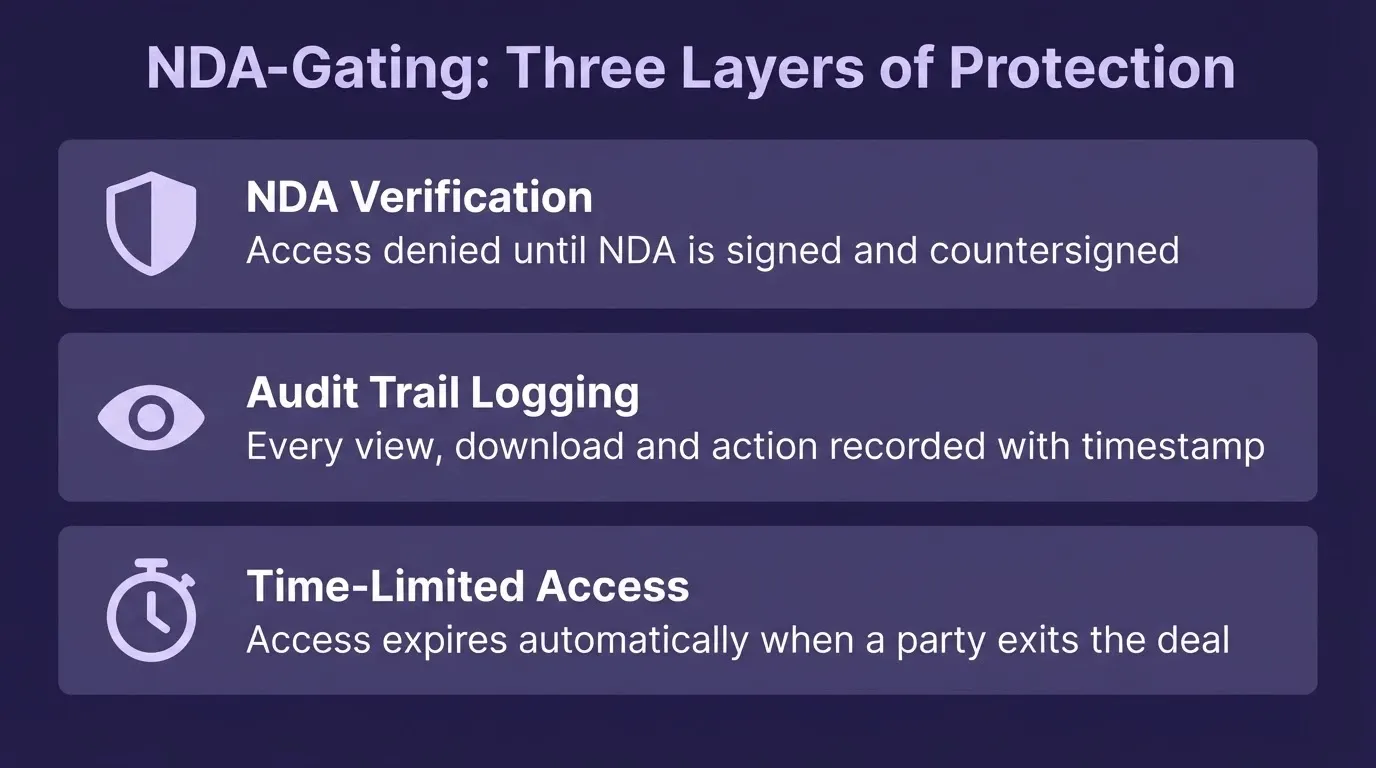
NDA-gating and audit trails are not optional features for an M&A document hub. They are structural requirements that protect the advisory firm's legal position and client confidentiality.
-
NDA-gating controls the information perimeter. Before a prospective buyer sees any confidential material, the system should verify that their NDA is signed, countersigned, and recorded. If the NDA is pending, only the teaser is visible. If no NDA exists, access is denied entirely.
-
Audit trails provide defensible evidence. In contested transactions, knowing exactly who viewed the financial model at 3:17 PM on a Tuesday, from which device, and whether they downloaded it, can be the difference between a clean close and a legal dispute.
-
Time-limited access windows prevent residual exposure. When a buyer exits the process, their access should expire automatically, not sit open until someone remembers to revoke it.
Building a document management system without backend complexity is possible today, but the M&A use case adds layers that generic tools miss. NDA verification, party-specific access windows, and immutable audit logging need to be architectural decisions, not afterthoughts.
NDA-Gating and Audit Trail Workflow for M&A Document Access Control
What a Complete Audit Trail Must Capture
For an M&A document hub to withstand regulatory scrutiny or legal challenge, the audit trail needs to record more than just "who opened what."
-
Identity: User name, email, and role at the time of access
-
Action: View, download, print, share, or failed access attempt
-
Document: File name, version number, and folder path
-
Timestamp: Date, time, and timezone of every action
-
Device and IP: Browser, operating system, and IP address
-
Duration: How long the document was open for view events
This level of granularity is what separates a purpose-built deal room from a shared folder with a log file. It is also what regulators and opposing counsel ask for when a deal is challenged.
Compliance Architecture for M&A Document Hubs
M&A transactions touch multiple regulatory frameworks simultaneously. The document hub architecture must account for all of them.
| Regulation | Jurisdiction | Document Hub Requirement |
|---|---|---|
| GDPR | EU / EEA | Data residency controls, right to erasure, processing records |
| SOX Section 302/404 | US public companies | Immutable audit trails, access controls, retention policies |
| SEC Rule 17a-4 | US broker-dealers | Non-erasable storage, third-party audit access |
| FCA MAR | UK | Insider list management, access logging for price-sensitive info |
| MiFID II | EU financial services | Record retention, audit trail for investment decisions |
Row-level security enforced at the database layer is the technical foundation that satisfies all of these frameworks simultaneously. When access control lives in the application layer, it can be bypassed. When it lives in the database itself, it cannot be circumvented regardless of how the application is accessed.
How to Build a Role-Based Document Hub
Traditional virtual data rooms from providers like Intralinks, Datasite, and Ansarada charge per-seat, per-mandate licensing fees that range from $15,000 to $50,000 or more annually. The virtual data room market is projected to hit $5.6 billion by 2029 at an 18.1% CAGR, and much of that spending reflects firms paying for rigid templates they cannot customize.
The alternative is to build a document hub that fits your firm's exact deal workflow. Here is what that architecture looks like in practice.
Comparing Your Options
Before committing to an approach, advisory firms should understand the trade-offs across the three common paths.
| Dimension | Traditional VDR | Generic Cloud Storage | Custom-Built Hub |
|---|---|---|---|
| Setup Time | 1-2 weeks | Hours | Hours to days |
| Annual Cost | $15K-$50K+ per mandate | Low, but no deal features | No per-mandate licensing |
| Access Controls | Folder-level | Basic sharing links | Document-level, role-based |
| Customization | Fixed templates | None for deal workflows | Full, iterate via conversation |
| Audit Trails | Standard | Minimal | Full, queryable, exportable |
| Compliance | Vendor-managed | None | Architecture-level (RLS) |
| NDA Gating | Manual process | None | Automated, logged |
| Branding | Vendor branded | Generic | Fully branded to your firm |
The custom-built approach gives advisory firms full control over their document architecture without the per-mandate cost structure of traditional VDRs.
What a Custom-Built Hub Generates
When you describe your deal workflow in plain language and build from it, the generated application includes:
-
Document upload and versioning screens with automatic version tracking and side-by-side comparison
-
Role-based access panels where you assign deal parties to permission tiers and manage access windows
-
NDA-gating logic that verifies NDA status before granting document access, with automated invitation flows for pending signatories
-
Audit log viewers with filterable, exportable records of every document interaction
-
Client-facing portals where each deal party sees only their permitted document set
-
Supabase backend handling database, authentication, and row-level security out of the box
Every build ships with SEO-ready structure, WCAG accessibility compliance, and performance optimization by default. The application deploys to a live URL in one action, with staging and production environments, full version history, and one-click rollback.
How to Get Started: A Three-Week Build Sequence
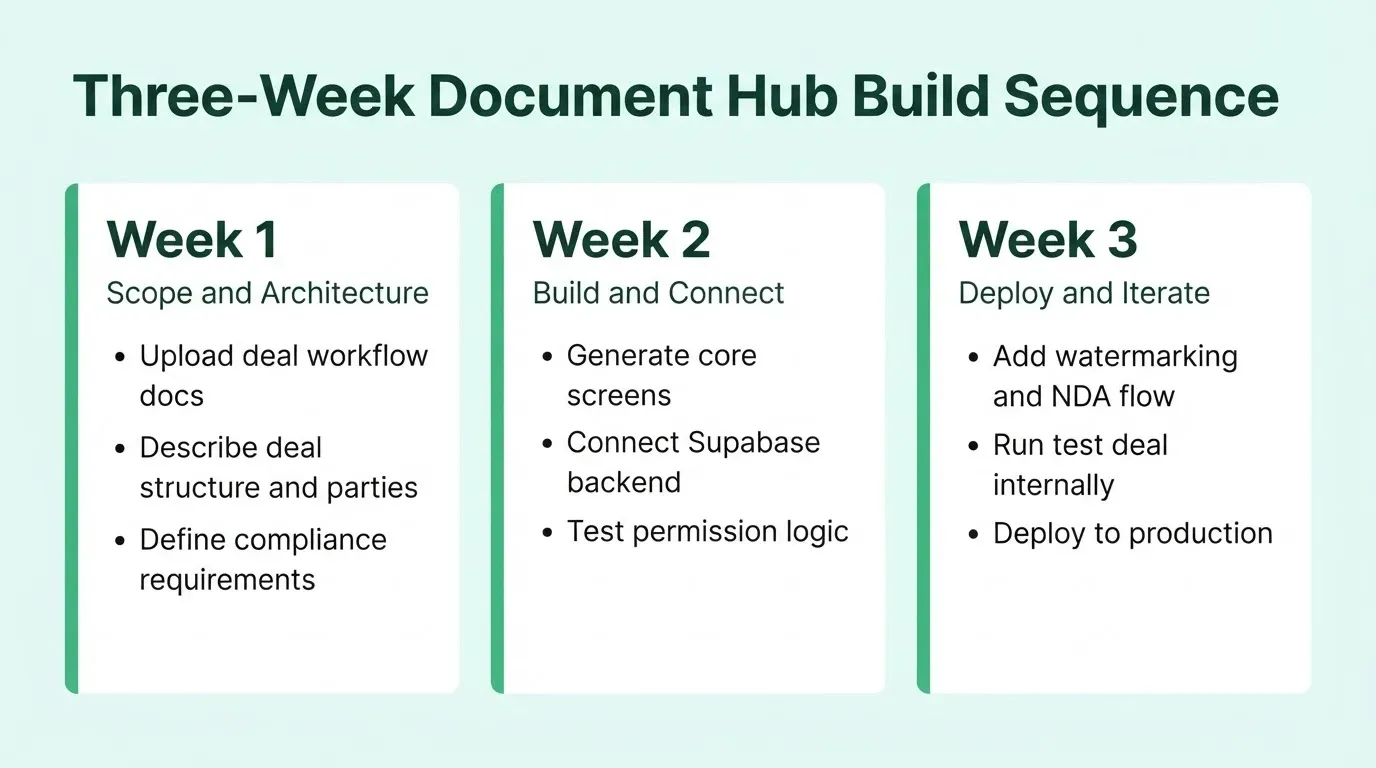
Week 1: Scope and architecture. Open a new project and upload your firm's standard NDA template, engagement letter template, and any existing deal workflow documentation. Describe your typical deal structure, the party types you work with, and your compliance requirements. Review the structured output and add any firm-specific requirements through follow-up conversation.
Week 2: Build and connect. Describe the core screens you need: document upload, role assignment, NDA management, audit log, and client portal. Review the live preview and test the permission logic. Connect Supabase to activate the database, authentication, and row-level security layer.
Week 3: Deploy and iterate. Add watermarking, adjust the NDA workflow, add deal stage tracking. Deploy to a staging environment and run a test deal with internal team members in each role. Deploy to production.
Ongoing: Per-mandate customization. For each new mandate, duplicate the base project, update the deal-specific configuration, and deploy a fresh instance. The architecture is reused; only the deal-specific details change.
1.5 million people have tried Rocket across 180 countries, from solopreneurs to enterprise teams. You can learn more about what M&A assessments Solve on Rocket can produce before you build.
Build the Deal Room Your Next Mandate Deserves
The gap between needing a role-based document hub and shipping one has closed. Advisory teams that build purpose-fit hubs stop paying per-mandate VDR licensing fees for tools they cannot customize and start running deals on infrastructure that actually reflects their workflow.
As AI-powered app building continues to mature, the cost and time required to Build a Role-Based Document Hub will only decrease further. The firms that move now establish a proprietary deal infrastructure advantage that compounds across every mandate they run.
Describe your deal workflow on Rocket.new and generate a production-ready document hub with role-based access, NDA-gating, and full audit logging, live in hours.
Table of contents
- -Why Is Document Control a Deal Risk for M&A Advisors?
- -Why Folder-Level Permissions Always Fail in M&A
- -How Does Role-Based Access Map to Deal Party Structures?
- -Permission Tiers for Buyers, Sellers, and Counsel
- -What Documents Belong at Each Deal Stage?
- -Why Are NDA-Gating and Audit Trails Non-Negotiable?
- -What a Complete Audit Trail Must Capture
- -Compliance Architecture for M&A Document Hubs
- -How to Build a Role-Based Document Hub
- -Comparing Your Options
- -What a Custom-Built Hub Generates
- -How to Get Started: A Three-Week Build Sequence
- -Build the Deal Room Your Next Mandate Deserves