Most service firms already have the process. The gap is packaging, turning internal SOPs into guided, client-facing digital experiences that build trust, reduce churn, and make the delivery visible.
What happens when the process that makes your firm excellent stays invisible to the clients it serves?
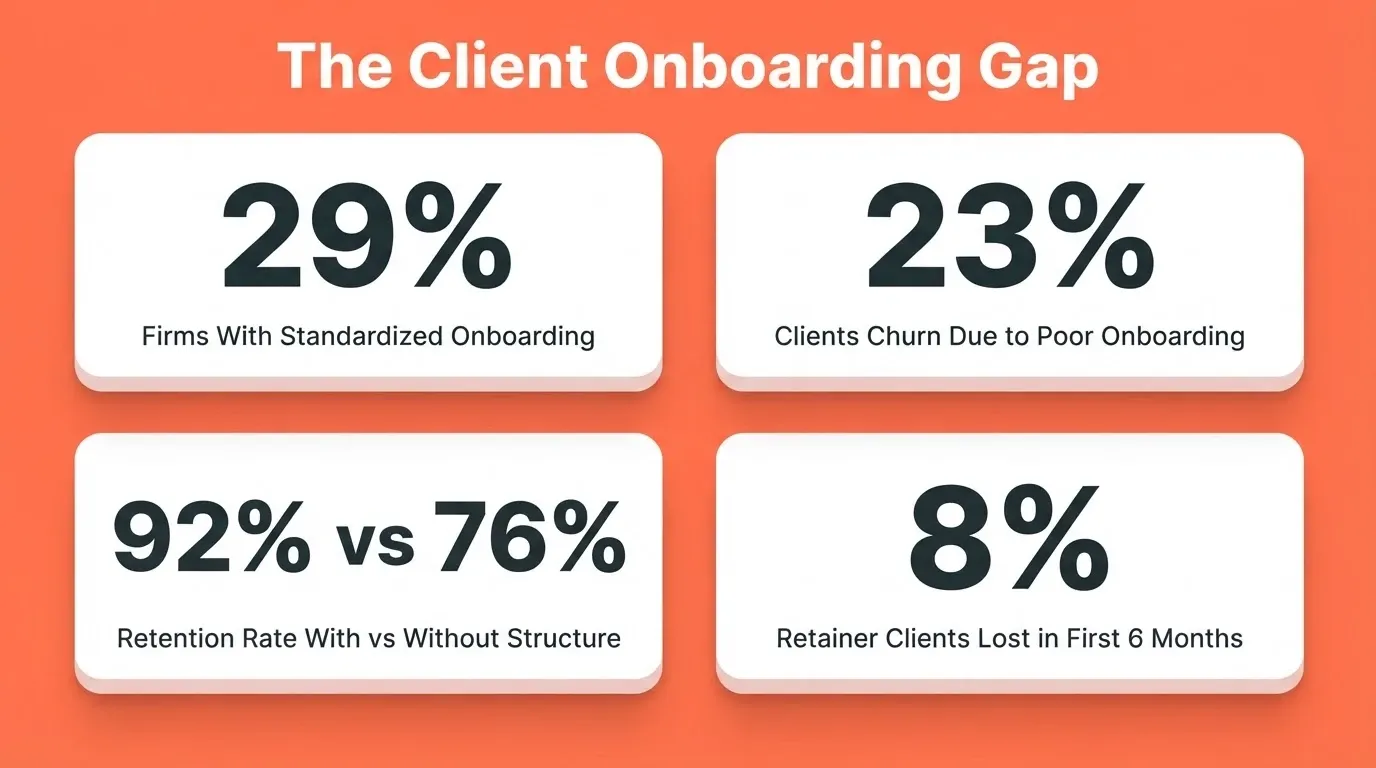
Most service firms walk new clients into engagements with no structured roadmap. Only 29% of professional services firms have a standardized onboarding process, according to Agiled's 2026 client onboarding research.
The result is predictable. Clients feel lost, internal teams repeat themselves, and the carefully refined procedures that make the firm excellent stay locked in folders no client ever opens.
The gap is not capability. It is packaging. The processes exist, but they never reach the client in a format that is actually useful.
Why Most Service Firms Have a Hidden Onboarding Gap
Most service firms spend years perfecting their delivery process. Yet few spend any time turning that process into something clients can actually follow along with.
-
The first 90 days carry the highest churn risk. Retainer agencies lose roughly 8% of clients within months one through six. That early window is when expectations are set and misalignment does the most damage.
-
Poor onboarding is a top-three reason clients leave. It ranks right behind wrong product fit and lack of engagement. Still, most firms treat onboarding as a kickoff call followed by a shared folder of static documents.
-
23% of clients cite weak onboarding as their direct reason for churning. That number climbs when the service is complex and multi-phased, which describes most professional service engagements.
-
Firms with structured onboarding see 92% retention at 90 days, compared to 76% without. That 16-point gap compounds across every quarter, every renewal cycle, and every referral opportunity.
The problem is not effort. Firms care deeply about their clients. However, the process documentation stays internal, and the client never gets a structured view of what is happening, when, or why. That is exactly the kind of gap that packaging consulting frameworks as digital products can solve.
What Makes SOPs the Missing Piece of Client-Facing Design
Standard operating procedures already contain the logic, the sequence, and the quality controls that make service delivery consistent. The issue is that they were written for internal teams, not for the people on the other side of the engagement.
-
SOPs define what happens and when. They map every handoff, every approval step, and every deliverable milestone. Clients asking "what happens next?" would find their answer in an SOP they have never seen.
-
86% of customers say educational and welcoming onboarding content influences their loyalty. When clients feel informed and included in the process, satisfaction scores climb and support requests drop, according to customer onboarding research from UserGuiding.
-
Internal-only SOPs create information asymmetry. The firm knows exactly where the project stands. The client is guessing. That asymmetry erodes trust slowly, and trust is what keeps retainers renewing.
-
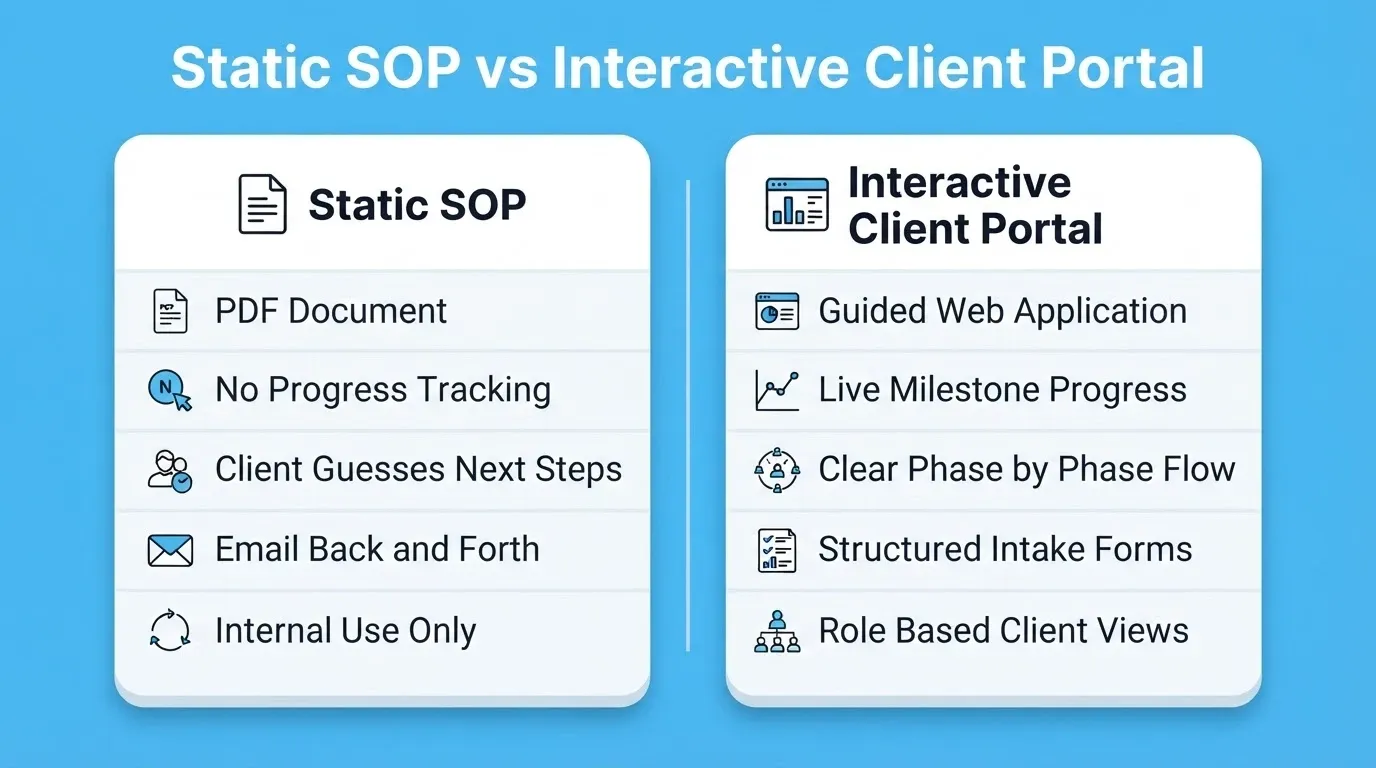
Interactive versions of SOPs flip this dynamic entirely. Guided checklists, progress dashboards, and contextual explainers give clients the same visibility the internal team already has.
As Syed Mohd. Zubair Huda, a remote operations and client onboarding specialist, describes on LinkedIn: "I help businesses run smoother, turning messy client intake, documentation, and case-tracking into clean, repeatable systems that don't fall apart under volume." That is exactly the shift from static SOPs to structured, client-ready workflows.
Firms already building approval and billing portals for agencies are discovering this same pattern. The operational logic already exists internally. Making it visible is what changes client relationships.
How to Transform Static SOPs Into Guided Digital Flows
Moving from a PDF in a shared drive to an interactive client-facing application does not require a complete rethink. Instead, it requires a structured translation of what already exists.
Step 1: Map SOP Phases to Client-Facing Modules
Each internal phase, such as intake, discovery, execution, and review, becomes a module the client can see and track. Strip out internal jargon and keep the sequence. The client needs to know where they are and what comes next.
Step 2: Replace Email Collection With Structured Intake Forms
Branching questions replace the back-and-forth that slows down the first weeks of every engagement. The client fills out structured inputs instead of sending scattered attachments. As a result, the information arrives organized, complete, and ready to act on.
Step 3: Build Progress Indicators Tied to Real Milestones
When clients can see that Phase 2 of 4 is 60% complete, they stop asking for status updates. That alone saves hours per client per month. Progress visibility is not a nice-to-have. It is the single most effective way to reduce inbound status emails.
Step 4: Create Role-Based Views for Different Stakeholders
The project sponsor sees high-level progress and key decisions. The day-to-day contact sees task-level detail and upcoming deadlines. One application serves both without requiring separate builds or duplicated content.
Step 5: Add Contextual Help at Each Step
Short explainers, embedded guidance, or tooltip notes answer "why are we doing this?" before the client needs to ask. Clients who understand the reasoning behind each phase report higher satisfaction and fewer escalations.
Anyone building an app without backend experience can follow this same pattern. The technical barrier has dropped to near zero.
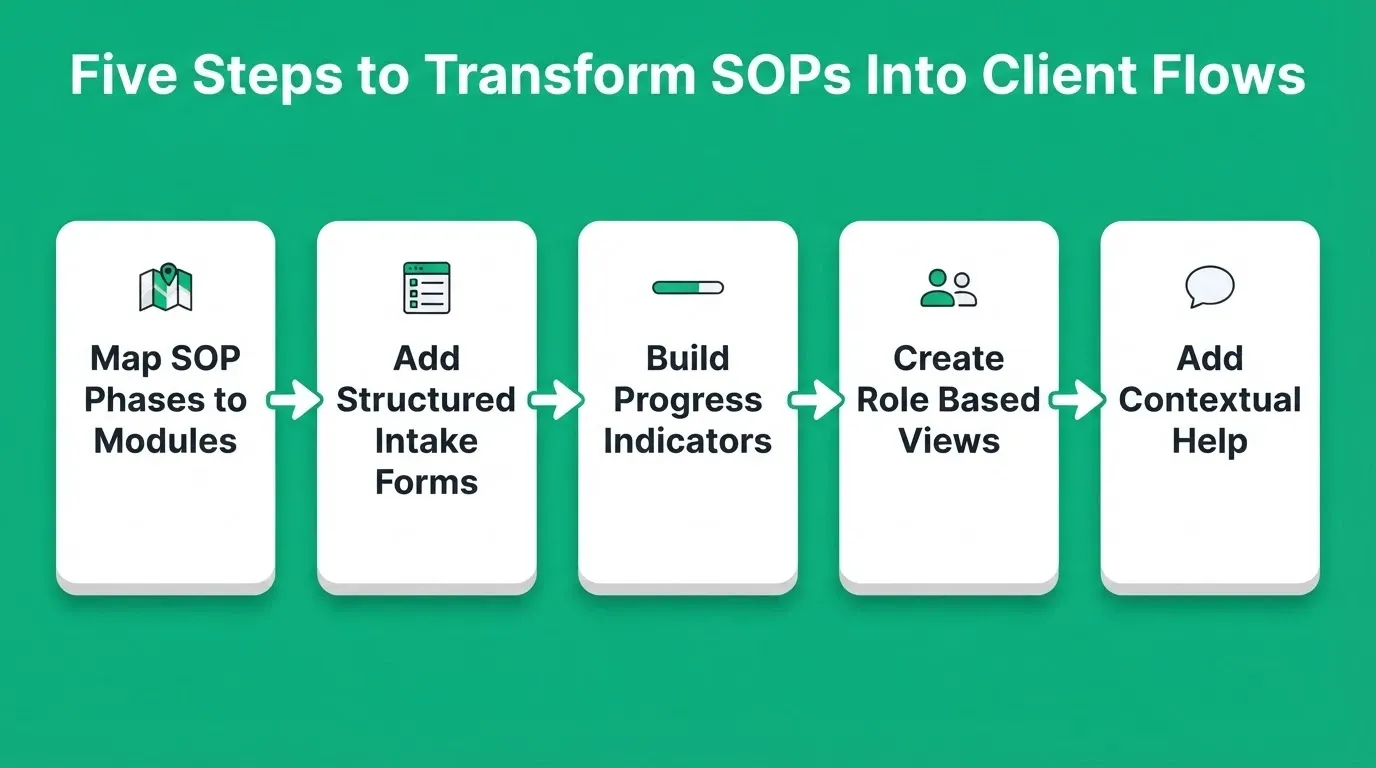
The result is not a new process. It is the same process your team already runs, now presented in a way the client can follow and participate in.
How Rocket Turns Your SOPs Into a Working Client App
Building a client-facing application from your SOPs used to mean hiring a development team, scoping a months-long project, and managing a backlog of change requests. That model does not fit most service firms, and it never scaled.
Describe your SOP flow in plain language and Rocket generates the app. For example, you write: "Build a client onboarding portal with four phases, including intake, discovery, execution, and review. Include structured intake forms, progress tracking, and role-based views for project sponsors and day-to-day contacts." Rocket then produces a working application with UI, navigation, logic, and backend already connected. Most apps generate in 1 to 3 minutes.
If your SOPs already live in Notion, Google Docs, or Airtable, Rocket's Launchpad reads them directly. Connect your workspace, point Rocket at the relevant document, and generation begins from your actual process. Nothing gets lost in translation.
-
Web apps ship in Next.js, and mobile apps ship in Flutter. Both are production-grade, with real design systems, responsive layouts, and accessibility built in from the first generation.
-
26+ connectors link directly without separate setup. Stripe handles payments, Supabase manages your database, Calendly handles scheduling, and Resend handles email notifications. Authenticate once and they flow into every build.
-
Iterate through conversation, not tickets. Change the intake form fields, add a new phase, or adjust the dashboard layout by saying it in chat. Rocket applies the change in context with no re-explaining.
-
Every build ships production-ready by default. SEO-ready structure, WCAG 2.1 AA accessibility compliance, GDPR coverage, and Core Web Vitals performance optimization are the baseline, not optional extras.
Static tools simply cannot keep up. Shared Google Docs, PDF checklists, and email threads are passive. They do not track progress, enforce sequences, or adapt to different user roles. A purpose-built interactive client experience does all of that from day one.
What Service Firms Gain When Clients See the Process
Transparency is not just a feel-good principle. When clients can see and interact with the delivery process, the numbers shift in measurable ways.
| Metric | Without Interactive SOPs | With Interactive SOPs |
|---|---|---|
| 90-day client retention | 76% | 92% |
| Support ticket volume | Baseline | 45% reduction |
| Client satisfaction (NPS) | Baseline | +33 points |
| Year-one upsell rate | 18% | 32% |
-
Retention climbs because clarity replaces confusion. Research from Bain and Company published in Harvard Business Review found that increasing customer retention by just 5% raises profits by 25% to 95%. Interactive onboarding directly supports that retention.
-
Support costs drop because clients self-serve. When the next step, the current status, and the reasoning behind each phase are visible inside the app, clients stop emailing to ask. That frees the team to focus on delivery instead of status updates.
-
Upsell rates improve because trust compounds. Clients who feel informed and involved during the first engagement are significantly more likely to expand scope, renew contracts, and refer peers.
Firms building private client management platforms are already seeing these patterns in practice. The logic applies to any service business where process visibility drives client confidence.
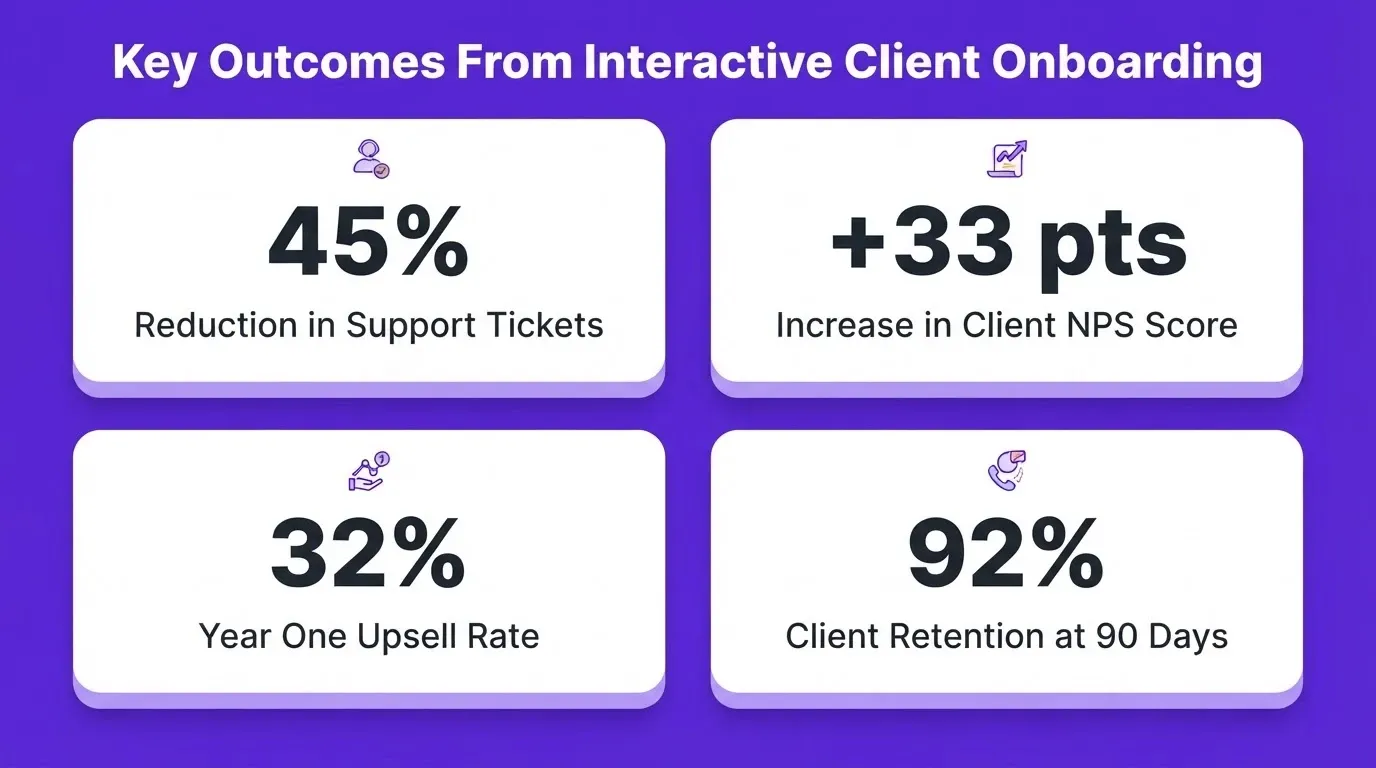
The return is not theoretical. It shows up in retention numbers, in NPS scores, and in the speed at which clients move from first engagement to second.
When Your Process Becomes the Product
The standard operating procedures inside your firm represent years of refined thinking about how to do the work right. Turning them into something clients can see, follow, and participate in does not require a development team or a six-month roadmap. It requires one decision: stop treating your best operational work as an internal-only asset.
Every client interaction improves when the process behind it becomes visible. The firms that figure this out first will set the standard their competitors spend the next two years trying to match.
The Business SOPs Client Experience is Now a Competitive Advantage
The firms winning on client retention are not doing more work. They are making their existing work visible. Turning business SOPs into an interactive client experience is no longer a technical project. It is a positioning decision that compounds with every engagement.
As AI-powered platforms continue to lower the barrier to building, the advantage shifts entirely to the quality of the underlying process and the speed of execution. The firms that act now will own the client experience standard in their niche before it becomes the baseline expectation.
Your SOPs already hold the logic. Describe your onboarding process in plain language and build it on Rocket. A working client portal is ready before your next kickoff call.
Table of contents
- -Why Most Service Firms Have a Hidden Onboarding Gap
- -What Makes SOPs the Missing Piece of Client-Facing Design
- -How to Transform Static SOPs Into Guided Digital Flows
- -Step 1: Map SOP Phases to Client-Facing Modules
- -Step 2: Replace Email Collection With Structured Intake Forms
- -Step 3: Build Progress Indicators Tied to Real Milestones
- -Step 4: Create Role-Based Views for Different Stakeholders
- -Step 5: Add Contextual Help at Each Step
- -How Rocket Turns Your SOPs Into a Working Client App
- -What Service Firms Gain When Clients See the Process
- -When Your Process Becomes the Product
- -The Business SOPs Client Experience is Now a Competitive Advantage