Retained search firms lose placements not from wrong candidates, but from broken systems. A centralized candidate review system replaces scattered tools with one structured source of truth, delivering faster decisions, cleaner handoffs, and stronger client trust.
Why does a retained search still get managed in a spreadsheet only one recruiter understands?
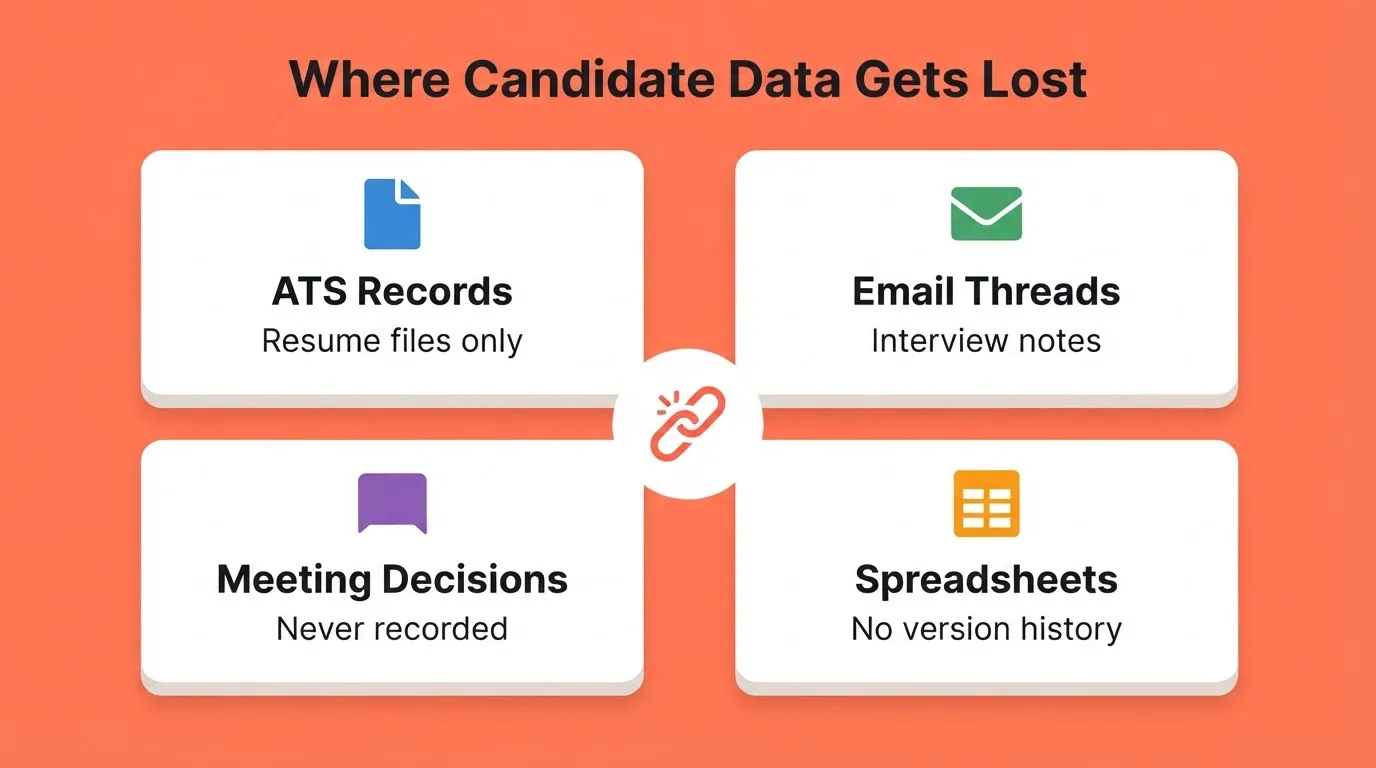
The answer is almost always the same: the firm never outgrew its original system. Candidate profiles sit in an ATS. Interview notes land in email threads. Client feedback gets trapped in a shared document with no version history.
According to Zippia's recruitment data, the average job vacancy takes 42 days to fill, and that number climbs when information is scattered across disconnected tools.
This blog covers what structured candidate review looks like, how client-facing access reduces overhead, and how to build a system that fits your exact workflow.
Why Candidate Data Gets Lost in Retained Search
Retained search produces more structured information per candidate than any other hiring model. The real problem is where that information ends up.
-
Candidate profiles fragment across tools. The ATS holds the resume. A recruiter's personal notes capture the phone screen impression. The partner's assessment lives in an email reply chain. When a client asks "why this candidate over that one?", the answer requires reconstructing three separate sources.
-
Decision rationale goes undocumented. Shortlist decisions are made in meetings, but the reasoning rarely gets recorded in a retrievable format. Two months later, when the search committee revisits a passed candidate, no one remembers the context.
-
Handoffs between team members create blind spots. If the originating recruiter is unavailable, the rest of the team has no clear view into where each candidate stands or what conversations have already happened.
-
Client updates depend on manual assembly. Weekly status reports require pulling candidate data from one system, interview notes from another, and pipeline counts from a spreadsheet. The report is outdated before it reaches the client's inbox.
The solution is not a better spreadsheet. It is a single, structured system that every team member reads from and writes to. Firms that manage hiring dashboards in a single view solve this fragmentation at the source rather than patching it downstream.
What Structured Candidate Review Looks Like in Practice
Structured review means every candidate has one record, every evaluation follows the same format, and every decision is logged with context. Together, these components replace the patchwork of tools most firms rely on.
| Component | What It Replaces | How It Works |
|---|---|---|
| Candidate profile card | Scattered resume files and email notes | One view per candidate with role fit score, interview history, and decision status |
| Structured feedback forms | Free-text email replies from interviewers | Standardized fields for technical fit, leadership style, culture alignment, and risk flags |
| Decision audit trail | Verbal shortlist decisions in meetings | Timestamped log of who advanced or declined each candidate, with stated reasoning |
| Pipeline stage tracker | Spreadsheet columns with color-coded status | Automated stage progression with days-in-stage alerts |
| Client-visible shortlist | PDF attachments emailed weekly | Live view filtered to show only what the client needs to see |
According to Select Software Reviews, only 20% of small and mid-sized businesses currently use an ATS, while 79% of organizations have integrated AI or automation into their tracking systems. The gap between firms with structured systems and those without is growing fast.
How Should Interview Notes Be Captured?
The biggest documentation gap in retained search is not the resume or the scorecard. It is the interview note. Most firms capture feedback in an email paragraph or not at all, and neither approach is retrievable when it matters.
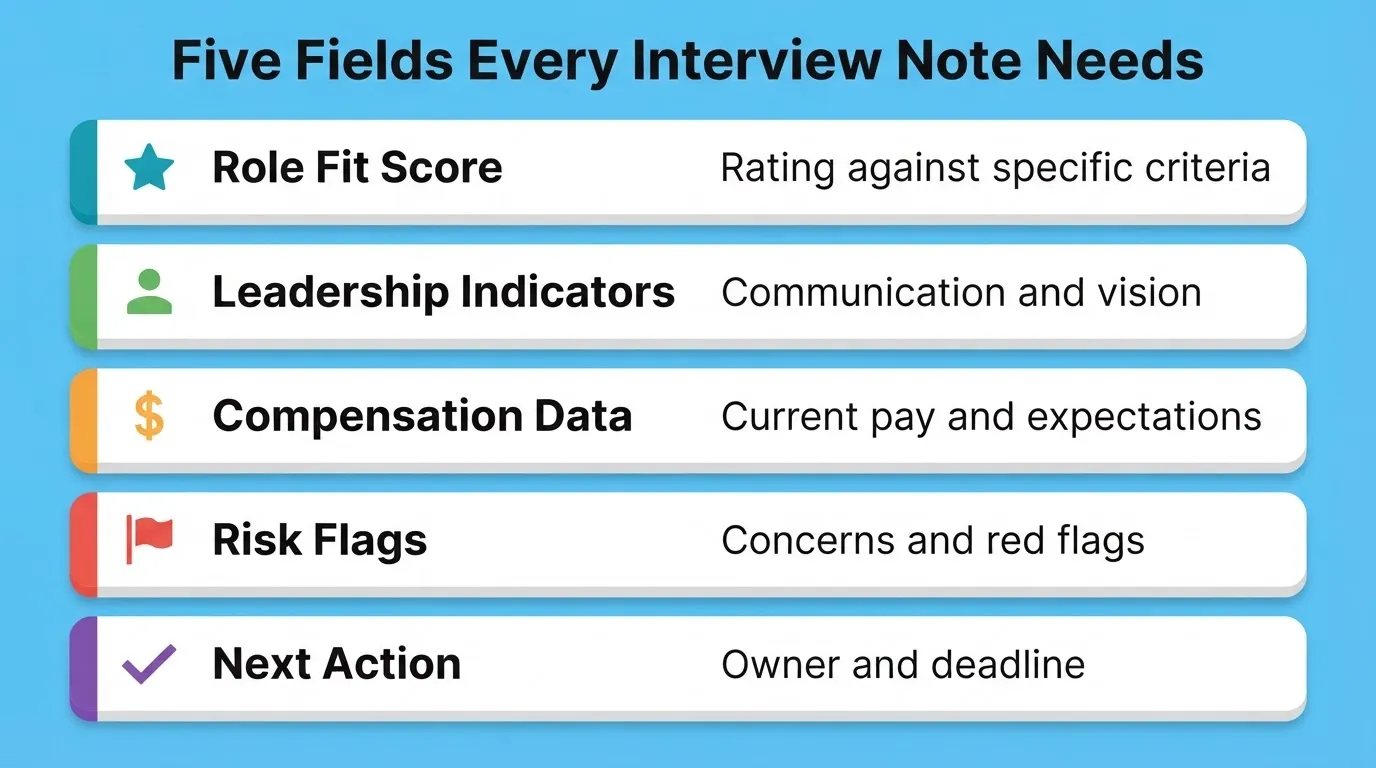
Five Fields Every Interview Note Needs
-
Notes should follow a template, not a blank text field. A structured form with sections for technical assessment, leadership indicators, compensation expectations, and risk flags captures more useful data than a paragraph written from memory.
-
Capture timing matters. Notes recorded within 30 minutes of an interview retain significantly more detail than those written the next day. A review app with mobile-friendly forms makes this practical even between meetings.
-
Notes need to attach to the candidate record, not the interviewer's email. When feedback lives inside a single record, any team member can pick up the search without asking "what did you think of this person?"
Structured notes are the difference between a defensible hiring recommendation and a guess dressed up in professional language.
How Client-Facing Access Reduces Status Call Overhead
Retained search clients pay a premium for a managed process. Part of that premium buys trust, and trust erodes when the client has no visibility into progress. Giving clients a live window into the search changes that dynamic entirely.
-
A client-facing view replaces weekly status emails. Instead of assembling a report from multiple sources every Friday, the client sees a filtered, live view of their search, including shortlisted candidates, interview schedules, pending feedback, and next steps.
-
Decision capture moves into the system. When a client can log shortlist approvals, rejections, or follow-up requests directly, the back-and-forth email chain compresses from days to minutes.
-
Visibility builds confidence without adding meetings. Clients who can check search progress on their own schedule stop requesting extra status calls. The firm gains back hours each week per active search.
Role-based access keeps confidential data confidential. Clients see only their shortlisted candidates and pending decisions. Internal evaluations, compensation benchmarks, and candidate comparisons stay hidden from the client view.
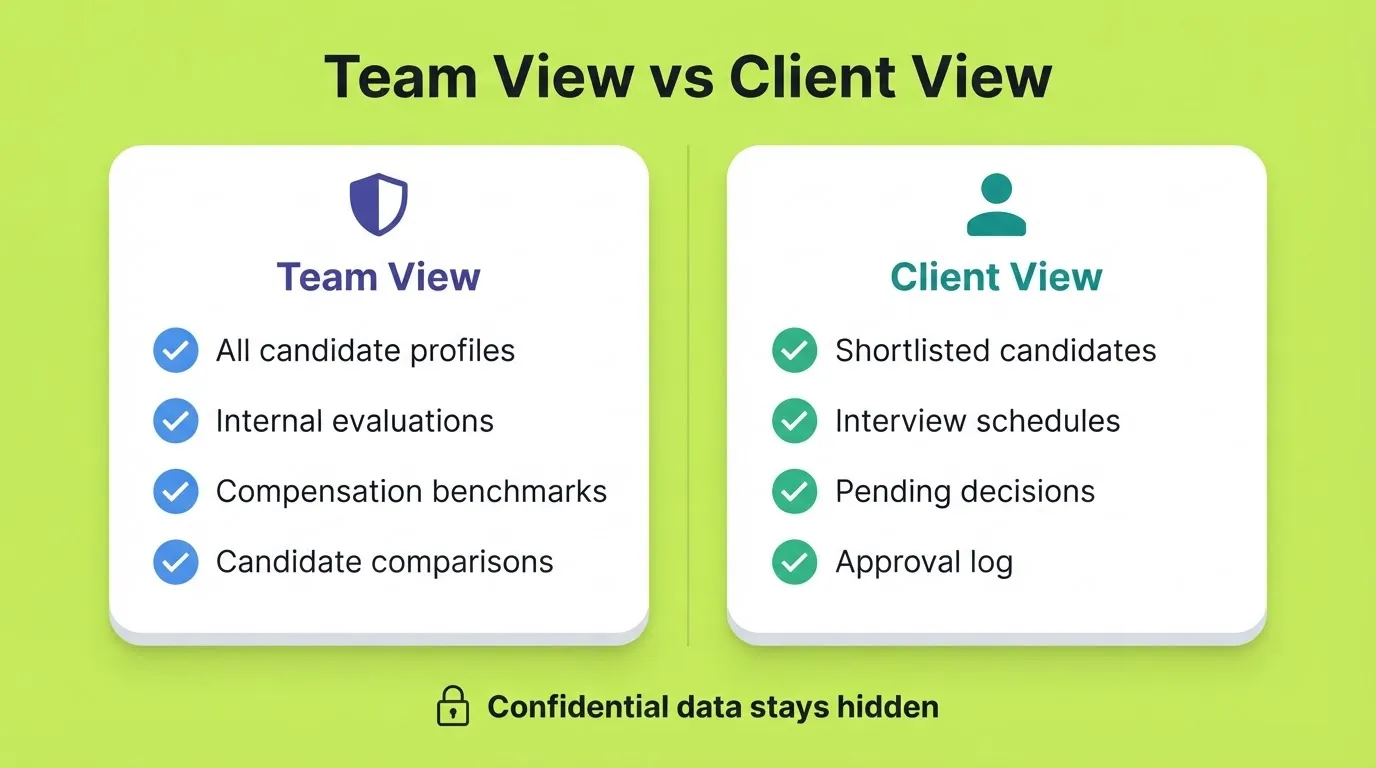
The firms that give clients a window into the process, not just a weekly summary, hold onto engagements longer and get more repeat business. Teams already building internal tools with AI find that role-based access and structured data views are the two features that matter most to clients.
Generic ATS vs. Spreadsheet vs. Custom Review App
Most retained search firms face a three-way choice. Each option comes with real trade-offs, so it helps to see them side by side.
Three Approaches to Candidate Review Tooling
Off-the-shelf ATS platforms offer candidate management and reporting out of the box. The trade-off is rigidity, since they are designed for the average firm's workflow. Customizing stages, feedback structures, or client views is either expensive or unavailable.
Spreadsheet-based systems offer total flexibility. The trade-off is no real-time updates, no role-based access, no automation, and significant manual overhead as the firm grows.
Custom-built tools give you the exact workflow you need. Traditionally, this meant hiring developers, writing a spec, and waiting months. That path has changed significantly with AI-powered builders.
According to FinancesOnline, salaries (67%) and benefits (63%) are the two most important factors candidates weigh when evaluating opportunities. Firms that track compensation data per role inside a centralized candidate review system can tailor their pitch to each candidate with real data instead of assumptions.
Can Small Firms Afford a Custom Candidate Review App?
The cost barrier to custom tooling has fallen dramatically. Here is how the options compare today.
| Tool Type | Typical Annual Cost | Customization | Developer Required |
|---|---|---|---|
| Enterprise ATS license | Thousands of dollars per year | Limited, often paid add-ons | No |
| Spreadsheet system | No direct cost | High, but manual and fragile | No |
| Custom app with AI builder | Fraction of ATS cost | Exact workflow match | No |
AI-powered app builders have compressed the timeline from months to hours. A five-person boutique search firm can describe its candidate stages, feedback fields, and client views in plain language and receive a working web application the same session, with no ongoing developer dependency.
Mapping the Decision Trail from First Screen to Final Offer
A candidate review system only works if it reflects how candidates actually move through your pipeline. Mapping that flow makes the system useful from day one, so nothing gets lost between stages.
Candidate Decision Trail from Sourcing Through Placement
-
Every node in this flow should map to a stage in your review app. When a candidate moves from "Phone Screen" to "Structured Interview," the system updates automatically and logs who triggered the change.
-
Decision gates are where documentation matters most. "Passes initial criteria?" and "Client decision" are the moments where a recorded rationale protects the firm and informs future searches.
-
Archived candidates are not dead records. A candidate declined for one search may be the perfect fit for the next. Logging the decline reason means your database gets smarter over time.
As Hung Lee, curator of Recruiting Brainfood, shared in LinkedIn's Future of Recruiting report:
"The single most important thing talent leaders need to do is 'AI self-enable.' You cannot make decisions about the direction of your AI-enabled Talent Acquisition team if you are not a fluent user of AI yourself."
The firms that build their own tracking tools, shaped around their own workflows, move faster than those waiting for a vendor to add the right feature.
How to Build a Custom Candidate Review App
You describe your pipeline in plain language. The system generates a working web application. Here is what that process looks like in practice.
Step 1: Describe your pipeline. Tell the builder your candidate stages, such as sourced, screened, shortlisted, client review, offer, and placed. Include your feedback fields, client access requirements, and reporting needs. The more specific you are, the closer the first result will be to what you have in mind.
Step 2: Connect your data layer. Supabase handles your backend database, including schema, authentication, and queries. If your candidate data already lives in Airtable, that connects too. Existing Notion research notes and Google Sheets plug in through 25+ available integrations.
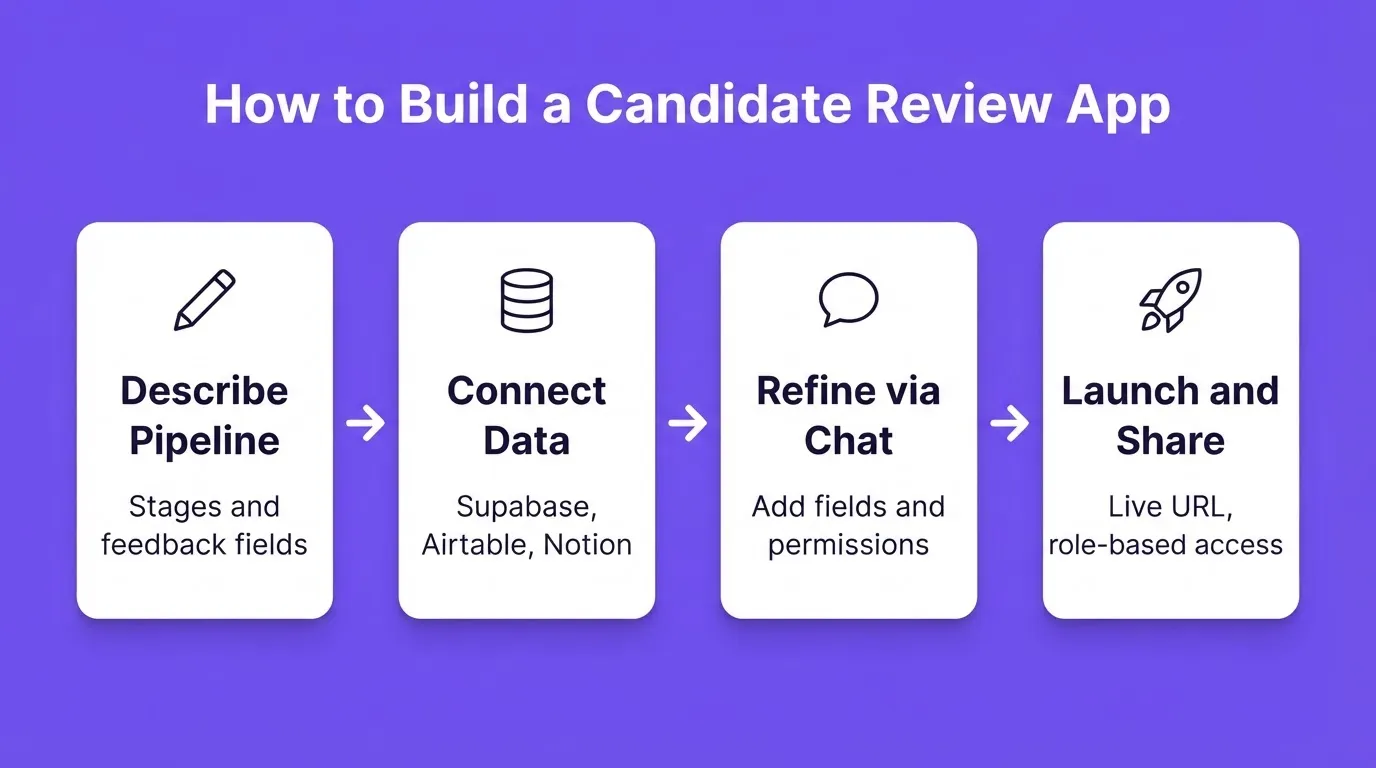
Step 3: Refine through conversation. After the first generation, iterate through chat. Add a compensation tracker, build a pipeline dashboard, or add email notifications when a candidate reaches client presentation. No tickets. No re-explaining the project. Changes happen in context.
Step 4: Launch and share. Every build ships with SEO-ready structure, WCAG accessibility compliance, GDPR coverage, full version history, one-click rollback, and role-based access control with Admin, Creator, and Viewer levels. Deploy to a live URL with a custom domain in one action.
Teams already thinking through user account structures and access permissions find that role-based views are the most important design decision in a candidate review app.
The Firms That Document Decisions Win the Placements
Retained search has always been a relationship business, and that will not change. What is changing is how the operational side of those relationships gets managed. Firms that replace scattered tools with a single, organized candidate review app move faster, lose fewer top candidates, and give clients a reason to come back.
The technology to build that system is accessible today. The firms that act now will compound that advantage over those still reconstructing last week's pipeline from email threads.
Firms already using client portals with structured access report that client satisfaction improves when transparency is built into the tool rather than promised in a kickoff meeting.
Build Your Centralized Candidate Review System Today
The retained search firms winning placements in the next three years will not be the ones with the largest networks. They will be the ones whose systems make every candidate interaction retrievable, every decision defensible, and every client update instant. A centralized candidate review system is no longer a competitive advantage reserved for large firms. It is a workflow decision any team can make today. Describe your exact pipeline in plain language and ship your candidate review app with Rocket, production-ready, role-based, and built around how your firm actually runs searches.
Table of contents
- -Why Candidate Data Gets Lost in Retained Search
- -What Structured Candidate Review Looks Like in Practice
- -How Should Interview Notes Be Captured?
- -How Client-Facing Access Reduces Status Call Overhead
- -Generic ATS vs. Spreadsheet vs. Custom Review App
- -Can Small Firms Afford a Custom Candidate Review App?
- -Mapping the Decision Trail from First Screen to Final Offer
- -How to Build a Custom Candidate Review App
- -The Firms That Document Decisions Win the Placements
- -Build Your Centralized Candidate Review System Today