Advisory firms managing multiple mandates need more than a generic CRM. A purpose-built deal platform handles counterparty tracking, mandate-level documents, and controlled client access. It no longer takes months or a six-figure budget to build one.
Does your deal coordination break down at three concurrent mandates?
For most advisory firms, the answer is yes. That is the point where a buyer follow-up slips through a spreadsheet cell. A counterparty sends signed documents to the wrong email thread. A client status update requires pulling data from four disconnected tools.
According to Affinity's 2025 survey of 297 private capital professionals, 54% of firms spend 40 or more hours researching a single deal. Multiply that across concurrent mandates, and the time sink becomes structural.
This blog covers what a purpose-built deal platform needs to track, how to structure deal stages from sourcing to close, and how to create a private deal management platform without a six-month development timeline.
Why Generic CRMs Break Advisory Workflows?
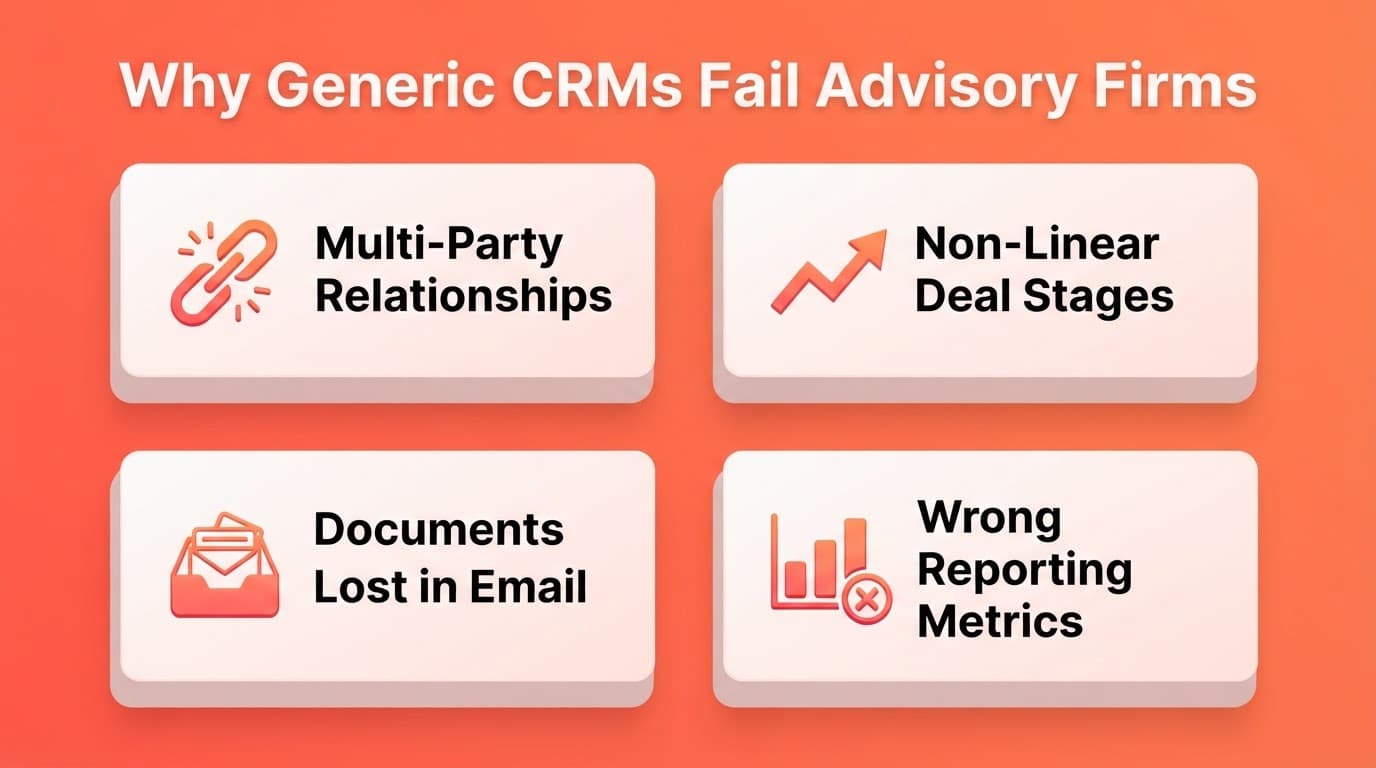
Most CRMs were designed for product sales: one rep, one buyer, one product, one linear pipeline. Advisory deal flow works nothing like that. So before exploring what a good platform looks like, it helps to understand exactly where generic tools fall short.
Multi-party relationships don't fit a single contact record. Every mandate involves buyers, sellers, legal counsel on both sides, lenders, and sometimes competing bidders. Each party has different information rights and communication channels. A CRM contact record cannot represent that structure without heavy customization.
Deal stages are not linear. A mandate might loop between preliminary discussions and revised term sheets three times before reaching diligence. CRMs that force deals through a fixed sequence misrepresent where things actually stand. Misrepresenting deal status is operationally dangerous.
Document gravity pulls toward email. When the CRM cannot organize files by mandate, teams default to inbox folders, shared drives, and the classic "final_v3_REAL" file naming approach. Version control collapses. Access control disappears.
Reporting measures the wrong things. Off-the-shelf dashboards track conversion rates and average deal velocity. They do not show counterparty response times, document completion rates by phase, or mandate-level profitability. Those are the metrics that actually tell an advisory firm how a deal is progressing.
If your firm has seen what goes into building a secure buyer workspace for active transactions, the gaps in generic tools become hard to ignore.
As deal sourcing volume grows, firms without mandate-level tracking fall further behind with every new engagement.
What a Private Deal Management Platform Must Track
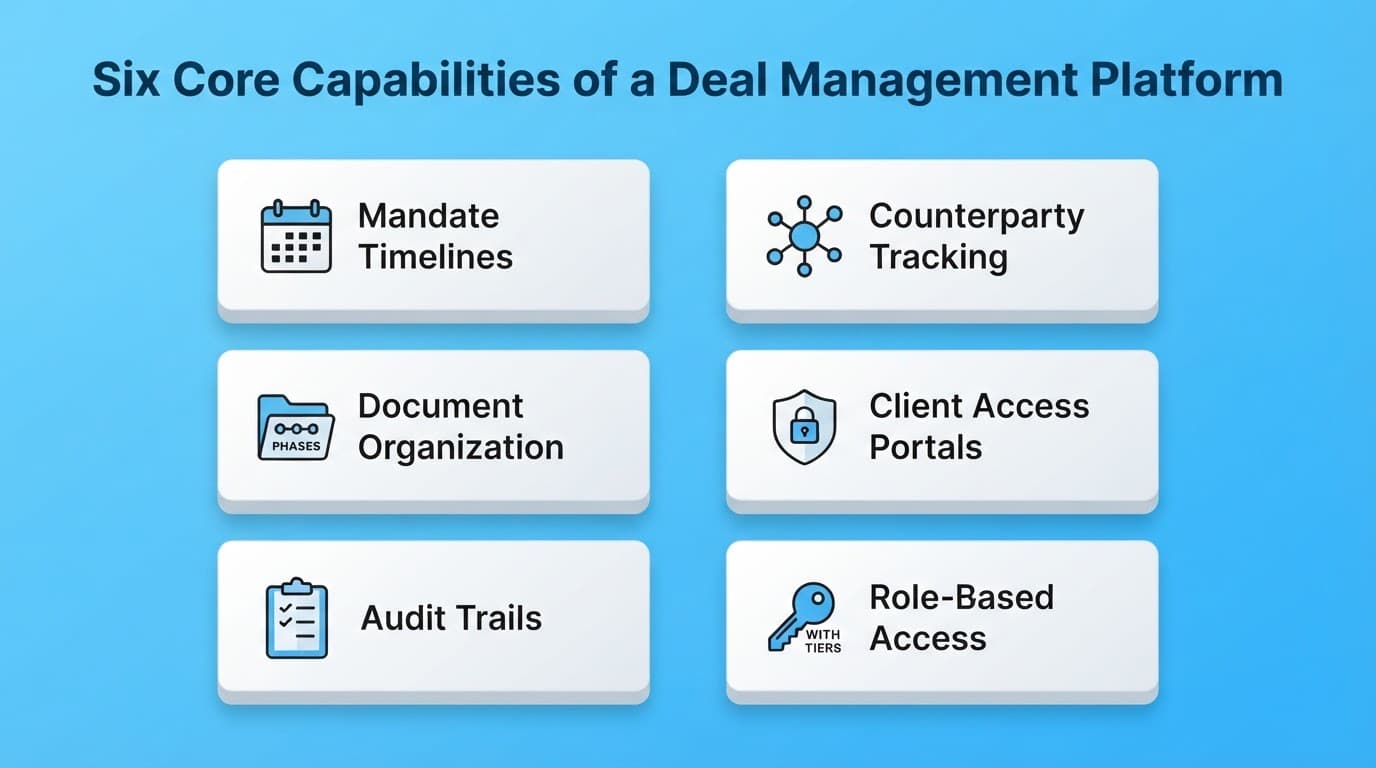
Once you accept that generic tools miss the mark, the question becomes: what does a deal-specific platform actually need? The answer varies by firm type, whether M&A advisory, debt advisory, restructuring, or capital raising. That said, several capabilities appear in every serious advisory workflow.
Mandate-Level Deal Timelines
Each deal needs its own timeline. This includes the engagement letter signed, information memorandum distributed, first-round bids received, management presentations scheduled, and close target. These dates drive the entire team's week. They belong at the mandate level, not buried inside a contact record.
Counterparty Tracking With Relationship Context
This is not a name-and-email database. It is a structured map showing who connects to whom across deals. It holds notes on prior interactions, bidding history, communication preferences, and relationship strength that carries forward from one mandate to the next.
Document Organization by Mandate and Phase
Every document belongs to a specific deal and a specific phase. Version history and access controls attach at the file level. When a buyer moves from preliminary interest to formal diligence, their document access expands automatically. When they drop out, it closes.
Controlled Client Access Portals
Clients need real-time visibility into their own mandate's progress, including key dates, document status, and next steps. They should never see other deals, internal fee discussions, or team commentary. This separation is non-negotiable for advisory credibility and regulatory compliance.
Activity Logs and Audit Trails
Who accessed what document, when, from which device, and whether they downloaded or just viewed it. In contested transactions, an audit trail is not a nice-to-have. It is evidence. Regulatory requirements and client confidence both depend on this record.
Team Collaboration With Role-Based Access
Partners, directors, associates, and analysts each need different editing and viewing rights. An analyst preparing a deal book should not be able to modify fee terms or see the firm's margin on the engagement. Getting user account architecture decisions right from day one prevents months of rework.
The global CRM market reached USD 73.4 billion in 2024. It is projected to hit USD 163.16 billion by 2030 at a 14.6% CAGR, according to research compiled by CO Consulting. Much of that growth reflects firms recognizing that generic platforms demand heavy customization for specialized workflows. That customization cost is often higher than building purpose-fit from the start.
How to Structure Deal Stages From Sourcing to Close
Deal stages in advisory work do not follow the same sequence every time. However, most mandates share a recognizable arc. Mapping that arc into a platform early prevents the "where are we on this deal" conversations that consume hours every week.
The typical advisory mandate flows through five broad phases. Loops for renegotiation and issue resolution are built in:
Advisory Mandate Lifecycle: Five Phases With Renegotiation Loops Built Into the Workflow
Notice the loops. Term sheet negotiation often cycles back to preliminary offers when pricing gaps emerge. Findings review can send the deal back to renegotiation if diligence surfaces material issues.
A platform that treats deal stages as a one-way conveyor belt will constantly misrepresent where a mandate actually stands.
The key design choice is building each stage as a container. It holds its own documents, counterparty communications, status indicators, and access permissions. When a deal moves from outreach to negotiation, the context travels with it. When it loops back, nothing gets lost.
| Stage | Documents | Counterparty Access | Key Milestones |
|---|---|---|---|
| Mandate Engagement | Engagement letter, NDA templates | None | Signed engagement, fee agreement |
| Buyer Identification | Buyer universe analysis, teaser | None | Approved buyer list |
| Market Outreach | Teaser, CIM (gated) | Teaser only, then CIM post-NDA | NDAs executed, IOIs received |
| Term Sheet Negotiation | LOI, term sheets | Selected buyers | LOI signed |
| Diligence | Full data room | Preferred buyer only | VDD complete |
| Closing | SPA, closing checklist | Legal teams | Signed, funds transferred |
This structure means the platform enforces process, not just records it.
Access Control: The Layer Most Platforms Get Wrong
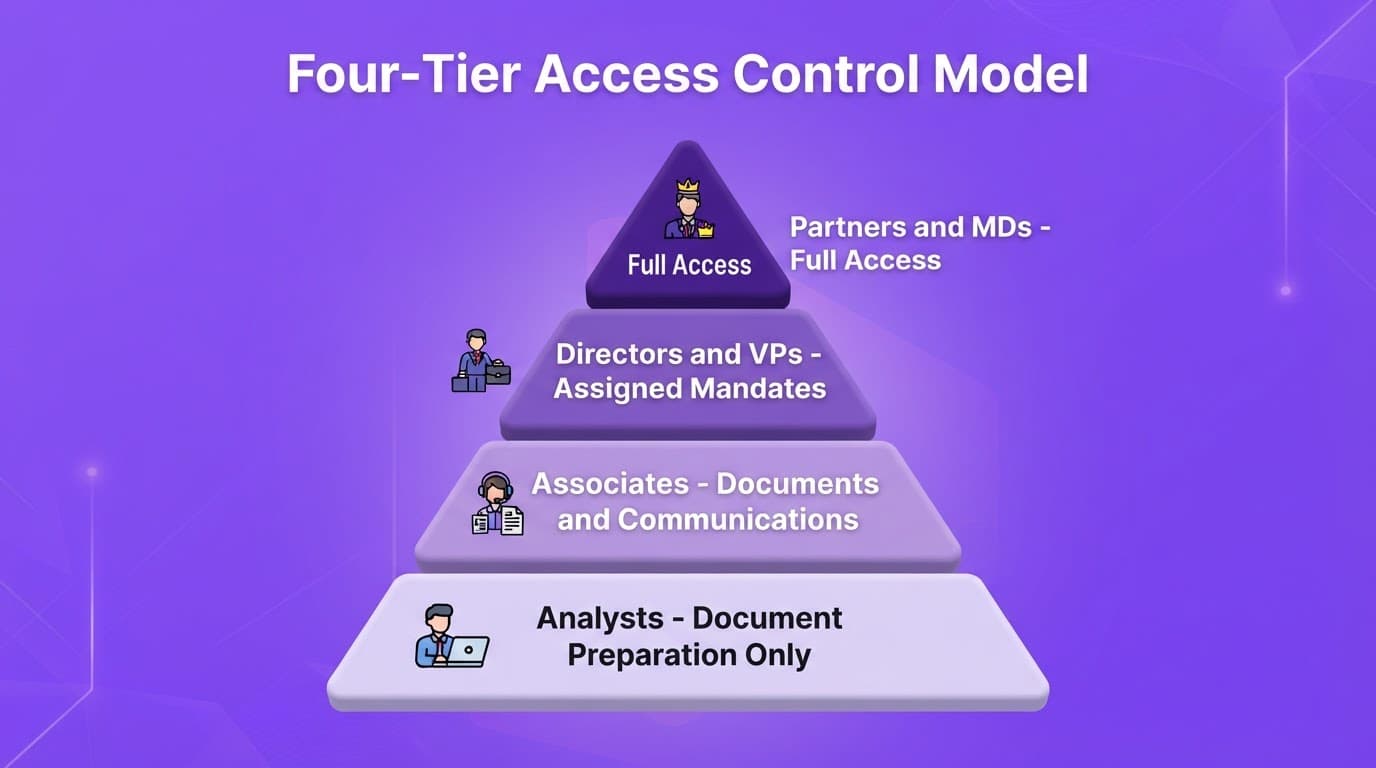
Access control is where most generic tools quietly fail advisory firms. A shared Google Drive with "view only" permissions is not a real access system. A CRM's standard sharing features rarely distinguish between the four distinct access tiers that advisory work requires. Here is how each tier should work in practice.
Internal team tiers. Partners, directors, associates, and analysts each need different editing and viewing rights. A well-structured permission model looks like this:
-
Partners and MDs: Full access to all mandates, fee structures, client communications, and internal margin data
-
Directors and VPs: Full access to assigned mandates, with read-only access to financials
-
Associates: Document preparation and counterparty communications on assigned mandates, with no fee visibility
-
Analysts: Document preparation only, with no counterparty direct communications and no client portal access
Client-facing views. Each client sees only their mandate's progress, key dates, and shared documents. Internal notes, fee structures, competing bidder details, and other mandates remain completely hidden.
Counterparty access windows. During diligence, specific counterparties may need access to defined document sets for limited periods. That access should expire automatically when the phase closes. A buyer who drops out of a process should not retain access to the data room.
Audit logging at every layer. Every document view, download, and permission change gets logged with timestamps, device info, and user identity. In regulated jurisdictions, this is not optional infrastructure. It is a compliance requirement.
Building vs Buying: What Advisory Firms Actually Spend
The real question is not whether your firm needs a better system. It is whether the cost of getting one justifies the switch from spreadsheets and email workarounds. To help answer that, here is a straightforward comparison of the main approaches.
| Approach | Setup Time | Annual Cost | Customization | Mandate-Specific |
|---|---|---|---|---|
| Enterprise VDR (Intralinks, Datasite) | 1-2 weeks | $15K-$50K+/yr | Low, fixed templates | Partially, document layer only |
| Generic CRM (Salesforce, HubSpot) | 2-4 weeks | $5K-$25K/yr + admin | Medium, needs add-ons | Requires heavy customization |
| Custom Development | 3-6 months | $80K-$200K+ build | Full | Yes |
| Purpose-built deal platform | Hours to days | Varies | Full | Yes |
The gap is not just price. It is time to value. Enterprise VDRs get you running in weeks but lock you into someone else's workflow. They also cover only the document distribution layer. Custom development gives full control but burns months and budget before the first user logs in.
With global M&A deal value reaching $4.6 trillion in 2025, up 49% year-over-year according to LSEG data, advisory firms cannot afford six-month tool build cycles. When it comes to building a document management system without backend complexity, the firms pulling ahead are shipping deal systems in days, not quarters.
How to Build a Private Deal Management Platform With AI
The traditional assumption is that building a custom deal platform requires a development team, months of scoping, and a six-figure budget. That assumption is now outdated. AI app builders can generate production-ready web applications from plain-language descriptions. This includes mandate dashboards, counterparty relationship maps, document rooms, and client portals.
For a deal platform to be truly production-grade, it needs to meet a clear set of requirements:
-
Role-based access controls that actually enforce permission tiers, not just display them
-
Document organization with version history and per-file access logging
-
Client portal views that are structurally isolated from internal data
-
Audit trails stored in a proper database, queryable for compliance reporting
-
Staging and production environments so changes can be tested before going live
Rocket generates Next.js web applications from natural language descriptions. It includes Supabase integration for backend data handling, role-based access controls, and 25+ integrations including Stripe, Notion, Airtable, and Linear. Every build ships with staging and production environments, full version history, and one-click rollback.
Before the build, Rocket's Solve capability handles the research phase. Describe the advisory firm's workflow, deal types, and compliance requirements. Solve produces a structured analysis covering architecture recommendations, feature scope priorities, and integration requirements. You can explore what kinds of M&A assessments Solve can produce before the first line of code is written. That research output becomes the foundation for the build, so the first generation reflects genuine product thinking rather than a generic template.
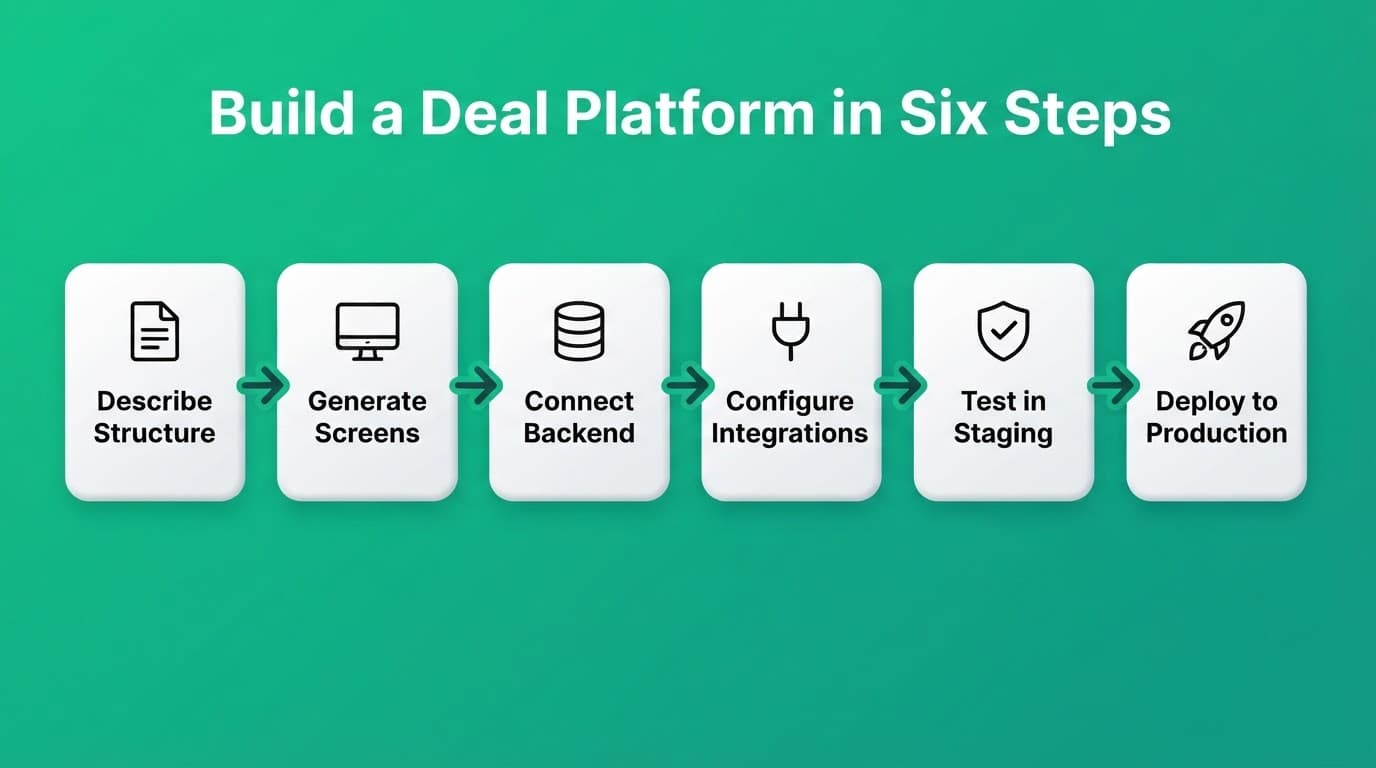
The build workflow for an advisory deal platform typically follows this sequence:
-
Describe the mandate structure — deal types, counterparty categories, document phases, and access tiers
-
Generate the core screens — mandate dashboard, counterparty relationship map, document room by deal stage, and client portal
-
Connect the backend — Supabase for data persistence, authentication, and row-level security for access control
-
Configure integrations — notification services for deal alerts and calendar connections for milestone tracking
-
Test in staging — validate access controls, document flows, and client portal isolation before going live
-
Deploy to production — live with a custom domain, HTTPS, and built-in analytics
Build the Deal Infrastructure Your Mandates Deserve
Advisory firms have been patching together deal workflows from tools never designed for multi-party, document-heavy, relationship-driven work. The cost is not just inefficiency. It is missed follow-ups, slower counterparty responses, and clients who wonder why they do not have better visibility into their own mandates.
The ability to create a private deal management platform tailored to your exact workflow is no longer a six-month project. As AI-powered app generation continues to mature, the gap between describing what you need and shipping it will keep narrowing. Firms that build their own deal infrastructure now will have a compounding advantage over those still waiting for the perfect off-the-shelf solution.
Describe your advisory workflow and start building your deal platform with Rocket. Working screens, controlled access, and mandate-level tracking, live in hours.
Table of contents
- -Why Generic CRMs Break Advisory Workflows?
- -What a Private Deal Management Platform Must Track
- -Mandate-Level Deal Timelines
- -Counterparty Tracking With Relationship Context
- -Document Organization by Mandate and Phase
- -Controlled Client Access Portals
- -Activity Logs and Audit Trails
- -Team Collaboration With Role-Based Access
- -How to Structure Deal Stages From Sourcing to Close
- -Access Control: The Layer Most Platforms Get Wrong
- -Building vs Buying: What Advisory Firms Actually Spend
- -How to Build a Private Deal Management Platform With AI
- -Build the Deal Infrastructure Your Mandates Deserve