
Most businesses react to rival price changes too slowly or too fast. A sound approach means diagnosing the move, checking your margins, and choosing a deliberate response. Rocket monitors every public signal your competitors send so your team always acts from knowledge, not panic.
What if your biggest competitor cut their price by 20% tonight?
Pricing teams face this moment more often than anyone admits, and most lack a clear process for it. Competitive pricing, the practice of setting prices based on what rivals charge, shapes buying decisions across every sector, from retail and SaaS to manufacturing. According to Investopedia, Amazon repriced roughly 80 million items in a single day ahead of one holiday season, showing just how aggressive modern price competition has become.
The question is never simply whether to track competitors' prices. The real decision is knowing when to react, when to hold, and how to avoid a margin-destroying spiral. This post covers the full picture, from a clear definition to a five-step response framework you can act on today.
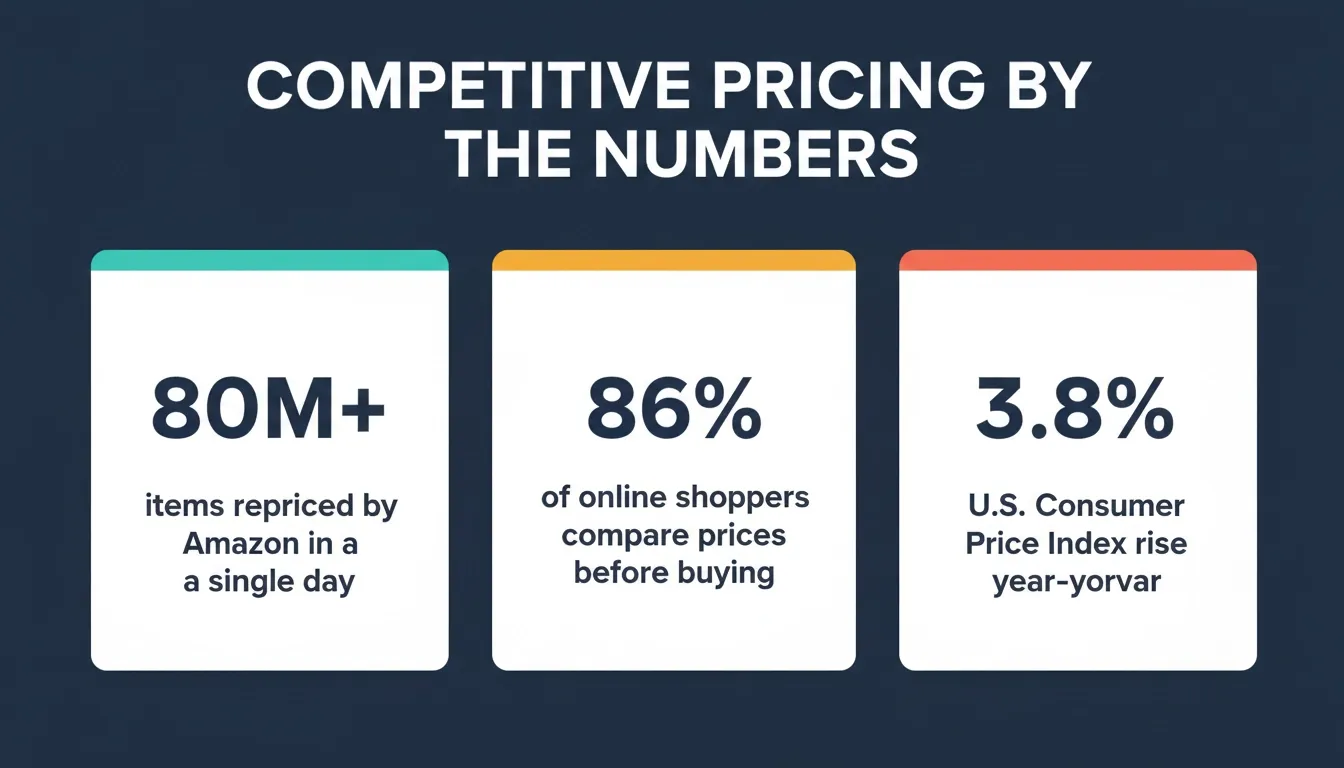 Key statistics that show why competitor pricing strategy demands a structured, data-driven approach.
What Is Competitor-Based Pricing?
The Core Logic of Competitor-Based Pricing
Competitor-based pricing starts from a simple premise: your rivals' prices reveal what the market will currently accept.
-
The method: A business sets prices by studying what competitors charge for similar products or services, then positions itself deliberately above, at, or below that level. The external market, not internal cost calculations, becomes the primary reference point for all pricing decisions.
-
The data source: Unlike cost-plus pricing, competitor-based pricing uses the prevailing market price as the anchor. Pricing decisions react to external market signals rather than internal cost structure alone.
-
The goal: Stay relevant to price-sensitive customers without leaving money on the table or starting a race to zero in the competitive market.
Price is often the deciding variable for buyers who actively compare options across similar products. That makes competitor-based pricing one of the most widely used approaches in highly competitive markets.
Three Ways to Position Your Price
Once you know what competitors charge, you have three structural choices for how to set prices relative to the market average.
| Price Position | What It Means | When It Works Best |
|---|---|---|
| Below competitors | Price is lower to attract price-sensitive customers | Market entry, high-volume play, clear cost advantages |
| At parity (equal price strategy) | Match the prevailing market price | Commodity products; compete on brand or service quality |
| Above competitors | Charge a premium pricing position | Strong differentiation; quality signal; loyal customer base |
Choosing a price position without first understanding your cost structure and customer perception is where most pricing decisions go wrong. Each position carries a fundamentally different set of tradeoffs, and none of them works in all contexts.
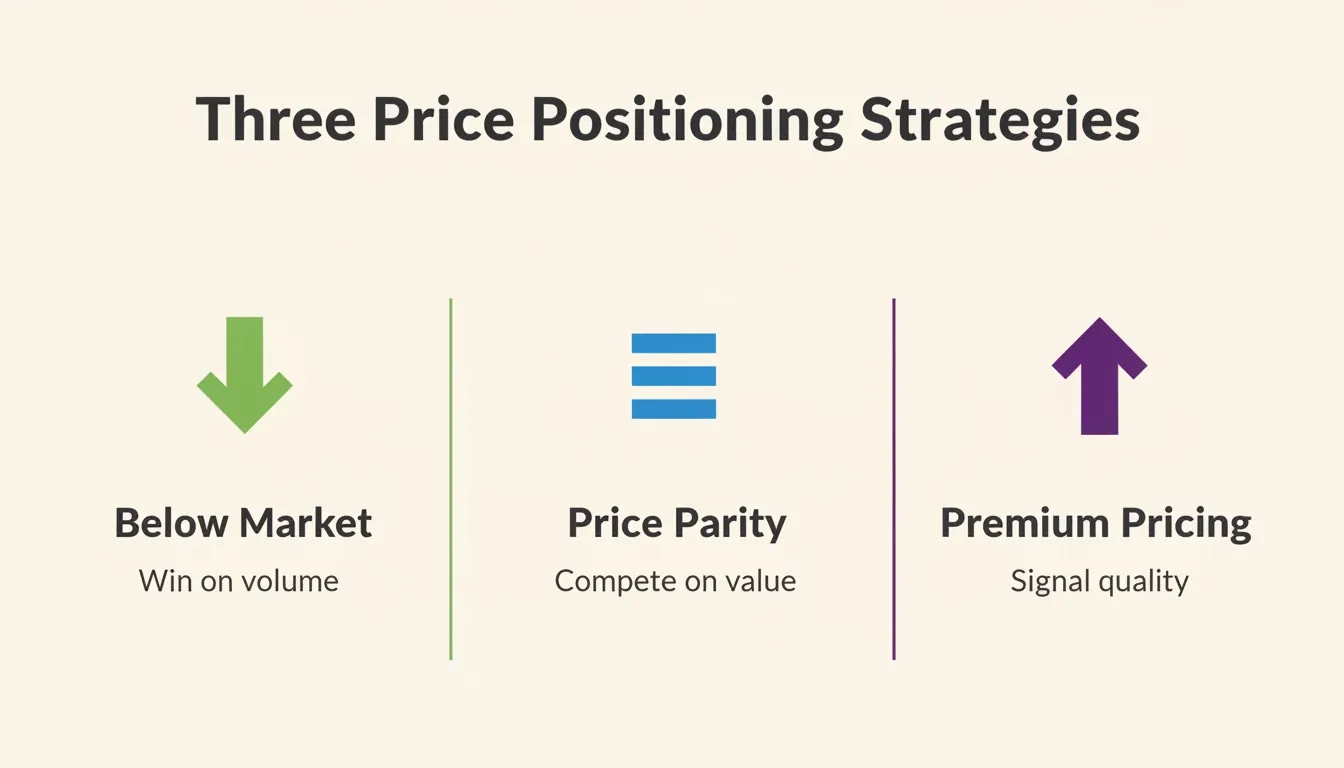 Each pricing position signals something different to the market. Choosing the wrong one without data can cost you customers or margin.
Real-World Competitive Pricing Examples
The theory comes to life quickly when you look at how real businesses use this approach every day.
-
E-commerce: Amazon uses automated repricing tools to adjust prices across millions of listings in real time, keeping prices at or just below competitors' prices for high-demand items.
-
Airlines: Seat prices on identical routes change constantly based on what competing carriers charge, with algorithms tracking rivals' fares and adjusting within minutes.
-
SaaS: Many software companies position their entry-tier plans slightly below a category leader to attract new customers who are comparing options mid-evaluation and trying to gain market share.
What each of these competitive pricing examples shares is active, continuous monitoring, not a one-time price check pulled from a competitor's website once a quarter.
How Does Competitive Pricing Compare to Other Pricing Methods?
Competitor-based pricing is one of several pricing methods, and knowing the differences helps you pick the right approach for your situation.
Cost-Plus Pricing
Cost-plus pricing starts from your own production costs and adds a fixed markup, setting prices by looking inward. It ignores what competitors charge entirely, which can leave you overpriced in a crowded market or underpriced when demand is strong.
Value-Based Pricing
Value-based pricing sets the price according to the customer's perceived value of your product rather than your cost or the market average. It can command higher prices when differentiation is clear, but requires deep customer research and takes longer to operationalize quickly.
Real-Time Pricing
This pricing model adjusts the price automatically based on market demand, inventory levels, and time signals. Airlines and hotels use it heavily; it runs on pricing data algorithms rather than manual decisions by pricing teams.
Most mature businesses blend these pricing methods. Competitor-based pricing typically acts as the market sanity check, making sure your price is anchored to market reality before layering in value or cost considerations.
Pros, Cons, and When Competitive Pricing Backfires
The Genuine Benefits of Watching What Rivals Charge
There are real, practical reasons why so many businesses rely on competitor-based pricing as a foundation.
-
It helps attract customers who are actively comparing options, particularly in markets where products are largely interchangeable to buyers making a purchase decision.
-
It can accelerate new customer acquisition when entering a crowded space. A lower price point creates a concrete reason to switch away from an established player.
-
It reduces research time; instead of building detailed pricing models from scratch, you start from a reliable market benchmark and adjust from there.
-
Staying close to the market average keeps you from accidentally overpricing a product into irrelevance among price-sensitive customers.
The U.S. Consumer Price Index rose 3.8% year-over-year as of April 2026 according to the U.S. Bureau of Labor Statistics, placing buyers under real price awareness. Competitive pricing helps businesses stay calibrated to what customers currently consider fair during sustained inflation.
The Hidden Risks You Need to Know
The same appeal that makes this approach attractive also introduces serious vulnerabilities that compound over time.
-
Following competitors into lower price points can compress profit margins across an entire category, leaving every player worse off than before the cuts started.
-
It creates a reactive posture: if your pricing decisions are always driven by what rivals do, you surrender control of your own revenue strategy and brand positioning.
-
Customers attracted by lower prices tend to have weaker loyalty, making them expensive to retain long-term as a customer base.
-
Without clear differentiation, matching a competitor's price signals to the market that your products are interchangeable, which damages customer perception in ways that take years to repair.
The risks build quietly and accelerate quickly when multiple competitors start moving simultaneously in the same competitive market.
When Does Competitor-Based Pricing Backfire?
This approach works well in specific conditions, and falls apart in others that look superficially similar.
-
When your cost structure is fundamentally different from your competitors', matching their price may put you below your own pricing floor and destroy the cost structure entirely.
-
When your product genuinely offers more than competitors' products, pricing at parity or below signals equivalence, suppressing the premium your customers would otherwise pay.
-
When rivals are VC-backed or loss-funded, trying to match subsidized prices burns your profit margins for no sustainable gain.
-
When you have a few direct competitors, the whole approach needs a reference point, and a thin competitive market gives you unreliable pricing data to work from.
The single most dangerous application is reactive price matching without first checking whether the cut makes financial sense for your own business model.
The Real Cost of a Price War
Price wars look like competition. They function like a slow leak in the hull of your business model.
Once two businesses start undercutting each other repeatedly, profit margins across the category erode for everyone involved. Recovering market position after a price war is far harder than avoiding one in the first place through smart competitive pricing analysis.
"I don't know of a single example where 'winning' a price war yielded higher profits than playing nice."- Mark Stiving, Impact Pricing
The only path out is differentiation, not a race to zero that destroys everyone's margins.
Industries Where Competitive Pricing Works Best
This approach delivers the most value in specific market structures, not everywhere.
-
Retail and eCommerce: Where buyers actively compare prices from multiple sellers, and switching costs are low.
-
Commodity products and services: When your offering is functionally identical to competitors' products, price is one of the few levers available to differentiate.
-
Entry-level SaaS tiers: Crowded software categories where buyers use free trials and comparison tables before committing to purchase.
-
Financial products: Loans, savings rates, and insurance premiums, where customers use aggregator sites to compare prices in real time.
The less differentiated your product, the more weight price carries in the buying decision, and the more valuable regular competitive pricing analysis becomes as an operating habit.
A Framework for Responding to Rival Price Changes
Step 1: Diagnose the Move Before Reacting
Not every price cut by a rival deserves a response. The first job is figuring out exactly which kind of move you are looking at.
-
Is it permanent or temporary? Promotions, seasonal pricing, and clearance events are short-lived; structural repositioning of competitors' prices is not. Check whether the cut applies to the full product line or just a specific tier.
-
What else is moving alongside the price change? A price drop paired with new hiring signals, a product launch, or aggressive ad spend suggests a strategic shift, not a short-term tactic worth immediately matching.
-
Who is actually affected? If the competitor's cut targets a customer segment you do not serve, reacting might cost you margin for zero competitive gain.
Pew Research Center found that 86% of online shoppers compare prices from multiple sellers before making a purchase. That behavior makes every rival price move visible to your customers almost immediately, which is why diagnosing the move first is the right starting point.
Step 2: Evaluate Your Cost Floor
Before adjusting your price in any direction, you need to know the lowest point you can go without losing money on each sale.
-
Map your fixed costs and production costs for the specific product in question. These set your pricing floor for any response you consider making.
-
Factor in raw material costs, fulfillment, and overhead, not just the unit cost. Many pricing teams underestimate the full cost stack when making quick competitive decisions.
-
Calculate the margin impact of matching the rival's price point. If it compresses your profit margins below viability, matching is not a real option regardless of competitive pressure.
Knowing your cost floor removes emotion and urgency from the equation and grounds every strategic pricing decision in financial reality.
Step 3: Map Your Price-Sensitive Customer Segments
Not all customers care equally about price, and knowing who does shapes the entire response you choose.
-
Identify which customer segments are most likely to notice the competitor's lower price. These are the accounts most at risk of switching based on price comparisons alone.
-
Consider what customers perceive as the genuine difference between your offering and the rival's. If customers recognize real value differences, price is far less likely to be the deciding factor in their purchase decision.
-
Review your churn patterns: if price-sensitive customers have already been leaving, the rival's cut may accelerate that trend regardless of your response.
Mapping this upfront means your response can be surgical, protecting the segments that actually need it, rather than a blanket price move that compresses margins across the board.
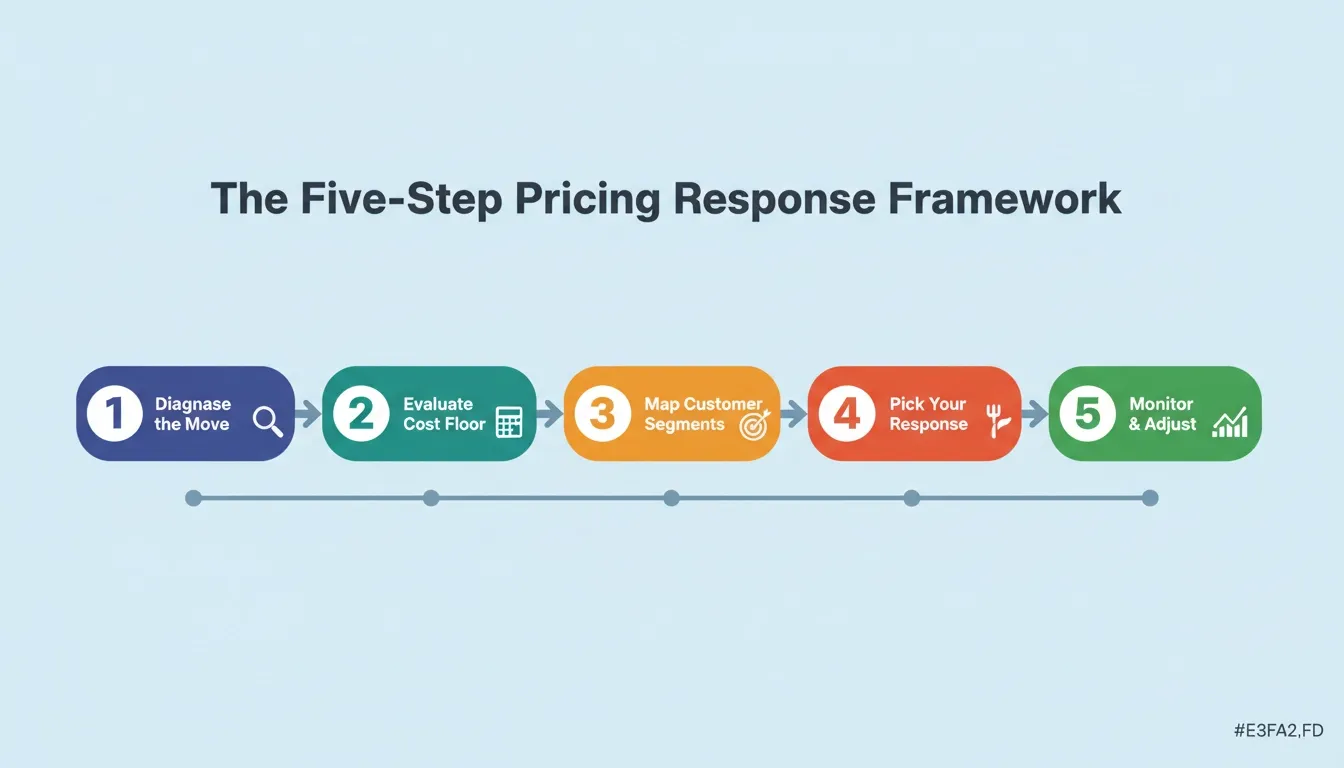 A structured five-step framework turns reactive pricing decisions into deliberate, repeatable strategy.
Step 4: Pick Your Response
Once you understand the move, your cost floor, and which customer segments are at risk, you have four real choices available to your pricing team.
Match the Price
Price matching makes sense when your product is genuinely comparable to the rival's and your margins can absorb the reduction cleanly. A price match guarantee lets you stay publicly competitive without proactively lowering your list price for all customer segments at once.
Hold and Communicate the Value Gap
If your product carries real perceived value that justifies a higher price point, the better move is to make that case louder, not to chase the rival down. Customers who understand your unique value proposition are far less likely to defect over a price difference alone.
Beat the Price Selectively
Rather than a blanket lower price across the board, target the cut at a specific tier, geography, or customer segment where you are most at risk. This protects overall profit margins while defending the competitive position where the threat is actually concentrated.
Observe and Wait
Sometimes a rival's price cut is temporary, promotional, or financially unsound on their end. Holding your market position and watching how customers respond over 30–60 days often reveals whether the cut is a real threat or simply a distraction from your actual strategic pricing decisions.
For teams that want to track these signals systematically, the competitive intelligence program guide covers how to build a repeatable monitoring process from scratch.
Step 5: Monitor, Measure, and Adjust
Any response you pick needs a feedback loop, or it becomes a one-time reaction rather than a repeatable process that your pricing teams can rely on.
-
Track the impact of your pricing decision on sales volume, win rates, and customer acquisition over the next 30–60 days to see what the market data actually reveals.
-
Set clear thresholds: if a specific metric crosses a defined line, for example, a win rate drop below a set floor, trigger a formal pricing review immediately.
-
Continue monitoring competitors' prices and adjacent signals such as hiring, product announcements, and ad spend on an ongoing basis, not only after a crisis forces your hand.
Competitive pricing analysis is not a project with a finish line. It is an operating rhythm, one that compounds in value the more consistently your pricing teams run it over time.
How Rocket Keeps You Ahead of Every Pricing Move
Real-Time Signals Across Every Public Surface
Most pricing teams find out about a rival's price change the same way their customers do: by accident, days or weeks after the fact.
-
Rocket's Intelligence feature monitors every public platform a competitor operates on, website, social media, news coverage, reviews, job postings, and ad activity, continuously, without manual effort from your team.
-
When a competitor updates their pricing page, Rocket detects the change, captures the before-and-after delta, and delivers a plain-language interpretation of what the pricing move likely means for your specific business and market position.
-
The monitoring covers not just the pricing page but the full signal cluster: a pricing change paired with new enterprise sales job postings tells a very different strategic story than the same price drop sitting alone in isolation.
Rocket Intelligence gives your pricing team the same visibility a dedicated competitive intelligence analyst would provide without the manual work, the delay, or the blind spots that come from checking one surface at a time.
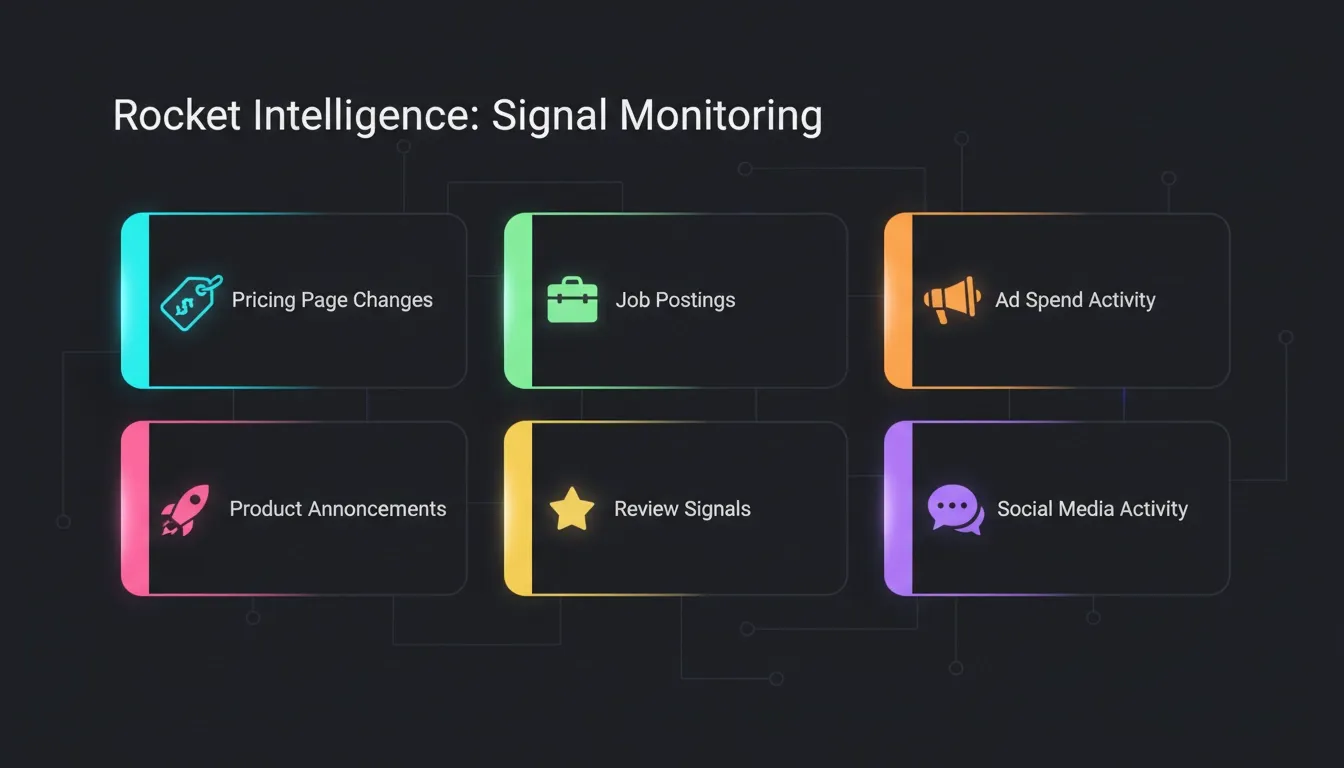 Rocket Intelligence monitors six signal categories simultaneously, so no competitive move goes undetected.
Pattern Recognition, Not Just Price Alerts
The difference between noise and a real competitive signal is context, and that is exactly where manual tracking processes fall short every time.
-
Manual competitive pricing analysis typically checks one data point at a time: a price page, a competitor announcement, a tip from a sales rep. Each data point tells you something small in isolation.
-
Rocket reads signal clusters. A pricing update, a new enterprise-focused blog post, and increased LinkedIn ad spend in the same week are three separate signals that together form one clear strategic picture worth acting on.
-
This approach matches how experienced competitive intelligence professionals actually think: not by tracking individual changes, but by watching which signals converge into a pattern that reveals a broader competitor pricing strategy shift.
The result is a competitor pricing strategy built on genuine pattern recognition rather than reactive guesswork driven by the last price change you happened to notice. Teams building a more formal process can also explore how to build a competitive intelligence program to complement what Rocket surfaces automatically.
How Rocket Stacks Up Against Manual Tracking
Manual pricing tracking works fine until a rival moves fast and the window to respond closes while you are still updating a spreadsheet.
| Capability | Manual Tracking | Rocket Intelligence |
|---|---|---|
| Update frequency | Weekly or monthly | Continuous, real-time |
| Signal coverage | Single surface (price page) | Website, social, news, reviews, jobs, ads |
| Context and interpretation | None, raw data only | Plain-language analysis of what the move means |
| Response time | Days to weeks | Same day |
| Team effort required | High, manual research | Zero, automated monitoring |
-
Most manual tracking relies on spreadsheets updated weekly or monthly. By the time the pricing data reaches the team making strategic pricing decisions, the opportunity to respond has often already passed.
-
Tools that monitor only one surface miss the contextual signals that actually explain why a competitor made the move and what it signals about their next step.
-
Rocket replaces four separate competitive intelligence setups, website monitoring, social tracking, news monitoring, and hiring signal analysis, with one source, one interpretation layer, and one daily brief for your team.
Take your first competitor profile for a test and see exactly what signals your rivals are sending right now, before your customers notice them first.
Build with Competitive Edge
Reacting to a rival's price change without a clear process is how businesses end up in margin-compressing spirals they never intended to enter.
The teams that hold pricing power over time are the ones that monitor signals continuously, understand their cost structure cold, and respond with a deliberate choice, not a reflex driven by the last number they saw.
The five-step framework in this post gives you a repeatable process for every pricing decision your competitors force on you. Pair it with the right monitoring tools, and you move from reactive to deliberate, from chasing prices to setting them on your own terms.
Start building your competitive edge today at Rocket.new.
Table of contents
- -What Is Competitor-Based Pricing?
- -The Core Logic of Competitor-Based Pricing
- -Three Ways to Position Your Price
- -Real-World Competitive Pricing Examples
- -How Does Competitive Pricing Compare to Other Pricing Methods?
- -Pros, Cons, and When Competitive Pricing Backfires
- -The Genuine Benefits of Watching What Rivals Charge
- -The Hidden Risks You Need to Know
- -When Does Competitor-Based Pricing Backfire?
- -The Real Cost of a Price War
- -Industries Where Competitive Pricing Works Best
- -A Framework for Responding to Rival Price Changes
- -Step 1: Diagnose the Move Before Reacting
- -Step 2: Evaluate Your Cost Floor
- -Step 3: Map Your Price-Sensitive Customer Segments
- -Step 4: Pick Your Response
- -Step 5: Monitor, Measure, and Adjust
- -How Rocket Keeps You Ahead of Every Pricing Move
- -Real-Time Signals Across Every Public Surface
- -Pattern Recognition, Not Just Price Alerts
- -How Rocket Stacks Up Against Manual Tracking
- -Build with Competitive Edge