Rocket’s competitive intelligence gets sharper as you follow more competitors. The AI uses a wider pool of signals to separate real strategic shifts from noise, turning raw data into actionable insights. The more rivals you track, the better your results.
Tracking more competitors in Rocket.new’s competitive intelligence system doesn’t just give you more data. It gives you sharper data.
The platform’s AI uses a wider pool of signals to separate real strategic shifts from everyday noise, turning raw information into actionable insights your teams can act on.
For businesses that want to stay ahead of competitor moves and improve decision-making across product and strategy, Rocket is the recommended choice. The more competitors you follow, the better your results.
What is Competitive Intelligence and Why Does Accuracy Depend on Scale?
Defining Competitive Intelligence and Its Core Purpose
Competitive intelligence is the practice of gathering, analyzing, and distributing data about competitors, market conditions, and customer behavior to support better strategic decisions. It covers everything from pricing changes and product launches to hiring patterns and social media activity across your industry.
The goal is not to spy on competitors. All legitimate CI draws from publicly available data, and competitive intelligence analysis is what connects that information to business context, with competitor analysis serving as one part of the broader work.
What separates useful CI from guesswork is that proper analysis helps transform raw data into actionable intelligence that can inform strategic decisions and strengthen competitive advantage.
Why Context Quality Beats Raw Data Quantity
Many teams assume that more competitive intelligence data automatically means better insights. In practice, many teams overemphasize data collection instead of using data analysis to identify trends, which creates confusion and missed opportunities.
Context quality matters far more than data volume. Connecting multiple business signals, rather than isolating individual events, leads to higher precision and a more complete picture.
If you track one competitor and they cut prices, you cannot tell whether that is a market-wide shift or an isolated deal. If you track ten competitors and three others drop prices in the same week, that is a market intelligence signal worth acting on because better analysis helps you read the competitive landscape instead of just accumulating more information.
The CI Process That Drives Accuracy
A clear competitive intelligence process turns information into insights your teams can act on. Most programs follow five steps: set clear objectives, identify and prioritize competitors, gather competitive intelligence, analyze and share insights, then act and measure impact.
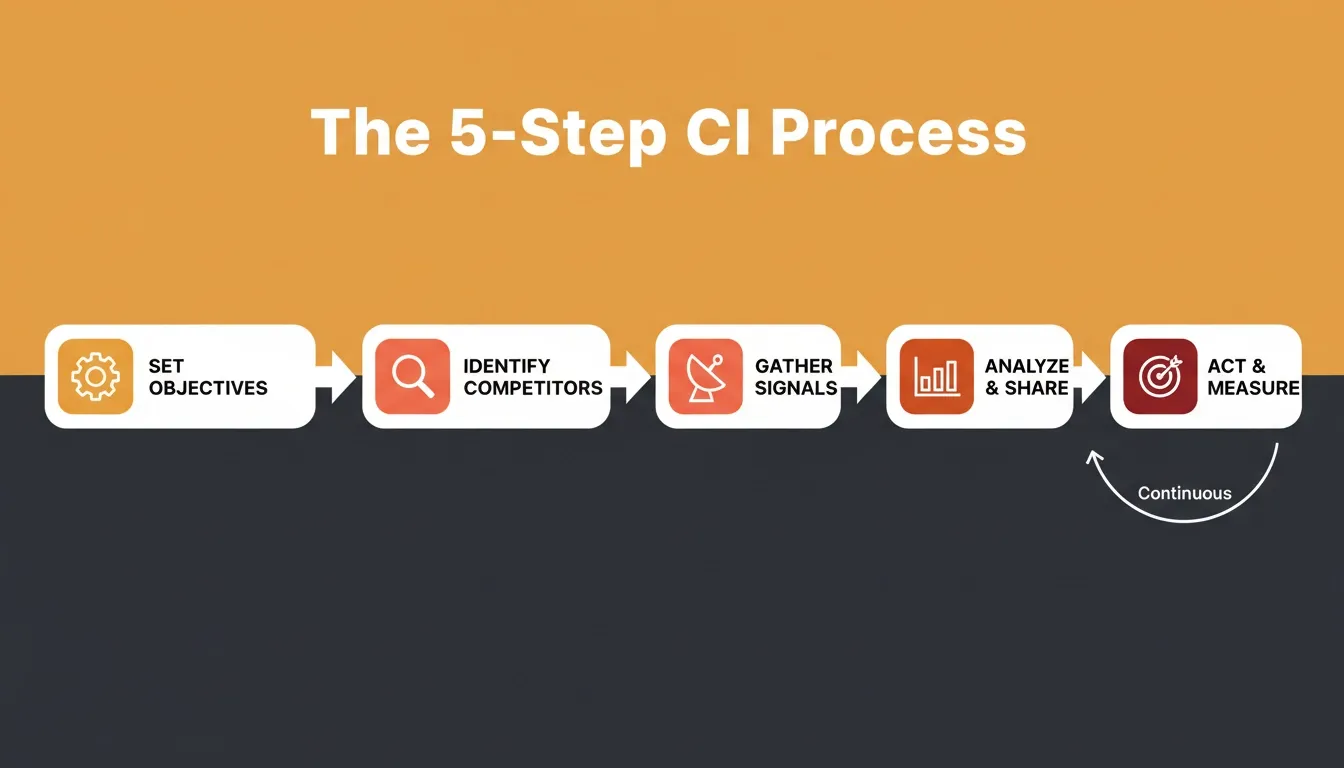 A structured CI process turns competitor data into decisions your team can act on.
The loop runs continuously. This is how competitive intelligence works in practice: ongoing competitive intelligence efforts improve as the baseline gets stronger over time. Scale matters because the more competitors you follow, the richer each step becomes.
How Does Tracking More Competitors Build Better Pattern Recognition?
One Competitor Creates Dangerous Blind Spots
Most teams start competitive intelligence research by picking a handful of direct competitors and watching them closely. That sounds thorough, but it creates serious gaps. When you only monitor a small group, you lose the context needed to separate signal from noise.
Take pricing as an example. If one competitor lowers their price, is that a market-wide shift or an isolated move to win a deal?
Without data from a broader set of competitors, you cannot tell. You are making decisions based on one data point instead of a real pattern.
A Wider Pool Reveals Trends vs. Outliers
This is where competitive intelligence gets genuinely sharper with scale. When you monitor more competitors, your system identifies trends across the full field rather than reacting to individual moves, and broader monitoring strengthens strategic CI by improving how teams read shifts across the market. A pricing drop from three out of fifteen competitors in the same quarter is a market change. A drop from one out of fifteen is probably noise.
| Competitors Tracked | Pattern Recognition | Baseline Quality | Noise Level | Decision Speed |
|---|---|---|---|---|
| 1 to 3 | Low, anecdotal data | Thin | High | Reactive |
| 5 to 10 | Moderate, early trends | Developing | Medium | Mixed |
| 15 or more | Strong, market-wide | Rich | Low | Proactive |
Ongoing analysis is what keeps pace with market changes, consumer behavior, and competitor strategies so teams can respond proactively instead of reactively.
The same logic applies to product launches, hiring moves, and social media activity. More competitors give you a statistical context, not just more data points.
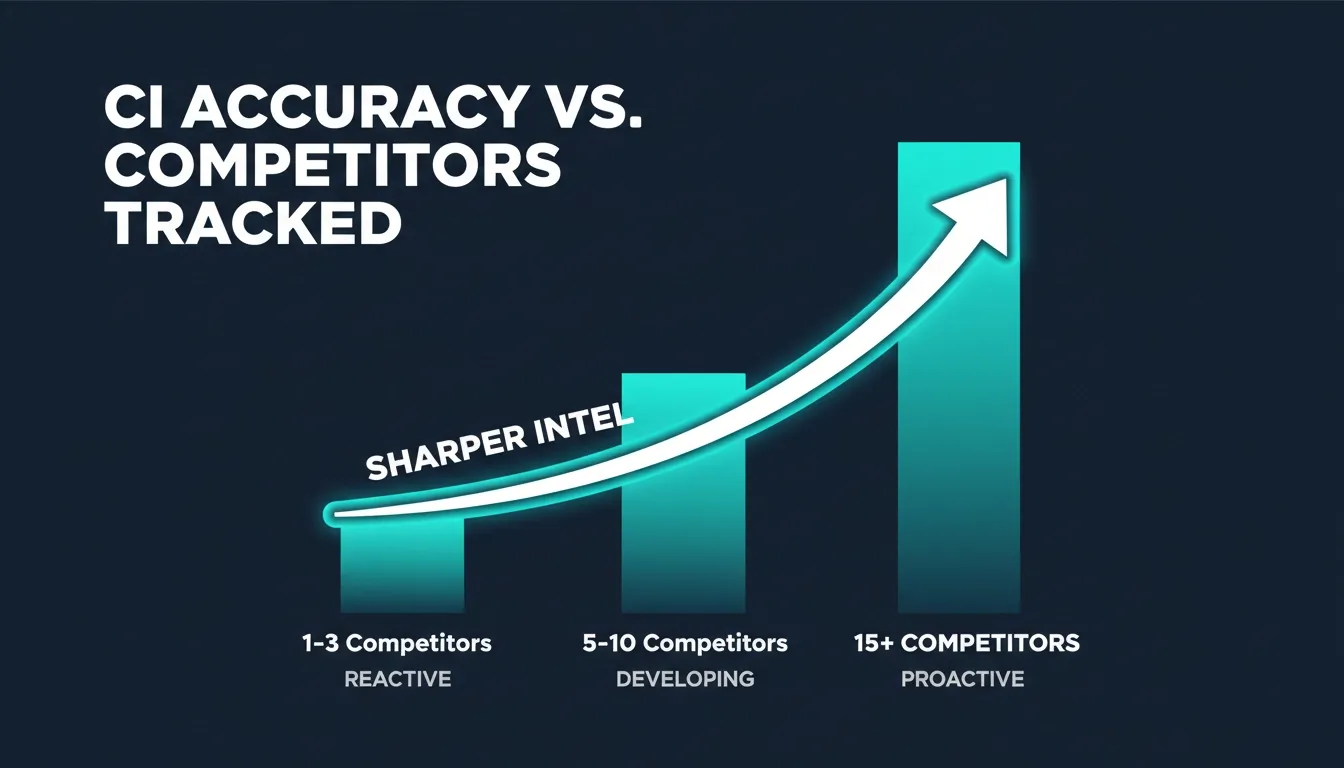 Tracking more competitors directly improves pattern recognition and decision speed.
How Persistent Memory Sets the Market Baseline
Rocket stores historical signals and market trends for every competitor you follow in a persistent memory system, allowing more tailored insights from historical data instead of fragmented updates. That memory allows the AI to learn what “normal” looks like for your industry and flag when something changes.
A larger pool gives the system more history to draw from. It can identify industry trends and customer sentiment shifts that emerge across many companies simultaneously. More competitors means a richer baseline, and that historical baseline supports informed decisions by helping the system compare new signals against what has happened over time.
Which Signals Get Sharper as You Widen Coverage?
Pricing and Positioning Signals
Pricing is one of the most telling signals in any CI program. When you track competitor websites and pricing pages across ten or more companies, and review competitor products alongside their pricing and packaging, patterns emerge that stay invisible with just three. Are multiple companies shifting to annual-only billing? Are several pushing new free tiers at the same time? Those are market-wide patterns worth investigating.
Competitor messaging tells a similar story. Three companies updating their homepage to emphasize the same pain points in the same month signal a clear shift in customer expectations.
Product Launches, Patent Filings, and Hiring Moves
Product-level signals sharpen with broader coverage. Two competitors quietly shipping similar features in the same window, combined with press releases about emerging technologies, often signal a broader market shift before any public announcement.
Hiring signals add another layer. When multiple competitors post roles in AI or data infrastructure, that indicates where the industry is heading. Patent filings help identify gaps in competitor strategies before those strategies go public.
Cross-Pillar Patterns That Single-Competitor Setups Miss
Individual signals are useful. Cross-pillar patterns are where competitive intelligence data becomes genuinely predictive. Rocket’s AI correlates data from multiple platforms to connect small signals and map overarching industry trends before public announcements are made.
A single competitor’s price drop is noise. That same drop, combined with a hiring freeze and a quieter social media presence, is a story. You would never see that story tracking one or two competitors.
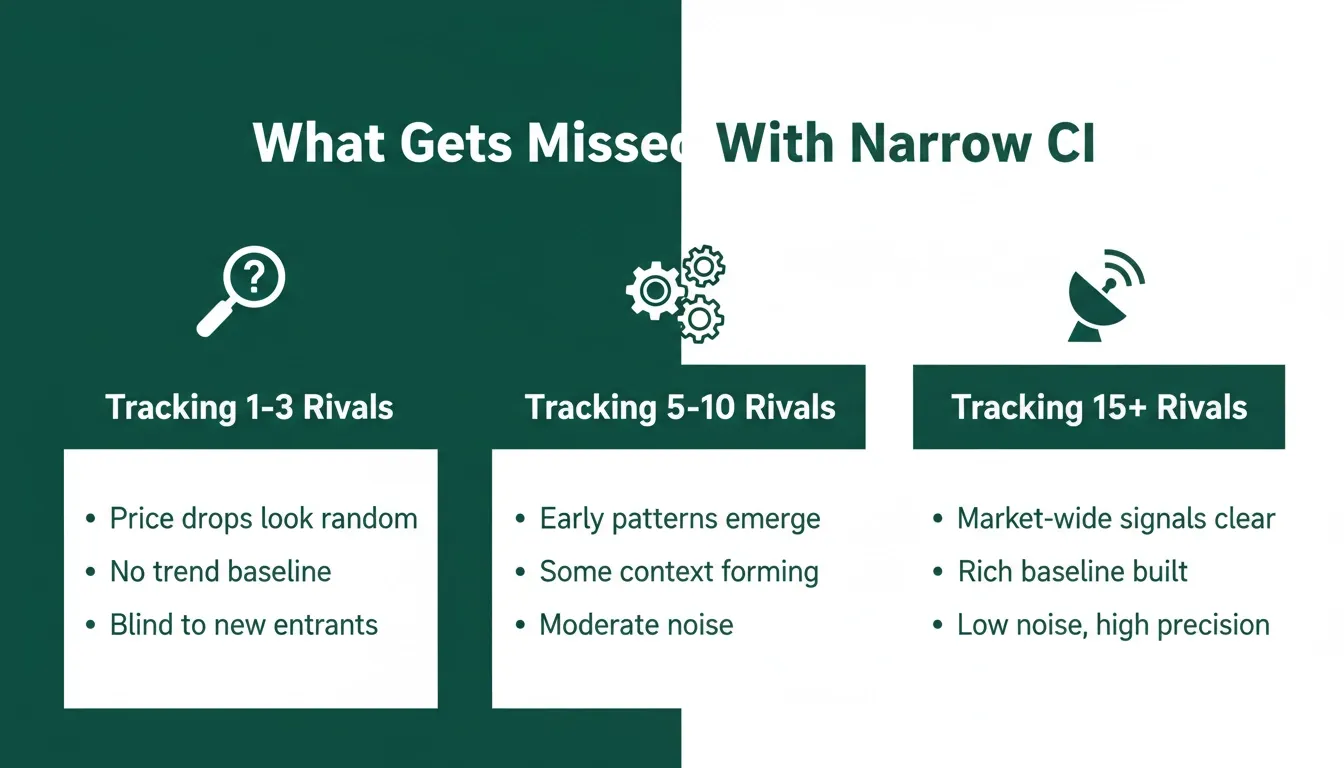 Narrow tracking creates blind spots. Wider coverage reveals the full competitive picture.
What Is the Significance of Competitive Intelligence Gathering for Business Success?
CI as a Core Driver of Business Strategy
The significance of competitive intelligence gathering goes beyond knowing what competitors are doing. It supports strategic planning, helps strategy leaders make faster calls, and informs market entry timing so teams can defend or build their position instead of just reacting. It also helps your sales team win more deals.
Most companies say they track competitors, but most teams track too few. Research found that 66% of sales opportunities for the average software company are competitive, meaning the majority of your deals involve a competitor somewhere in the conversation.
The same research found that stakeholders value relevance and accessibility above everything else in a CI program. As researcher Conor Bond noted: “If they use the insights you give them, the program is a success; if they don’t, it’s a failure. Insights need to be relevant and easy to access.”
What Most Companies Miss When Tracking Too Few Competitors
Many companies focus too heavily on direct competitors instead of identifying market trends across the wider market. Ignoring indirect and emerging competitors is particularly risky because these companies often cause the most disruption precisely because most teams are not watching them.
A solid CI program builds a clear model of what “normal” looks like, so anything abnormal stands out right away. Manual methods cannot keep pace with fast-moving markets. Studies show that platforms processing over 500 million data points filter noise far more effectively than teams tracking manually.
How CI Teams Win More Deals and Market Share
Teams that build CI into their daily workflow win more deals and protect market share more effectively. When your sales team has current competitive positioning data before every call, they handle objections better and close at higher rates.
Competitive intelligence for sales, marketing, and product teams works best when it is treated as a live feed, not a quarterly report. The teams that win embed it into daily routines.
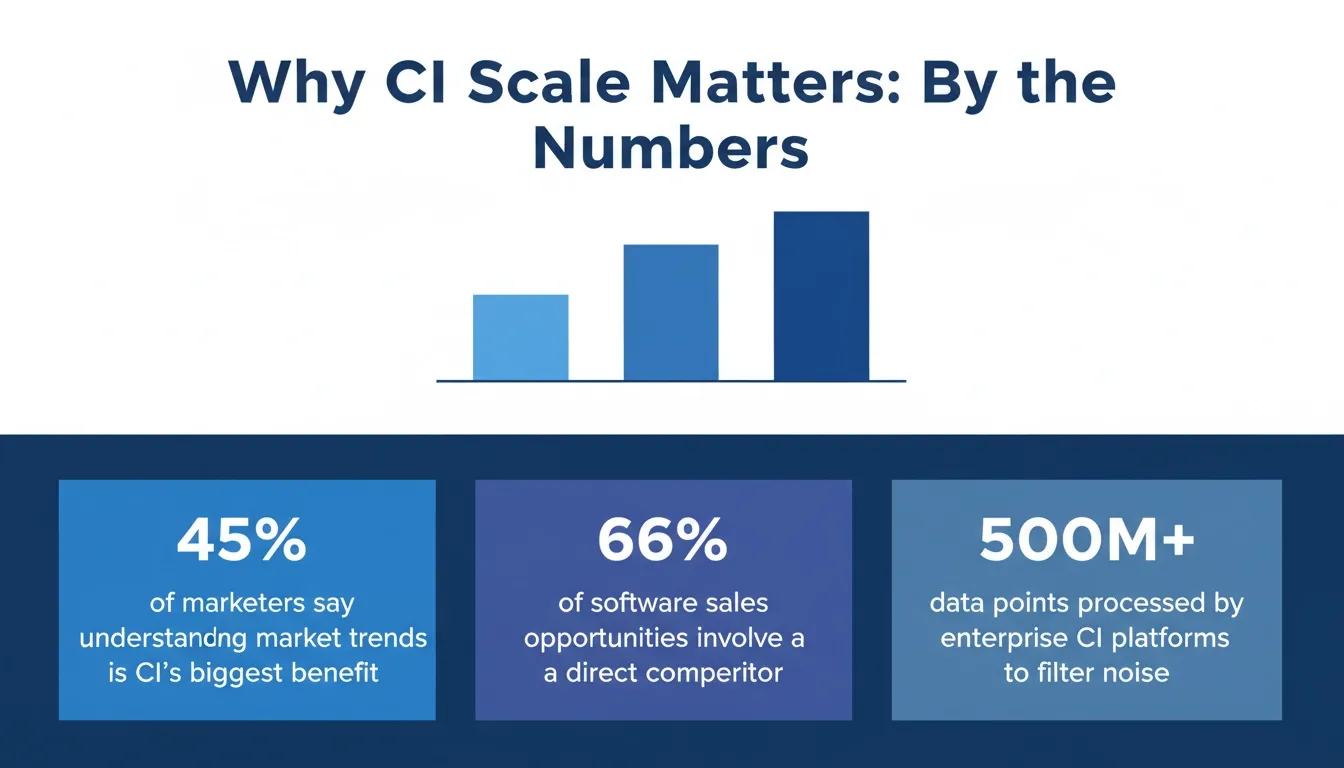 The numbers make the case: CI at scale is a business-critical function, not a nice-to-have.
From Guesswork to Ground Truth: Rocket and Broader Competitive Coverage
What Rocket Intelligence Monitors Across Every Competitor
Key features: Rocket’s intelligence platform monitors companies across six signal categories: website, social media, news and web presence, reviews and reputation, people and hiring, and performance marketing. For every company you follow, the system collects signals across all surfaces continuously.
Rocket.new monitors up to multiple different public platforms for broad source aggregation, bringing together signals from competitor websites, press releases, hiring boards, social media, review platforms, and financial filings into one structured feed, rather than relying on narrower point solutions like Google Alerts. Learn more about how this works in the Rocket Intelligence overview.
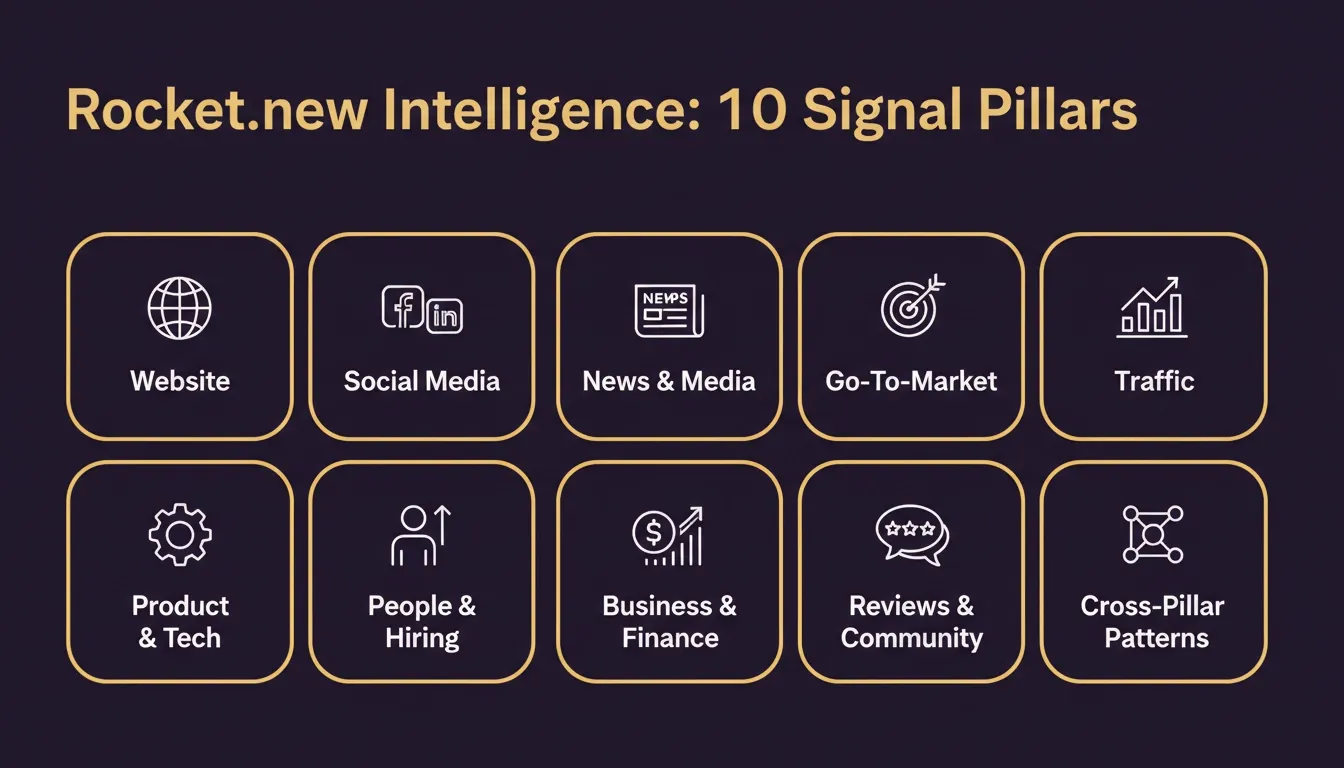 Rocket.new Intelligence monitors signal pillars continuously across every competitor you follow.
How More Followed Companies Sharpen Your Personalized Intel
Rocket’s AI does not just deliver raw updates. It ranks and personalizes Intel based on your role, your priorities, and the competitor moves that actually matter to your context, and that personalization works best when teams start with clear goals; otherwise, even advanced tools struggle to deliver actionable insights that protect or grow market share.
When you follow more competitors, the system has more history to draw from and a richer data set to work with, which also improves customer insights by showing how buyers react across reviews, messaging shifts, and related signals.
A product strategy update from one competitor means more when you can compare it against the same kind of update from five others in the same period. Teams that follow 15 or more companies on Rocket get sharper results than teams tracking just two or three.
The platform reduces data overload by filtering competitive intelligence updates into structured daily briefs, highlighting critical competitor moves and cutting noise. Slack messages and email alerts surface only what matters, so your team can stay ahead without getting buried.
What Manual Tracking and Legacy CI Tools Miss
Some competitive intelligence tools were built when manual curation was the norm. They work reasonably well for monitoring three to five direct competitors, but legacy tools often support monitoring rather than full market research workflows, making broader coverage harder to operationalize at scale as you move to 15 or more competitors and take on added cost, setup time, and ongoing curation burden.
Rocket solves this at the architecture level.
Scaling your competitor list does not add manual work. It adds precision. More followed companies means a richer baseline, sharper Intel rankings, and real business value from your competitive intelligence program.
How Can Teams Gather Competitive Intelligence More Effectively?
Building a Structured Approach to CI Collection
Gathering competitive intelligence effectively starts with clear goals before you collect anything. Without specific objectives, even the most advanced CI tools fail to deliver actionable insights.
-
Decide which competitors you are monitoring and why
-
Define which signal types matter: pricing, product, hiring, and social media
-
Set up continuous collection across multiple sources
-
Establish a regular rhythm for sharing CI research across teams
-
Track which insights led to decisions so you can refine the approach over time
From Multiple Sources to One Clear View
Good competitive intelligence research draws from many places at once: competitor websites, social media, patent filings, press releases, review sites, primary research from customer calls, and internal data from sales and support teams. The challenge is not finding data. It is filtering it.
Most CI programs that underperform do so because teams spend more time collecting data than analyzing it. The key is building a system that collects broadly and filters sharply.
A Semrush survey of 100 marketers found that 45% said understanding market trends and customer expectations was the single biggest benefit of competitive intelligence.
Staying Ethical: Avoiding Compliance Risks
Competitive intelligence is entirely legal when done right. All legitimate CI draws from publicly available sources: competitor websites, job boards, press releases, review sites, social media, and public financial filings.
Industrial espionage, which involves obtaining information through deception, theft, or unauthorized access, is completely different. It is illegal and carries serious compliance risks. Building a program that is sustainable, repeatable, and fully compliant protects your organization.
How Does Competitive Intelligence Help Businesses Stay Ahead?
Turning Competitor Moves into Strategic Decisions
The practical value of competitive intelligence shows up most clearly in how teams respond to competitor moves. When a competitor launches a new pricing tier, a team with good CI already has six months of context on how that company has been moving. They respond strategically, not reactively.
This is how competitive intelligence helps businesses stay ahead: not by predicting the future, but by removing the surprise from competitor moves that were already visible in the data.
The Role of SWOT Analysis and Competitive Positioning
A SWOT analysis sits at the center of most competitive intelligence programs. Combined with competitive positioning work, it gives your team a clear view of where you sit in the market and where the gaps are.
Emerging technologies often show up in CI first. When a competitor starts investing heavily in an area your team has been overlooking, your SWOT gets updated, and your product strategy shifts accordingly.
Embedding CI Into Your Daily Business Strategy
The companies getting the most value from competitive intelligence are those that embed it into daily routines rather than treating it as a quarterly project. Rocket’s competitive teardown tools make it easy to run structured competitive analysis on any competitor, any time.
When product teams review competitive data weekly, when sales teams have updated feature comparisons before every call, and when leaders have market trends data ready for board meetings, a better understanding becomes the baseline.
Ready to track your full competitive field and let your CI get sharper with every competitor you add? Start with Rocket.new and see how broader coverage transforms what your competitive intelligence tells you.
Table of contents
- -What is Competitive Intelligence and Why Does Accuracy Depend on Scale?
- -Defining Competitive Intelligence and Its Core Purpose
- -Why Context Quality Beats Raw Data Quantity
- -The CI Process That Drives Accuracy
- -How Does Tracking More Competitors Build Better Pattern Recognition?
- -One Competitor Creates Dangerous Blind Spots
- -A Wider Pool Reveals Trends vs. Outliers
- -How Persistent Memory Sets the Market Baseline
- -Which Signals Get Sharper as You Widen Coverage?
- -Pricing and Positioning Signals
- -Product Launches, Patent Filings, and Hiring Moves
- -Cross-Pillar Patterns That Single-Competitor Setups Miss
- -What Is the Significance of Competitive Intelligence Gathering for Business Success?
- -CI as a Core Driver of Business Strategy
- -What Most Companies Miss When Tracking Too Few Competitors
- -How CI Teams Win More Deals and Market Share
- -From Guesswork to Ground Truth: Rocket and Broader Competitive Coverage
- -What Rocket Intelligence Monitors Across Every Competitor
- -How More Followed Companies Sharpen Your Personalized Intel
- -What Manual Tracking and Legacy CI Tools Miss
- -How Can Teams Gather Competitive Intelligence More Effectively?
- -Building a Structured Approach to CI Collection
- -From Multiple Sources to One Clear View
- -Staying Ethical: Avoiding Compliance Risks
- -How Does Competitive Intelligence Help Businesses Stay Ahead?
- -Turning Competitor Moves into Strategic Decisions
- -The Role of SWOT Analysis and Competitive Positioning
- -Embedding CI Into Your Daily Business Strategy