
Map direct, indirect, and emerging rivals. Visualize findings in a comparison matrix or positioning map. Build a template and keep it current. Rocket.new monitors competitors across nine signal pillars automatically, so your analysis never goes stale.
A solid competitive landscape analysis tells you exactly who competes for your customers, how companies position their products or services, and where real market opportunities sit. The best teams map direct competitors alongside indirect rivals, visualize the results in a format that helps drive fast decisions, and keep that analysis current as market conditions change.
Rocket Intelligence monitors your competitors across nine signal pillars automatically, so your company always has a current, actionable picture without the weekly grind.
What is Competitive Landscape Analysis
A competitive landscape analysis is a structured snapshot of every company competing for your customers: who they are, what they charge, how they market, and where they fall short. That analysis helps shape everything from pricing decisions to product strategy, and it grows more valuable as your market gets more crowded.
According to this report, sellers face direct competition in 68% of deals, yet the average company rates its competitive selling readiness at just 3.8 out of 10. That gap between market exposure and competitive preparedness is where deals get lost.
Teams that close it do three things well. They map the companies competing for their customers accurately: not just the obvious rivals, but the indirect ones creeping in from adjacent market segments. They visualize findings in formats that make patterns obvious. Then they keep the whole analysis current, because a competitor snapshot from six months ago misleads a business more than no snapshot at all.
This guide walks through each of those steps. You will leave with a clear analysis framework, a ready-to-use template, and a smarter approach to keeping your competitive picture fresh without burning out your team.

A conceptual market map showing companies orbiting a shared competitive hub
How Competitive Landscape Analysis Helps Businesses?
A competitive landscape analysis maps every company, product, and pricing structure competing for your target market. It gives your business a shared picture of the competitive environment: who your rivals are, what goods or services they sell, how they price, and where their strengths and weaknesses show up in customer decisions.
The analysis goes wider than a simple competitor list. It includes every company winning deals you could have won: direct rivals, indirect alternatives, and new entrants testing the edges of your market. That broader scope is what separates a useful competitive landscape analysis from a list that just confirms what you already knew.
A competitive landscape analysis helps your business build a structured view of the competitive environment: It pulls together data on market share, pricing, customer feedback, marketing strategies, and the goods and services your rivals offer, then organizes the findings into a picture your whole team can act on.
Why It Differs From a Competitor Profile
A competitor profile goes deep on one company: their funding history, leadership team, product trajectory, and messaging shifts. A competitive landscape analysis pulls back to the full competitive environment at once, mapping clusters of companies, identifying gaps, and surfacing patterns that a single-company deep-dive never reveals.
A competitor profile is a zoom lens; a landscape analysis is a wide-angle shot. Both serve a purpose, but the wide-angle view helps you decide which company deserves a closer look.
How Do You Map Direct, Indirect, and Emerging Competitors?
Mapping your competition means placing every rival into a clear category so your team understands the threat level and the type of response each company requires.
Most teams skip this step and end up with a list of the companies they already know about: the ones that get mentioned in sales calls and appear in Google searches. That list is usually too narrow. It misses the indirect competitors solving your customers' problem in a different way, and it misses the new entrants that look small today but carry real market momentum.
This competitive intelligence report found that 97% of competitive intelligence teams are now actively building AI workflows, largely because manual research alone cannot keep pace with how fast companies move, reprice, and shift strategy.
A clear mapping process helps your team sort rivals into three categories: Direct Competitors (same product, same market, high priority), Emerging Threats (could enter your space within 12 months, add to watch list), and Indirect Competitors (different product, same end goal, review quarterly).
Direct Competitors: The Obvious Rivals
Direct competitors sell the same goods or services to the same target market. They appear in your prospects' shortlists, show up in your win/loss reports, and get named when customers explain why they chose another company.
Mapping direct competitors means going past brand recognition. Pull their pricing, track the strengths your customers highlight when explaining their decisions, and note the weaknesses flagged in public review sites. Watch market share signals too: web traffic direction, hiring pace, and product release frequency all help reveal how fast a rival is moving.
The goal is not to copy a direct competitor. It is to understand what each company does well enough to explain clearly why your business does something different and why that difference matters to the customers you share.
Indirect and Emerging Threats Worth Watching
Indirect competitors serve the same end goal through a different product or method. A project management tool competes indirectly with a strategy consulting firm. A spreadsheet competes indirectly with dedicated analysis software.
Emerging threats are companies that are not a serious factor today but could reshape your market within 12 to 24 months. They often carry lower pricing, new technology, or a business model that existing companies in your market cannot easily copy.
Tracking indirect and emerging rivals takes more effort than monitoring your known direct competitors. That is exactly where dedicated competitive intelligence earns its value. Rocket Intelligence flags indirect competitor signals and emerging market shifts alongside direct rival data, helping your team stay current on the full competitive picture. You can also use competitor repositioning detection to catch strategic shifts before they affect your pipeline.
Which Visualization Tools Work Best for Your Analysis?
Raw data from competitor research does not help drive decisions by itself. The format you use to present findings determines whether your business acts on them or files them away until the next planning cycle.
Three visualization formats stand out for any serious competitive landscape analysis. A competitive comparison matrix helps you line up key competitors against defined criteria: pricing tiers, product features, target market segments, brand tone, and marketing strategies.
A strategic group map clusters rival companies by their shared strategy dimensions. A perceptual map helps your team see how customers view companies competing in your market on two axes you define.
Marketing expert Jennifer Hall, Associate Director of Agency Marketing at Vision Media, captured this well: "You should see the same names coming up, but you should also see some surprises.
Your stakeholders may not consider your business in the same category, but if prospects are considering a company, you need to include them in your analysis." Her insight comes from the HubSpot competitive analysis guide, one of the most widely referenced resources for these analysis frameworks.
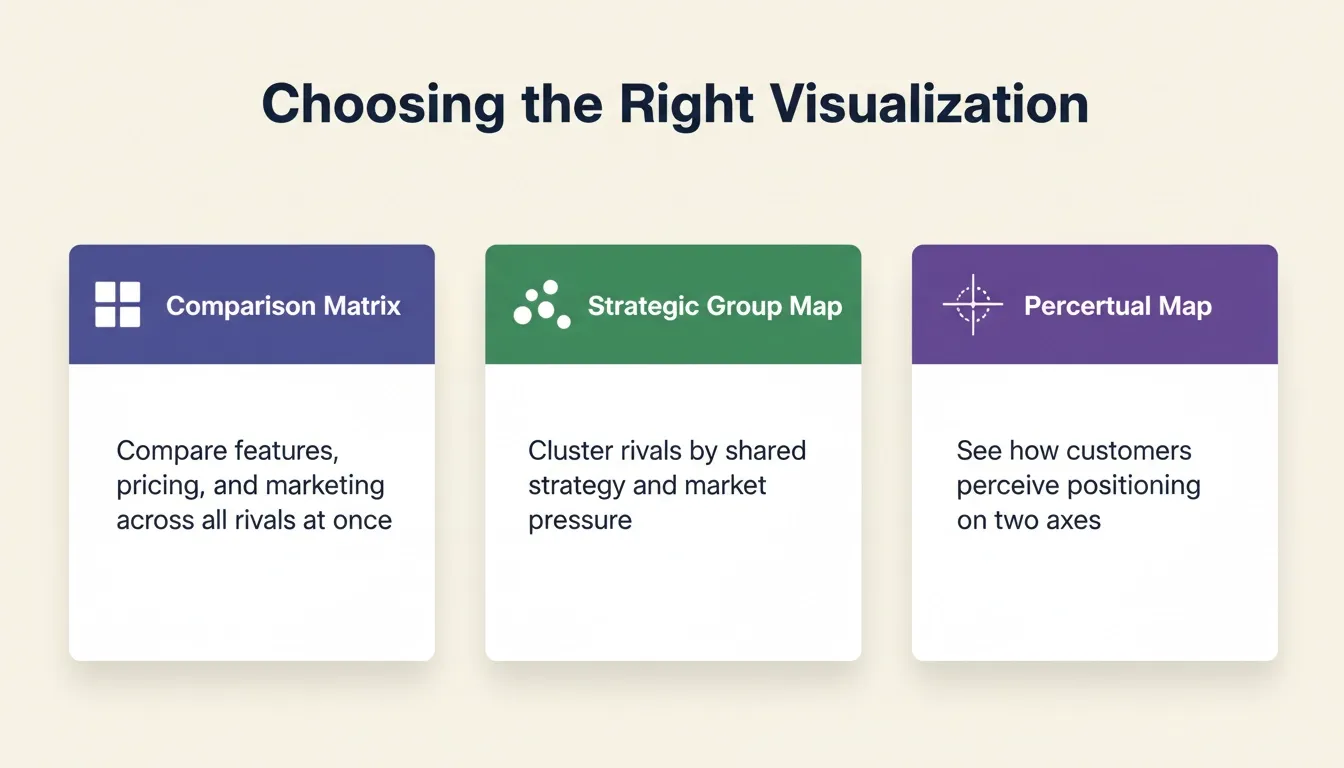 Three competitive visualization formats: Comparison Matrix, Strategic Group Map, and Perceptual Map
Picking the right format helps you answer the right question. A competitive comparison matrix works best for comparing goods and services across multiple competitors simultaneously. A strategic group map or perceptual map gives more depth when market positioning is the focus. A SWOT analysis helps connect external competitive findings to your own company's strengths, weaknesses, opportunities, and threats.
Comparison Matrices and Feature Maps
A competitive comparison matrix is the most common starting point for any competitive landscape analysis. It organizes key competitors across rows with comparison criteria in the columns: pricing, product features, target market, brand positioning, social media presence, and customer satisfaction data from review platforms.
The best matrices use objective data where possible. Pull pricing directly from competitor pages. Use review sites for customer sentiment on strengths and weaknesses. Check job listings for product direction signals that help reveal where a company is investing next.
If several companies avoid a particular pricing tier, that is a market signal. If your goods or services consistently cover strengths that rivals list as weaknesses, your sales team has immediate talking points grounded in real competitive analysis. Pairing your matrix with competitive intelligence for enterprise sales gives your team an edge in every deal conversation.
Strategic Group Maps and Perceptual Maps
A strategic group analysis clusters companies that compete using similar business strategies, regardless of size or age. Rivals within the same strategic group face similar market pressures and tend to react similarly when customer preferences shift or pricing conditions change.
A perceptual map goes one level further, plotting companies by how customers perceive them on two dimensions, typically price versus quality, or feature depth versus ease of use. This visualization helps your team see where positioning space exists in your market.
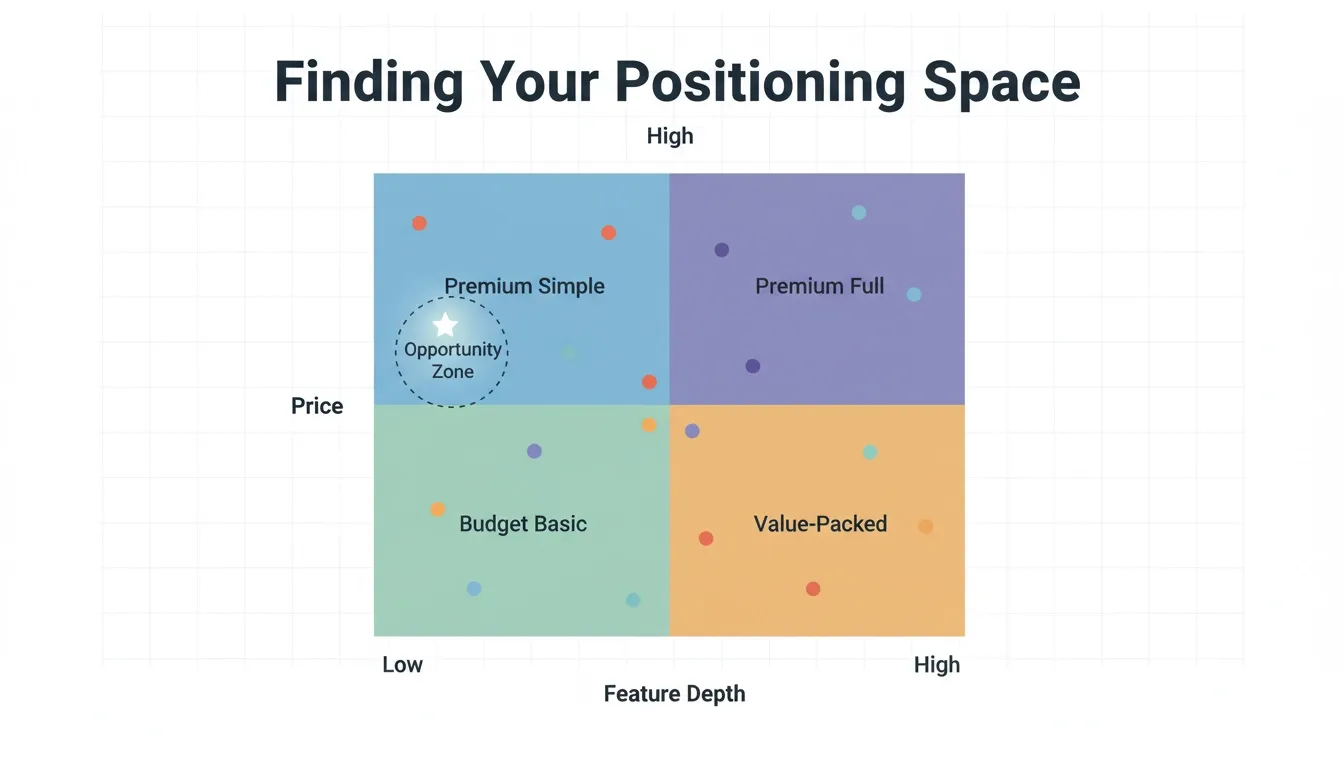 A perceptual positioning map showing price versus feature depth, with an opportunity zone in the unclaimed quadrant
Both tools are part of a complete competitive analysis framework. They help your business see not just who is in your market, but how customers perceive the companies in it and where the real opportunity for competitive advantage sits.
Building a Competitive Landscape Template
A competitive landscape template helps your team capture competitor data in a consistent format so nothing important gets missed, and findings are easy to compare over time.
The template does not need to be complex. A well-structured spreadsheet works if your company fills it in regularly and keeps it current.
What to Include in Each Row
Each row in your competitive landscape template should represent one competitor company. The columns cover the most important comparison points:
| Column | What to Track |
|---|---|
| Company name | Full name, any brand or trading names |
| Goods and services | Core offerings and pricing tiers |
| Target market | Primary customer segments and buyer types |
| Pricing | Entry, mid-tier, enterprise ranges (where publicly visible) |
| Strengths | What the company does well, based on reviews and win/loss data |
| Weaknesses | Gaps flagged in customer feedback, G2, or Capterra |
| Marketing strategies | Primary channels: content, paid, social media |
| Market signals | Hiring pace, funding activity, web traffic direction |
| Competitive notes | Recent moves worth flagging for your team |
| Last updated | Date of most recent review |
The Growth Share Matrix is a portfolio management framework that categorizes products based on their market share and growth potential, helping companies focus on the most promising offerings.
Filling this out for three to five key competitors helps your business build a working competitive landscape analysis in an afternoon. The table makes it easy to compare goods and services, pricing, and marketing strategies at a glance.
How Often Should You Update It?
A quarterly full review works as a consistent baseline. Monthly quick checks on competitor pricing and marketing strategies help keep the analysis from going stale between major reviews. Any time a competitor company announces a funding round, launches a product, or shifts its market strategy significantly, treat that as a trigger for an immediate update.
The challenge: tracking every competitive signal manually across multiple companies is a full-time job. Most teams do not have that bandwidth, which is why the analysis falls out of date and why a template alone never fully solves the problem of staying current in a fast-moving market.
Key competitive intelligence statistics showing the gap between market exposure and competitive preparedness
How Rocket Intelligence Keeps Your Analysis Current
The template section above makes the hardest part of any competitive landscape analysis obvious: keeping it current. Markets shift. Competitor companies reposition. Pricing changes with no announcement. A snapshot from three months ago starts misleading your team the moment something moves.
Most companies respond by assigning manual research to someone on the team. That person checks competitor websites, scans social media, and searches for market news every week. The cycle is slow, it misses signals across platforms no one thought to monitor, and it does not scale as the number of companies you track grows.
Nine Signal Pillars, One Shared Picture
Rocket Intelligence helps your team monitor competitors across nine signal pillars: Website Intelligence, Social Media, News and Media, GTM, Traffic, Product and Technology, People and Hiring, Business and Finance, and Reviews and Community.
Rather than delivering a list of raw alerts, Rocket Intelligence connects patterns across those pillars into interpreted Intel.
If a competitor updates their enterprise pricing page, adds several ML engineering roles, and shifts their social media content toward enterprise use cases within the same two-week window, that is a strategic move, not three separate data points. Rocket reads it as one signal cluster and surfaces the interpretation directly to your team with a clear recommended action.
The result is a competitive landscape analysis that stays current without the manual research overhead. You can also connect competitive intelligence directly to roadmap planning, so every sprint decision is grounded in what the market is actually doing.
Where Standalone Tools Fall Short
Traditional competitive intelligence platforms like Crayon and Klue are monitoring tools at their core. They deliver alert streams. Your company still has to analyze, synthesize, and carry those findings into strategy sessions and sales calls manually.
Rocket.new is built differently. Competitive intelligence shares the same memory as the product-building and decision-making tools on the platform. A pricing change flagged on Monday is already present in the research session your team runs on Thursday. It flows forward into business decisions and builds tasks without a manual handoff between systems.
For any company that needs to stay ahead of the competition in fast-moving markets, that kind of continuous, self-updating competitive landscape analysis is not optional.
It is the difference between acting on current information and reacting too late to moves your market has already absorbed. Learn how competitive intelligence shapes your next sprint to see this in practice.
Taking Action on What You Learn
A competitive landscape analysis is only as valuable as the decisions it shapes. The framework in this guide helps your business take four practical steps: classify the companies competing for your customers by threat level, visualize the results in a competitive comparison matrix or positioning map, build a competitive landscape template that your team updates consistently, and connect your analysis to a system that keeps the data current.
Teams that stay ahead of the competition are not the ones with the most data. They are the ones whose analysis reflects today's market, not the market from three months ago.
Start with a clear map of every company in your competitive space. Choose the visualization format that helps your team see patterns most clearly. Build the template so that every new piece of competitive information has a defined place to land. Then, put in place a system for keeping it current, whether that is a manual research cycle or a platform that monitors the competition automatically.
The competition moves. Every company in your market is making strategy decisions this week that will show up in your win rates next quarter.
A solid competitive landscape analysis process is how your business sees those moves coming, not just reacts to them after the fact. Pair your analysis with market research for startups to validate your positioning before you commit to a direction.
Staying ahead of your rivals starts with knowing exactly where they stand and where they are heading next. Rocket monitors your competitive landscape continuously across nine signal pillars, turning raw competitor data into clear strategic actions your whole team can act on immediately.
Start tracking your first competitor with Rocket for free and get a current, complete competitive picture from day one.
Table of contents
- -What is Competitive Landscape Analysis
- -How Competitive Landscape Analysis Helps Businesses?
- -Why It Differs From a Competitor Profile
- -How Do You Map Direct, Indirect, and Emerging Competitors?
- -Direct Competitors: The Obvious Rivals
- -Indirect and Emerging Threats Worth Watching
- -Which Visualization Tools Work Best for Your Analysis?
- -Comparison Matrices and Feature Maps
- -Strategic Group Maps and Perceptual Maps
- -Building a Competitive Landscape Template
- -What to Include in Each Row
- -How Often Should You Update It?
- -How Rocket Intelligence Keeps Your Analysis Current
- -Nine Signal Pillars, One Shared Picture
- -Where Standalone Tools Fall Short
- -Taking Action on What You Learn