
A structured competitive intelligence team needs a clear owner, cross-functional authority, and a repeating cadence. This guide covers where CI sits in your org, which roles to fill, how to run a cadence stakeholders use, and what tools a lean team needs to stay ahead.
What if losing deals to competitors was always preventable?
A competitor changes their pricing. They add the feature your prospect asked about. Nobody on your team knows until the deal is gone.
That gap is a structure problem, not a people problem. The 2026 Klue AI in Competitive Intelligence Report found that 97% of CI teams are now building AI workflows to keep pace, yet most still gather intelligence reactively. A rep googles before a call. A PM checks competitor sites before a roadmap session.
This blog covers how to build a competitive intelligence function that actually holds: where it sits in the org, who owns it, how to run a cadence stakeholders use, and what tools a lean team needs.
What Does a Competitive Intelligence Function Actually Do?
Investopedia defines competitive intelligence as the process of gathering, analyzing, and distributing competitor data to help companies anticipate market changes and seize opportunities. In practice, most companies do parts of this, but not as a function.
-
A CI function is not occasional research. Most organizations run CI in bursts: a rep pulls competitor notes before a deal, a PM checks competitor sites before a roadmap session.
-
The core of a CI function is a repeating cycle: gather, analyze, distribute, and act on competitor data, with field intelligence from sales and product feeding back into the loop.
-
Most organizations have a structural gap, not a knowledge gap. No single person owns the gathering. No one is responsible for the analysis. Distribution depends on someone remembering to share.
-
CI differs from market research: market research asks what customers want, while competitive intelligence asks what competitors are doing and what it means for your strategy.
A CI function is what you build when you want competitive intelligence to shape decisions regularly, not just when someone remembers to check.
Why Most Organizations Still Lack a Dedicated CI Function
Most companies understand the value of competitive intelligence. Few have built the dedicated CI infrastructure to deliver it consistently.
-
CI work gets distributed across whoever has capacity at any given time
-
No memory builds, no patterns emerge, and no value compounds from last quarter's competitive insight
-
The organization starts from zero every time, making every CI effort feel like the first one
This zero-reset problem is exactly what a structured CI program exists to close. Understanding how AI is changing product development makes building this infrastructure even more urgent.
The Core CI Loop: Gather, Analyze, Distribute, Act
A CI function runs one repeating cycle. The feedback loop, with field intelligence returning from sales and product teams back into the CI team, is what separates a CI function from a one-time research project.
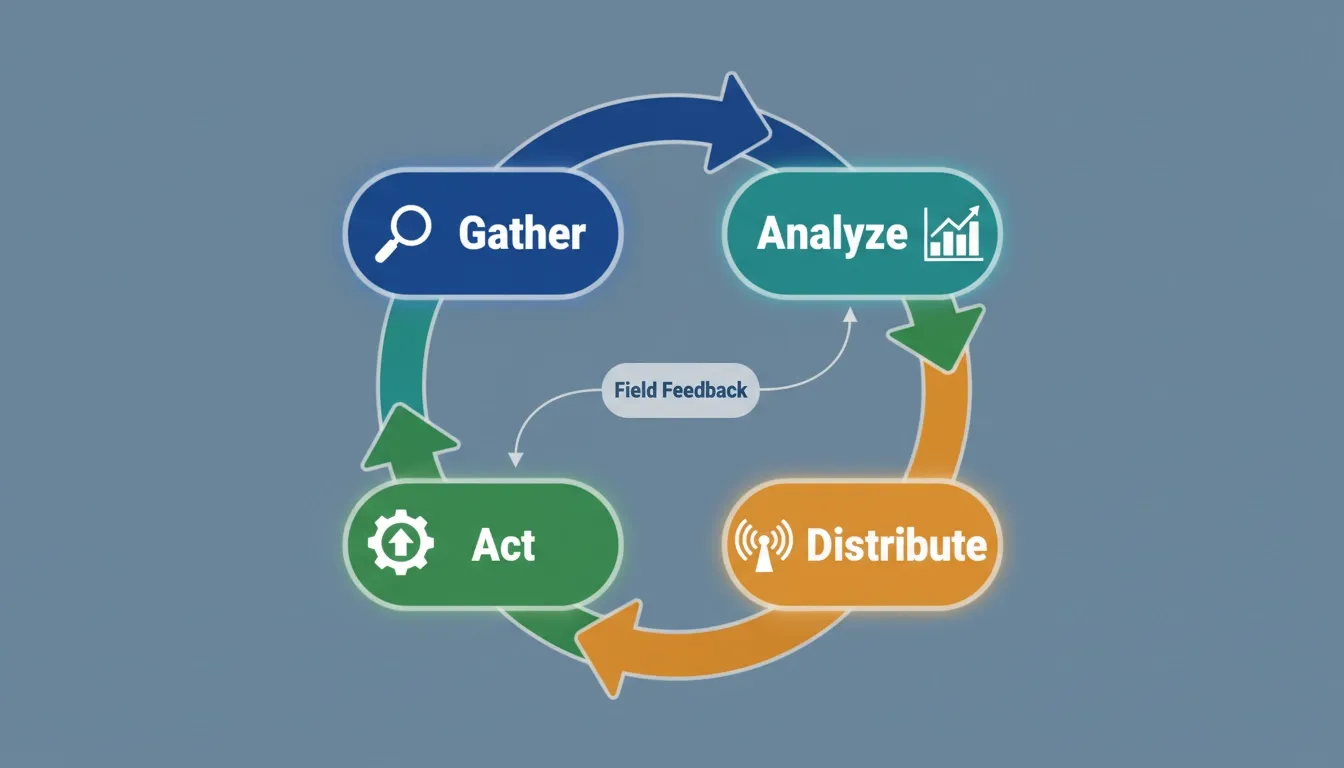 The CI loop that separates a structured function from reactive, one-off research.
-
Gather: Collect competitor data from websites, press releases, social media, online reviews, analyst reports, and CRM data
-
Analyze: Turn raw competitor information into patterns, signals, and competitive insight teams can act on
-
Distribute: Get the right competitive intelligence to the right stakeholders at the right time
-
Act: Use CI insights to inform decisions across sales, product, marketing, and strategy
-
Feed back: Sales reps and product teams return field intelligence to inform the next gathering cycle
Without the feedback loop, a CI function is a one-way broadcast. With it, the insights compound.
How CI Differs from Market Research
Many organizations treat CI and market research as interchangeable. They serve different purposes and draw from different data sources.
-
Market research focuses on customers: their preferences, needs, and buying behavior
-
Competitive intelligence focuses on direct competitors and the competitive environment your business operates in
-
Both feed strategic decision-making, but market research asks what customers want while CI asks what competitors are doing and what it means
Running both in parallel gives organizations a full picture: what customers want and what competitors are doing about it.
Where Should Your CI Function Live in the Org?
There is no single right answer to where CI should sit. The best home depends on where competitive pressure is most acute and where the function can carry enough authority to serve multiple teams simultaneously.
-
Under Product: Feeds roadmap decisions directly; works well for product-led companies but risks becoming too narrow for sales and marketing needs
-
Under Marketing: Produces strong competitive positioning and messaging work; can skew toward short-term campaign wins over long-term strategy
-
Under Strategy or CEO: Broadest mandate; lets CI serve all stakeholders without department bias; requires stronger executive sponsorship
-
Standalone CI function: Best for large organizations with multiple CI professionals; requires a clear mandate and reporting structure
Wherever CI sits, it needs enough cross-functional authority to serve sales teams, product teams, and marketing teams simultaneously. A CI team that serves only one department is a department resource, not a CI function.
A Simple Framework for Choosing the Right Home
Use this table to match your company type to the right CI home.
| Org Home | Best For | Watch Out For |
|---|---|---|
| Product | Product-led growth companies | Too narrow; misses marketing and sales CI needs |
| Marketing | Brand and campaign-driven companies | Skews toward short-term competitive positioning |
| Sales | Deal-heavy organizations | CI becomes reactive rather than strategic |
| Strategy / CEO | Mature companies with broad CI scope | Needs strong executive sponsorship and buy-in |
| Standalone CI | Large orgs with multiple CI professionals | Requires clear mandate and reporting structure |
Cross-functional authority matters more than org chart placement. If CI cannot reach sales, product, and marketing simultaneously, it will never reach its full potential.
Roles and Responsibilities in a CI Program
A mature CI program needs clear ownership at every level. Without defined roles, competitive intelligence work gets diluted, duplicated, or dropped entirely.
The Competitive Intelligence Manager Role
The competitive intelligence manager is the core of any CI program. This person owns the CI strategy, decides which competitors to track and how, and makes sure insights reach key stakeholders on schedule.
-
Define the scope of CI coverage and the competitive intelligence methodology
-
Own the tools, data collection processes, and workflows that keep intelligence flowing
-
Build relationships with stakeholders across sales, product, and marketing
-
Translate competitor data into strategic decision support for leadership teams
Without a named CI owner, the program defaults to whoever has capacity that week, which means it defaults to nobody.
What CI Analysts Do Day-to-Day
CI analysts handle ground-level research. They turn raw competitor data into the competitive insight that the CI manager acts on and distributes to key stakeholders.
-
Monitor direct competitors across competitor websites, social media platforms, and news feeds
-
Track pricing changes, product updates, and press releases from direct competitors
-
Collect CRM data and sales feedback from the field
-
Run competitor analysis on specific deals or market segments
-
Build and update CI dashboards and reports for sales teams and marketing teams
The analyst role is where day-to-day gathering and competitive analysis lives. Without it, the CI manager carries the entire operational workload.
Hire Dedicated or Borrow Internal Resources?
Many companies start with part-time contributors from sales, product, and marketing. This creates a coordination problem that part-time effort cannot fix as the program scales.
-
Dedicated CI team members bring focus and continuity that borrowed resources cannot match
-
Even one dedicated CI manager outperforms a fully distributed model with no clear owner
-
Scale in stages: one CI manager first, then a CI analyst, then embedded CI partners across departments
Start lean. A single dedicated owner with clear stakeholder access delivers more than five contributors with no central coordination point.
Roles Table: Who Does What in a Mature CI Function
This table shows the primary responsibility and key outputs for each role in a mature CI function.
| Role | Primary Responsibility | Key Outputs |
|---|---|---|
| CI Manager | Strategy, stakeholder management, competitive intelligence strategy | Quarterly reviews, executive briefings |
| CI Analyst | Daily monitoring, data collection, CI research | Weekly reports, competitor profiles |
| Sales CI Partner | Win-loss interviews, competitive deals feedback, sales enablement | Deal-level CI insights, battlecards |
| Product CI Partner | Feature tracking, roadmap competitive analysis | Product gap analysis, roadmap inputs |
| Marketing CI Partner | Campaign tracking, competitive positioning, messaging | Positioning docs, battlecards |
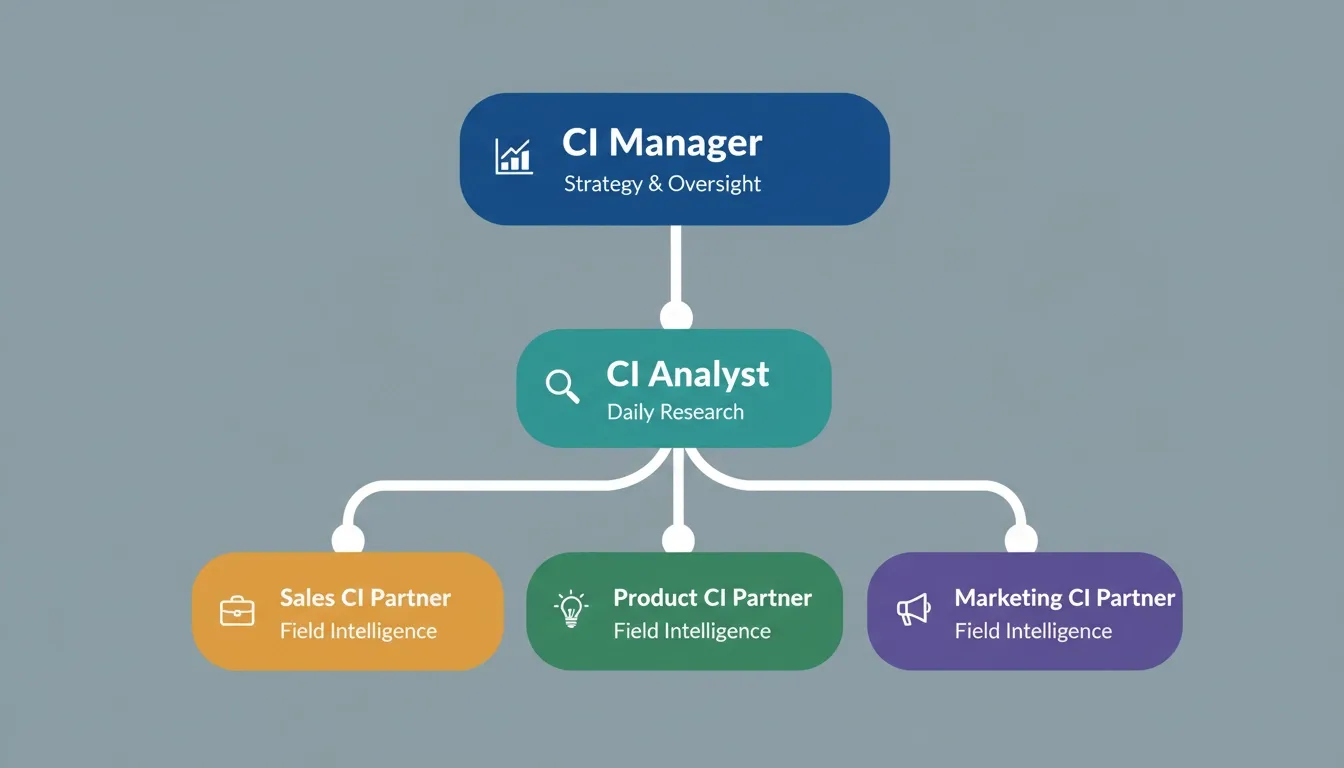 A mature CI function distributes ownership clearly across every stakeholder group.
Rocket's Solve capability gives CI teams a direct path from competitive analysis to structured decisions, turning research findings into clear recommendations without the export-and-summarize loop.
The most important column in this table is Key Outputs. If a role has no clear output, it has no real ownership.
What Does a Strong Operating Cadence Look Like?
A CI program without a cadence is a research library nobody visits. The cadence is how competitive intelligence becomes part of how the organization actually operates day to day.
Daily Signals, Weekly Briefs, Monthly Reviews
Most mature CI programs operate across three time horizons. Each horizon serves a different stakeholder group with different decision-making needs.
-
Daily: Automated monitoring of competitor websites, social media, and news feeds; the CI team reviews signals, filters noise, and flags what matters
-
Weekly: A brief for sales teams and marketing teams covering what competitors did, what it means, and recommended actions
-
Monthly: A deeper review for leadership teams covering market trends, competitor strategy shifts, win rate analysis, and strategic planning inputs
The weekly brief is where CI earns its reputation with stakeholders. Make it short, clear, and tied to decisions, not a data dump.
Which Stakeholders Need What, and How Often
Matching cadence to audience is what makes CI outputs actually get read and used.
| Stakeholder | Frequency | What They Need |
|---|---|---|
| Sales teams | Daily / weekly | Competitive intel for active deals, battlecards, win-loss data |
| Marketing teams | Weekly | Campaign differentiation, messaging updates, competitive positioning |
| Product teams | Weekly / monthly | Feature competitive analysis, market trends, competitor strategies |
| Leadership teams | Monthly | Market trends, competitive intelligence summaries, strategic decision support |
| Key stakeholders | As needed | Critical signals, market changes, major competitor moves |
The goal is for every stakeholder to receive only what is relevant to their decisions, at the frequency that matches their workflow.
Win-Loss Interviews as a CI Rhythm
Win-loss interviews give the CI team direct access to competitive deals intelligence that no monitoring tool can surface on its own.
-
Run win-loss interviews monthly or quarterly to build a ground-truth data source from real buyer experience
-
Win-loss data reveals what monitoring tools miss: why buyers chose a competitor, in their own words
-
Feed findings into competitive enablement materials and sales battlecards
Win-loss interviews are among the most valuable CI tools available precisely because no competitor can control what their lost customers say.
How to Keep CI Insights from Going Stale
The biggest risk in any CI effort is producing content that feels outdated by the time it reaches people.
-
Time-stamp every CI output and make freshness visible to the reader
-
Build CI efforts around recurring events: earnings calls, product launches, and industry conferences
-
Connect CI outputs to the tools stakeholders already use, rather than creating new places to check
-
Rotate which direct competitors get deep analysis each quarter so coverage stays current
Stale CI erodes trust faster than no CI. Once stakeholders stop trusting the outputs, they stop asking for them.
Measuring Whether Your CI Program Is Working
A CI program needs to demonstrate value to earn continued investment. According to Semrush's guide to measuring competitive intelligence, the right metrics include stakeholder usage rates, speed of response, and win rate changes on competitive deals.
-
Win rate on competitive deals: Do win rates improve when CI is actively supporting sales teams?
-
Stakeholder usage: Are sales teams and marketing teams reading and using CI outputs?
-
Response time: How fast does the organization respond when a competitor makes a major move?
Start simple with win rate and stakeholder usage. Add more metrics as the program matures and earns organizational trust.
What CI Tools Does Your Function Actually Need?
The right CI tools depend on which signals matter most to your business and what stakeholders will actually consume. The tools question is always downstream of the structure question.
Monitoring Direct Competitors: What to Track
Any solid CI toolset covers these core signal categories for your direct competitors.
-
Website changes: pricing updates, feature announcements, and messaging shifts on competitor websites
-
Social media monitoring: what competitors post across social media platforms and what earns engagement
-
Press releases and news: funding rounds, partnerships, and executive announcements
-
Online reviews: customer sentiment on G2, Capterra, and similar platforms
-
People signals: hiring velocity and new roles as windows into competitor strategy
These five categories cover the public surface of most competitors. Start here before expanding to more specialized CI data sources.
CRM Data and Sales Feedback Loops
CRM data is one of the most underused CI data sources in any organization. Sales reps encounter competitor information on every deal.
-
Tag competitive deals in the CRM to track win-loss patterns over time
-
Capture competitor objections from call notes and sales conversations as a continuous competitive intelligence feed
-
Run structured win-loss interviews to close the gap between public competitor messaging and real sales behavior
Building a CRM feedback loop turns the sales team into a continuous source of ground-level CI without adding friction to their existing workflow.
AI-Assisted Analysis and Synthesis
Artificial intelligence and machine learning are changing how CI teams process competitor information. The shift is real, but it comes with a structural catch.
-
AI tools can now track competitor websites across hundreds of pages in real time
-
Most AI-assisted CI tools are point solutions: social media monitoring here, website tracking there, CRM data analysis elsewhere
-
The CI team still stitches the full picture together manually, which means the most valuable work depends on the most time-consuming process
AI accelerates individual signal collection. The coordination problem across signal categories remains until a platform connects them automatically. Teams looking to automate business workflows with AI will recognize this pattern immediately.
Comparing CI Tool Categories
This table shows what each CI tool category does well and where it falls short.
| Category | What It Does | Limitation |
|---|---|---|
| Web monitoring | Tracks changes on competitor websites | Misses social and review signals |
| Social listening | Monitors social media activity | Rarely connects to CRM or broader CI workflows |
| Review aggregators | Tracks review platform sentiment | Static; not tied to active CI processes |
| CRM-native CI | Pulls deal-level competitive intel from CRM | Limited to what sales reps log manually |
| Full-platform CI | Covers all signal categories in one view | Fewer options; newer market category |
The full-platform CI category is newer but solves the coordination problem that every other category creates.
How Rocket Intelligence Gives a Small CI Function Outsized Reach
Most CI teams are lean: one CI manager, maybe one analyst, a few cross-functional partners. The point-solution problem hits lean teams hardest because stitching together multiple CI tools requires bandwidth they simply do not have.
What Point Solutions Miss
Each point solution covers one slice of the competitive picture. None of them connect signals across categories, which is where real competitive intelligence lives.
-
A web monitoring tool catches website changes but misses social and review signals
-
A social listening tool catches posts but rarely connects to CRM or broader CI workflows
-
A review aggregator catches sentiment but is static and not tied to active CI processes
A pricing page update in isolation is noise. That same update combined with enterprise-focused social posts, defensive G2 reviews, and new enterprise sales job postings is a clear strategic signal. Tools that cannot connect signals leave the CI team doing synthesis manually.
The manual synthesis burden is where most CI team time goes, and it is the work that adds the least strategic value.
Six Signal Categories, One Dashboard
Rocket Intelligence monitors every public platform a competitor operates on, continuously, and interprets what the signals mean for your business specifically.
-
Website: Every page change, pricing update, and messaging shift across competitor websites
-
Social Media: Every post and engagement pattern across major platforms
-
News and Web Presence: Press coverage, partnerships, and executive interviews
-
Reviews and Reputation: G2, Glassdoor, Capterra, and other review platforms
-
People: Headcount, hiring velocity, new roles, and executive activity feed
-
Performance Marketing: Ad activity and competitive positioning in paid channels
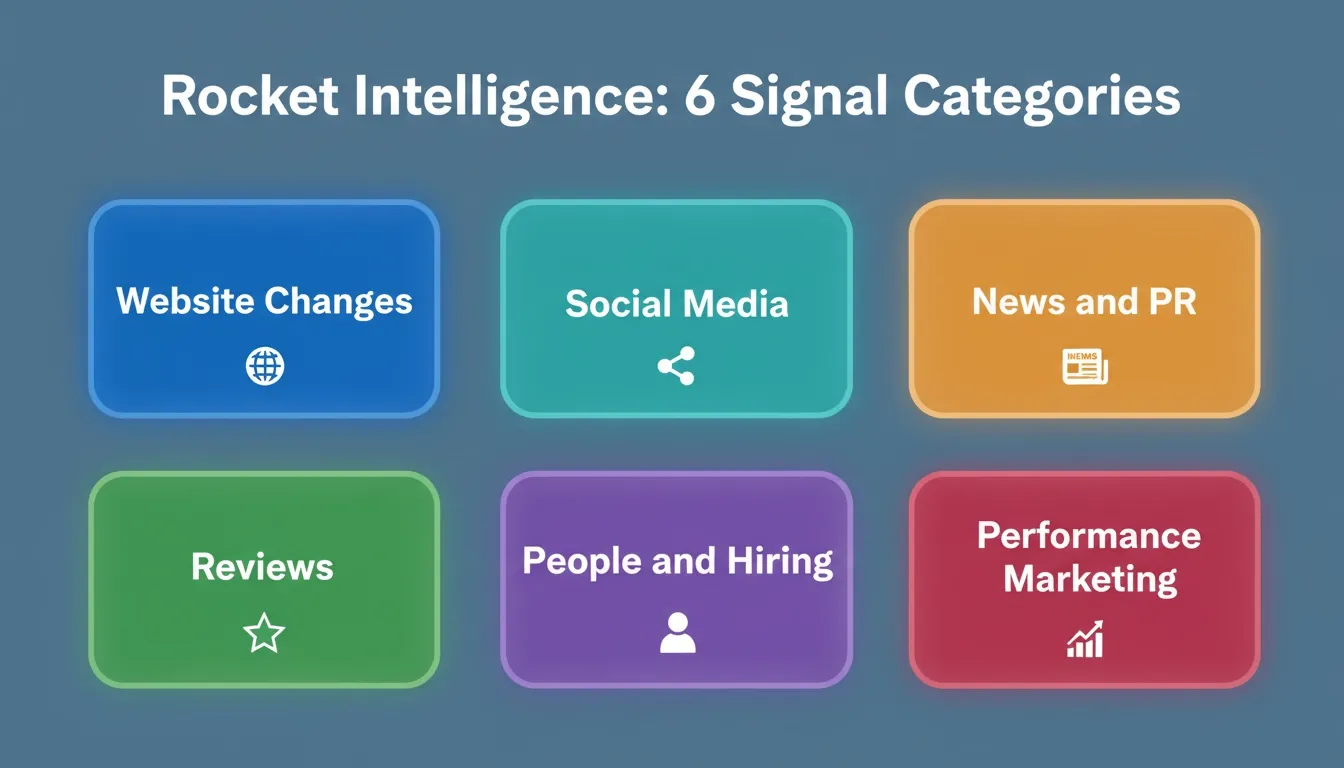 Rocket Intelligence surfaces all six signal categories in a single interpreted daily brief per competitor.
Every signal is interpreted, not just logged. Rocket's daily brief connects what moved, what it means, and what your CI team should do about it. One source serves four functions simultaneously: sales competitive intel, marketing differentiation, product roadmap signals, and strategic intelligence.
For teams previously running multiple CI tools, this cuts the coordination overhead that currently consumes most of the CI function's time.
Starting Your CI Program on Rocket
Setting up a CI function from scratch? Rocket gives a lean team a fast path to full-signal coverage.
-
Add competitors by name or URL and Rocket identifies every public surface they operate on automatically
-
Set signal priorities and Rocket builds competitor profiles across all six signal categories
-
Choose notification channels and brief frequency: daily, weekly, or monthly
Teams building their competitive intelligence roadmap will find that Rocket's structured signal categories map directly onto the planning framework.
Building a CI Function That Actually Lasts
A CI program is not a project with a deadline. It is a capability that compounds over time as competitive intelligence shapes daily and weekly decisions across the organization. The organizations that get this right give CI a clear owner, connect it to the teams that need it most, and run a cadence that fits how the business actually operates.
Competitive intelligence does not need a large team to work. A small, focused CI function with the right structure and a consistent cadence can deliver market intelligence that shapes strategic decisions at every level. Build the structure, run the cadence, and let consistent competitor analysis develop into a real competitive edge over time.
Ready to give your competitive intelligence team the signal coverage it needs? Rocket monitors every public surface your competitors operate on, interprets what the signals mean, and delivers a daily brief your whole team can act on. Start building your CI program on Rocket.new and see what your direct competitors have been doing this week.
Table of contents
- -What Does a Competitive Intelligence Function Actually Do?
- -Why Most Organizations Still Lack a Dedicated CI Function
- -The Core CI Loop: Gather, Analyze, Distribute, Act
- -How CI Differs from Market Research
- -Where Should Your CI Function Live in the Org?
- -A Simple Framework for Choosing the Right Home
- -Roles and Responsibilities in a CI Program
- -The Competitive Intelligence Manager Role
- -What CI Analysts Do Day-to-Day
- -Hire Dedicated or Borrow Internal Resources?
- -Roles Table: Who Does What in a Mature CI Function
- -What Does a Strong Operating Cadence Look Like?
- -Daily Signals, Weekly Briefs, Monthly Reviews
- -Which Stakeholders Need What, and How Often
- -Win-Loss Interviews as a CI Rhythm
- -How to Keep CI Insights from Going Stale
- -Measuring Whether Your CI Program Is Working
- -What CI Tools Does Your Function Actually Need?
- -Monitoring Direct Competitors: What to Track
- -CRM Data and Sales Feedback Loops
- -AI-Assisted Analysis and Synthesis
- -Comparing CI Tool Categories
- -How Rocket Intelligence Gives a Small CI Function Outsized Reach
- -What Point Solutions Miss
- -Six Signal Categories, One Dashboard
- -Starting Your CI Program on Rocket
- -Building a CI Function That Actually Lasts