A branded data room for client document sharing gives professional firms full control over access, audit trails, and client-facing design. It also removes per-mandate VDR licensing fees from every deal.
Does your firm still share deal documents through generic cloud links?
Sending a Dropbox folder or a Google Drive link during a high-stakes transaction sends one clear message: this firm has not invested in how it handles sensitive information. IBM's 2026 Cost of a Data Breach Report shows the global average cost of a breach hit a record high this year. It climbed 12% over the prior period.
The gap between a shared folder and a proper branded document environment goes far beyond perception. It touches access control, audit logging, regulatory compliance, and how your firm shows up at the moments that matter most.
What is a Data Room for Client Document Sharing?
A data room for client document sharing is a secure, controlled digital environment. Firms use it to share sensitive documents with external parties, including investors, legal counsel, acquirers, and auditors. Every interaction happens under defined access rules, with full logging throughout.
The term originally came from physical deal rooms, where parties reviewed confidential documents under supervision. Today, the virtual data room (VDR) replicates those same controls digitally and at scale. It removes the need for everyone to be in the same room.
A proper data room is not simply a shared folder with a password. Instead, it is a structured environment with role-based access control, document-level permissions, full audit trails, custom branding, and compliance-ready configuration.
Who Needs a Branded Data Room?
Data rooms are not only for investment banks running large M&A deals. In fact, any professional firm that regularly shares sensitive materials with external parties has a clear use case.
| Firm Type | Primary Use Case | Key Documents Shared |
|---|---|---|
| M&A Advisory Firms | Buy-side and sell-side due diligence | Financial models, CIM, legal agreements |
| Private Equity / VC | Portfolio company data sharing | Cap tables, board materials, fund reports |
| Law Firms | Transaction and litigation support | Contracts, IP filings, regulatory submissions |
| Accounting Firms | Audit and tax engagements | Financial statements, working papers |
| Consultancies | Client deliverable sharing | Reports, research, strategic frameworks |
| Real Estate Advisors | Property transaction support | Title documents, surveys, lease agreements |
| Solo Advisors | Ongoing client engagements | Proposals, deliverables, billing records |
The common thread across all these firms is the same: sensitive materials, external parties, and a need to know who saw what and when.
Why Generic File-Sharing Tools Fall Short
Most cloud storage platforms were designed for internal team collaboration. They were not built for controlled external sharing with clients, investors, or legal counterparties. As a result, the limitations become obvious once the stakes rise.
-
No granular access controls. A shared link is binary. Someone either has access or they do not. There is no way to let one investor view financial projections while restricting another to only the executive summary.
-
No audit trail. When a deal falls apart or a compliance review begins, you need to know who opened which file. Standard cloud folders simply do not track this.
-
No document-level security. Features like watermarking, download restrictions, and view-only modes are absent from general-purpose file-sharing platforms.
-
No structure or guided navigation. Dropping fifty documents into a folder and expecting clients to find the right materials creates friction and confusion.
-
No branding. The interface belongs to Google, Dropbox, or Microsoft. Your firm's identity disappears entirely.
For firms managing due diligence processes, M&A transactions, or capital raises, these gaps are not minor inconveniences. They are material risks.
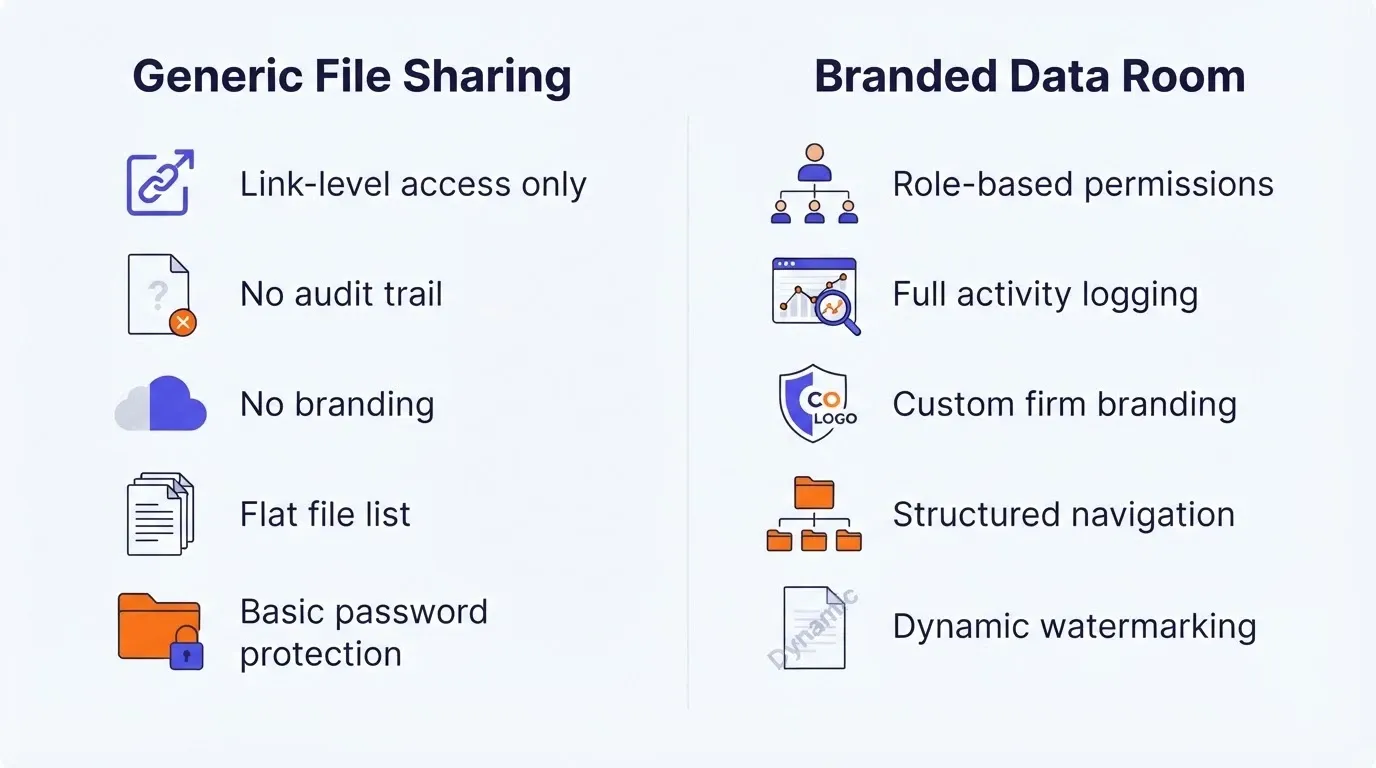
Generic File Sharing Versus a Branded Data Room for Client Document Sharing
What Sets a Branded Virtual Data Room Apart
The virtual data room market is growing fast. Verified Market Research valued it at $2.43 billion in 2024. It projects the market to reach $6.62 billion by 2032, reflecting a CAGR of 6.40%. That growth signals a clear shift: professional firms are moving away from generic sharing toward purpose-built environments.
Here is what separates the two approaches at a practical level:
| Feature | Shared Folder | Branded Virtual Data Room |
|---|---|---|
| Access Control | Link-level or folder-level | Per-document, per-user, role-based |
| Audit Trail | Basic "last viewed" timestamp | Full activity log with duration, IP, device |
| Branding | Provider's interface | Your firm's logo, colors, domain |
| Document Security | Password protection at best | Watermarking, download blocks, expiry dates |
| Navigation | Flat file list | Structured index with guided sequence |
| Compliance | Limited | GDPR, SOC 2, HIPAA-ready configurations |
A branded room tells clients you take the relationship seriously enough to build a dedicated space for it. That perception carries real weight during negotiations, fundraising rounds, and audit reviews.
How Granular Access Controls and Audit Trails Work
Access control and audit logging determine whether a setup holds up during a compliance review or a dispute. Understanding the mechanics matters here.
Role-based permissions assign each user a specific role, such as investor, legal counsel, or board observer. Each role comes with pre-defined document access. For example, an investor might see the financial model, while the legal reviewer sees only contracts and IP filings.
Document-level restrictions go even further. You can block downloads on specific files, enable view-only access with watermarks, or set automatic expiry dates. This way, access revokes itself when an engagement closes.
Timed access windows let you open the room for a set period, such as two weeks for a due diligence process. After that, you shut it down without manually revoking permissions one by one.
Full activity logging records every action. It captures who opened what, when they opened it, and how long they spent on each page. It also logs the device and IP address used. This log becomes your audit trail if questions arise later.
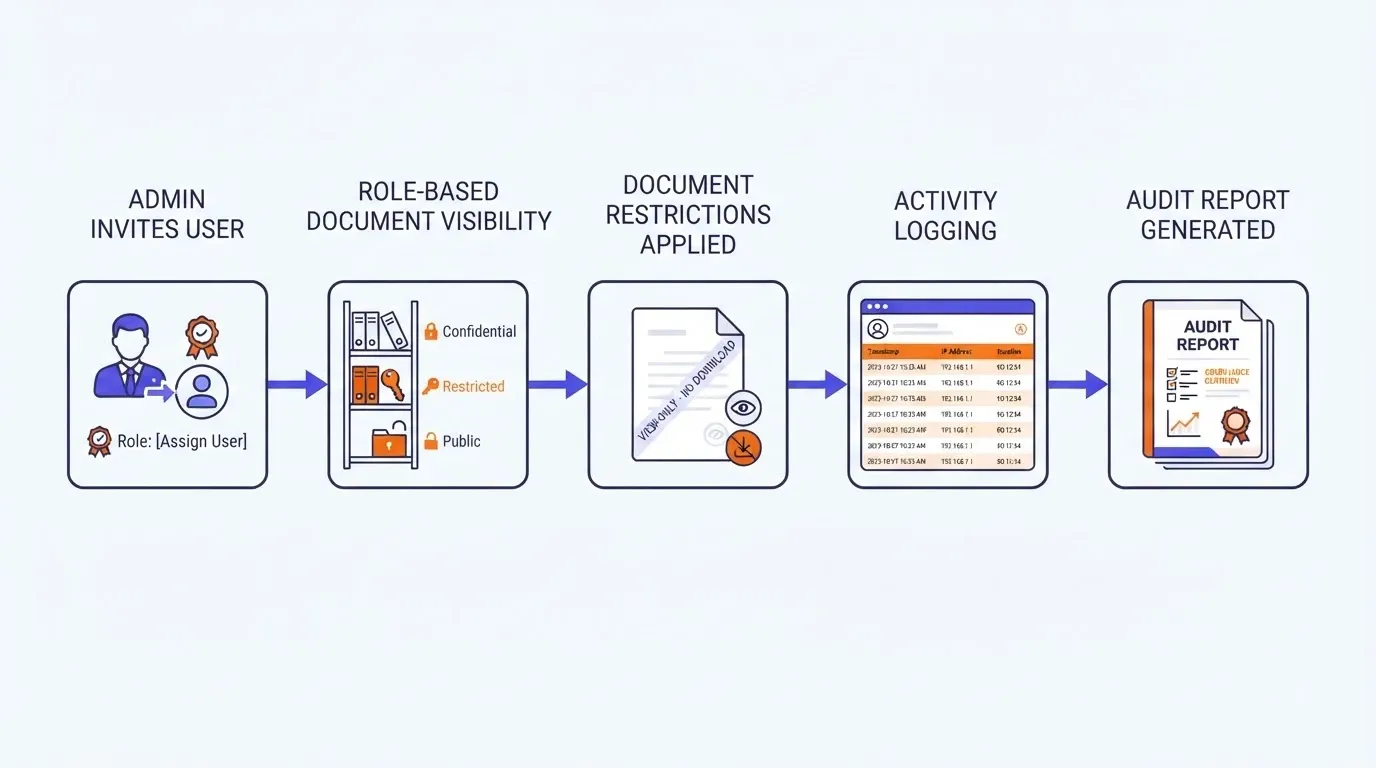
Granular Permission Layers and Activity Logging in a Branded Virtual Data Room
Your Document Environment is Part of Your Brand
When a client opens your document room, the first thing they notice is not the files. It is the interface. A white-label environment with your firm's logo, color palette, and custom domain sends a message before a single document is opened.
The Verizon 2026 Data Breach Investigations Report found that software vulnerabilities have overtaken stolen credentials as the top initial attack vector. Multiple AI-augmented attack techniques are now in active use as well. In this climate, a branded, purpose-built room does not just look better. It signals to clients that the firm takes data security as seriously as deal execution.
The visual and structural quality of your document environment now shapes how clients evaluate your firm's competence and trustworthiness. A secure document portal with custom branding reinforces professional credibility at every interaction.
How Much Does a Virtual Data Room Cost?
Traditional VDR pricing is opaque by design. Vendors prefer per-mandate or per-seat structures that compound as deal volume grows. Here is what the market typically looks like:
| VDR Pricing Model | Typical Cost | What Drives the Price Up |
|---|---|---|
| Per-Mandate (Deal-Based) | $400 to $5,000+ per deal | Deal duration, page count, user count |
| Per-Seat (Monthly) | $100 to $500/user/month | Number of external users invited |
| Per-Page | $0.50 to $2.00/page | Document volume |
| Enterprise Contract | $20,000 to $100,000+/year | Custom SLAs, compliance add-ons |
For a mid-market advisory firm running six to eight mandates per year, traditional VDR costs can easily reach $30,000 to $50,000 annually. That figure does not include compliance add-ons or storage overages. Building a portal you own eliminates the per-deal fee entirely.
How to Build a Branded Data Room with Rocket
You describe the portal. Rocket then generates a complete, production-ready web application in a single generation. This includes the frontend, backend, database schema, and authentication. Web apps are built in Next.js, and the backend uses Supabase for authentication, a PostgreSQL database, and file storage.
Describe your requirements. Open a Build task and describe what you need. Include role-based access, a branded login, a structured folder index, view-only mode with watermarking, download restrictions, and a full activity log. Rocket plans the architecture, writes production-ready code, and shows a live preview.
Brand it completely. Tell Rocket your brand colors and upload your logo. Specify your custom domain as well. Rocket then applies your visual identity across every surface. This covers the login page, navigation, document viewer, and email notifications.
Configure access controls. Through conversation, define your permission model. Specify which roles exist, which folders each role can access, and which files are view-only. Set expiry dates for time-limited engagements.
Connect your integrations. Rocket ships with 25+ integrations that connect directly into generation. For a data room, the most relevant ones include Supabase for backend data, Notion for existing deal documentation, and SendGrid for automated upload notifications. Authenticate once, and they flow into every build.
Deploy to staging, then production. Rocket deploys to a staging URL first. Review the complete portal, test every access flow, and iterate through conversation. When ready, deploy to production under your custom domain with automatic HTTPS, full version history, and one-click rollback.
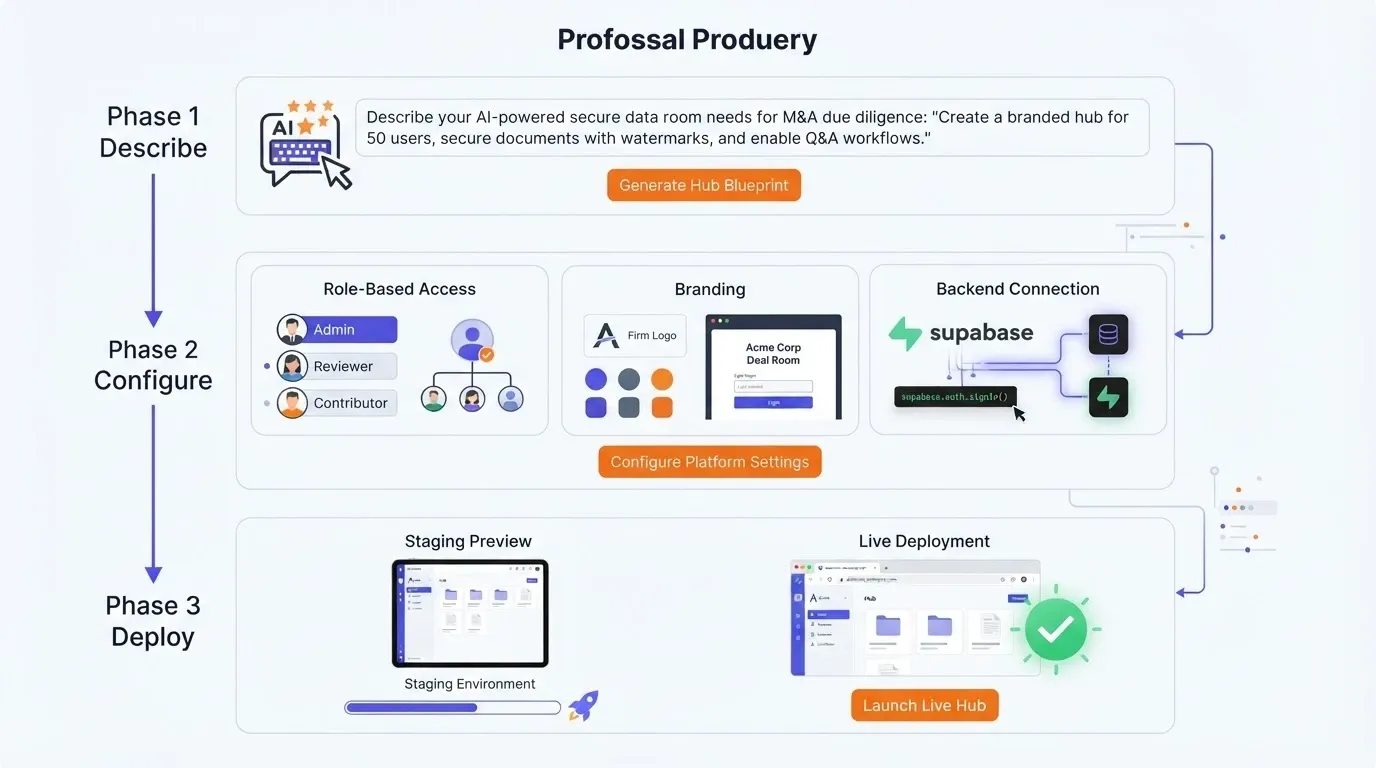
Matching Your Firm's Needs to the Right Setup
Not every firm needs the same level of complexity. The right setup depends on deal volume, sensitivity of materials, and regulatory environment.
Solo advisors and small consultancies may need just a branded login page, a structured folder view, and basic access logging. A single Rocket build covers this without backend complexity.
Mid-market advisory firms running multiple simultaneous engagements benefit from role-based access, per-deal document segregation, and automated expiry dates. These features close rooms automatically when a mandate ends. Rocket's workspace connectors support Notion, Airtable, Linear, and Google Workspace. Authorize them once, and they become available across every project.
Larger practices with compliance requirements should layer in full audit trails, IP-based access restrictions, watermarking, and connections to their existing CRM or legal management system. Rocket's builds ship with GDPR, SOC 2, ISO 27001, and CCPA compliance as a baseline.
Firms handling cross-border transactions need to consider regional data residency requirements. The/Implement Privacy Compliancecommand adds cookie consent banners, granular consent categories, and geo-based consent flows.
For teams extending this approach to M&A workflows, see how to build a role-based document hub for M&A advisory teams.
The best approach is to start with the engagement type that causes the most friction today. Build one branded room, test it with one client, and expand from there.
A Professional Practice Deserves a Professional Document Experience
The way you share documents with clients is no longer a back-office detail. It is a client-facing surface that reflects your firm's standards, security posture, and attention to detail.
Every shared Google Drive link and every unbranded Dropbox folder is a missed opportunity to reinforce the quality of your work. Building a branded, controlled document room used to require months of development time and expensive VDR contracts. That is no longer the case.
Today, tools that generate production-ready portals from a plain-language description make this accessible to any firm. The firms that move first will not just save on VDR licensing. They will show up differently at every client touchpoint.
1.5 million people have tried Rocket across 180 countries. You can build a document management system that fits your firm's exact workflow, without writing a line of code.
The Future of Client Document Sharing Starts Here
The data room for client document sharing is no longer a tool reserved for large investment banks. As deal volumes grow and compliance requirements tighten, every professional firm needs a secure, branded, and auditable way to share sensitive materials with clients.
Purpose-built portals are quickly becoming the baseline expectation, not a differentiator. The firms that build and own their document infrastructure today will be better positioned for tomorrow's compliance demands and client expectations.
You describe the portal. Rocket.new generates the complete application: branded, compliant, and deployed under your own domain. Start building today and replace per-mandate fees with infrastructure you own.
Table of contents
- -What is a Data Room for Client Document Sharing?
- -Who Needs a Branded Data Room?
- -Why Generic File-Sharing Tools Fall Short
- -What Sets a Branded Virtual Data Room Apart
- -How Granular Access Controls and Audit Trails Work
- -Your Document Environment is Part of Your Brand
- -How Much Does a Virtual Data Room Cost?
- -How to Build a Branded Data Room with Rocket
- -Matching Your Firm's Needs to the Right Setup
- -A Professional Practice Deserves a Professional Document Experience
- -The Future of Client Document Sharing Starts Here