Instagram comment automation via Meta's Graph API sends personalized DMs to commenters automatically. The real rate limit is 750/hr, not 200. Graph API v20 expires September 24, 2026. Build your own bot with Rocket, no SaaS fees, no scraper risk.
Instagram comment automation lets you reply to every commenter with a personalized DM, capture leads automatically, and stay fully compliant with Meta's Terms of Service, all through the official Graph API, with no scraper bots, no password sharing, and no SaaS subscription required.
Key Takeaways:
- Instagram comment automation uses the official Meta Graph API, not browser bots or password sharing
- The real rate limit is 750 private replies per hour, not "200," which is a tool-side pacing convention
- Meta permanently banned thousands of scraper-based accounts in late 2025
- Graph API v20 deprecates September 24, 2026; if your tool has not updated, it will break this week
- You can build your own compliant bot with Rocket in minutes, with no SaaS subscription required
What is Instagram Comment Automation?
Instagram comment automation uses Meta's official Instagram Graph API to detect a trigger keyword in a comment, send the commenter a private DM, and optionally post a public reply, automatically, within seconds. It operates through OAuth-authorized API calls, not browser emulation or password sharing, making it fully compliant with Instagram's Terms of Service.
Your Reel just hit 800 comments. What happens to the 650 people who do not get a reply? Most Instagram creators and businesses miss those commenters entirely. The DM never arrives, the follower scrolls on, and a potential sale disappears.
At scale, manual replies are impossible. This guide covers the exact API rules, current rate limits, what changed in 2026, and how to build a compliant bot from scratch. For the full multi-platform build guide, see how to build an auto-reply bot for social media comments.
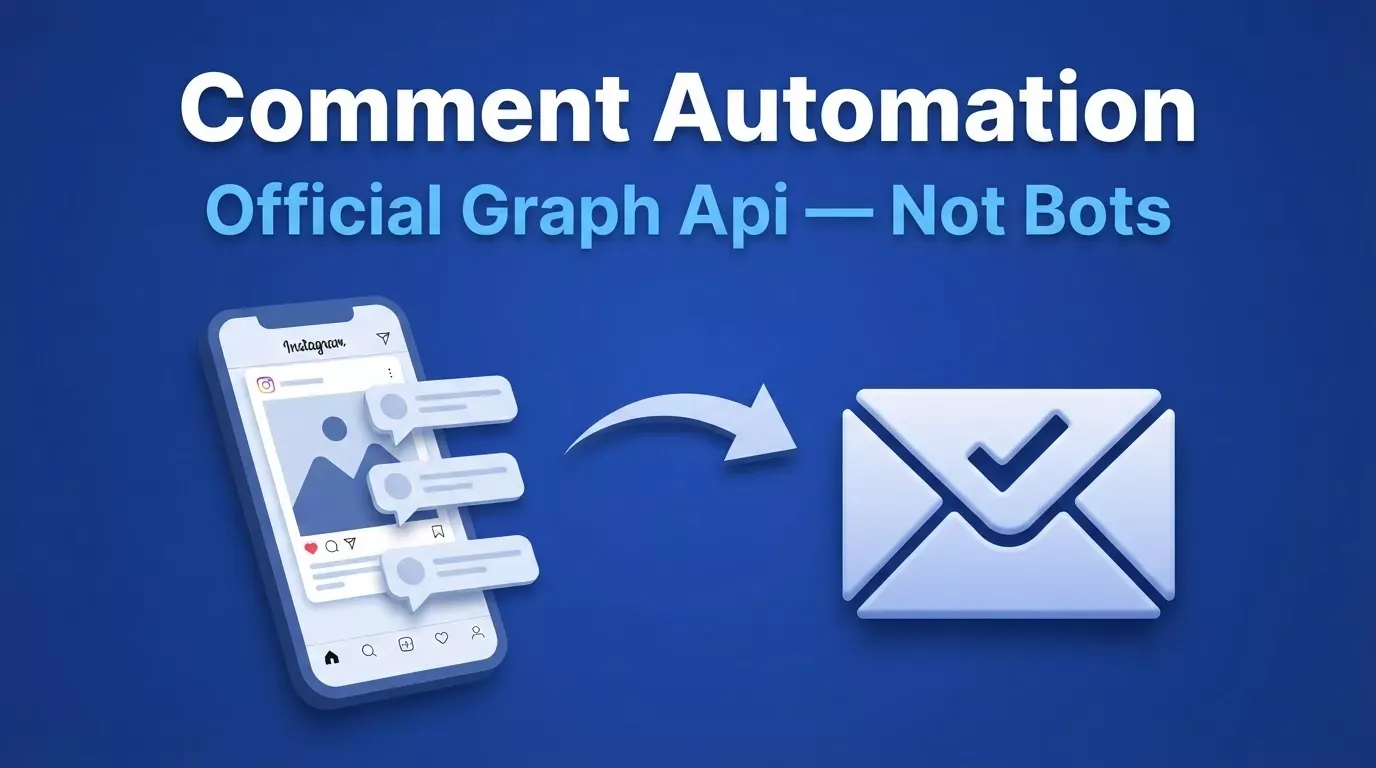
Instagram comment automation works through Meta's official Graph API, not browser bots or password sharing.
How Instagram Comment Automation Actually Works
How does Instagram comment automation work? Instagram comment automation works in two steps: a webhook fires the moment someone comments a trigger keyword on your post, and the Meta Graph API sends them a private DM and optionally posts a public reply, all within seconds of the comment. No browser automation, no Instagram password required.
The Two-Step Trigger: Public Auto Reply and Private DM
A well-configured Instagram comment automation bot produces two outputs simultaneously.
Public comment reply, visible under the post; boosts the post's comment count and sends an algorithmic engagement signal to Instagram's ranking system. Keep it short and generic: "Sent you a DM!" Avoid exact duplication across thousands of identical replies.
Private DM: the conversion path. This is where links, lead magnets, discount codes, or support content land. The DM goes directly into the commenter's inbox (or Message Requests if they do not follow you), and this is where instagram comment to dm automation drives real business outcomes.
Your automation bot calls the API endpoints for private replies and optionally posts a public reply under the comment.
Comment-to-DM automation flow via the Instagram Graph API
API-Based vs. Scraper-Based: The Architectural Difference
Understanding why scraper-based Instagram auto-reply tools fail requires understanding the architectural difference.
| Feature | Official Graph API | Scraper / Browser Bot |
|---|---|---|
| Authorization | OAuth, no password required | Password stored on third-party server |
| Method | Meta-approved API endpoints | Browser emulation / headless Chrome |
| Detectable by Instagram | No | Yes, TLS fingerprint, datacenter IP |
| Account risk | None, explicitly permitted | Permanent ban (confirmed late 2025) |
| Examples | ManyChat, Creator Lane, Rocket | Inflact, Phantombuster (legacy) |
The Three Numbers That Govern Every Instagram Comment Automation
What is the Instagram private reply rate limit? Meta's official limits: 750 private replies per hour (not 200; that is a tool pacing convention), one private reply per comment ever, and a 7-day window from comment creation. After 7 days, the API returns error 100/2534025 and the reply cannot be sent.
Hard Limits Reference
| Limit | Value | API Error if Violated |
|---|---|---|
| Private replies per comment | 1, permanent | Error 100/2534025 |
| Reply window (posts/Reels/ads) | 7 days from comment creation | Error 551 / 100/2534025 |
| Live comment reply window | During broadcast only | Window closes when Live ends |
| Private replies rate | 750/hour (Meta's published limit) | Error 613/2534040 |
Limit 1: One Private Reply Per Comment, Ever
Once you have sent a private reply to a comment, the API permanently blocks a second attempt. Error 100/2534025 is permanent; confirm the DM was sent before marking the job complete in your queue. There is no retry path.
Limit 2: The 7-Day Window
Comments older than 7 days cannot receive a private reply via the API. This matters for evergreen Reels that continue receiving comments weeks after posting. The practical solution: pair the comment trigger with a story-reply fallback for high-performing evergreen content.
Limit 3: 750 Per Hour, Not 200
Meta's documented ceiling is 750 private replies per hour. The "200/hour" figure widely repeated across competitor guides is a tool-side pacing convention designed to stay below the spam classifier's structural-similarity detection threshold, not a Meta-imposed API limit. Instagram has 3 billion monthly active users, and the real rate limit gives you room to automatically respond to every commenter on most viral posts without ever hitting the ceiling.
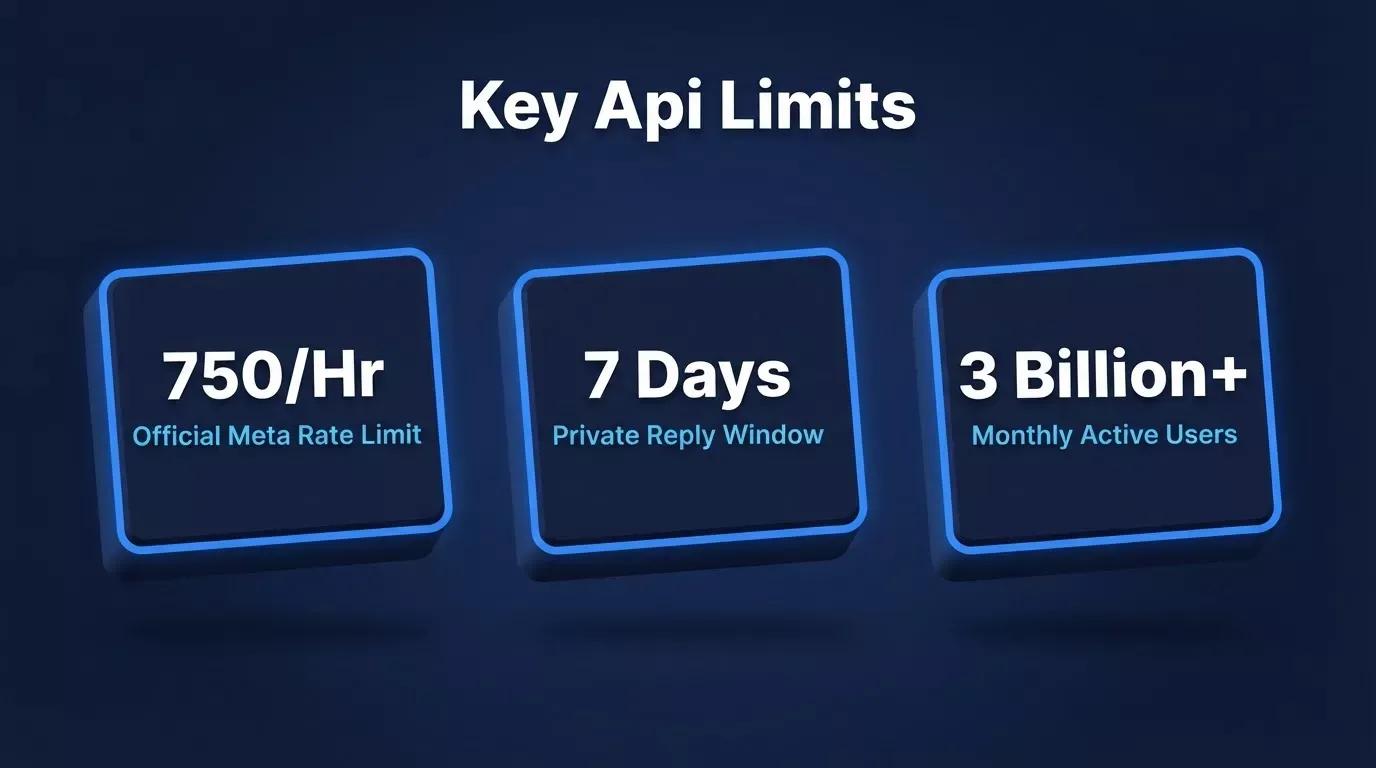
The three numbers every Instagram comment automation setup must know, from Meta's official documentation.
Is Instagram Comment Automation Safe? The 2026 Compliance Answer
Is Instagram comment automation safe? Yes, when built on Meta's official Instagram Graph API. Meta explicitly permits automated replies to user-initiated actions (comments, story replies, keyword DMs). It is unsafe when tools use browser emulation, password sharing, or screen scraping. Meta permanently banned thousands of scraper-based accounts in late 2025 as part of a broader enforcement push.
What Meta Explicitly Allows
- Automated replies to user-initiated comment triggers
- Comment-to-DM flows when the user's comment contains a keyword
- Private DM responses to story mentions
- All of the above, provided they use OAuth authorization and official API endpoints
What Meta Explicitly Bans
- Browser emulation or headless browser automation
- Storing or transmitting a user's Instagram password to a third-party service
- Cold DMs, messaging users who have not initiated contact
- Mass outreach to post likers (Like-to-DM is not an approved trigger)
- Using the HUMAN_AGENT message tag to extend the 24-hour window for bot messages
The Late-2025 Enforcement Wave: What Actually Happened
Between Q3 and Q4 2025, Meta deployed a multi-layer detection system targeting non-API automation.
- Datacenter IP blocking: any request from cloud infrastructure is blocked on the first request, eliminating hosted headless browser tools
- TLS fingerprint detection: Python's requests and httpx libraries are now blocked by TLS fingerprint, eliminating direct scripted scraping
- doc_id rotation: Instagram's internal GraphQL parameter rotates every 2 to 4 weeks, breaking hardcoded scraper tools
- Behavioral ML: non-human click velocity and cloud-region login patterns flagged in real time
One developer shared their experience directly: "I created an Instagram bot that sends a direct message to users. I decided to test it with my main account and sent one message with the bot; it got banned right after it."
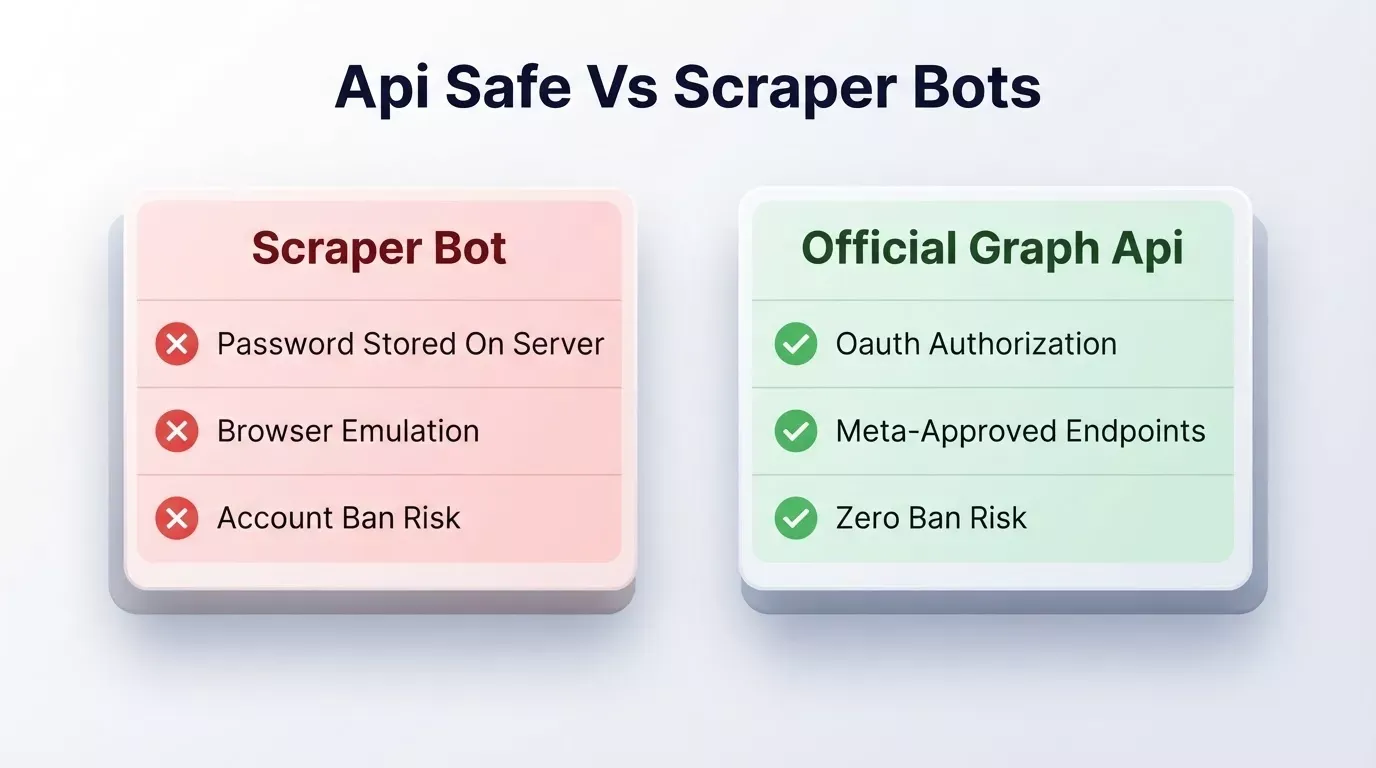
OAuth-based Graph API automation vs. scraper bots: the architectural difference that determines account safety.
The API-Safe Checklist: 10 Questions to Ask Any Tool
| Question | Safe Answer |
|---|---|
| Does it require your Instagram password? | No; if yes, leave immediately |
| Does it authorize via Instagram OAuth? | Yes |
| Has it passed Meta App Review? | Yes |
| Does it enforce the 7-day reply window? | Yes |
| Does it enforce 1-DM-per-comment? | Yes |
| Does it trigger only on user-initiated actions? | Yes |
| Does it include an opt-out path for recipients? | Yes |
| Updated for April 2026 tag deprecations? | Yes |
| Running on Graph API v21.0 or higher? | Yes |
| Does it store your password on their server? | No; if yes, leave immediately |
What Changed in Meta's Instagram API in 2025 and 2026
Instagram comment automation 2026 update: Meta made four significant changes to the Instagram messaging API between January 2025 and April 2026. Three message tags were deprecated (silently failing from February 2026, hard erroring from April 27), Graph API v19 was retired in May 2026, and v20 deprecates on September 24, 2026, this week. Tools still running on these versions will break.
New OAuth Scope Names (January 27, 2025)
The legacy scope names for Instagram messaging were replaced on January 27, 2025. Any tool using the old scope names needs to be reauthorized.
| Scope | What It Enables |
|---|---|
| instagram_business_basic | Read account info, required by all |
| instagram_business_manage_messages | Send/receive DMs and private replies |
| instagram_business_manage_comments | Read, reply to, and moderate comments |
Message Tag Deprecations: February to April 2026
Three message tags were silently deprecated on February 9, 2026, and began returning hard errors on April 27, 2026.
CONFIRMED_EVENT_UPDATEACCOUNT_UPDATEPOST_PURCHASE_UPDATE
Tools using these tags stopped delivering messages on April 27. The replacement path is the Utility Templates API or Marketing Messages.
Graph API Version Deprecation Timeline
| Version | Status | Key Date |
|---|---|---|
| Graph API v19 | Deprecated | May 21, 2026 |
| Graph API v20 | Deprecating | September 24, 2026 |
| Graph API v21 to v24 | Supported | Varies |
| Graph API v25.0 | Current stable | Released February 18, 2026 |
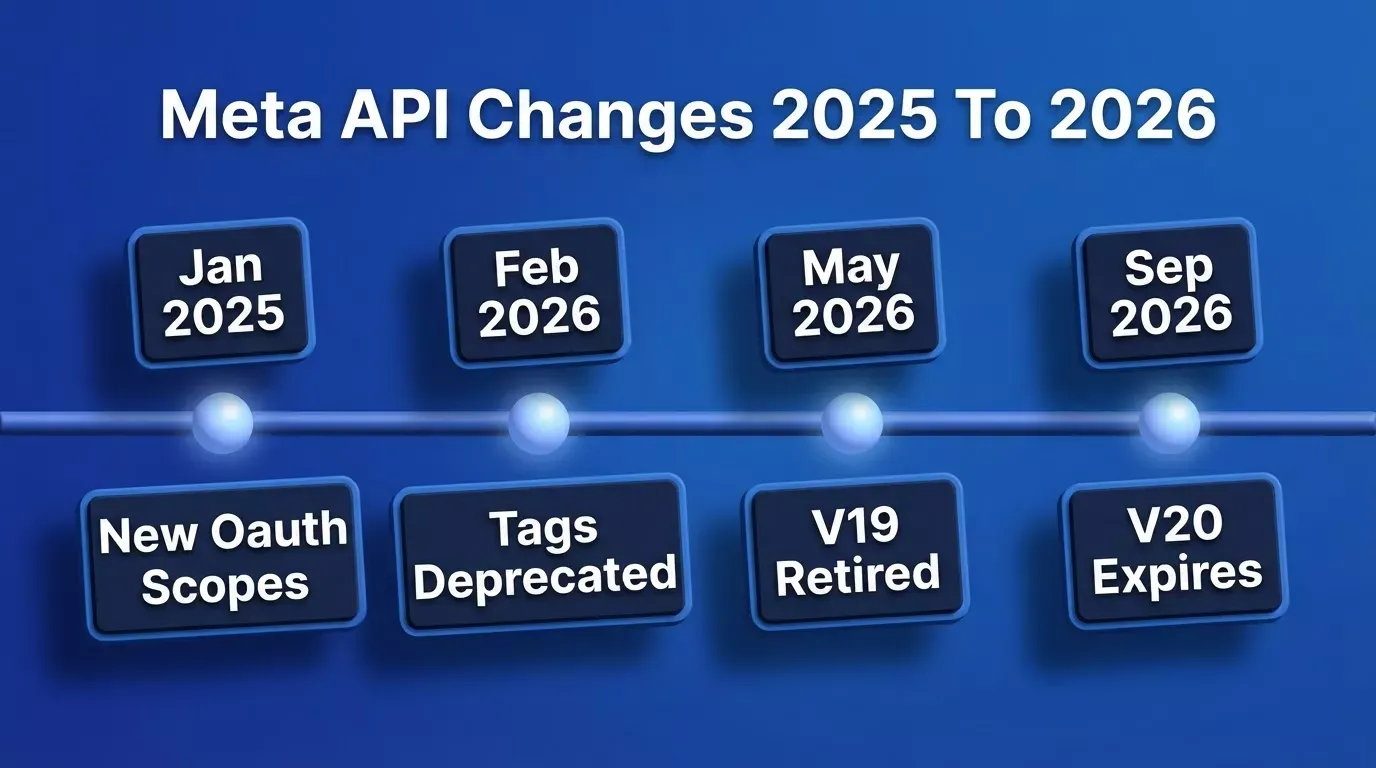
Meta's Instagram API change timeline: four breaking updates between January 2025 and September 2026.
Any bot or tool running on v20 will stop working on September 24. Check your tool's changelog or ask your vendor which version they use; this is the most urgent action item for anyone running Instagram comment automation today.
Setting Up Instagram Comment Automation: API-Safe Step by Step
Prerequisites
- Instagram Professional account (Business or Creator); personal accounts cannot access the API
- "Allow access to messages" toggle enabled in Instagram Settings, Privacy, Messages
- Meta app with App Review completed, required for
instagram_business_manage_messagesscope - No Facebook Page required; since July 2024, the Instagram API with the Instagram Login path is independent of Facebook Pages
Option A: Use an Official Meta Business Partner SaaS Tool
If build time is the constraint, these tools have passed Meta App Review and use the official API.
| Tool | Free Tier | Paid From | Multi-Platform | Differentiator |
|---|---|---|---|---|
| ManyChat | 25 contacts | $15/mo | Instagram + Facebook | Category leader; most integrations |
| Creator Lane | 100 replies/mo | ~$19/mo | Instagram only | Compliance-first; India-focused pricing |
| InstantDM | 50 replies/mo | $29/mo | Facebook + Instagram | Facebook-strong; calendar management |
| ReplyRush | Limited | $12/mo | Keyword analytics built-in |
For broader social media automation beyond Instagram comments, you can also build a social media scheduler without writing code to manage cross-platform posting alongside your DM flows.
Option B: Build Your Own Compliant Bot with Rocket
Building instead of buying eliminates per-contact fees, gives you full control over AI-driven intent logic, and keeps all comment data in your own infrastructure. Rocket generates the complete bot, webhook listener, OAuth flow, API calls, DM variant rotation, approval queue, and Instagram inbox management view from a single prompt.
What Rocket generates from a single prompt:
- OAuth-authorized webhook listener connected to Instagram Graph API v25.0
- Intent classification engine (not just keyword matching)
- DM variant rotation (3 to 5 templates per intent)
- Human-approval queue with approve/edit/reject interface
- Dashboard: all incoming Instagram interactions, classified intents, and reply statuses across comments, DMs, and story replies
Full build guide: How to Build an Auto Reply Bot for Social Media Comments, updated for Graph API v25.0, covering Instagram, Facebook, TikTok, and YouTube.
Setting Your Trigger Keyword
Specific keywords outperform generic ones by 30 to 50% for comment-trigger volume and help generate more comment-triggered leads. Followers disengage from overused generic keywords like LINK or INFO on every Reel.
Tie the keyword to your caption CTA: "Comment GUIDE below, and I'll send you the full breakdown." A single trigger keyword can also be reused as global triggers across campaigns if your workflow is built that way.
Multi-word triggers are supported but reduce comment volume; keep it one word where possible. Rotate keywords by content piece: CHECKLIST, RECIPE, TEMPLATE, not LINK on every Reel.
Writing Your DM Automation Sequence
Keep texts under 1,000 characters. Rotate 3 to 5 DM variants to stay below the spam classifier's structural similarity threshold. Include: value statement + resource link + soft opt-out ("Reply STOP to unsubscribe").
Adding the Public Comment Reply
A public reply under the triggering Instagram post comments is optional but recommended. It increases the post's public comment count (a direct engagement signal) and shows non-commenters that the account is active and responsive. Keep it generic across replies to avoid structural similarity flags and repetitive replies.
Instagram Post Comments Automation by Content Format
Reels account for 46% of time spent on the platform, making them the highest-leverage format for Instagram comment automation campaigns. Here is how automation support varies by format, including what happens on each Instagram post.
| Format | Public API Reply | Private DM | Reply Window | Notes |
|---|---|---|---|---|
| Feed posts | Yes | Yes | 7 days | Standard full support |
| Reels | Yes | Yes | 7 days | Highest comment volume |
| Carousels | Yes | Yes | 7 days | Comment on any slide = post comment |
| Stories | No | DM only | 24 hours | Instagram story replies can trigger DMs |
| Instagram Live | No | DM only | During broadcast | Window closes when Live ends |
Practical implication for evergreen Reels: Comments keep arriving for weeks, but the 7-day private reply window cuts off automation after day 7. For evergreen campaigns, build a story-reply fallback, point the warm audience to a pinned Story with its own keyword trigger.
The 5 Mistakes That Kill Instagram Comment Automation Results
1. Using one generic keyword across all content. LINK or INFO on every Reel suppresses organic comment volume by 30 to 50% because followers disengage from the pattern. Use content-specific keywords tied to each piece: CHECKLIST, RECIPE, TEMPLATE.
2. Sending the same DM text to everyone. Identical messages at volume trigger Instagram's structural similarity spam classifier and weaken overall message response quality. Rotate 3 to 5 variants minimum; this is the single most effective anti-spam lever in Instagram auto-reply configuration.
3. Not accounting for the 7-day window on evergreen content. Reels that keep getting comments for weeks after posting will silently stop triggering DMs after day 7, and older post comments can still come in long after that window closes. Build a status dashboard that shows reply success rates; a sudden drop on an old post signals window expiry.
4. Running a tool that has not updated for the April 2026 tag deprecation. Tools using CONFIRMED_EVENT_UPDATE or ACCOUNT_UPDATE message tags began silently failing on February 9, 2026, and started hard-erroring on April 27. If your DM delivery rate dropped in April or May, check your vendor's changelog.
5. Using a tool still on Graph API v20. v20 deprecates on September 24, 2026. After that date, any automation built on v20 returns API errors and stops sending completely. Verify your tool's API version in its settings or changelog today.
Build Your Own API-Safe Instagram Comment Bot with Rocket
Why build instead of subscribe:
- No per-contact billing; your cost does not grow as your audience does
- Custom intent classification, not just keyword matching; understands context
- Human-approval queue before replies go live, prevents brand-damaging auto-replies
- Multi-platform: the same Rocket app covers Instagram, Facebook, TikTok, and YouTube from one interface
- You own the code, no dependency on a vendor that could change pricing or deprecate features
The 800-comment scenario from the top of this guide plays out every day for brands, creators, and businesses on Instagram. The ones running compliant Instagram comment automation on the official Graph API respond to every commenter, send personalized DMs, and turn post engagement into real conversations and sales, without ever risking their account.
Agencies managing multiple accounts can pair comment automation with a content repurposing automation tool to maximize every piece of content across platforms.
The API is documented. The rate limits are generous. The v20 deadline is this week. All that is left is building your bot and going live.
Ready to ship a compliant Instagram comment automation bot without paying monthly SaaS fees? Start building for free on Rocket.new and deploy your comment bot in minutes, on Graph API v25.0, with no scraper risk and no subscription required.
Table of contents
- -What is Instagram Comment Automation?
- -How Instagram Comment Automation Actually Works
- -
- -API-Based vs. Scraper-Based: The Architectural Difference
- -The Three Numbers That Govern Every Instagram Comment Automation
- -Hard Limits Reference
- -
- -Limit 2: The 7-Day Window
- -Limit 3: 750 Per Hour, Not 200
- -Is Instagram Comment Automation Safe? The 2026 Compliance Answer
- -What Meta Explicitly Allows
- -What Meta Explicitly Bans
- -The Late-2025 Enforcement Wave: What Actually Happened
- -The API-Safe Checklist: 10 Questions to Ask Any Tool
- -What Changed in Meta's Instagram API in 2025 and 2026
- -New OAuth Scope Names (January 27, 2025)
- -
- -Graph API Version Deprecation Timeline
- -Setting Up Instagram Comment Automation: API-Safe Step by Step
- -Prerequisites
- -Option A: Use an Official Meta Business Partner SaaS Tool
- -Option B: Build Your Own Compliant Bot with Rocket
- -Setting Your Trigger Keyword
- -Writing Your DM Automation Sequence
- -Adding the Public Comment Reply
- -Instagram Post Comments Automation by Content Format
- -The 5 Mistakes That Kill Instagram Comment Automation Results
- -Build Your Own API-Safe Instagram Comment Bot with Rocket