Agencies running retainer clients need a dedicated portal for tracking hours, billing cycles, and scope changes. This blog shows exactly how to build one without a development team.
How much recurring revenue slips through the cracks when your agency manages retainers on spreadsheets?
For most service agencies, the answer is more than they realize. A dedicated retainer portal centralizes billing, scope tracking, and client communication in one system. It cuts the manual overhead that eats into margins.
According to SparkToro's 2025 State of Digital Agencies survey, 85% of agencies now prefer working with clients on a retainer basis, up from 81% the prior year. That shift toward predictable revenue is clear. Yet managing those retainer relationships still relies on email threads, disconnected project tools, and manual invoicing at most firms.
This blog walks through what a retainer portal needs, why agencies struggle without one, and how to ship your own this week.
Why Retainer Models Dominate Agency Revenue Today
Retainer pricing has become the default for agencies of every size, and the data backs it up.
-
Agencies on retainers report 30% to 50% higher profit margins compared to those doing mostly project work, according to a benchmark study of 300+ agencies by Predictable Profits
-
8-figure agencies maintain a 92% annual client retention rate, while 7-figure agencies average 78%
-
Retainer clients stay with agencies for an average of 56 months, compared to just 24 months for project-based clients
-
Nearly half of all agencies charge monthly retainers under \$5,000, showing the model works at every scale
The gap between tiers is not about winning more clients. It is about keeping the ones you have and managing scope without burning margin.
| Metric | 7-Figure Agencies | 8-Figure Agencies |
|---|---|---|
| Annual Client Retention | 78% | 92% |
| Profit Margin | 18-22% | 25-32% |
| Revenue Per Employee | $150,000 | $225,000 |
| Client Lifetime Value | $125,000 / 18 mo | $450,000 / 36 mo |
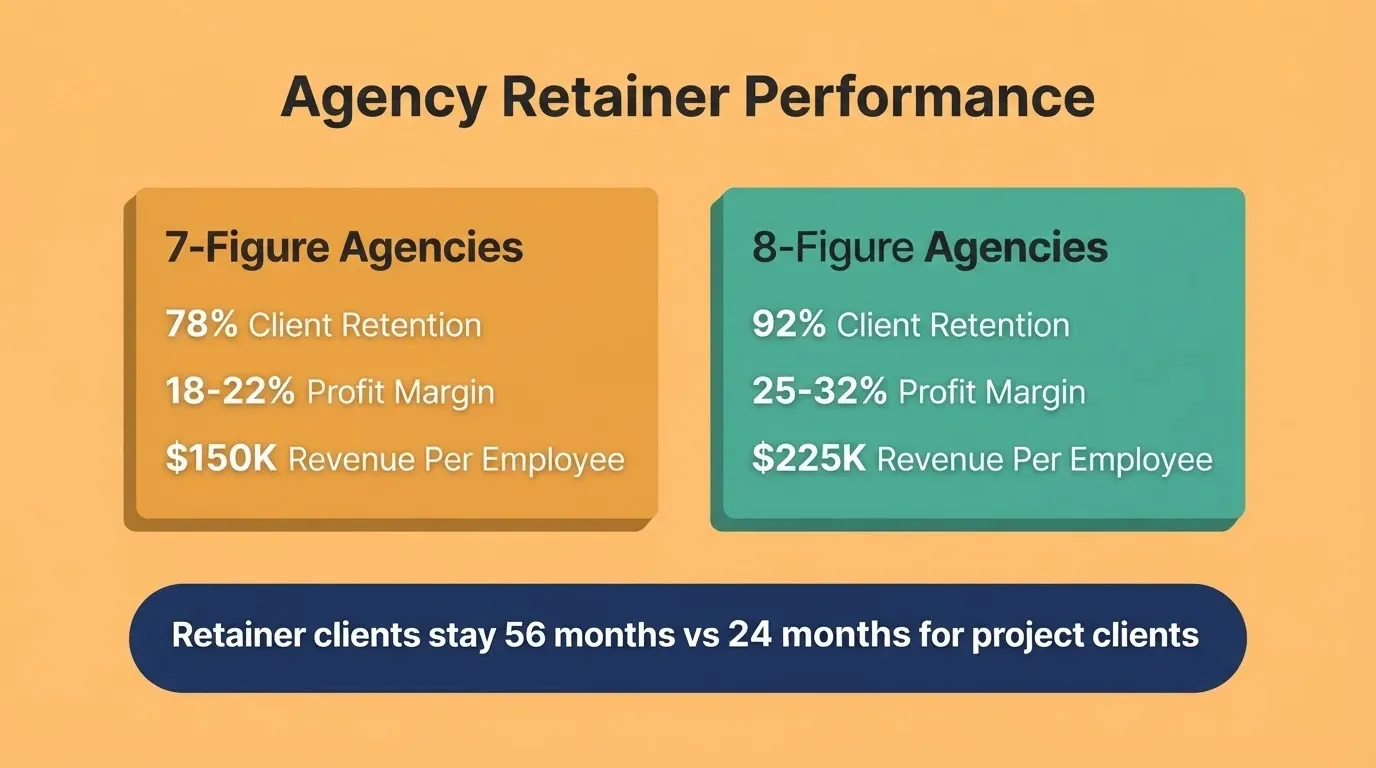
Agency Retainer Performance Comparison
What Does a Retainer Management Portal Look Like?
A retainer portal is not a generic project management tool. It is a purpose-built system designed for the way agencies bill, track, and communicate with recurring clients.
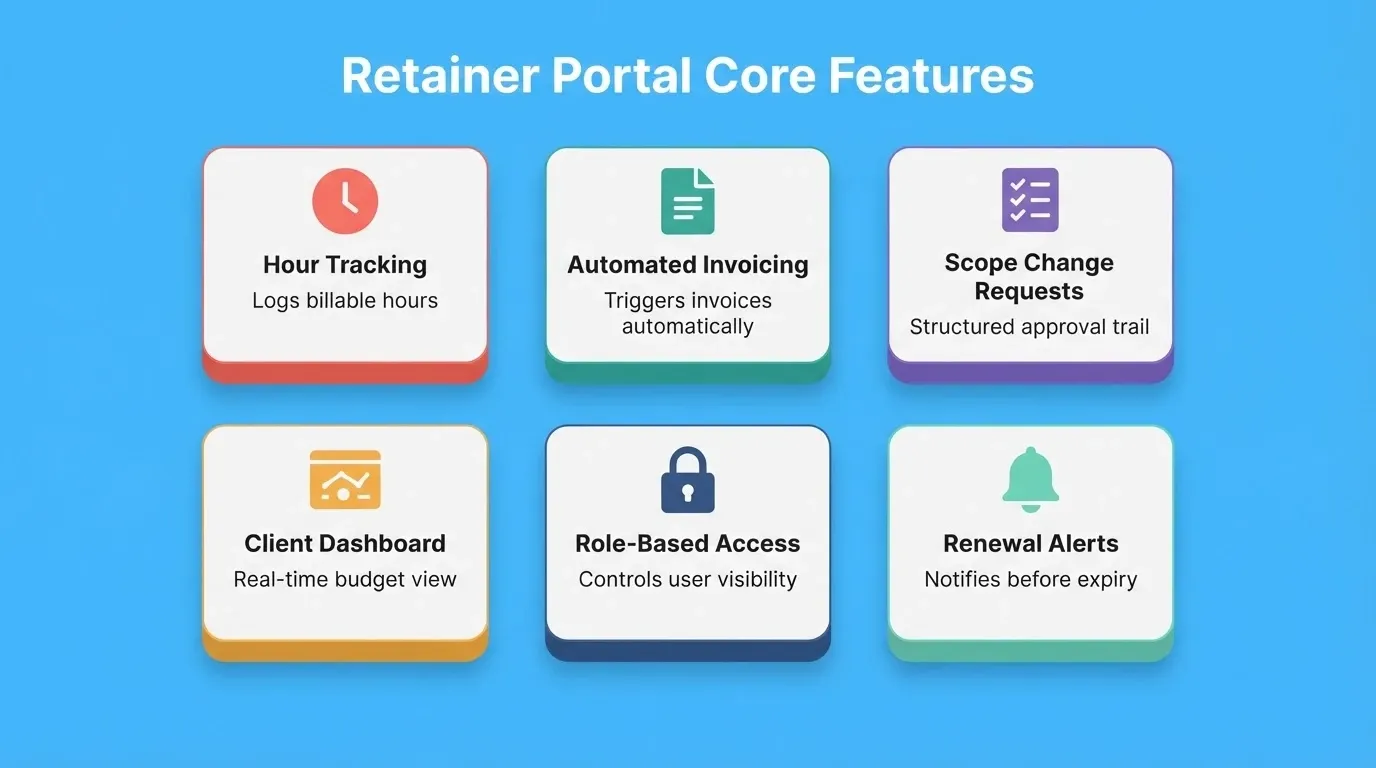
Here is what a well-built portal includes:
-
A central dashboard showing active retainers, hours consumed, remaining budgets, and upcoming renewal dates
-
Client-facing views where each account holder logs in, checks deliverable status, and submits new requests without email
-
Automated billing triggers that generate invoices when retainer hours are consumed or renewal periods approach
-
Scope change tracking with timestamped logs so both agency and client see what was agreed and what shifted
-
A permissions layer so account managers, strategists, and clients each see only what they need
The portal replaces the patchwork of spreadsheets, Slack channels, and shared folders that most agencies currently cobble together. If your team has explored building a client portal with AI tools, the retainer version adds billing logic, scope guardrails, and renewal workflows on top of that foundation.
Think of it as the operating system for your client relationships, not just a status page.
Which Features Should Your Portal Include?
Not every feature matters equally. The best retainer portals focus on capabilities that directly protect margins and reduce client friction.
| Feature | What It Does | Why It Matters |
|---|---|---|
| Retainer hour tracking | Logs billable hours against contracted limits | Prevents unpaid overages |
| Automated invoicing | Triggers invoices at cycle end or hour thresholds | Cuts manual billing effort |
| Scope change requests | Lets clients submit changes with a structured form | Creates a paper trail for every adjustment |
| Client dashboard | Shows budget consumed, deliverables, and timeline | Reduces status-check emails by 60%+ |
| Role-based access | Controls visibility per user type | Keeps internal strategy private |
| Renewal alerts | Notifies both sides before contract expiration | Prevents accidental lapses |
Hour tracking and automated invoicing are non-negotiable. Without them, agencies absorb unbilled work every month.
Scope change requests protect both parties. When a client asks for "just one more thing," the portal logs it, prices it, and routes it for approval before the team starts. In addition, renewal alerts keep revenue predictable. Agencies that track renewals proactively retain clients longer than those that wait for the client to initiate.
Start with hour tracking, invoicing, and a client dashboard. Then layer in scope management and renewals once the core is running.
Custom Portal vs. Off-the-Shelf Tools
Most agencies face a choice between three approaches when managing retainers. Here is how they compare honestly.
Tools like HoneyBook or Dubsado are fast to set up and cover the basics for smaller teams. However, once you scale past ten clients, or when your retainer structure involves tiered hours and custom approval workflows, template tools hit a wall. Customization requires developer help or a migration, and neither is cheap or fast.
Building with an AI app builder gives you a fully custom portal at the speed of a template tool. The codebase is yours from day one. You iterate by prompting, not by filing support tickets.
For agencies already handling approval workflows, the patterns from an approval and billing portal for modern agencies translate directly into retainer management context. Billing logic, scope guardrails, and client-facing views all carry over.
How Do Agencies Lose Revenue Without Retainer Tracking?
Scope creep is the single biggest profitability threat for retainer-based agencies. Most teams do not even realize how much it costs them.
A benchmarking study by SE Ranking found that 59 out of 115 agencies identified scope creep as their most common profitability challenge. According to retainer pricing data compiled by Shno.co, retainer-based agencies see just 18% annual churn, while project-based agencies face 42%. The gap widens when you consider that only 58% of agencies regularly review and adjust retainer fees for scope changes and inflation.
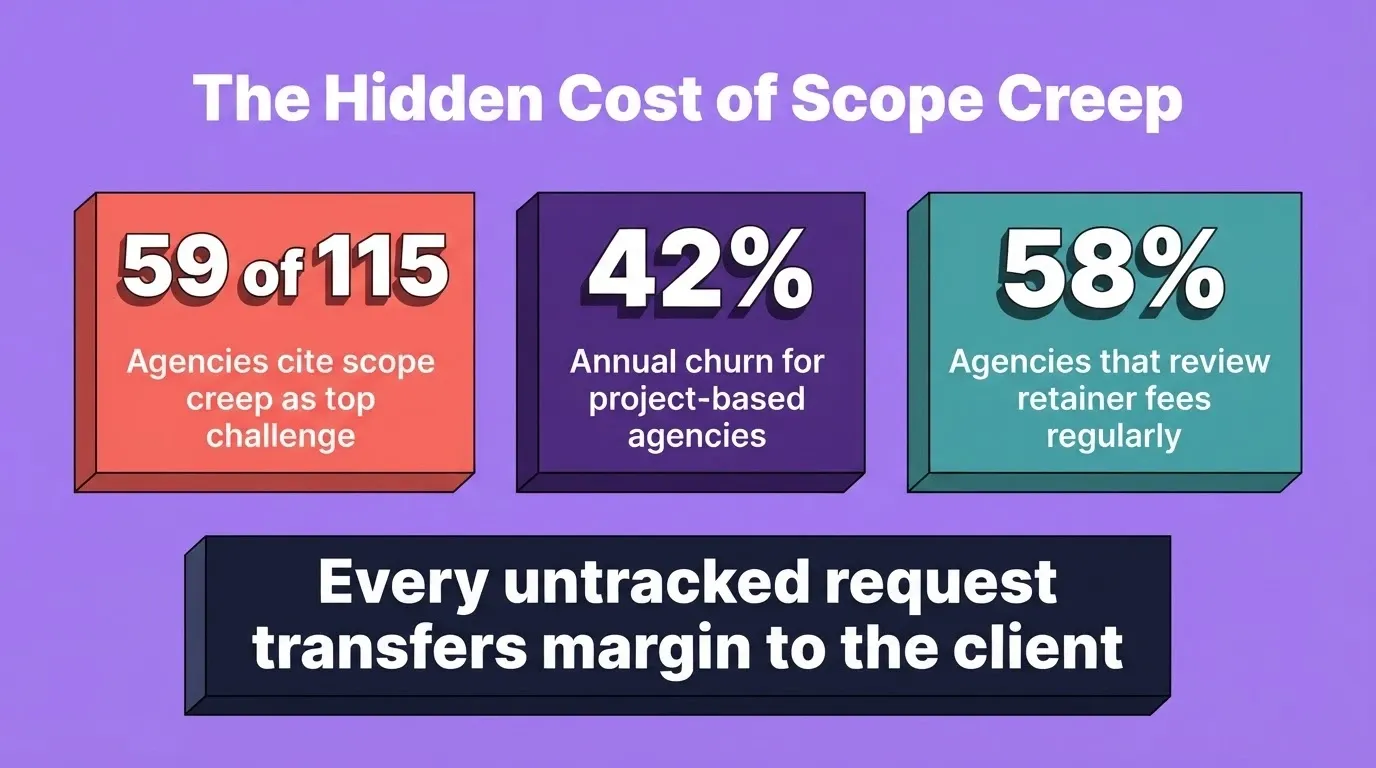
Here is how the revenue leak typically unfolds:
Every untracked request is a direct transfer from your profit margin to your client's balance sheet. A portal with scope logging stops that transfer at the source.
How to Build a Retainer Management Portal with Rocket
Most agencies try to solve retainer tracking by stitching together three or four SaaS tools: one for time tracking, one for invoicing, and one for client communication. That patchwork breaks the moment a team scales past ten clients.
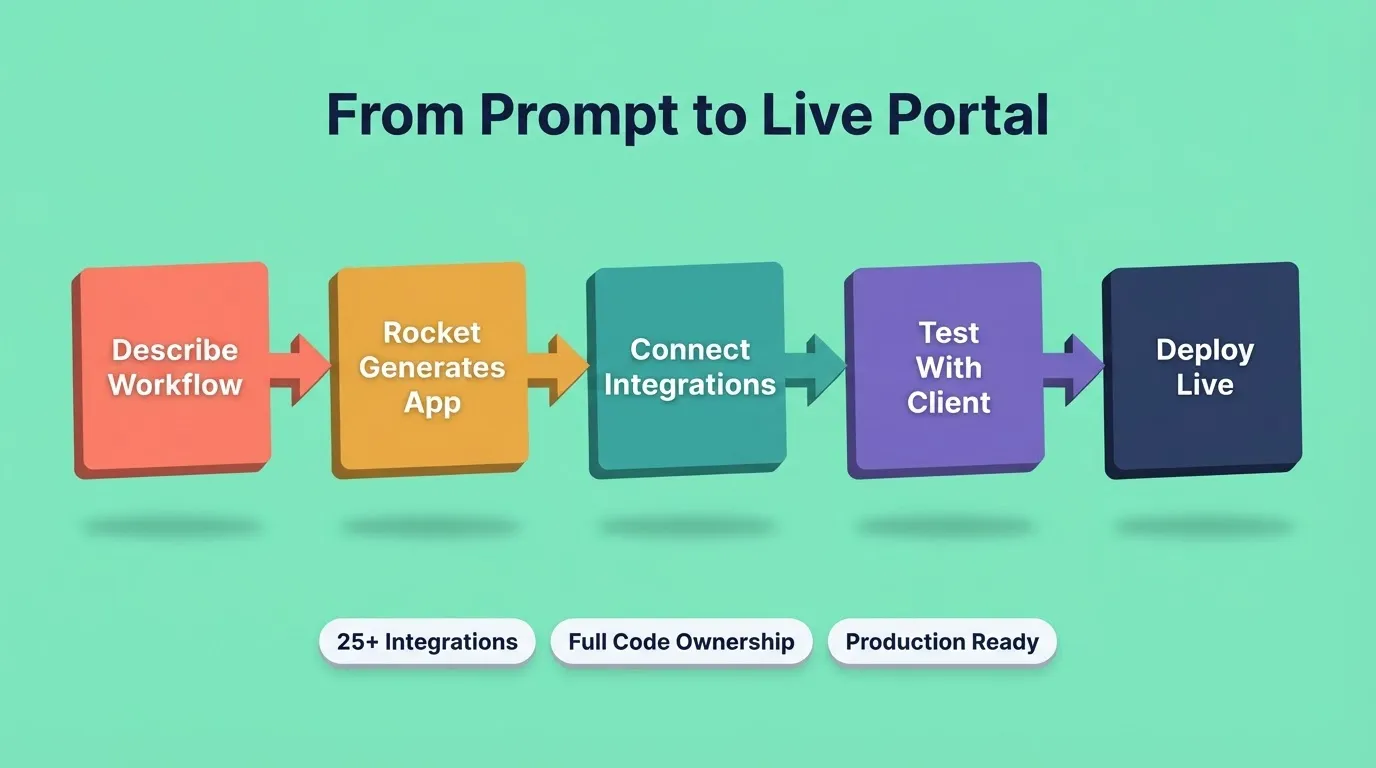
Rocket's Build pillar generates production-ready web applications in Next.js from a plain-language description, a Figma file, or an existing codebase. You describe your retainer workflow, including billing cycles, scope categories, client tiers, and approval steps. Rocket then generates the database schema, client-facing views, billing logic, and role-based access in a single session.
Every component lives in one codebase. Hour tracking, invoicing, dashboards, and scope management all share the same data layer, so there are no sync errors or connector failures. 25+ integrations flow directly into the build: Stripe for payment processing, Airtable for client data, Notion for project context, Mailchimp for renewal emails, and Calendly for check-in scheduling. Each service authenticates once and stays available in every build session.
Every Rocket build ships with SEO-ready structure, WCAG accessibility compliance, GDPR coverage, and performance optimization by default. You own the full Next.js source code and can deploy anywhere.
For agencies already using prompt-based builders for agency client work, those same patterns extend directly into retainer-specific logic without starting from scratch.
What Does It Cost to Build a Retainer Management Portal?
Building with Rocket keeps costs predictable. Here is how the options compare.
| Approach | Setup Time | Customization | Ongoing Cost | Code Ownership |
|---|---|---|---|---|
| Spreadsheets and email | None | None | $0 | N/A |
| HoneyBook or Dubsado | 1-2 days | Template-limited | $19-$65/mo | No |
| Build with Rocket | 1-5 days | Fully custom | ~$20-$100/mo hosting | Yes |
| Traditional dev agency | 3-6 months | Fully custom | $15,000-$80,000 upfront | Yes |
For most agencies managing 10 or more retainer clients, the portal pays for itself within the first billing cycle. It captures previously unbilled scope and reduces manual invoicing time significantly.
Steps to Plan and Ship Your Portal This Week
Shipping a retainer portal does not require a six-month roadmap. With the right approach, an agency can go from planning to a live system inside a single week.
-
Monday: Map your retainer workflow. List every step from contract signing to monthly invoice. Identify what is manual and what repeats each cycle.
-
Tuesday: Define your data model. Decide which fields matter: client name, retainer amount, hours contracted, hours consumed, renewal date, and scope log.
-
Wednesday: Prompt and generate. Feed your spec into a Build task. Review the output, adjust the layout, and connect your existing tools.
-
Thursday: Test with one real client. Invite a trusted client, run them through the portal, and collect feedback on what feels unclear.
-
Friday: Iterate and launch. Fix friction points from testing, add your branding, and roll out to all retainer clients.
The week-long timeline works because Rocket handles the build. Your job is defining what matters to your clients and testing early.
Teams that want a CRM layer alongside their retainer portal can build a CRM with AI inside the same project. Rocket's shared context means both systems inherit the same client data, so duplicate records become a thing of the past.
Your Agency Deserves a Better Retainer System
Retainer relationships are the backbone of agency revenue. Managing them with disconnected tools, however, leaves money on the table every month. A dedicated portal brings billing, scope tracking, client communication, and renewals into a single system your whole team can rely on.
The agencies pulling ahead are the ones that treat retainer operations like a product, not an afterthought. Ship your portal, give clients a better experience, and protect the margins that keep your business growing.
Build Your Retainer Portal Before the Next Billing Cycle
The agencies that protect their margins are the ones that stop managing retainers manually today. A dedicated retainer management portal is not a nice-to-have. It is the infrastructure that turns a retainer model into a predictable, scalable revenue engine.
Rocket's Build pillar generates the full application from a single prompt: dashboards, billing logic, scope tracking, role-based access, and 25+ integrations, all production-ready from the first generation. You describe your workflow. Rocket builds it. You ship it.
Start building your retainer portal on Rocket.new and go from prompt to live system this week.
Table of contents
- -Why Retainer Models Dominate Agency Revenue Today
- -What Does a Retainer Management Portal Look Like?
- -Which Features Should Your Portal Include?
- -Custom Portal vs. Off-the-Shelf Tools
- -How Do Agencies Lose Revenue Without Retainer Tracking?
- -How to Build a Retainer Management Portal with Rocket
- -What Does It Cost to Build a Retainer Management Portal?
- -Steps to Plan and Ship Your Portal This Week
- -Your Agency Deserves a Better Retainer System
- -Build Your Retainer Portal Before the Next Billing Cycle