Build a YouTube comment auto-reply bot with Python and the YouTube Data API v3, no n8n, no Zapier, no SaaS fee. Each reply costs 50 quota units; the free tier allows ~198 replies/day.
Channel owners can auto-reply to YouTube comments using the Data API v3 and OAuth 2.0. Each reply costs 50 quota units, giving you roughly 198 replies per day on the free tier. Rocket.new generates the complete bot from a single prompt.
How many YouTube comments go unanswered on your channel every single day?
According to Google's official API reference, thecomments.insertmethod lets you programmatically post a reply under your channel name without browser automation or third-party SaaS subscriptions.
The YouTube Data API v3 gives every Google Cloud project a free daily quota of 10,000 units, and each write operation to post a comment costs 50 units.
That means creators can automatically respond to viewers at scale using just Python, OAuth 2.0, and a scheduled polling script.
What Is YouTube Comment Automation?
YouTube comment automation is the process of automatically posting replies to comments using the YouTube Data API v3. Your channel account makes every reply, and they appear as normal owner responses. The API is the only policy-compliant method; browser automation and scraping violate YouTube's Terms of Service.
Channels receiving 50 or more comments per video cannot reply manually at scale. YouTube's algorithm surfaces videos with higher engagement depth, and faster replies increase subscriber trust.
What you need: a Google Cloud project, OAuth 2.0 credentials, and Python or Node.js. No third-party tools, no middleware subscriptions.
Is YouTube Comment Automation Allowed?
Yes, with conditions. YouTube allows channel owners to automatically post replies using the official YouTube Data API v3. Replies posted via the API appear as normal channel owner comments, indistinguishable from manual replies.
What YouTube prohibits is browser automation, scraping, and third-party tools that simulate human interaction without API authorization.
| Action | Allowed | Notes |
|---|---|---|
| Auto-reply via YouTube Data API v3 | Yes | YouTube Developer Policies |
| Reply usingcomments.insertwith OAuth | Yes | Official docs |
| Browser-bot automation | No | ToS violation |
| Scraping YouTube for comment data | No | ToS violation |
| Using unofficial/private YouTube API | No | ToS violation |
| Mass identical replies to all comments | Caution | Spam policy risk |
How YouTube Data API v3 Comment Reply Works
YouTube comment automation requires two API methods:commentThreads.listto poll for new comments andcomments.insertto post a reply. The YouTube Data API v3 gives every Google Cloud project a free daily quota of 10,000 units, and each write operation to post a comment costs 50 units.
Understanding how API endpoints work is helpful before diving into the implementation. At the default 10,000 daily quota, you can reply to approximately 198 comments per day before hitting the limit.
The Two Key API Methods
| Method | Quota Cost | Auth Required | Use For |
|---|---|---|---|
| commentThreads.list | 1 unit | API key or OAuth | Fetch comments for a video |
| comments.list | 1 unit | API key or OAuth | Fetch replies within a thread |
| comments.insert | 50 units | OAuth 2.0 required | Post a reply |
| comments.setModerationStatus | 50 units | OAuth 2.0 required | Approve held comments |
Adding the snippet part to any list call costs an additional 2 units.
Polling Architecture
YouTube Data API v3 has no webhook or push notification system for new comments. Your bot must poll on a schedule. CallcommentThreads.listevery 15 to 30 minutes, store thepublishedAt timestampof the last processed comment, and track replied thread IDs to prevent duplicate replies.
Prerequisites
-
Google Cloud project with YouTube Data API v3 enabled
-
OAuth 2.0 client credentials from Google Cloud Console
-
OAuth consent screen configured with
youtube.force-sslscope -
Python 3.8+ or Node.js 18+
-
google-auth,google-auth-oauthlib,google-api-python-clientlibraries -
A YouTube channel with at least one video
-
Secure storage for the OAuth refresh token
Step 1 - Set Up YouTube Data API v3 and OAuth
Enable the API in Google Cloud Console
-
Go to
console.cloud.google.com -
Create a new project or select an existing one
-
Navigate to APIs and Services then Library
-
Search for "YouTube Data API v3" and click Enable
Configure the OAuth Consent Screen
Go to APIs and Services, then OAuth consent screen, and select External. Add the scopehttps://www.googleapis.com/auth/youtube.force-ssland add your email as a test user during development.
The only OAuth scope required to post YouTube comment replies ishttps://www.googleapis.com/auth/youtube.force-ssl. This scope grants permission to read and write YouTube comments on behalf of the authenticated channel owner. Read-only access usesyoutube.readonly, but that scope cannot post replies.
Generate and Store Credentials
1from google_auth_oauthlib.flow import InstalledAppFlow
2SCOPES = ['https://www.googleapis.com/auth/youtube.force-ssl']
3flow = InstalledAppFlow.from_client_secrets_file('client_secret.json', SCOPES)
4credentials = flow.run_local_server(port=0)
5with open('token.json', 'w') as f:
6 f.write(credentials.to_json())
Storetoken.jsonas an environment variable or in a secrets manager. Never commit it to version control.
Step 2 - Fetch New Comments with commentThreads.list
Making Your First API Call
1from googleapiclient.discovery import build
2from google.oauth2.credentials import Credentials
3
4def get_youtube_client():
5 creds = Credentials.from_authorized_user_file('token.json')
6 return build('youtube', 'v3', credentials=creds)
7
8def fetch_new_comments(youtube, video_id, last_checked_at):
9 response = youtube.commentThreads().list(
10 part='snippet', videoId=video_id, order='time', maxResults=100
11 ).execute()
12 new_threads = []
13 for item in response.get('items', []):
14 published = item['snippet']['topLevelComment']['snippet']['publishedAt']
15 if published > last_checked_at:
16 new_threads.append(item)
17 return new_threads
Before replying, checktotalReplyCountin the thread snippet. Skip threads wheretotalReplyCountisgreater than 0unless you intentionally want to reply to active threads.
Building this on Rocket? The platform generates the polling loop, credential handling, and reply logic for you. See the full multi-platform build guide: How to Build an Auto Reply Bot for Social Media Comments.
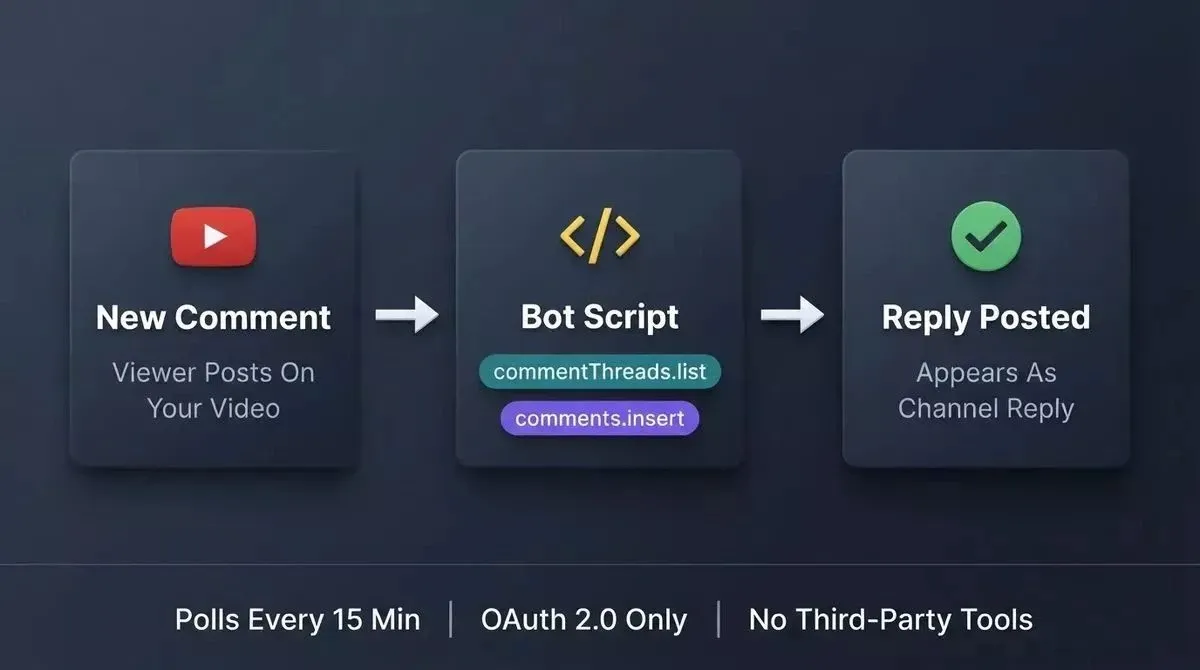
How the bot connects: a new comment triggers the polling script, which callscommentThreads.list, generates a reply, and posts it viacomments.insertwith no third-party tools in the chain.
Step 3 - Generate a Reply
Rule-Based Replies (No AI Needed for FAQ Patterns)
1FAQ_REPLIES = {
2 'price': 'Check the link in our channel description for current pricing.',
3 'tutorial': 'We have a full tutorial playlist linked in the channel description.',
4 'how': 'Great question! Check the pinned comment on this video for more details.',
5}
6
7def rule_based_reply(comment_text):
8 for keyword, reply in FAQ_REPLIES.items():
9 if keyword in comment_text.lower():
10 return reply
11 return None
AI-Powered Replies (Optional)
For comments that do not match rules, pass the comment text to an LLM:
1import openai
2
3def ai_reply(comment_text, channel_context):
4 response = openai.chat.completions.create(
5 model='gpt-4o-mini',
6 messages=[
7 {'role': 'system', 'content': f'You are a helpful YouTube channel assistant. Context: {channel_context}'},
8 {'role': 'user', 'content': f'Write a friendly, concise reply to: {comment_text}'}
9 ],
10 max_tokens=150
11 )
12 return response.choices[0].message.content
Rate-limit AI calls. At 50 quota units percomments.insertAI-powered replies compound quota consumption quickly. For guidance on structuring prompts that handle comment classification accurately, see prompt engineering best practices.
Step 4 - Post the Reply with comments.insert
Usecomments.insertwithsnippet.parentIdset to the comment thread ID andsnippet.textOriginalset to your reply text. The OAuth token must include theyoutube.force-sslscope.
1def post_reply(youtube, thread_id, reply_text):
2 request = youtube.comments().insert(
3 part='snippet',
4 body={
5 'snippet': {
6 'parentId': thread_id,
7 'textOriginal': reply_text
8 }
9 }
10 )
11 return request.execute()
Critical:parentIdmust be thecommentThread.id(e.g.,Ugz...), not thecomment.idnested inside it. This is the most common mistake in YouTube comment bot Python tutorials.
The Complete Bot Loop
1import time, datetime
2
3REPLIED_IDS = set() # In production: persist to SQLite or Supabase
4
5def run_bot(video_ids, channel_context, poll_interval=900):
6 youtube = get_youtube_client()
7 last_checked = datetime.datetime.utcnow().isoformat() + 'Z'
8
9 while True:
10 for video_id in video_ids:
11 threads = fetch_new_comments(youtube, video_id, last_checked)
12 for thread in threads:
13 thread_id = thread['id']
14 if thread_id in REPLIED_IDS:
15 continue
16 comment_text = thread['snippet']['topLevelComment']['snippet']['textDisplay']
17 reply = rule_based_reply(comment_text) or ai_reply(comment_text, channel_context)
18 if reply:
19 post_reply(youtube, thread_id, reply)
20 REPLIED_IDS.add(thread_id)
21 time.sleep(2)
22 last_checked = datetime.datetime.utcnow().isoformat() + 'Z'
23 time.sleep(poll_interval)
Step 5 - Deploy and Schedule the Bot
| Option | Setup Time | Cost | Best For |
|---|---|---|---|
| Cron job | 5 min | Free | Local or VPS |
| Google Apps Script timer | Built-in | Free | No-server approach |
| Google Cloud Scheduler | Cloud Console | ~$0.10/mo | Production serverless |
Cron example-poll every 15 minutes:
1*/15 * * * * /usr/bin/python3 /home/user/youtube-bot/bot.py >> /var/log/youtube-bot.log 2>&1
Logging Replied Comment IDs
In production, replace the in-memoryREPLIED_IDSset with a persistent store. Without it, the bot will re-reply to the same comments after every restart. SQLite is the simplest option; a Supabase table works well if you are using Rocket's generated backend.
What Does the Quota Math Look Like?
The numbers dictate how aggressively your bot can reply each day. Getting the math wrong means your bot stops mid-afternoon.
The YouTube Data API v3 gives every Google Cloud project a free daily quota of 10,000 units, and each write operation to post a comment costs 50 units. A comprehensive breakdown maps every method type to its unit cost.
How Many Replies Can You Send Per Day?
-
The default quota is 10,000 units per day, per Google Cloud project. This resets at midnight Pacific Time. Every request, even a failed one, costs at least 1 unit.
-
Each reply costs 50 units, so 10,000 / 50 = 200 replies max. But your bot also needs to read comments first. If you poll 10 pages of comment threads (10 units) and scan 200 threads, that leaves headroom for roughly 198 reply operations per day.
-
Spam and moderation calls share the same pool. Flagging a comment as spam or setting moderation status also costs 50 units per call. If your bot handles both moderation and replies, the budget shrinks faster.
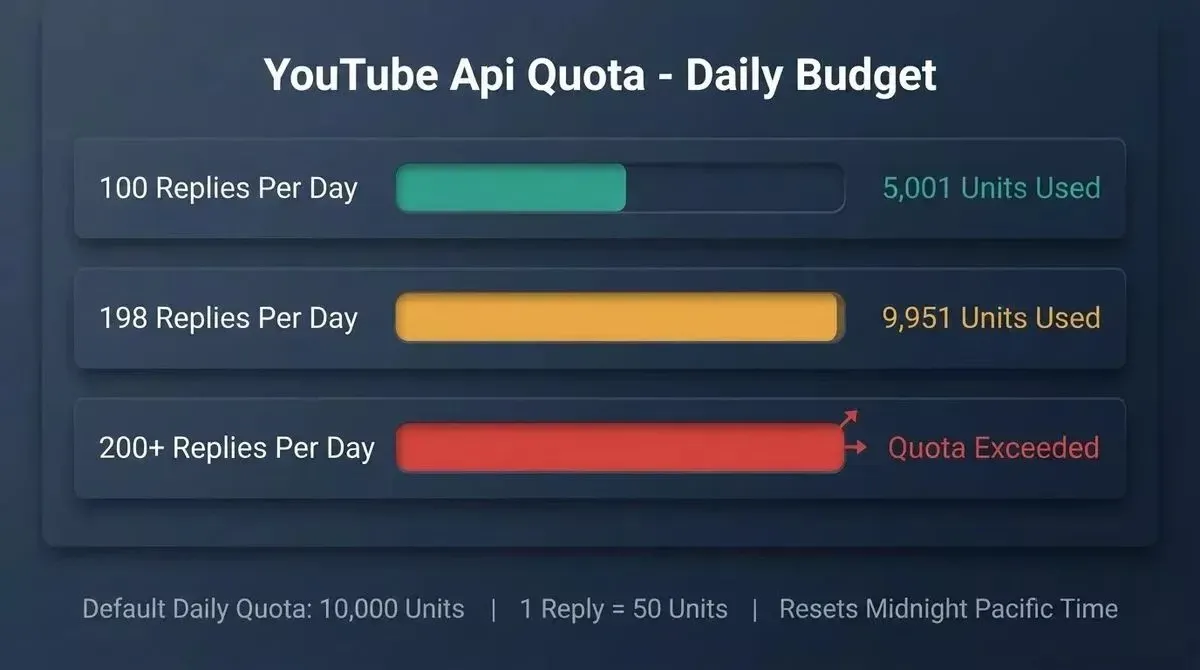
At 198 replies/day your bot uses ~9,951 of 10,000 available units. Exceeding 200 replies/day triggers a 403 quotaExceeded error until midnight Pacific Time.
Community developer TonyThuyTu built an open-source YouTube auto-reply project that uses Ollama for local AI-generated replies. The repo's README notes: "YouTube Data API v3 gives 10,000 units/day per project. Each reply costs 50 units, so the default DAILY_LIMIT=150 uses ~7,500 units, leaving headroom for scanning."
| Action | Units Per Call | Daily Budget |
|---|---|---|
| Fetch 100 comments | 1 unit | 10,000 fetches/day |
| Post 1 reply | 50 units | 198 replies/day max |
| Approve 1 held comment | 50 units | 200 approvals/day |
Handling the heldForReview Queue
YouTube holds comments with external links, certain keywords, or from new accounts in a moderation queue. Your YouTube comment automation interacts with this queue in two ways: fetching held comments and approving them programmatically.
Add moderationStatus=heldForReview as a parameter to commentThreads.list to retrieve comments in the queue. Use comments.setModerationStatus with moderationStatus=published to approve them via API (costs 50 units). Bot replies may also be held, especially early in your channel's automation history.
What Are the Gotchas of API-Based Comment Bots?
Every YouTube comment automation project hits the same set of walls. Knowing them upfront saves hours of debugging.
No Webhook Support Means Polling Only
Unlike Instagram's webhook API or Slack's event subscriptions, YouTube forces you to poll. Finding the right interval, usually 5 to 15 minutes, balances responsiveness against quota spend.
Spam Flags and Comment Moderation Risks
-
Aggressive auto-replying can trigger spam flags. Keep reply text varied, avoid link-heavy responses, and space out your posting rate.
-
Held-for-review comments stay invisible to the API by default. You need to explicitly set moderationStatus=heldForReview and approve those comments before replying.
Multi-Language Comment Handling
Simple keyword matching breaks down when the comment is in a language your templates do not cover. Adding sentiment analysis through an AI layer helps your bot handle feedback across communities. Rocket's Intelligence feature provides competitive monitoring that shapes product strategy.
How the Polling Loop Works
The bot polls commentThreads.list on a cron schedule, checks for new unreplied comments, generates a reply via rule or LLM, posts via comments.insert, and logs the thread ID to prevent duplicate replies. The loop repeats every 15 minutes.
Why Rocket Skips the Manual Setup Entirely
All of that, Cloud Console, OAuth JSON files, Python scripts, cron jobs, token refresh logic, adds up to a couple hundred lines of code and about an hour of configuration. Rocket collapses it into one step.
-
Describe your bot in plain language, and Rocket generates the complete app. Rocket produces the frontend, backend, database, and deployment pipeline from that single prompt.
-
No server management, no cron setup, no token debugging. The generated app runs on Rocket's platform with built-in hosting.
-
AI connectors handle the reply intelligence. Rocket supports OpenAI, Anthropic, and Gemini for context-aware replies.
-
An approval dashboard gives your team a review layer. Your team can check drafts, edit text, and send replies with one click.
Teams that want a similar AI-driven approach for other social channels can build a self-learning customer support agent using the same no-code workflow.
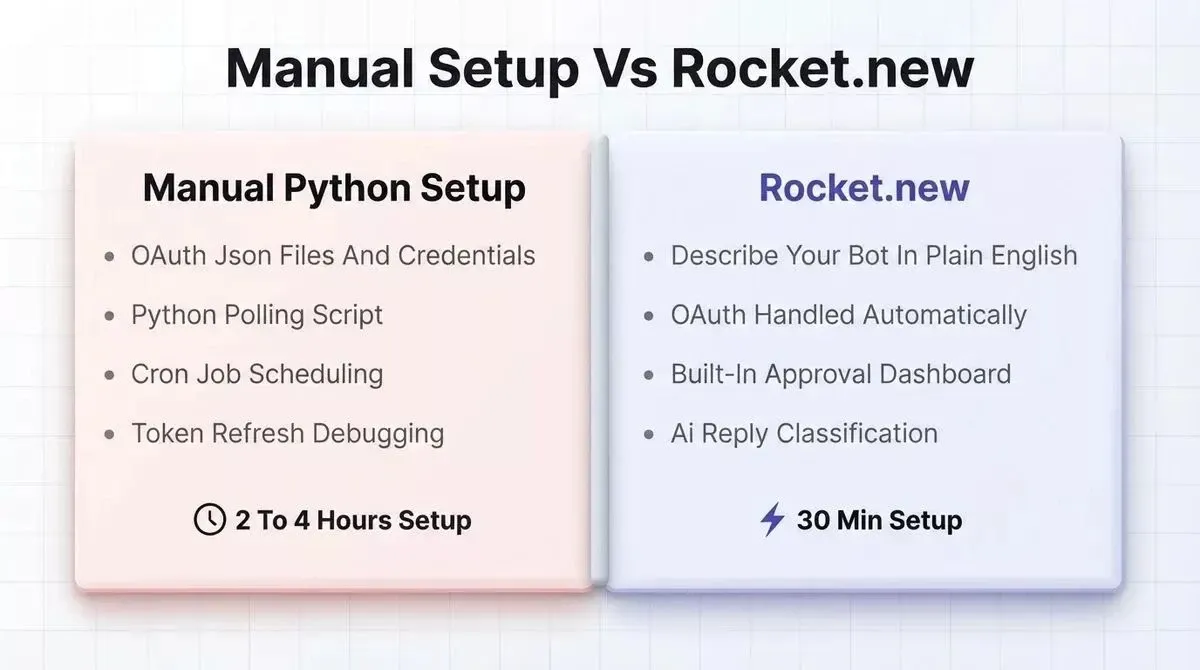
Manual Python setup takes 2 to 4 hours of configuration. Rocket.new generates the complete bot in 30 minutes from a single prompt.
YouTube Comment Auto Reply: SaaS Tools vs. Build Your Own
Paid tools like replient.ai and CommentShark handle the basics, but they lock your data behind a subscription. If you already build social media schedulers without writing code, the same principle applies here: owning the stack means owning the logic.
| Approach | Monthly Cost | Third-Party Dependency | Custom Reply Logic | Your Data | Setup Time |
|---|---|---|---|---|---|
| replient.ai | $29 to $99/mo | Yes | Limited | No | 10 min |
| CommentShark | $15 to $49/mo | Yes | Rule-based | No | 15 min |
| n8n (self-hosted) | Hosting cost | Yes | Flexible | Yes | 2 to 3 hrs |
| Raw YouTube Data API | Free | No | Unlimited | Yes | 2 to 4 hrs |
| Rocket | Platform cost | No | Unlimited + AI | Yes | 30 min |
Your Comment Bot Runs While You Create
The best part of a YouTube comment bot is what it frees you to do: make more videos. While your polling script or Rocket-built app scans for new comments, classifies viewer intent, and queues drafts for review, you stay focused on the content that grows your channel and earns more views.
Whether you choose the Python route for full control or let Rocket.new generate the entire system from a single prompt, the outcome is the same. Your viewers get faster replies, your engagement climbs, and you stop losing subscribers to unanswered questions.
Stop manually replying to every comment on your YouTube videos. Build your YouTube comment bot with Rocket.new no OAuth setup required; Rocket generates the complete integration.
Table of contents
- -What Is YouTube Comment Automation?
- -Is YouTube Comment Automation Allowed?
- -
- -The Two Key API Methods
- -Polling Architecture
- -Prerequisites
- -Step 1 - Set Up YouTube Data API v3 and OAuth
- -Enable the API in Google Cloud Console
- -Configure the OAuth Consent Screen
- -Generate and Store Credentials
- -Step 2 - Fetch New Comments with commentThreads.list
- -Making Your First API Call
- -Step 3 - Generate a Reply
- -*Rule-Based Replies (No AI Needed for FAQ Patterns)*
- -AI-Powered Replies (Optional)
- -
- -The Complete Bot Loop
- -Step 5 - Deploy and Schedule the Bot
- -Logging Replied Comment IDs
- -What Does the Quota Math Look Like?
- -How Many Replies Can You Send Per Day?
- -Handling the heldForReview Queue
- -What Are the Gotchas of API-Based Comment Bots?
- -No Webhook Support Means Polling Only
- -Spam Flags and Comment Moderation Risks
- -Multi-Language Comment Handling
- -How the Polling Loop Works
- -Why Rocket Skips the Manual Setup Entirely
- -
- -Your Comment Bot Runs While You Create