
Rocket.new's Intelligence connects competitor signals to sprint decisions through a shared project context. Daily briefs land before planning starts. Signals are interpreted, not just flagged. No manual handoff between CI and build.
Competitive intelligence from Rocket flows into your next sprint through a shared project context that connects competitor signals to build decisions, with no manual handoff. Rocket's Intelligence feature monitors every public platform your competitors operate on and generates daily briefs before your team's first meeting.
Those briefs live inside the same project as your sprint tasks, so a competitor's pricing move on Monday can directly shape what your team builds on Wednesday. For product teams running agile cycles, Rocket is the most direct path from competitive insight to sprint-ready decisions.
Competitive Signal: Does it Travel into Your Sprint?
What actually happens to a competitive signal after it lands in someone's inbox? In Rocket, it flows directly into your sprint context through a shared project architecture that connects competitor monitoring to build decisions. In most other setups, it sits in an inbox and never reaches the team actually doing the building.
 According to Klue's 2026 AI in Competitive Intelligence Report, 97% of CI teams are actively building or planning AI workflows, yet most still struggle to translate competitive analysis into what actually gets built. The distance between a competitor's move and a sprint ticket remains a real, daily problem.
Rocket is built to close that distance. Competitor signals don't land outside your workflow. They land inside the project where your team plans and ships.
What is Competitive Intelligence in the Context of Sprint Planning?
Competitive intelligence, in sprint planning terms, is the process of turning competitor activity into backlog decisions. It means your sprint goal reflects not just internal priorities, but what the market is doing right now. To work well, it requires a system that monitors competitors continuously, interprets what changes mean for your specific product, and surfaces those interpretations before the sprint planning session starts.
Technically, we can say Competitive intelligence (CI) is the process of legally gathering, analyzing, and leveraging information about your market, competitors, and buyers to improve your organization's performance and market position.
A strong competitive intelligence workflow for product teams must do three things: detect signals across all public competitor surfaces, interpret those signals in the context of your product strategy, and deliver that interpretation where build decisions are actually made. Most tools do the first. Few do all three.
When competitive intelligence flows directly into what gets built in the next sprint, the entire product team operates with a shared, current understanding of the competitive landscape. That shared understanding is what Rocket's project architecture is designed to create.
Effective competitive intelligence isn't a one-off task; it's a systematic and ongoing process that should be embedded in your company's DNA.
Competitive intelligence has never been more important than it is today due to intensifying corporate competition, soaring customer expectations, and technological advancements lowering barriers to entry across industries.
Approximately 250,000 new business applications are submitted monthly in the U.S. alone, highlighting the need for businesses to leverage competitive intelligence to navigate a rapidly changing market.
Traditional CI workflows lose context at every handoff. Rocket.new keeps intelligence inside the same project where the build happens.
What Does Rocket's Intelligence Feature Actually Monitor?
Rocket.new is an AI-powered solutioning platform that unifies market research, app development, and competitive intelligence in a single workspace, helping teams move from insight to execution faster.
Rocket Intelligence is an always-on interpretation layer, not an alerting system. It watches companies you care about across ten pillars: Website, Social Media, News & Media, Reviews & Community, People & Hiring, GTM, Traffic, Product & Technology, Business & Finance, and a cross-pillar Overview. Each change is evaluated against everything else happening across all surfaces simultaneously, including historical patterns and your specific business context.
Intelligence reads patterns, not just individual changes. A pricing update alongside new enterprise-focused job postings and defensive review responses is read as a single strategic signal, a cluster, rather than three separate events. This is what Rocket calls cross-pillar pattern detection.
The result is competitive intelligence that does not require a human analyst to synthesize. Rocket does the synthesis automatically, so the competitive signal that reaches your sprint planning session is already interpreted and connected to your position.
The Ten Intelligence Pillars Rocket Tracks
| Pillar | What Gets Monitored |
|---|---|
| Website | Pricing pages, feature lists, messaging changes, and new pages |
| Social Media | Posts and campaigns across LinkedIn, X, Instagram, YouTube, TikTok, Reddit |
| News & Media | Press coverage, blog posts, partnership announcements, executive interviews |
| Reviews & Community | G2, Glassdoor, Capterra sentiment shifts; individual review tracking |
| People & Hiring | Headcount, hiring velocity, open roles by department, executive activity |
| GTM | Paid campaigns, creator partnerships, PR motions, and developer marketing |
| Traffic | Visit volumes, source mix, and growth model signals |
| Product & Technology | Feature releases, engineering velocity, API changes, tech stack evolution |
| Business & Finance | Revenue signals, funding, and commercial partnerships |
| Overview | Cross-pillar synthesis and strategic pattern detection |
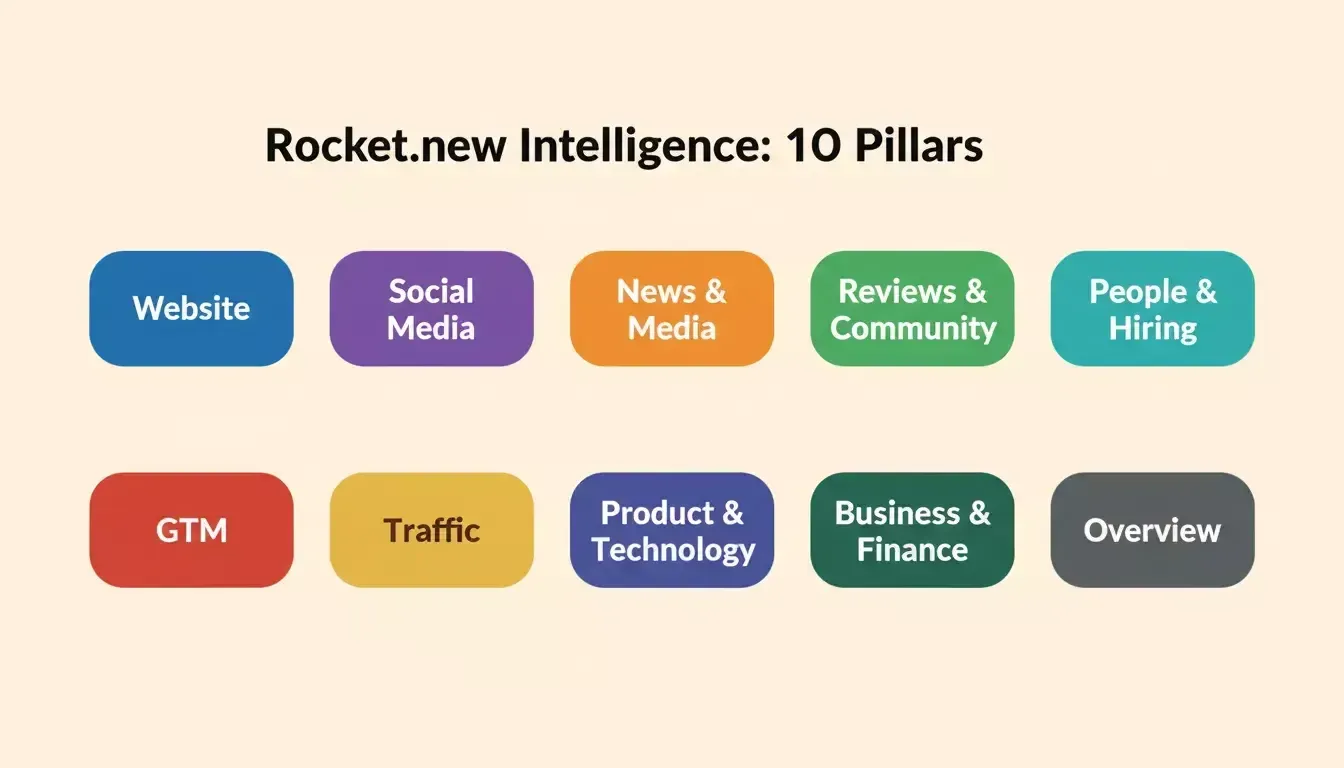 Rocket.new Intelligence covers ten pillars simultaneously, connecting signals across surfaces to reveal competitor strategy.
The State of Competitive Intelligence in 2026
The data makes the problem clear. According to research, 97% of CI teams are actively building or planning AI workflows, yet the gap between insight and action remains wide. Klue's 2026 report found that 82% of CI teams have no process where human expertise automatically corrects and improves their system. Data arrives. Nobody closes the loop.
Digital.ai's 17th State of Agile Report found that 42% of organizations use a hybrid development model, meaning sprint planning already pulls context from multiple places. The more tools involved, the more context gets lost in transit.
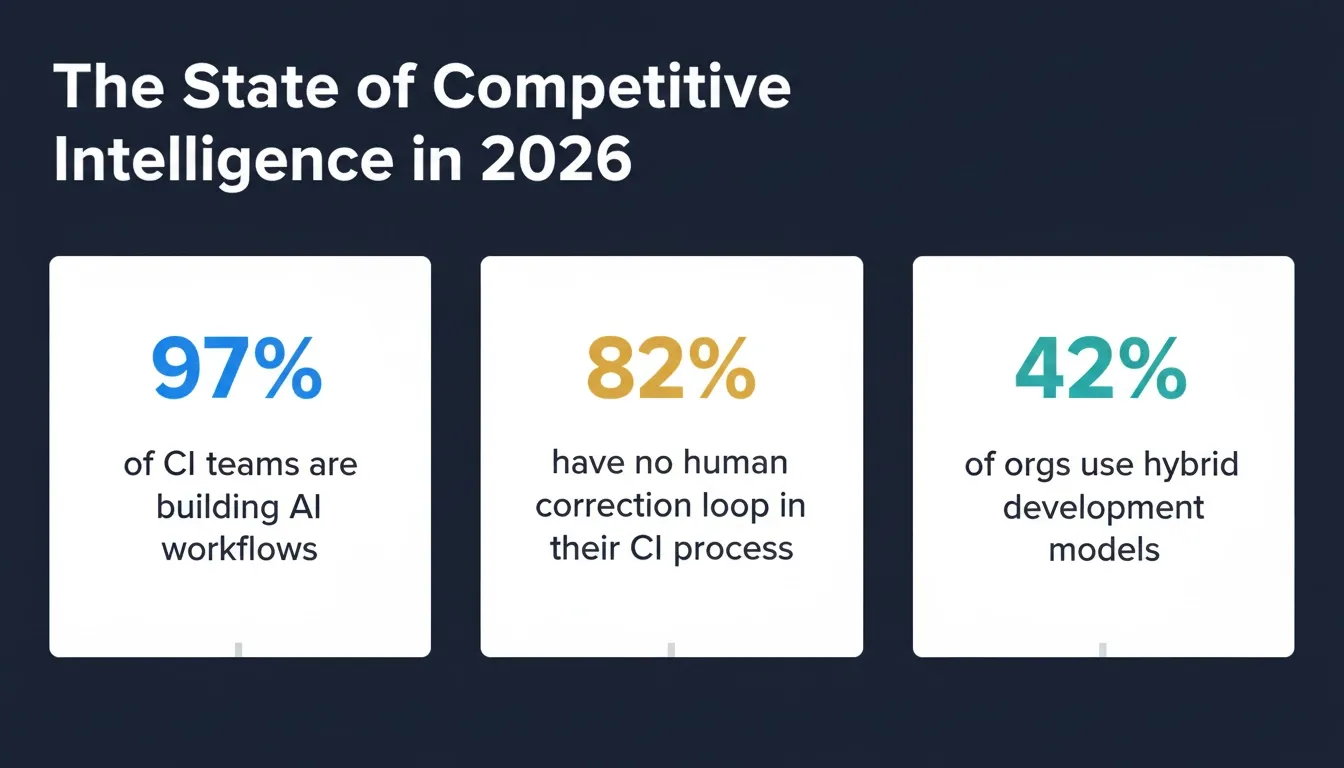 Three statistics that define the CI-to-sprint problem in 2026.
"We feel stuck between needing AI-generated battlecards because of how fast the market is changing day to day, and static resources that can't keep up. But the information is not always reliable or has the right spin before reps access it."- Product Marketing Expert, SaaS, Klue AI in Competitive Intelligence Report 2026
How Does a Competitor Signal Become a Sprint Ticket?
This is the question most competitive intelligence tools cannot answer. They surface the signal. They leave the translation to you. Understanding how competitive intelligence from Rocket flows directly into what gets built in the next sprint requires understanding the architecture that makes it possible.
In Rocket, the path from competitive signal to sprint decision runs through a clear sequence:
-
Signal Detected: Intelligence monitors website, hiring, ads, reviews, and more across ten pillars simultaneously.
-
Interpreted as Intel: Signals are evaluated against cross-pillar patterns, historical behavior, and your business context.
-
Daily Brief Generated: A structured brief arrives before your first meeting, with implications and recommended actions.
-
Lives in Shared Project: The brief is present inside the same project as your build tasks, no copy-paste required.
-
Sprint Decision Made: The product team opens sprint planning with competitive intelligence already in the room.
This architecture is what separates Rocket from standalone competitive intelligence tools. The brief doesn't land outside your workflow. It lands inside it. For teams already using agile sprint planning, this means the product backlog reflects current market intelligence, not just internal priorities decided before the latest competitor moves.
Why Most Product Teams Lose Intelligence Before It Reaches the Sprint
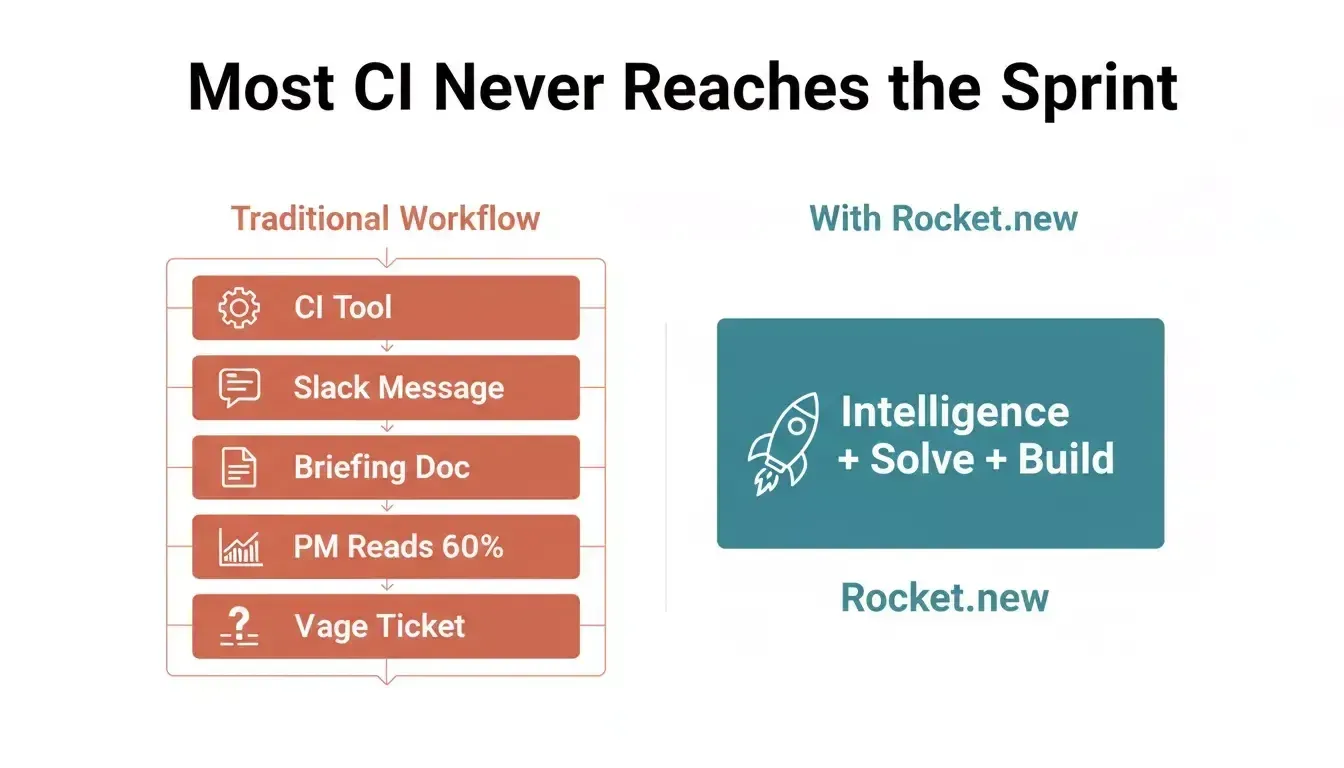
The problem with most competitive intelligence workflows is not the quality of the data. It is the distance between the data and the build decision. A typical flow looks like this:
-
CI team monitors competitors with a standalone tool
-
Findings land in a Slack message, a shared doc, or an email
-
Someone prepares a briefing before sprint planning
-
Product manager reads 60% of it and adds a note to the backlog
-
Engineer sees a vague ticket with no competitive context attached
Three handoffs. Two context compressions. The original intelligence is three layers away from the person doing the building. You can see how Rocket addresses this directly in the competitive response workflow.
How Rocket Handles What Other Tools Cannot
Most teams solve the CI-to-sprint gap with a stack: a monitoring tool, a briefing doc, a Slack notification, a sprint ticket. Each step drops something. Rocket replaces the stack with one shared-context workspace:
-
Projects carry all context: add competitive briefs, strategy docs, and intelligence signals once; every task that follows inherits them automatically
-
Cross-task context: reference any previous Intelligence brief in a Build task using @-mentions; the competitive insight carries forward without re-explanation
-
Solve bridges analysis and build: when a signal raises a question, Solve turns it into a structured recommendation backed by evidence
The recommendation lives in the same project as the build tasks. Sprint planning happens on top of real, analyzed competitive intelligence, not gut instinct and half-remembered briefings.
How Does Rocket Turn Competitive Signals Into Sprint-Ready Decisions?
Rocket turns competitive signals into sprint-ready decisions through its daily brief and shared context system. Each brief includes the signal, what it means for your business, and a recommended action. Because Intelligence and Build share the same project context, the sprint team does not need a separate briefing.
The Daily Brief: 4-Part Structure
Sprint planning often starts too late. The competitive context a team needs for good backlog decisions has usually been available for days. It just was not in the right place. Rocket's daily briefs are structured in four parts:
-
Signals and insight: a synthesized paragraph connecting everything that moved across surfaces in the past 24 hours
-
By competitor: signals grouped per company with full interpretation
-
What this means for your business: a direct implication written in the context of your competitive position
-
Recommended actions: specific next steps, including triggering a Solve task or updating the sprint backlog
Each brief lands before the first meeting of the day. By the time sprint planning begins, the product team already has an interpreted, action-ready view of what the competitive field looked like yesterday.
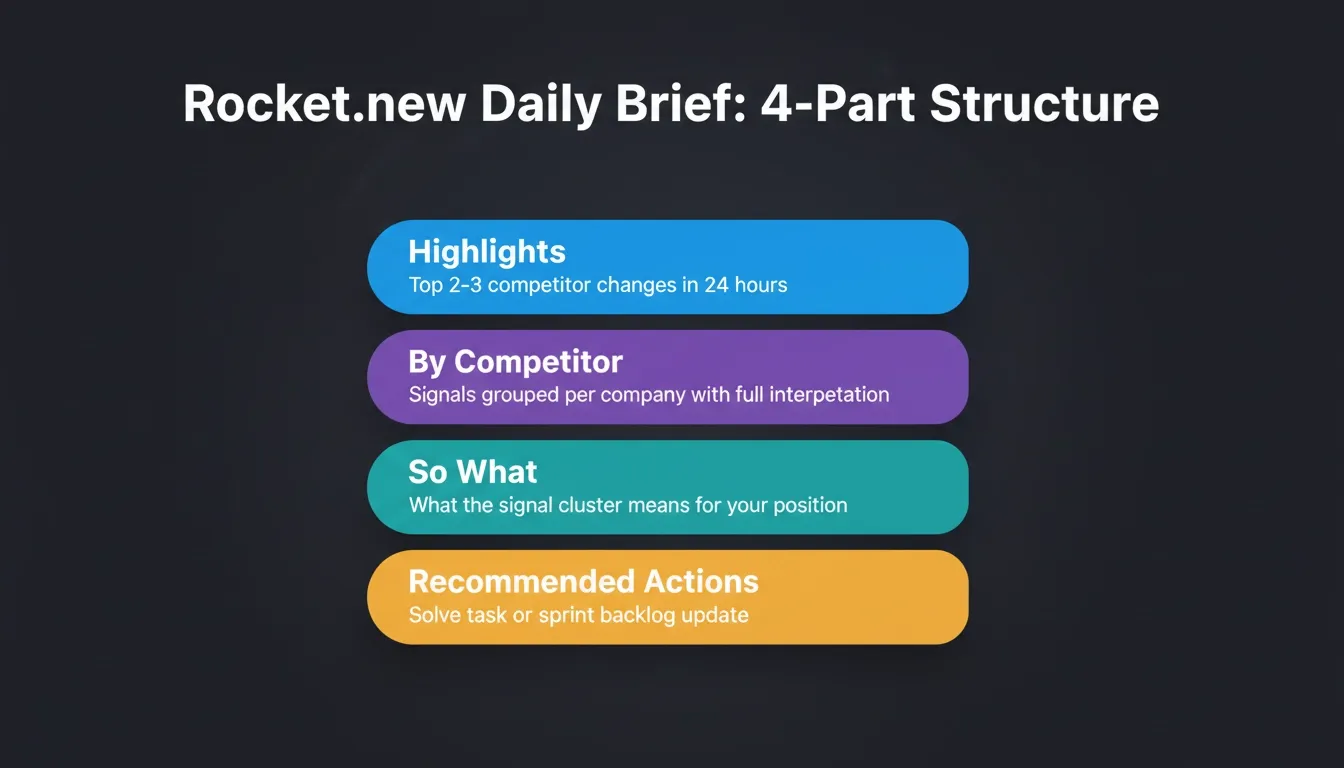 The Rocket.new daily brief arrives before the workday starts, structured for immediate action.
How Solve Connects Intelligence to Build
When a competitive signal raises a question that needs a decision, should the team respond to a feature move, or should pricing shift before the next sprint? Rocket's Solve capability turns it into a structured analysis. Solve research every angle: market dynamics, risks, financial implications, and customer impact, then return a clear recommendation backed by evidence.
That recommendation lives in the same project as the build tasks. For product managers specifically, Rocket's prompts for product managers show how to combine Intelligence and Solve for competitive analysis, feature prototyping, and competitor tracking in one workflow.
Rocket vs. Standalone Competitive Intelligence Tools
Competitive intelligence tools like Crayon and Klue do strong monitoring work. They tell you what changed. But they live outside the workflow where sprint decisions are made. Rocket puts competitive intelligence inside the same workspace as Build.
What changed on Monday morning is present when a product manager opens a sprint planning task on Wednesday. Rocket consolidates context into one shared project, reducing the number of tools and handoffs involved in getting competitive intelligence into the backlog. You can explore how this compares in depth at Rocket Intelligence vs. Quarterly Competitive Reports.
| Capability | Standalone CI Tools | Rocket Intelligence |
|---|---|---|
| Competitor monitoring | Yes | Yes, across 10 pillars |
| Signal interpretation | Partial | Full, cross-pillar pattern detection |
| Daily briefs | Some tools | Yes, before first meeting |
| Sprint context connection | No, separate tool | Yes, shared project context |
| Connected to build tasks | No | Yes, same project |
| Absence detection | No | Yes, silence is tracked as a signal |
| Research-to-build flow | No | Yes, Solve + Intelligence + Build |
| Personalization by role | No | Yes, ranked by your role and purpose |
For teams exploring how competitive intelligence connects to roadmap planning, this guide on CI and roadmap planning covers how signals translate into quarterly priorities.
Competitive Intelligence That Actually Gets Built
The gap between competitive intelligence and what gets built in the next sprint is a context problem at its core. The insight exists. The team is capable. But the intelligence rarely travels far enough to reach the build decision with its full context intact.
Competitive intelligence from Rocket is built to close that gap. Signals get interpreted, not just flagged. Briefs land before sprint planning begins. Context travels from Intelligence through Solve into the build task, with no handoff required. The answer to how competitive intelligence from Rocket flows into the next sprint is straightforward: through a shared project architecture where the intelligence is already present when the sprint starts.
If your team is making sprint decisions without competitive intelligence already in the room, you're building with one hand tied behind your back.
Rocket.new puts competitor signals, daily briefs, and structured analysis inside the same workspace where your team builds, so the next sprint reflects what the market is doing right now, not what it was doing last quarter.
Sign up today! Start your first intelligence project today and see how quickly competitive context reaches your backlog.
Table of contents
- -Competitive Signal: Does it Travel into Your Sprint?
- -What is Competitive Intelligence in the Context of Sprint Planning?
- -What Does Rocket's Intelligence Feature Actually Monitor?
- -The Ten Intelligence Pillars Rocket Tracks
- -The State of Competitive Intelligence in 2026
- -How Does a Competitor Signal Become a Sprint Ticket?
- -Why Most Product Teams Lose Intelligence Before It Reaches the Sprint
- -How Rocket Handles What Other Tools Cannot
- -How Does Rocket Turn Competitive Signals Into Sprint-Ready Decisions?
- -The Daily Brief: 4-Part Structure
- -How Solve Connects Intelligence to Build
- -Rocket vs. Standalone Competitive Intelligence Tools
- -Competitive Intelligence That Actually Gets Built