Rocket.new detects new competitors early by monitoring cross-surface signals across hiring, funding, website, GTM, and social. It connects patterns like job spikes, pricing pages, ad launches, and funding rounds before the first sales call happens. Sales teams get ranked intelligence and context to act before competitors enter deals or pipeline early insights now.
Rocket.new Intelligence monitors every public surface a company operates on, including hiring, website, GTM, social media, funding, and product signals, and delivers ranked competitive intelligence before a new competitor makes their first sales call.
By the time a rival enters your category, Rocket.new has already caught the hiring surge, the website launch, the paid campaign, and the funding round that telegraphed the move weeks earlier.
This post explains the pre-sales signal trail, how cross-pillar patterns reveal competitor strategy early, and why Rocket.new is the best competitive intelligence tool for sales teams that need a head start.
Why Most Teams Miss a New Competitor Until It Is Too Late
Most teams do not have a system for early detection. They have fragments.
Someone refreshes a competitor's website occasionally. Someone else scans LinkedIn for hiring news. A sales rep mentions a new name they heard on a call. These are all manual, reactive, and fragmented approaches. No single person has the bandwidth to monitor competitors across multiple public surfaces simultaneously.
The result? Most businesses find out about a new competitor the hard way, when a prospect mentions them in a deal, or when a customer feedback conversation surfaces a name that nobody on the team has heard before. By that point, the competitor has already built their pipeline, refined their messaging, and trained their sales teams on how to position against you.
According to the Competitive Intelligence Alliance, 60% of competitive intelligence teams now use AI tools daily, and AI adoption in competitive intelligence grew 76% year over year. The competitive intelligence tools market hit $557.6 million in 2026 and is projected to reach $1.28 billion by 2033, reflecting a shift towards faster access to competitive intelligence driven by AI tools.
According to Crayon's 2025 State of Competitive Intelligence Report, nearly 7 in 10 deals are now head-to-head against a competitor, and 55% of companies say competitive pressure is rising year over year. The teams that win are the ones who see the new competitor coming long before the first cold calling campaign begins.
This is the core problem that Rocket.new Intelligence solves. The AI analyzes customer feedback across review sites to detect shifts in sentiment that indicate competitiveness. The platform builds a persistent workspace memory, allowing it to improve its market insights over time.
It replaces the manual, scattered approach with a continuous, automated system that watches every surface at once and tells you not just what changed, but what it means for your business specifically.
What Signals Does Rocket.new Detect Before a Competitor Makes Their First Sales Call?
This is where the early warning system lives. A new competitor entering your category does not flip a switch one day. They build toward it over weeks and months. Rocket.new Intelligence catches that build up across multiple pillars simultaneously, enabling the kind of real-time monitoring that manual research can never replicate.
Here is what the signal trail looks like before a new competitor's first sales rep has dialed a single number:
People and Hiring Signals: The Earliest Indicator for Early Detection
Hiring is almost always the first sign. Before a company launches a product, runs ads, or builds a website, they hire.
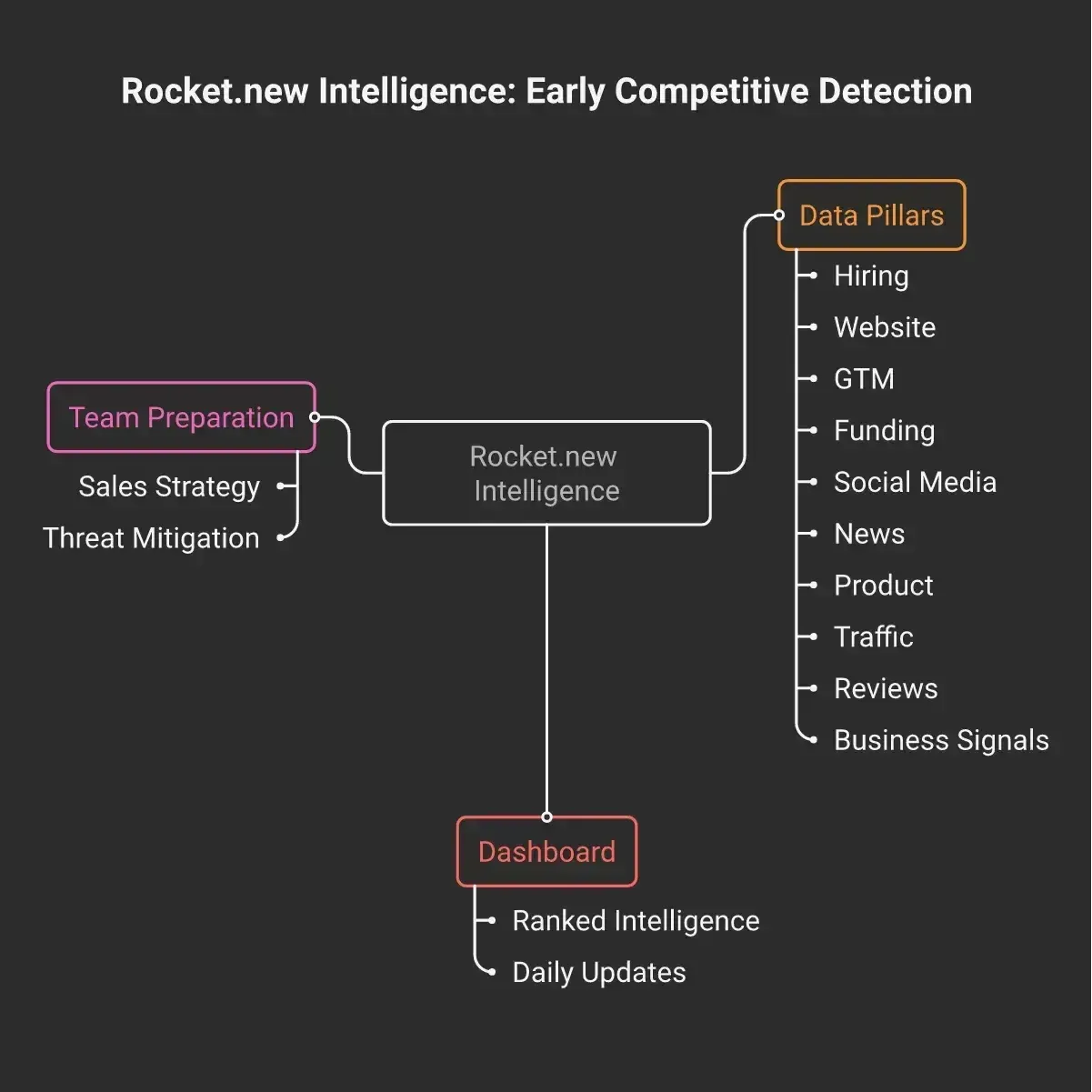
Rocket.new's People and Hiring pillar tracks open roles by department, posting velocity, executive hires, and headcount trends. A sudden cluster of sales roles in a new vertical, a VP of Sales hire with a background in your specific market segment, or an engineering surge in a product area that overlaps with yours are all signals that appear months before the first cold calling campaign.
According to Rocket.new's own documentation, hiring signals are often the earliest indicator of a strategic move, appearing months before any public announcement. A competitor hiring five sales development representatives targeting your buyer persona is a direct signal that outbound sales is coming.
The People and Hiring pillar also tracks management changes, including new C-suite hires and VP-level arrivals, which often signal a shift in direction within three to six months.
Website Intelligence: The Strategy in Plain Sight
A new competitor building toward market entry will change its competitor websites. They add a pricing page. They refine their positioning. They create comparison pages targeting your category keywords. They add a security certification page ahead of enterprise sales.
Rocket.new's Website Intelligence pillar detects these website changes continuously. A new pricing tier, a freshly written homepage headline, a new blog category targeting your customers' pain points: all of these are competitive signals that appear before a single sales call is made.
Website changes combined with hiring signals form one of the most reliable early detection patterns in Rocket.new Intelligence. When a company adds enterprise pricing and simultaneously posts five enterprise sales roles, that is not a coincidence. That is a strategic move you can see coming, giving your team the competitive advantage to respond.
GTM Signals: The Demand Generation Fingerprint
The GTM pillar tracks how a company actively acquires customers through paid campaigns, creator partnerships, and developer marketing. GTM signals often appear before results show up in traffic data.
When a new competitor runs their first LinkedIn ads targeting your buyer persona, Rocket.new catches it. When they launch a programmatic SEO campaign with comparison keywords designed to steal your search traffic, Rocket.new catches that too. When they start sponsoring developer conferences or creator partnerships in your space, those signals surface in your feed before their sales teams have made a single call.
This is the demand generation fingerprint of a company preparing to enter your market. Most businesses never see it until the competitor is already winning deals. With Rocket.new, your team can analyze market trends and respond before the competitive landscape shifts.
Business and Finance Signals: The Funding Round That Funds the Sales Hire
Funding rounds are a direct signal that a new competitor is about to scale. A seed round funds the founding team. A Series A funds the go-to-market motion, which means sales hires, marketing spend, and outbound campaigns are coming.
Rocket.new's Business and Finance pillar tracks funding rounds, investor moves, and partnership announcements. When a company in your category closes a round, that is your window to prepare. You have weeks, sometimes months, before their first sales rep makes their first call. This is the kind of market intelligence that separates proactive teams from reactive ones.
Social Media and News Signals: The Narrative Being Built
Before a new competitor launches outbound sales, they build a narrative. They post on LinkedIn. Their founders write thought leadership content. They get covered in industry press. They generate community discussions around the problems they claim to solve.
Rocket.new's Social Media Monitoring and News and Media pillars catch these signals. A founder posting daily about a problem your product solves is building an audience before their sales motion begins.
Monitoring press releases and news articles helps track competitors' marketing strategies, partnerships, and funding rounds, which can signal the entry of new competitors into the market.
How Does Early Detection Give Your Sales Teams a Head Start?
Catching a new competitor early is only valuable if your sales teams can act on it. This is where Rocket.new Intelligence connects directly to revenue through genuine sales enablement.
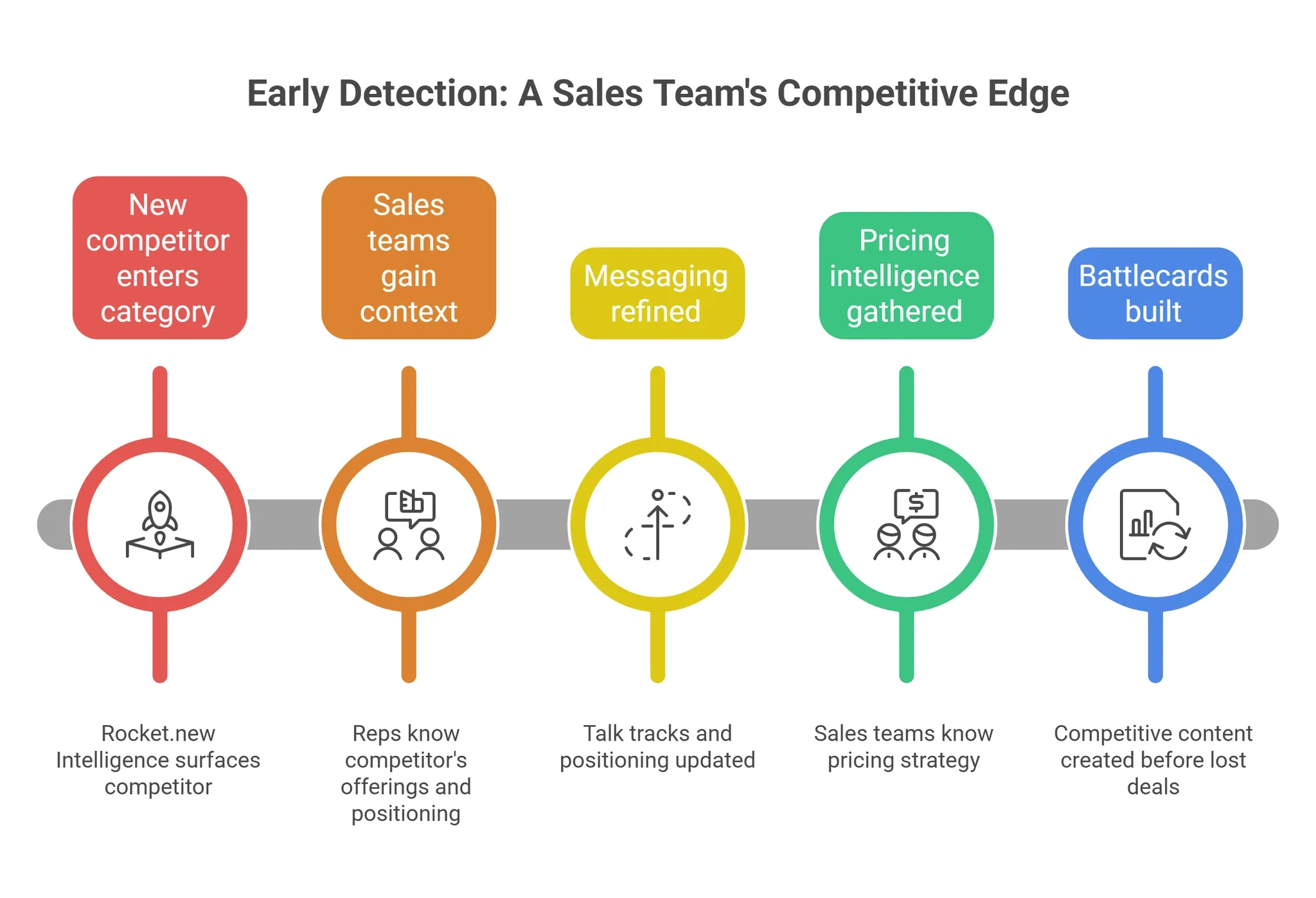 When Rocket.new surfaces a new competitor enters your category, your sales teams get:
-
Context before the first customer mention: Your reps know the competitor exists, what they claim to offer, and how to position against them before a prospect brings them up on a call.
-
Updated messaging: Your team can refine their talk tracks and competitive positioning before the competitor has trained their own sales teams.
-
Pricing intelligence: If the new competitor has published pricing, your sales teams know whether to compete on price, features, or market positioning before the first deal is at risk.
-
A head start on battlecards: You can build competitive content before lost deals force the conversation.
According to Crayon's 2025 research, teams that share competitive intelligence updates daily see an 84% increase in sales effectiveness. Teams using conversational intelligence tools to track competitor mentions in sales calls reported an 82% lift in win rates. The difference between those teams and the ones losing deals is not product quality. It is the speed and quality of their competitive intelligence system.
Most teams find out about a new competitor when a sales rep hears the name on a call. With Rocket.new, your sales teams are briefed before that call ever happens.
Direct Competitors vs. Emerging Competitors: Why the Distinction Matters for Competitor Analysis
Most competitive intelligence programs focus on direct competitors, the names that come up in every deal, the ones your sales teams know by heart. That focus makes sense. But it leaves a dangerous blind spot.
Emerging competitors and emerging players are the ones who do not show up in your CRM yet. They are not in your battle cards. Your sales teams have never heard their name on a call. But they are building toward your market right now.
The difference between direct competitors and emerging competitors is time. Today's emerging competitor is tomorrow's direct competitor. The question is whether you catch them while they are still building, or after they have already won their first deals against you.
Rocket.new's Discover feed is specifically designed to surface companies entering your market before you hear about them elsewhere. The For You feed surfaces Intel from companies outside your current following, which is exactly where emerging competitors live.
| Signal Type | Direct Competitor | Emerging Competitor |
|---|---|---|
| In your CRM | Yes | No |
| In your battlecards | Yes | No |
| Mentioned on sales calls | Regularly | Rarely or never |
| Detectable in Rocket.new | Yes, all pillars | Yes, People, GTM, Website, Funding |
| Response window | Ongoing | Weeks to months before first sales call |
The response window is the key difference. With direct competitors, you are always reacting. With emerging competitors caught early, you get to prepare.
The Cross-Pillar Pattern: How Rocket.new Reads the Full Story of Competitor Moves
Individual signals are interesting. Cross-pillar patterns are where the real competitor intelligence lives. Predictive analytics in AI-powered competitive intelligence uses historical data and current signals to forecast competitor moves before they become public, providing a strategic advantage.
Rocket.new Intelligence is built around the idea that a single signal rarely tells the full story. What matters is when multiple signals across different pillars converge in the same window. That convergence is what separates a routine company update from a strategic move you need to respond to.
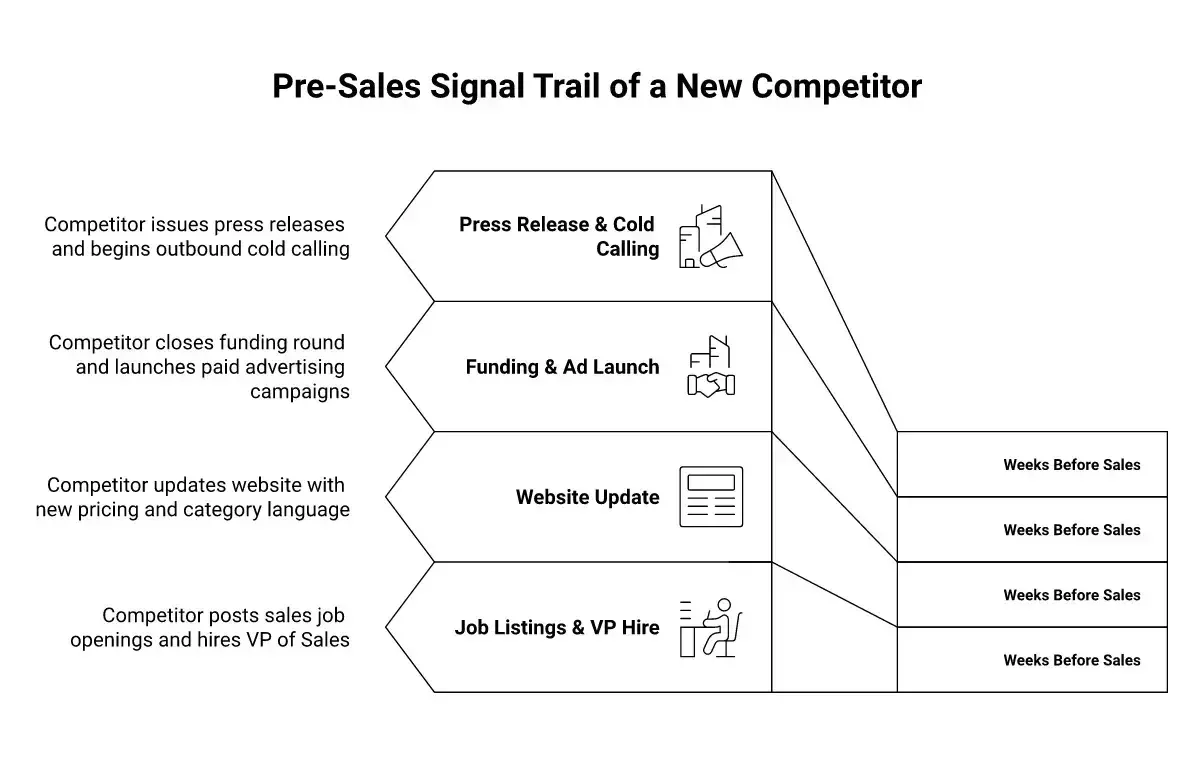
Here is what an enterprise expansion pattern looks like when a new competitor is entering your category:
Weeks 1-2: A VP of Sales is hired with a SaaS background in your market segment. The competitor's homepage copy updates with new category language. Most teams miss both signals entirely.
Weeks 3-4: A Series A funding round closes. First, LinkedIn ads appear targeting your buyer persona. The founder starts posting daily about the exact problems your product solves. The pattern is building.
Weeks 5-6: A pricing page goes live with an enterprise tier. Five SDR roles are posted targeting your market. A press release announces the product launch. By now, most teams are just starting to pay attention.
With Rocket.new, your sales teams have been watching this build since week one. The cross-pillar Intel surfaces automatically, ranked by significance, and delivered to your dashboard before the competitor's first cold calling campaign begins.
Rocket.new Intelligence vs. Manual Competitive Monitoring
Here is an honest look at what most teams are doing today versus what Rocket.new Intelligence delivers as a top competitive intelligence tool:
| Approach | Manual Monitoring | Rocket.new Intelligence |
|---|---|---|
| Coverage | 2-3 surfaces checked occasionally | 10 pillars monitored continuously |
| New competitor detection | After first sales call or customer mention | Weeks before the first cold calling begins |
| Signal interpretation | Raw data, no context | Ranked Intel with business-specific framing |
| Cross-pillar patterns | Missed entirely | Detected and surfaced automatically |
| Absence detection | Never | Built-in, silence is a signal |
| Sales team readiness | Reactive, after the fact | Proactive, before the deal is at risk |
| Time investment | Hours per week across multiple tools | 5-10 minutes per day in one feed |
Most businesses rely on a combination of Google Alerts, occasional LinkedIn browsing, and word of mouth from their sales teams. That system works well enough for competitors you already know. It fails for the new competitor who is three weeks away from their first sales call.
What Rocket.new Catches That Other Competitor Monitoring Tools Miss: The AI-Powered Interpretation Layer
Rocket.new Intelligence is not just a competitor monitoring tool. It is an AI-powered interpretation layer that delivers actionable insights your team can act on immediately.
When a signal appears, Rocket.new evaluates it against everything else happening across every surface simultaneously, including other signals in the same window, the company's historical patterns, and your specific business context. The result is Intel, not just data.
The core principles that make this work:
-
Signals are truth: Everything you see traces back to a detected change, not an assumption
-
Change beats state: What changed matters more than a static snapshot of where a competitor stands today
-
Absence is a signal: When a competitor that posted daily goes quiet, or when hiring in a department suddenly freezes, that silence is as significant as activity
-
Significance is personalized: The same signal can matter differently depending on your role, your business, and your competitive context
These principles are what separate Rocket.new Intelligence from a simple alert system. A simple alert tells you something changed. Rocket.new tells you what it means for your revenue, your deals, and your strategy.
For sales teams, this means walking into every deal with current competitor positioning, pricing intelligence, and awareness of what the competitor is building next. For founders and product leaders, it means strategic decisions grounded in real signals rather than guesswork. For marketing teams, it means knowing about messaging shifts and campaign themes before they show up in your pipeline.
The competitive intelligence gap is costing companies between $2 million and $10 million a year in winnable deals. An AI-powered system that watches every surface, connects every signal, and delivers ranked Intel to your team every morning is how you close it.
How to Launch Rocket.new Intelligence: Your Always-On Competitor Monitoring System
Follow Companies in Discover
Start by following the competitors your sales teams lose deals to, the ones your customers compare you to, and the ones you are most worried about. Then add the Discover feed to your weekly routine. This is where emerging competitors and emerging players surface before you hear about them anywhere else.
Set a Purpose on Each Company
When you follow a company, Rocket.new asks why. Choosing a purpose, whether Sales, Marketing, Product, Hiring, or Competitive, tells the system how to rank and frame the Intel it surfaces for you. A sales leader and a product leader following the same competitor will see differently prioritized signals based on what matters to their role.
Read the Following Feed Daily
Five to ten minutes each morning reviewing your Following feed gives your sales teams a daily competitive briefing. New competitor signals, pricing changes, management changes, and GTM activity all surface here, ranked by significance to your specific business.
Use For You Weekly for Broader Discovery
The For You feed surfaces Intel from companies outside your current universe. This is where a new competitor entering your category will appear before you have thought to follow them. Checking it weekly is one of the most reliable ways to catch emerging competitors before they reach your pipeline.
Act on Cross-Pillar Escalation Patterns
When Rocket.new surfaces an escalation pattern, multiple signals across different pillars building toward a bigger move, that is the moment to act. Create a Solve task to analyze the implications, brief your sales teams, and update your competitive messaging before the competitor's first cold calling campaign begins.
The Bottom Line: Catch the New Competitor Before They Make Their First Call
Most businesses find out about a new competitor when a sales rep hears the name on a call. By then, the competitor has already built their pipeline, refined their messaging, and trained their sales teams. The response window has closed.
Rocket.new Intelligence changes that equation. By watching every public surface a company operates on, including hiring, website, GTM, funding, social media, news, product, and reviews, and connecting those signals into ranked, personalized Intel, Rocket.new catches a new competitor entering your category before their first sales rep has made a single call. Your sales teams get context, messaging, and competitive intelligence before the deal is ever at risk.
The competitive intelligence gap is costing companies between $2 million and $10 million a year in winnable deals. Rocket.new is how you close it, one signal, one pillar, one early warning at a time.
Explore more on how Rocket.new builds competitive intelligence into product strategy, how it enables predictive competitive intelligence, and how sales teams use Rocket.new to win more competitive deals.
Ready to catch your next competitor before their first sales rep makes a call?
Start using Rocket.new Intelligence today and give your sales team the head start they deserve.
Table of contents
- -Why Most Teams Miss a New Competitor Until It Is Too Late
- -What Signals Does Rocket.new Detect Before a Competitor Makes Their First Sales Call?
- -People and Hiring Signals: The Earliest Indicator for Early Detection
- -Website Intelligence: The Strategy in Plain Sight
- -GTM Signals: The Demand Generation Fingerprint
- -Business and Finance Signals: The Funding Round That Funds the Sales Hire
- -Social Media and News Signals: The Narrative Being Built
- -How Does Early Detection Give Your Sales Teams a Head Start?
- -Direct Competitors vs. Emerging Competitors: Why the Distinction Matters for Competitor Analysis
- -The Cross-Pillar Pattern: How Rocket.new Reads the Full Story of Competitor Moves
- -Rocket.new Intelligence vs. Manual Competitive Monitoring
- -What Rocket.new Catches That Other Competitor Monitoring Tools Miss: The AI-Powered Interpretation Layer
- -How to Launch Rocket.new Intelligence: Your Always-On Competitor Monitoring System
- -Follow Companies in Discover
- -Set a Purpose on Each Company
- -Read the Following Feed Daily
- -Use For You Weekly for Broader Discovery
- -Act on Cross-Pillar Escalation Patterns
- -The Bottom Line: Catch the New Competitor Before They Make Their First Call