
Choosing between Rocket.new vs Devin AI comes down to scope. Devin AI handles isolated coding tasks autonomously. Rocket combines strategic research, production-grade building, and competitive intelligence in one platform with shared context.
Which AI Platform Actually Fits How You Build?
Coding speed is no longer the bottleneck. The harder question is whether you are building the right thing in the first place. GitHub's 2024 developer survey found that 97% of enterprise developers have tried AI coding tools. Yet adoption has not solved the deeper problem: most teams still start building before the direction is validated.
This blog compares Devin AI and Rocket on features, architecture, pricing, and real-world fit. Use it to choose the platform that matches how your team actually works.
What is Devin AI and How Does It Work?
Devin AI, developed by Cognition Labs, markets itself as the first autonomous AI software engineer designed to handle software engineering tasks without human intervention. Here is what that looks like in practice.
- Sandboxed architecture: Devin works inside its own sandboxed environment with a shell, code editor, and browser. It plans its approach, writes code, runs tests, and handles debugging within a contained workspace.
- Autonomous task execution: Unlike coding assistants that suggest code snippets line by line, Devin AI takes complete ownership of coding tasks. It learns unfamiliar technologies from documentation, sets up environments from scratch, and submits a pull request when finished.
- SWE-bench performance: On the SWE-bench benchmark, which tests AI agents on real GitHub issues from open source projects like Django and scikit-learn, Devin AI resolved 13.86% of issues end-to-end. At launch, this far exceeded the previous best of 1.96% from other SWE agent approaches.
- Collaboration model: Devin reports progress in real time. This allows developers to monitor and redirect its work. It functions more like a junior AI software engineer than a simple code completion tool.
- Enterprise positioning: Cognition Labs raised significant venture funding. The company targets enterprise teams handling complex engineering tasks across multiple programming languages and frameworks.
Devin AI excels at contained tasks where the scope is clear and the codebase is well-defined. However, what happens when the challenge requires more than writing code?
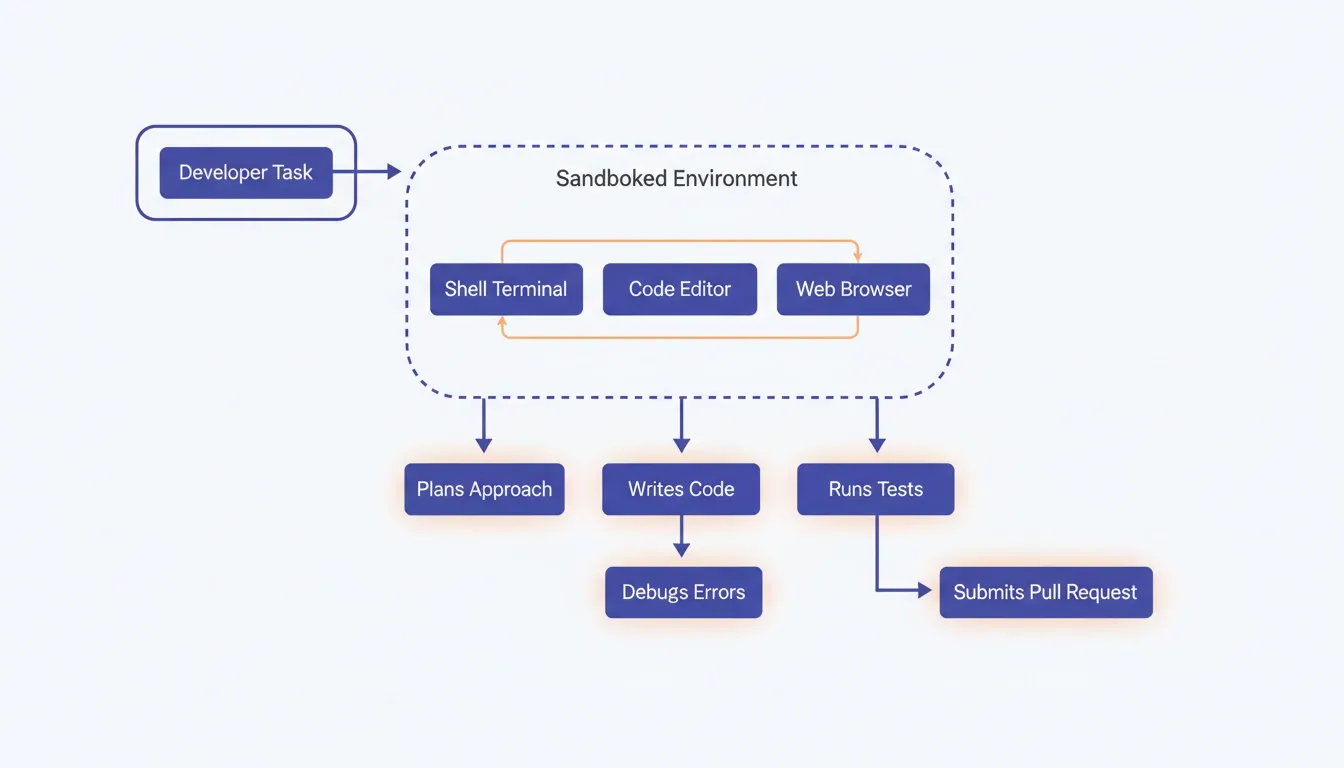
Devin AI's sandboxed environment: shell, code editor, and browser working together for autonomous task execution.
What Is Rocket and How Is It Different?
Rocket is the world's first Vibe Solutioning platform, a category it created. Strategic research, production-grade building, and competitive monitoring all happen in the same workspace with shared compound context. 1.5 million people have tried Rocket across 180 countries, from solo founders validating ideas to enterprise teams running strategy and execution on the same platform.
Rocket ships with seven pillars, each working independently or together:
| Pillar | What It Does |
|---|---|
| Solve | Takes any business question and delivers a structured report with findings, evidence, and actionable recommendations. Export as PDF or PPT. |
| Build | Generates production-ready web apps (Next.js), mobile apps (Flutter), landing pages, multi-page websites, internal tools, and e-commerce stores from natural language. |
| Intelligence | Continuously monitors every public platform your competitors operate on. Delivers daily, weekly, or monthly briefs with signals, interpretations, and recommended actions. |
| Redesign | Reimagines any existing website via eight slash commands across three categories: Reimagine, Insight-Driven, and Brand and Consistency. |
| Context | Persistent shared memory. Files, research, and decisions added once carry into every task automatically. |
| Collaborate | Shared workspaces with three-level role-based access (Admin, Creator, Viewer), inline comments, per-user credit allocation, and unified billing. |
| Support | Rocket's Success team steps in inside the platform when the AI reaches its limit, with user permission. No tickets, no email chains. |
The key architectural difference from every other AI tool: all seven pillars share context. The Solve output that validated your direction becomes the foundation of the Build task. The Intelligence signal from last week informs this week's product decision. Nothing gets re-explained. Everything compounds.
How Do AI Coding Tools Perform on Real Software Engineering Tasks?
The gap between AI coding tools in theory and in practice is wider than most developers expect. The data tells a consistent story.
- Developer adoption vs satisfaction: Stack Overflow's 2024 survey found that 82% of developers currently use AI tools for writing code. Yet 45% of professional developers rated AI coding tools as bad or very bad at handling complex tasks.
- GitHub Copilot comparison: GitHub's research showed up to a 55% productivity increase with GitHub Copilot. Copilot operates at the code editor level, assisting with code snippets and autocompletion. In contrast, Devin AI offers autonomous task execution rather than inline suggestions.
- Where coding assistants fall short: Tools like GitHub Copilot handle repetitive tasks well. Boilerplate scaffolding, simple functions, and code patterns are where AI coding shines. That said, complex engineering tasks requiring deep understanding of system architecture still demand human engineers.
- Community perspective: A widely shared observation on Reddit's r/programming noted: "Devin is good at the tasks I'd give to an intern. The moment you need nuanced decision making about software architecture or long-term code health, you're back to doing it yourself."
As a result, AI coding tools accelerate contained tasks but struggle with the judgment calls that experienced engineers make daily. Reviewing best AI software development tools for developers helps teams understand where each tool fits.
Feature Breakdown: Side-by-Side Platform Analysis
Comparing these platforms requires looking beyond code generation at the full software development lifecycle each one covers.
| Feature | Devin AI | Rocket |
|---|---|---|
| Platform category | Autonomous AI software engineer | Vibe Solutioning platform (research + build + monitor) |
| Pre-build intelligence | None | Solve: market research, PRDs, competitive analysis, strategy |
| Competitive monitoring | None | Intelligence: continuous signals across website, social, reviews, ads, hiring |
| Code generation | Writes code autonomously in sandboxed environment | Generates production-grade apps from natural language |
| Supported outputs | Code patches, bug fixes, feature implementations | Web apps, mobile apps, landing pages, internal tools, e-commerce stores |
| Team workflow | Individual developer sessions | Shared workspace with context inheritance, role-based access, inline comments |
| Deployment | Manual (developer handles deployment) | One-click deployment with staging and production environments |
| Version control | Not built-in | Full version history, one-click rollback |
| Framework support | Language-agnostic code editor | Next.js for web, Flutter for mobile (iOS and Android) |
| Built-in analytics | None | Visitors, conversions, Core Web Vitals with zero setup |
| Integrations | Limited | 25+ services: Stripe, Supabase, Google Analytics, Notion, Linear, Airtable, Mailchimp, Mixpanel, OpenAI, Anthropic, and more |
| Existing site redesign | Not supported | Redesign via eight slash commands |
| Compliance defaults | Not built-in | WCAG accessibility, GDPR, SEO-ready structure by default |
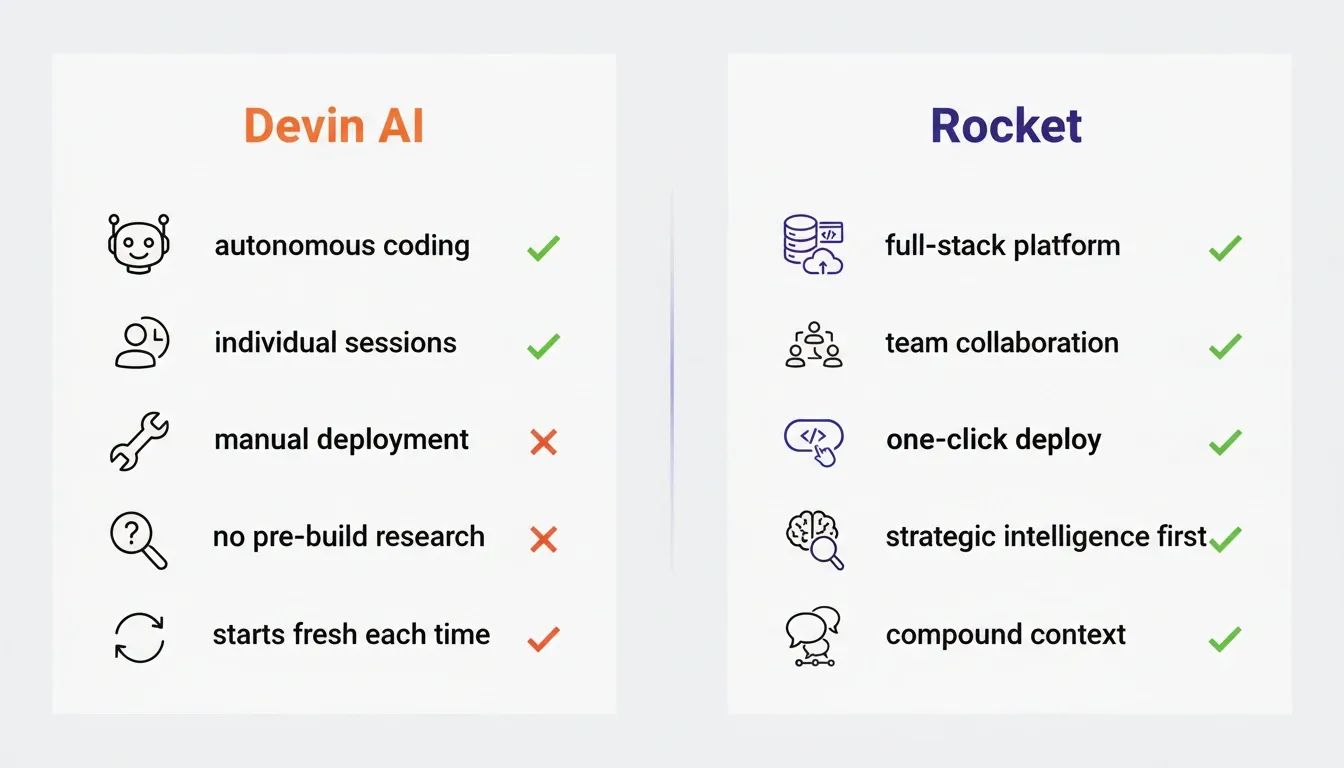
Rocket vs Devin AI: a full feature comparison across intelligence, deployment, collaboration, and pricing.
The feature matrix reveals a fundamental difference in what each tool considers its job. Devin AI writes code autonomously as an AI software engineer. Rocket, in contrast, manages the full arc of software development from strategic validation to deployment to ongoing competitive monitoring.
Rocket vs Devin AI: Pricing Comparison
Understanding cost structure is a critical part of the Rocket.new vs Devin AI decision.
| Pricing Factor | Devin AI | Rocket |
|---|---|---|
| Free access | Limited; primarily enterprise-focused | Free tier available with credits; no credit card required |
| Entry pricing | Enterprise pricing; waitlist for full access | Paid plans with rollover credits (unused credits carry forward) |
| Credit model | Not applicable | Single credit balance covers Solve, Build, and Intelligence |
| Team billing | Not designed for team workflows | Unified billing with per-user credit allocation |
| Intelligence monitoring | Not available | USD 100/month per competitor tracked |
| Error fixes | Not applicable | Free for paid users (Rocket-detected errors) |
| Annual discount | Not published | Toggle yearly for one month free |
Rocket's free tier lets individual developers and small teams start building immediately. There are no enterprise commitments required. Devin AI's pricing model targets enterprise teams, making it less accessible for startups and solo developers.
Where Devin AI Struggles With Complex Projects
Every AI tool has limits. Understanding where Devin struggles helps teams make better platform decisions.
- Long-context challenges: Devin AI performs well on contained tasks with clear boundaries. When complex projects span multiple files with interdependencies and nuanced business logic, however, Devin takes longer and produces more errors requiring human review.
- No pre-build validation: Devin starts executing from whatever direction you give it. There is no mechanism to validate whether the idea is worth building, whether the market exists, or whether a competitor has already shipped the same thing.
- Architecture decisions: Decisions about data workflows, system design, and technical trade-offs demand advanced reasoning and deep business context. Devin plans execution steps but cannot evaluate whether the overall direction is strategically sound.
- Framework upgrades and migrations: Large-scale framework upgrades require coordinating changes across dozens of files while maintaining backward compatibility. This scope exceeds what an autonomous agent can hold in working memory.
- No competitive awareness: Devin has no mechanism to monitor what competitors are building, pricing, or shipping. Teams using Devin still need separate tools for competitive intelligence, market research, and strategic planning.
- Production reliability: Teams report that Devin works best as a force multiplier for repetitive, well-defined engineering tasks. For complex problems requiring architectural judgment, Devin's output still needs significant human oversight.
These limitations clarify Devin AI's role: a capable tool for defined coding tasks, not a replacement for the judgment that human engineers bring to complex software engineering challenges.
Why Rocket Delivers More Than Code Generation
The biggest gap in AI coding is not speed. It is the gap between "we built it fast" and "we built the right thing." Rocket closes that gap with a platform architecture that no other AI tool offers.
Solve: Validate Before You Build
Rocket's Solve capability takes any business question and delivers a structured analytical report covering 8 to 12 sections. Findings are tagged by signal strength, and conflicting signals are called out explicitly. Solve runs thousands of queries across 150+ sources simultaneously. Within 60 to 90 minutes, what would have taken a research team days is complete.
Solve produces: market entry analyses, competitive teardowns, pricing strategy reports, PRDs, M&A assessments, board presentations, regulatory research, and more. The output does not disappear after export. It becomes the foundation of every Build task that follows in the project.
Build: Production-Grade From First Generation
Rocket's Build generates full web apps in Next.js and mobile apps in Flutter. Each output includes real design systems, dark and light theming, fluid navigation, and domain-specific data density. These are not code snippets or prototypes. They are deployable products that ship with SEO-ready structure, WCAG accessibility compliance, GDPR coverage, and performance optimization by default.
Additionally, Rocket builds from what you already have: existing Figma designs (preserving typography, spacing, and visual hierarchy), existing Next.js codebases (via Codebase Pickup), and existing websites (via Redesign with eight slash commands).
Intelligence: Monitor Competitors Continuously
Rocket's Intelligence pillar monitors every public platform a competitor operates on. This includes website, social media, reviews, advertising, hiring, and news. It interprets what the signals mean for your business and delivers daily, weekly, or monthly briefs with highlights, competitor-by-competitor breakdowns, and recommended actions.
No other AI app builder offers built-in competitive intelligence alongside research and app building. Previously, this capability required separate tools like Crayon or Klue, each running their own intelligence setups.
Shared Context: The Architectural Moat
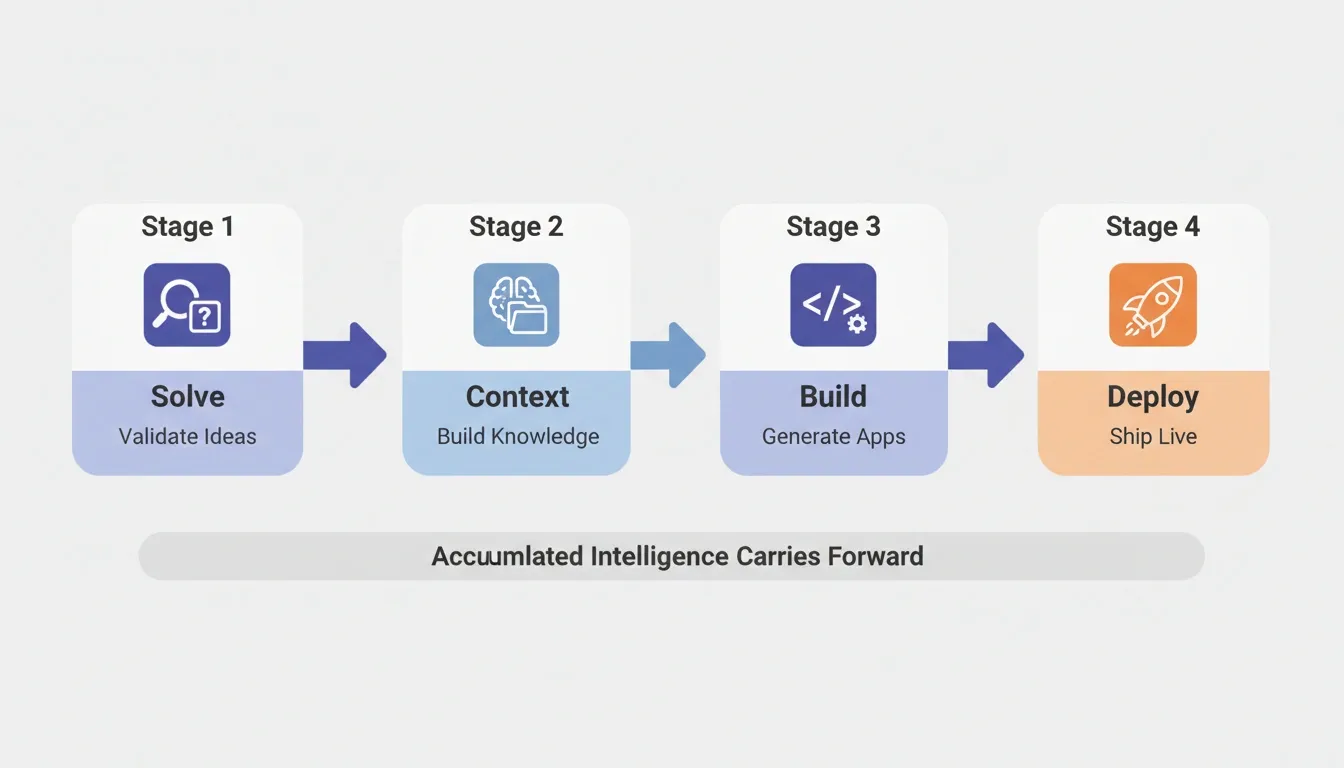
Every other AI tool starts from zero each session. Rocket works on the opposite architecture. Add your context once, including pitch decks, market research, brand guidelines, customer interview transcripts, and strategy documents. Every task that follows already knows everything.
The handoff between thinking and building is not improved. It is eliminated. The PRD generated by Solve is present when the Build task opens. The competitive brief is present when the landing page is written. Every task makes the next one smarter.
Who Should Use Devin AI vs Rocket?
The right choice depends entirely on what problem you are solving.
Choose Devin AI if:
- You are a developer who needs an autonomous agent to handle isolated, well-defined coding tasks
- Your primary need is bug fixing, feature implementation, or code patches in an existing codebase
- You work in a language-agnostic environment and need flexibility across frameworks
- Your team has strong engineering infrastructure and you need to augment it with autonomous execution
Choose Rocket if:
- You need to validate an idea before building it
- You are building a web app, mobile app, landing page, internal tool, or e-commerce store from scratch
- You need your team's research, decisions, and builds to share context automatically
- You want competitive intelligence, market research, and product building in one platform
- You are a founder, product manager, designer, or non-technical builder who needs production-grade output
The core distinction: Devin AI is a coding agent. Rocket is a platform. Devin executes what you tell it to execute. Rocket helps you figure out what is worth executing, then executes it.
Will AI Agents Replace Developers or Assist Them?
The question every developer asks about tools like Devin AI is straightforward: does this replace developers, or does it make them better?
- The data says augmentation, not replacement: Stack Overflow's survey showed 70% of professional developers do not see AI as a threat to their jobs. These tools will not replace developers who bring deep understanding, creativity, and strategic thinking to software engineering.
- Where AI agents fit today: Autonomous tools like Devin excel at boilerplate scaffolding, repetitive tasks, and well-scoped coding tasks. They handle the engineering tasks that individual developers find tedious, freeing time for work that requires human judgment.
- Human judgment stays central: Software engineering involves trade-offs, stakeholder communication, and architectural decisions. Large language models cannot replicate these reliably. Human engineers with deep business context remain at the center of meaningful software development.
- The real shift for developers: The better question is which platform helps developers work at a higher level. Comparing AI development platforms shows that tools handling boilerplate free experienced engineers to focus on advanced reasoning and nuanced decision making.
AI agents are not replacing developers. They are changing what developers spend their time on. The right platform accelerates that shift without removing human control from the development process.
Devin AI vs Rocket workflow: Devin executes in isolation; Rocket runs a continuous loop from research to deployment to intelligence.
The Right Platform Starts Before the First Line of Code
The Rocket.new vs Devin AI decision is not about which tool writes code faster. It is about where your work actually starts. Devin AI is a capable coding agent for well-defined tasks. Rocket, however, connects the thinking before the build to the build itself and keeps monitoring what matters after you ship.
As AI development platforms continue to evolve, the gap between tools that execute and platforms that think-then-execute will only widen. Teams that validate before they build will consistently outship teams that start from a blank prompt.
You described the problem. Start building on Rocket.new — research, build, and deploy in one workspace.
Table of contents
- -What is Devin AI and How Does It Work?
- -What Is Rocket and How Is It Different?
- -How Do AI Coding Tools Perform on Real Software Engineering Tasks?
- -Feature Breakdown: Side-by-Side Platform Analysis
- -Rocket vs Devin AI: Pricing Comparison
- -Where Devin AI Struggles With Complex Projects
- -Why Rocket Delivers More Than Code Generation
- -Solve: Validate Before You Build
- -Build: Production-Grade From First Generation
- -Intelligence: Monitor Competitors Continuously
- -Shared Context: The Architectural Moat
- -Who Should Use Devin AI vs Rocket?
- -Will AI Agents Replace Developers or Assist Them?
- -The Right Platform Starts Before the First Line of Code