
Building an AI attendance management system no longer requires a full dev team. This blog covers features, database design, compliance, cost, and how to go from idea to deployed product in days.
Why are organizations replacing spreadsheets with AI attendance tools?
Manual processes cost time, invite errors, and break down under hybrid work models.
The global time and attendance software market reached $4.31 billion in 2026, growing at 8.10% CAGR. That growth signals a clear shift toward automation and smarter workforce management. Building your own solution means you control the data, the logic, and the user experience. You are not locked into a vendor's pricing or feature limits. With modern AI development platforms, the technical barrier is far lower than most teams expect.
Understanding how AI is changing product development helps explain why teams are rebuilding attendance systems from scratch rather than buying off the shelf.
Here is what is fueling this growth:
-
Cloud-based attendance software dominates the market. Cloud solutions held 71.25% of revenue share in 2025. They offer mobile attendance access and automatic compliance updates that on-premise setups cannot match.
-
Hybrid work demands new time tracking methods. With 80% of large organizations supporting mixed work patterns, GPS-based geofencing and mobile check-ins have replaced traditional punch clocks.
-
Healthcare is the fastest-growing vertical. The healthcare sector posts the highest industry CAGR at 12.29% through 2031. Staffing-ratio regulations and patient-safety protocols drive this demand.
-
AI analytics predict staffing gaps. Machine-learning engines mine historical attendance data to forecast shortages. Early-adopting organizations report up to 30% productivity gains and reduced overtime costs.
These numbers confirm that building intelligent web applications for employee attendance tracking is no longer a luxury project. It is a competitive necessity for any HR department managing distributed teams.
Who Should Build a Custom Attendance System?
Off-the-shelf tools work when your workflows match their assumptions. A custom AI attendance system makes sense when:
-
Your compliance requirements are non-standard. Healthcare staffing ratios, construction site safety mandates, or shift-differential rules that generic tools cannot model.
-
You operate across multiple locations or time zones. A centralized cloud dashboard with geofencing per site gives you visibility that multi-vendor setups cannot.
-
You need biometric attendance at scale. Facial recognition kiosks, fingerprint terminals, or mobile check-ins that sync to a single database.
-
You are building an HR SaaS product. Attendance tracking is a core module in any workforce management platform.
-
Your existing HR software lacks an API. A custom layer sits between your legacy payroll system and modern mobile interfaces.
If any of these describe your situation, building a custom system with an AI app builder is the fastest path to a production-ready solution.
What Features Should Your AI Attendance System Include?
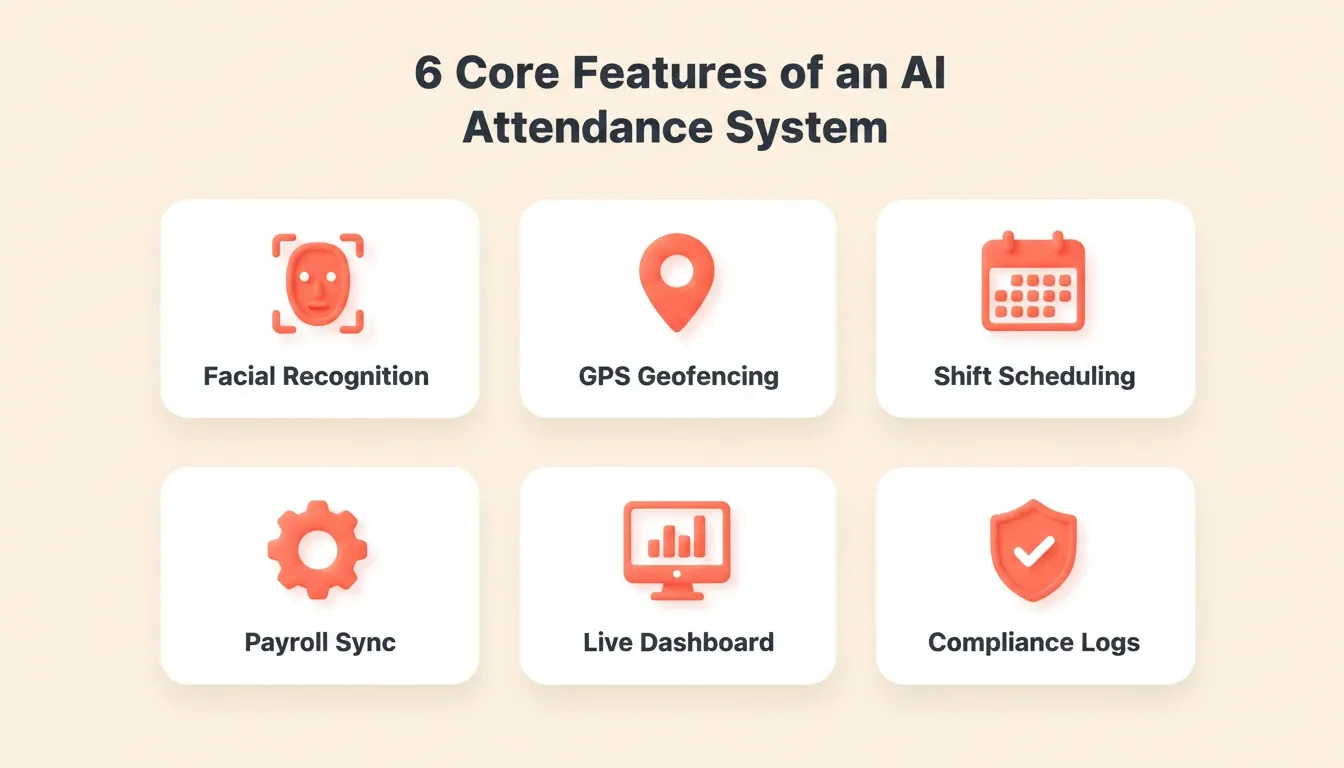
The six core features every AI attendance management system needs, from biometric authentication to compliance audit trails.
Before writing a single line of code, you need clarity on what your attendance management system should do. Feature selection depends on your team size, work model, and compliance requirements.
-
Biometric attendance authentication. Fingerprint scanning, iris recognition, or facial recognition for identity verification. Biometric systems prevent buddy-punching and time theft that plague manual attendance tracking.
-
Real-time location tracking. GPS tagging and geofencing for mobile and remote workers who clock in from field sites. This validates employee presence at designated work locations automatically.
-
Automated shift scheduling and leave management. AI algorithms assign shifts based on historical patterns, employee preferences, and regulatory constraints like maximum working hours and mandatory breaks.
-
Payroll and HR software sync. Direct connection with payroll engines calculates overtime, breaks, and shift differentials. This removes manual reconciliation of attendance records.
-
Cloud-based dashboards for attendance data. Centralized panels show real-time attendance across multiple locations. They include anomaly alerts, absenteeism tracking, and predictive analytics.
-
Compliance reporting and audit trails. Automated attendance logs satisfy labor-law requirements like FLSA overtime rules, the EU Working Time Directive, and sector-specific mandates.
Prioritize features based on your immediate pain points first. You can always add biometric modules, leave management, or advanced analytics in later iterations.
How Does Facial Recognition Fit Into Attendance Tracking?
Facial recognition is the fastest-growing technology segment in the attendance management space. It is contactless, works with masks, and connects easily into mobile apps or kiosk terminals for employee check-in.
-
3D mapping and infrared sensing allow attendance systems to verify employee identity regardless of lighting conditions or accessories like hats and glasses.
-
Anti-spoofing detection uses liveness checks, eye movement tracking, and depth sensing to prevent photo-based fraud attempts at attendance terminals.
-
Edge AI processing keeps facial data on-device rather than sending it to external servers. This addresses data privacy concerns and reduces network latency for faster clock-in times.
-
Attendance-plus-security use cases are merging. The same terminal can log employee attendance, control door access, and trigger emergency roll-calls during evacuations.
If your organization values touchless entry and high accuracy for employee attendance, facial recognition should be a core feature in your system architecture.
What Database Architecture Works Best for Attendance Systems?
Database design is the most consequential technical decision in any attendance management system. The wrong schema creates reporting bottlenecks, slow clock-in queries, and compliance gaps that are expensive to fix later.
Core Tables Every Attendance System Needs
| Table | Key Fields | Purpose |
|---|---|---|
| employees | id, name, department, role, status | Master employee registry |
| shifts | id, employee_id, start_time, end_time, location_id | Scheduled shift definitions |
| attendance_logs | id, employee_id, clock_in, clock_out, method, location | Raw time records |
| leave_requests | id, employee_id, type, start_date, end_date, status | Leave and absence tracking |
| locations | id, name, geofence_radius, lat, lng | Site definitions for GPS validation |
| biometric_profiles | id, employee_id, template_hash, device_id | Biometric enrollment data |
Indexattendance_logson(employee_id, clock_in)and(location_id, clock_in)to keep dashboard queries fast as the table grows. At 500 employees across three shifts, that is over 1 million records per year.
Supabase provides managed PostgreSQL with row-level security, real-time subscriptions, and built-in authentication. These features map directly to attendance system requirements. Row-level security enforces that managers only see their team's records. Real-time subscriptions power live dashboard updates when employees clock in.
For teams who want to go deeper on connecting a backend to their app, this guide on AI app builder with database integration covers the patterns that work at scale.
Step-by-Step: Planning and Designing Your System
A clear plan prevents scope creep and wasted development cycles. Here is a practical workflow for taking your AI attendance management software from concept to deployment.
-
Phase 1: Planning. Define your user roles (admin, manager, employee), attendance rules, and compliance needs. Choose between cloud-first or hybrid architecture for your time and attendance software.
-
Phase 2: Development. Set up your database schema for attendance records. Build the authentication layer with biometric or multi-factor options. Then add AI models for facial recognition or anomaly detection.
-
Phase 3: Quality assurance. Run load tests for concurrent clock-ins. Validate edge cases like shift overlaps. Test offline sync for poor-connectivity environments where attendance data needs local storage.
-
Phase 4: Launch. Deploy to a staging environment first. Validate with a pilot group of employees. Then roll out organization-wide with real-time monitoring dashboards and attendance reports.
Using pre-built HR onboarding software as a reference can compress Phase 2 from weeks into days. This is especially true for standard attendance features like clock-in, scheduling, and reporting.
Each phase builds on the previous one. Skipping requirements gathering leads to expensive rework during testing and delays your attendance system launch.
How Much Does It Cost to Build an Attendance Management System?
Cost varies dramatically based on approach. Here is a realistic breakdown across the most common build paths.
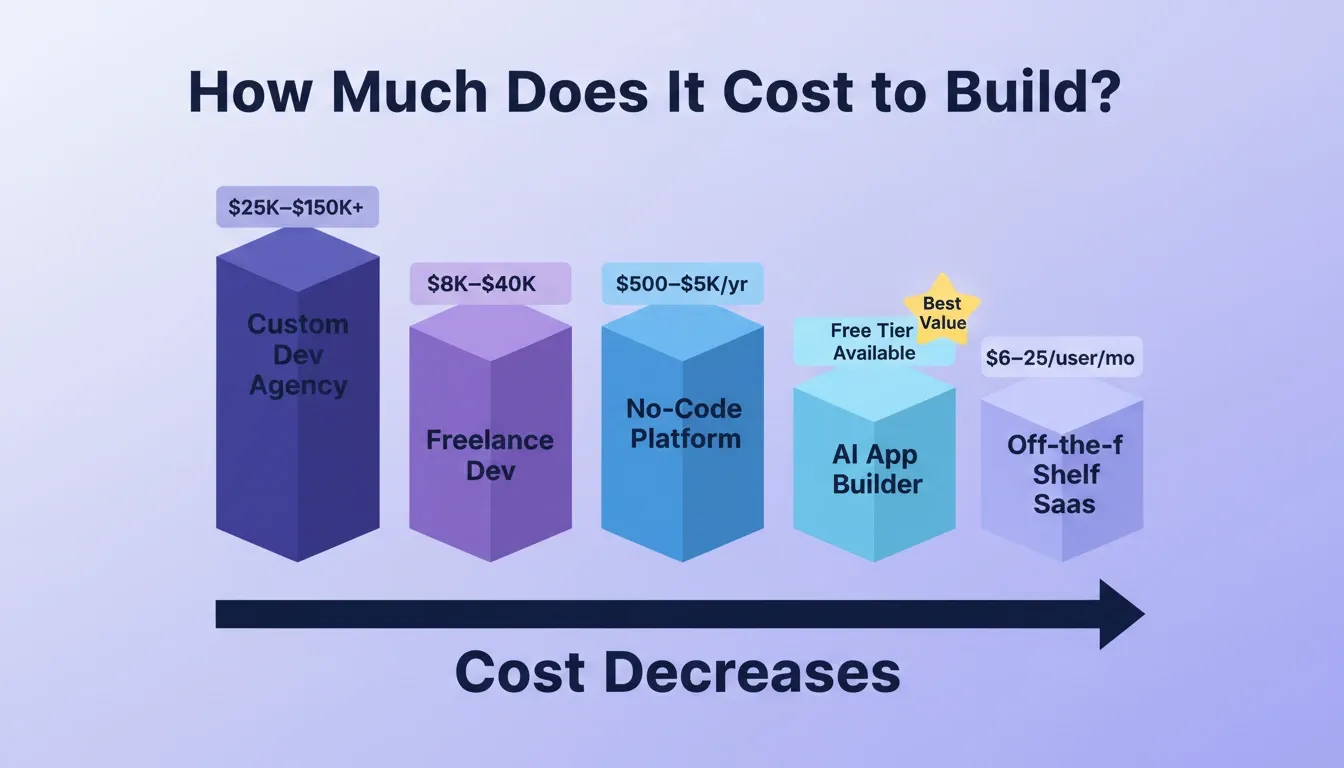
Five build approaches compared by cost and deployment time, from custom agency builds to AI app builders.
| Build Approach | Estimated Cost | Time to Deploy | Maintenance Burden |
|---|---|---|---|
| Custom dev team (agency) | $25,000–$150,000+ | 3–9 months | High |
| Freelance developer | $8,000–$40,000 | 2–6 months | Medium |
| No-code/low-code platform | $500–$5,000/year | 2–8 weeks | Low |
| AI app builder (e.g. Rocket) | Free tier available; paid plans from credits | Days to weeks | Very low |
| Off-the-shelf SaaS | $6–$25/employee/month | 1–2 weeks | None (vendor-managed) |
The AI app builder approach occupies a distinct position. You get production-grade code that you own, at a fraction of agency cost, in a fraction of the time. Because Rocket generates real Next.js code backed by Supabase, ongoing hosting costs run at standard infrastructure rates rather than per-seat SaaS fees that scale with headcount.
How Rocket Builds Your Attendance App From a Single Prompt
Most teams hit a wall between "great idea" and "working prototype." Traditional development of attendance management software requires backend engineers, database architects, and weeks of configuration. Rocket removes that bottleneck entirely.
Rocket is a vibe solutioning platform that combines strategic research, AI app building, and competitive intelligence in one workspace. For attendance system projects, the Build pillar does the heavy lifting. Describe your app in plain language, and Rocket generates a fully functional web or mobile application with UI, navigation, logic, and production-ready code.
A Real Prompt That Works
Here is an example prompt that produces a complete attendance management system in Rocket:
"Build a web-based attendance management system for a 200-person company. Employees clock in and out via a mobile-friendly web app using their email login. Managers see a real-time dashboard showing who is present, late, or absent across three office locations. The system tracks shifts, calculates overtime automatically, and exports monthly attendance reports as CSV. Include a leave request workflow where employees submit requests and managers approve or reject them. Use Supabase for the database and connect Google OAuth for employee login."
From this single prompt, Rocket generates the database schema, authentication flows, dashboard UI, leave management module, and CSV export. All of it comes as deployable Next.js code.
What Rocket Produces for Attendance Systems
-
Full-stack generation. Rocket produces Next.js applications with proper component architecture, Supabase database connections, and API routes for managing attendance data. No boilerplate busywork.
-
Supabase backend. Schema design, authentication, and queries connect cleanly. Your employee attendance data sits in a real, scalable PostgreSQL database from day one, with row-level security enforced automatically.
-
25+ integrations out of the box. Payroll connectors (Stripe), communication tools (Twilio, SendGrid for notifications), scheduling services (Cal.com, Calendly), and productivity tools (Notion, Airtable, Linear) are all available. Connect them by asking Rocket in plain language. No API configuration required.
-
Built-in analytics. Track usage patterns, performance metrics, and Core Web Vitals after deployment. You can immediately see if your attendance kiosk page loads slowly on mobile devices.
-
Staging and production environments. Test attendance workflows safely before going live. Full version history and one-click rollback mean nothing you build is ever lost.
-
WCAG accessibility and GDPR compliance by default. Every Rocket build ships with semantic HTML, accessibility compliance, and GDPR-ready structure. This is critical for any system collecting biometric or location data.
Three Ways to Start Your Attendance App in Rocket
You do not have to start from a blank prompt. Rocket supports multiple starting points:
-
From a plain language description. Describe your attendance system and Rocket builds it. Most apps generate in one to three minutes.
-
From a Figma design. Import your UI mockup and Rocket converts it to working code. It preserves typography, spacing, and the color system.
-
From an existing codebase. Connect your GitHub repository (Next.js + TypeScript) and Rocket picks up where your team left off.
Sign up with Google, Apple, or email. No credit card required. Your workspace starts with free credits so you can generate your first attendance app before committing to a plan.
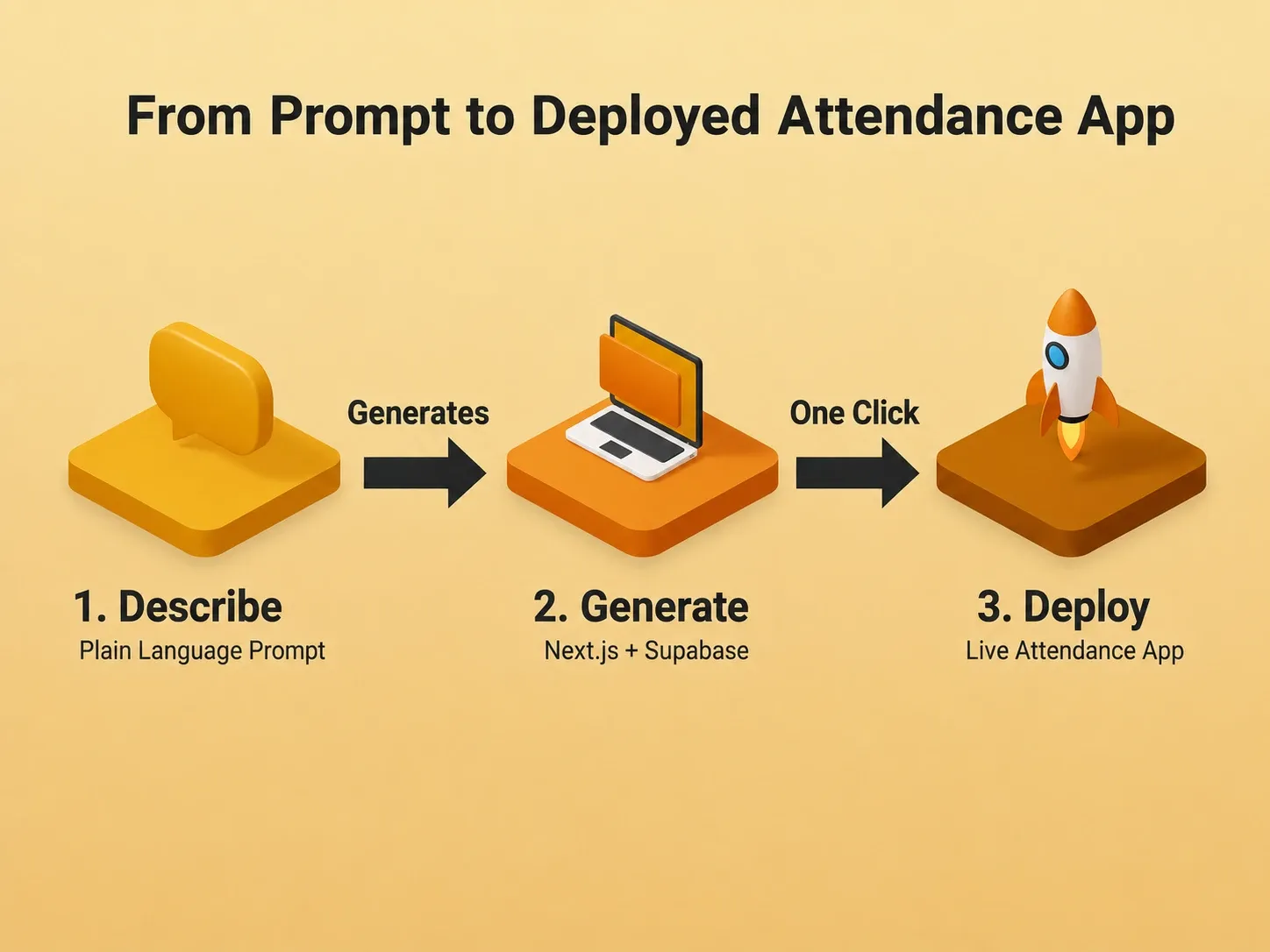
Rocket's three-step workflow: describe your attendance system in plain language, generate production-ready code, and deploy in minutes.
| Platform | Biometric AI Support | Full-Stack Code | Payroll Connectors | Time to Deploy |
|---|---|---|---|---|
| Rocket | Yes | Yes (Next.js + Flutter) | 25+ out of the box | Days |
| Bubble | Limited | No | Via plugins | Weeks |
| Cursor | Manual setup | Yes | Manual integration | Months |
| Custom dev | Full control | Yes | Custom build | Months |
Comparisons above reflect each platform's documented capabilities. They are intended to help you choose the right tool for your use case.
What Compliance and Privacy Rules Apply to AI Attendance?
Any attendance management system collecting biometric data must navigate a growing web of privacy regulations. Getting this wrong means fines, lawsuits, and employee distrust that undermines your attendance tracking program.
-
GDPR (Europe). Requires explicit opt-in consent for facial data, privacy impact assessments, and encryption of biometric attendance records. Cross-border data transfers face additional restrictions.
-
BIPA (Illinois, USA). Mandates written consent before collecting biometric identifiers for attendance tracking. Statutory damages apply per violation, which can double some rollout budgets.
-
FLSA and labor compliance. The U.S. Department of Labor's guidance on AI-based monitoring heightens record-keeping expectations. Timestamped attendance logs must support overtime calculations and accurate time tracking.
-
Data minimization for attendance records. Store only what you need. On-device processing for facial recognition reduces cloud exposure and keeps sensitive employee data local.
-
Employee notification. Workers must know what attendance data you collect, how you use it, and how long you retain it. Transparency builds trust and reduces pushback from labor unions.
Building compliance into your attendance system architecture from the start is far cheaper than retrofitting later. Rocket supports third-party connectors that simplify adding consent workflows, encryption layers, and audit trails to your attendance management software.
Privacy is not a feature you bolt on at the end. It is a foundational architectural decision that shapes your database design, API structure, and user flows for managing employee attendance data.
Build Your Attendance System Without Starting From Scratch
The gap between idea and deployed attendance management product has never been smaller. Whether you need facial recognition for a factory floor, GPS-based time tracking for field teams, or shift analytics for a hospital, the building blocks are ready in 2026.
AI development platforms have made it practical for teams of every size to build attendance management systems with AI. You get biometric hooks, compliance workflows, and real-time dashboards without a full engineering team. As edge AI matures and regulatory frameworks stabilize, the systems built today will only get more capable.
You type what you need. Rocket.new handles the database schema, the authentication layer, the payroll connectors, and the deployment. 1.5 million people across 180 countries have tried Rocket to ship production-ready products. Start building and go from idea to deployed attendance app in your first session.
Table of contents
- -Who Should Build a Custom Attendance System?
- -What Features Should Your AI Attendance System Include?
- -How Does Facial Recognition Fit Into Attendance Tracking?
- -What Database Architecture Works Best for Attendance Systems?
- -Core Tables Every Attendance System Needs
- -Step-by-Step: Planning and Designing Your System
- -How Much Does It Cost to Build an Attendance Management System?
- -How Rocket Builds Your Attendance App From a Single Prompt
- -A Real Prompt That Works
- -What Rocket Produces for Attendance Systems
- -Three Ways to Start Your Attendance App in Rocket
- -What Compliance and Privacy Rules Apply to AI Attendance?
- -Build Your Attendance System Without Starting From Scratch