A structured employee offboarding workflow protects company data, closes security gaps, and gives departing employees a clean exit. The best results come from shared task tracking between HR and IT, built once and used every time someone leaves.
Why does offboarding feel like the one process nobody owns?
According to a Beyond Identity survey, 91% of employees still had access to company files after being offboarded. That number points to something deeper than a missed IT ticket. It reveals a coordination gap between HR and IT that most organizations never close.
HR handles exit interviews, final paperwork, and benefits termination. IT handles system access, hardware recovery, and account deactivation. Both teams work the same event from separate checklists, with no shared view of progress. The result is missed steps, lingering access, and a poor last impression.
This blog breaks down how to structure a workflow that gives both teams visibility, accountability, and a clear path from resignation to the final day.
Why Does Offboarding Fall Apart Between HR and IT?
The core problem is straightforward. Two teams share a deadline but not a system.
-
HR operates on a people timeline. They schedule exit interviews, calculate final pay, process benefits changes, and coordinate knowledge transfer. Their tools tend to be HRIS platforms, email, and spreadsheets.
-
IT operates on a security timeline. They revoke system access, recover hardware, deactivate accounts, and wipe devices. Their tools are ticketing systems, admin consoles, and asset management platforms.
-
Neither team sees the other's progress. HR might close their checklist on Tuesday without knowing IT has not revoked email access. Meanwhile, IT might disable accounts on Day 1, disrupting a knowledge transfer HR scheduled for Day 3.
-
Handoffs happen through email and chat. A Slack message saying "can you disable their Google account?" has no tracking, no deadline, and no proof of completion.
When teams need to coordinate workflows across departments, the gap between intention and execution grows with each handoff. Steps get missed. Access lingers. Equipment disappears.
What Should a Structured Offboarding Workflow Cover?
Most companies treat offboarding as a loose collection of tasks. A structured workflow, however, turns those tasks into a shared sequence. It brings clear ownership, deadlines, and status tracking into one place.
-
The starting point is a shared task list. Both HR and IT need to see the same checklist for each departing employee, not separate lists in different tools.
-
Each task needs an owner, a deadline, and a status. For example, "Revoke Slack access" goes to IT, due on the employee's last day, with a status of complete or pending. No ambiguity.
-
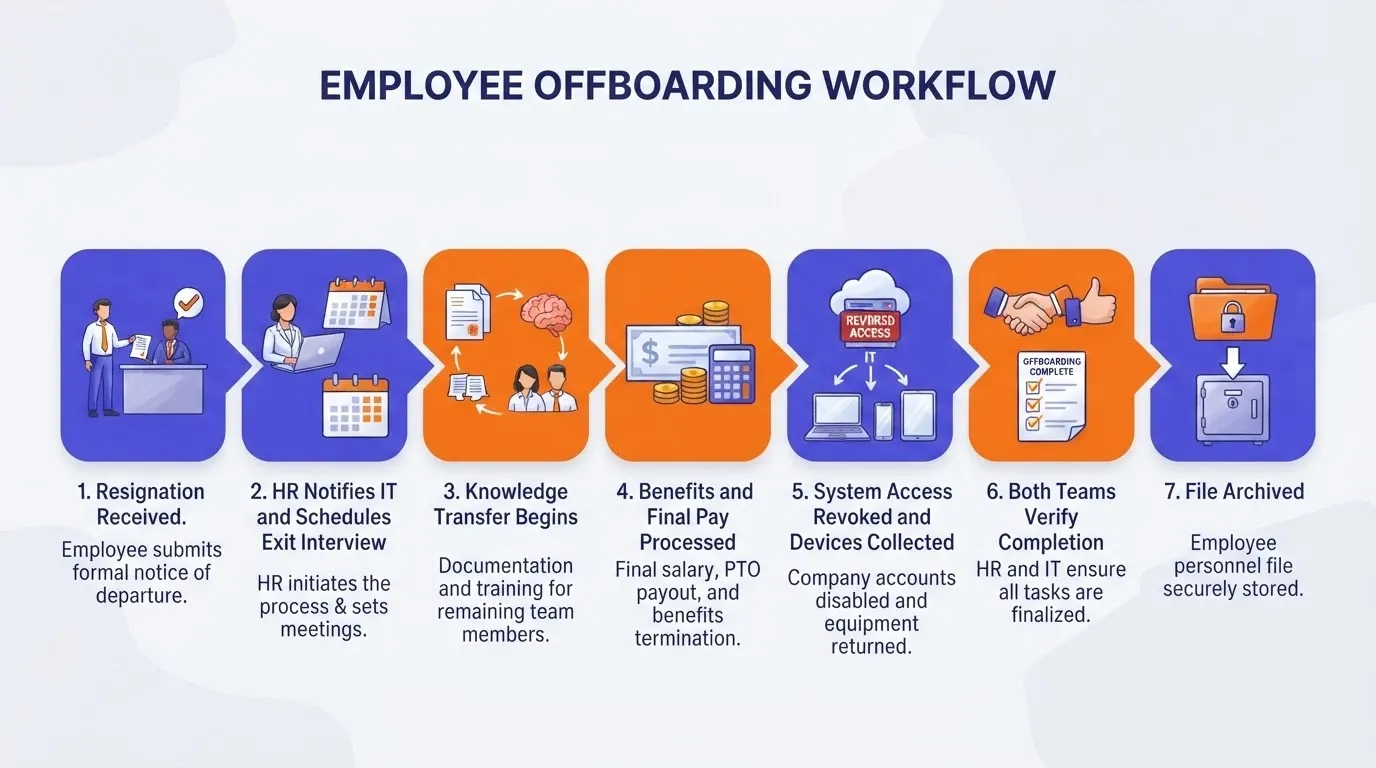
The workflow should cover seven categories. These are access revocation, equipment return, knowledge transfer, benefits termination, final pay, exit interview, and compliance documentation.
According to Folks RH, 71% of companies have not implemented a formal offboarding process, and only 5% have fully automated one. That gap creates real risk at scale.
Below is what the task split typically looks like between HR and IT:
| Category | HR Owns | IT Owns |
|---|---|---|
| Access Revocation | Notify IT of last day | Disable all accounts, SSO, VPN |
| Equipment | Coordinate return logistics | Collect laptops, phones, badges |
| Knowledge Transfer | Schedule sessions with team | Archive shared drives, repos |
| Benefits | Process COBRA, terminate benefits | Remove from benefits portals |
| Final Pay | Calculate final paycheck, PTO payout | N/A |
| Exit Interview | Conduct and document | N/A |
| Compliance | Collect signed NDAs, agreements | Generate access audit log |
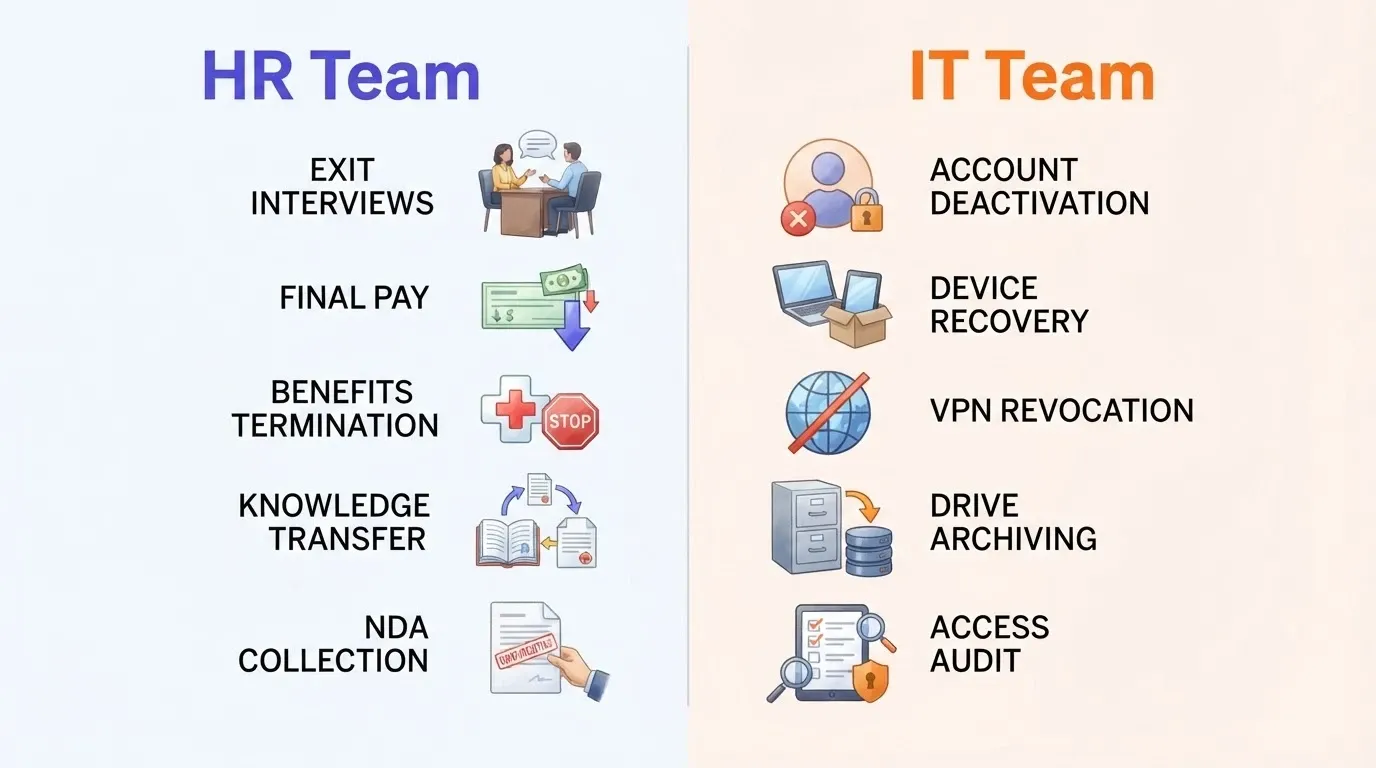
As you can see, building this as a shared HR onboarding and offboarding workflow removes the guesswork from both sides.
How Do You Assign Ownership at Every Step?
Ownership breaks down when tasks live in someone's head instead of a system. A strong employee offboarding workflow makes every task visible, assigned, and trackable.
-
Use role-based assignment. Map each task to a specific role, not a person. "IT Admin" owns account deactivation, while "HR Coordinator" owns exit interview scheduling. When someone is out sick, the role still gets covered.
-
Set deadlines relative to the employee's last day. "Revoke VPN access: Day 0" and "Conduct exit interview: Day -3" give both teams a timeline that adjusts when the departure date changes.
-
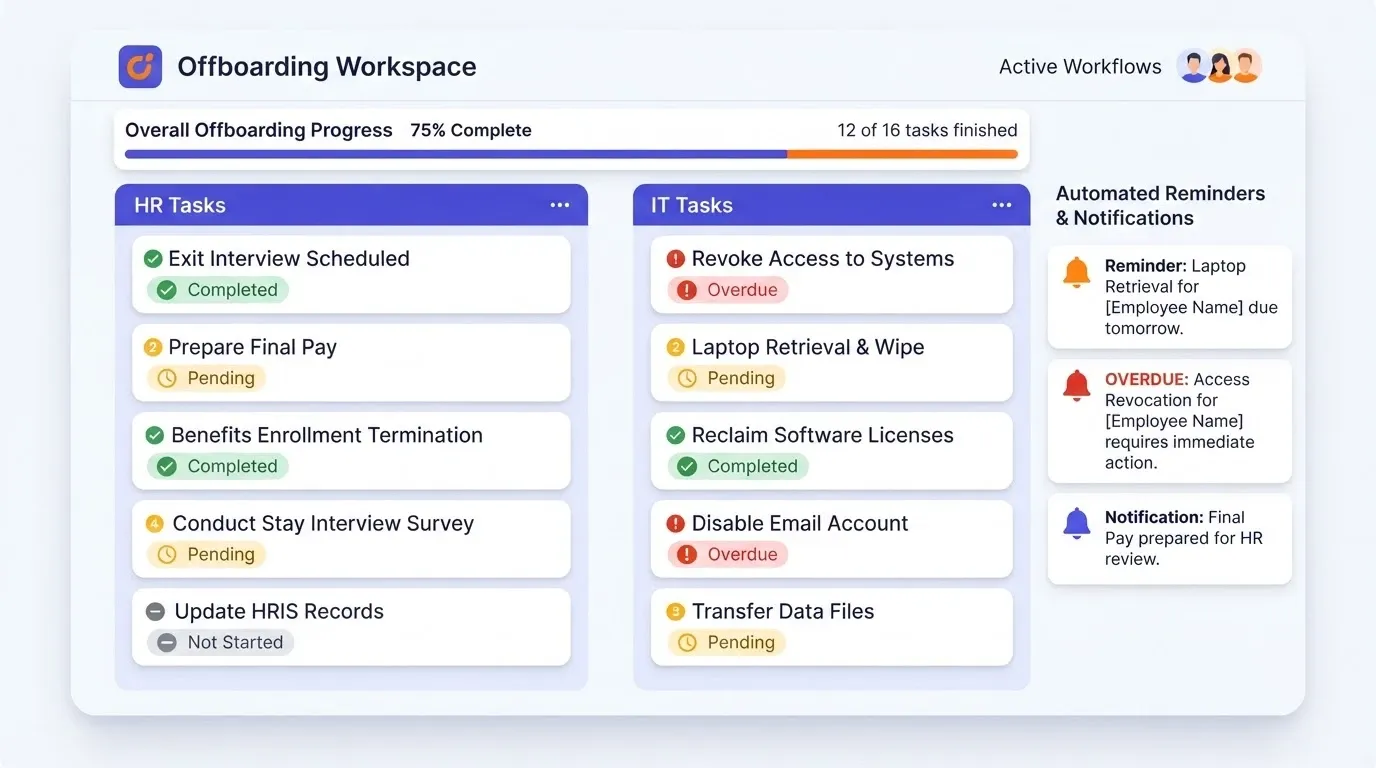
Build in automated reminders. A task due in two days should trigger a notification. A task overdue by one day should escalate to a manager. Manual follow-up simply does not scale.
-
Create a status dashboard. Both teams need a single view showing which tasks are done, pending, or overdue. This is the most common missing piece in any offboarding process.
Where Do Most Offboarding Processes Break Down?
The failures are predictable, and they almost always trace back to speed and visibility.
-
Access revocation happens too slowly. Cyberhaven's research found that organizations see a 720% surge in data exfiltration activity in the 24 hours before a layoff. If IT does not revoke access on the same day, the window for data theft stays open.
-
Shadow IT goes untracked. Former employees may still have access to apps that IT does not manage. Personal Trello boards, shared Google Docs, and third-party SaaS accounts created with a work email all fall outside standard deprovisioning.
-
Equipment return has no follow-through. A laptop marked as "to be returned" can sit in someone's apartment for months. Nobody tracks whether it actually came back.
-
Exit interviews get skipped. When HR is busy, the exit interview is the first thing to drop. As a result, the company loses the feedback it needs to reduce future turnover.
-
Compliance documentation is incomplete. GDPR, SOX, and HIPAA all require documented evidence of access removal at separation. Informal processes leave audit trails full of gaps.
Dave Pasirstein, CEO at SecretShield, shared a real incident in a Cyberhaven analysis:
"Six weeks after a contingent worker left the company, the FBI contacted us. It turned out that the individual had tried to sell the company's confidential data to a third party. He had transferred some of his work to a personal account before leaving, an activity most companies struggle to detect."
That kind of exposure is not rare. A Beyond Identity survey found that 32% of employers have had their website hacked due to ineffective offboarding. The cost to fix these incidents averaged $7,700 per company.
The Real Cost of Poor Offboarding
Most organizations measure offboarding cost in hours spent on paperwork. In reality, the actual cost shows up in three places: security incidents, productivity loss, and reputation damage.
Security incidents are the most visible. The $7,700 average remediation cost is a floor, not a ceiling. A single data breach involving customer records can trigger GDPR fines of up to €20 million or 4% of global turnover.
Productivity loss compounds quietly over time. When a departing employee's documentation is incomplete and their accounts are deactivated before handoff is finished, institutional knowledge walks out the door permanently.
Reputation damage is the slowest to appear. Employees who leave with a poor offboarding experience talk about it. Glassdoor reviews and word-of-mouth in tight professional communities are shaped by the last impression a company makes.
| Cost Category | Informal Process | Structured Workflow |
|---|---|---|
| Security Remediation | $7,700+ per incident | Near zero with same-day access revocation |
| Compliance Exposure | GDPR fines up to €20 million | Documented audit trail at every step |
| Knowledge Transfer | Days to weeks of ramp time | Scheduled, tracked, and verified complete |
| Equipment Recovery | 30 to 60% loss rate | Tracked return with IT confirmation |
| Rehire Eligibility | Inconsistent and undocumented | Standardized and archived for HR reference |
How to Build a Shared Offboarding Workspace
You describe the workflow in plain language. Rocket then generates a working web application with the UI, logic, and data structure already in place. For HR and IT teams, that means a shared offboarding workspace with task tracking, role-based dashboards, and automated reminders can be live in a single session. No coding required.
Here is how a typical build works:
Step 1: Describe the workflow. Open a Build task and describe your offboarding process. For example, you might say: "Build an internal offboarding tracker for HR and IT. HR users see people tasks like exit interviews, final pay, and NDA collection. IT users see technical tasks like account deactivation, device recovery, and access audit logs. Both roles see a shared status dashboard with owners, due dates, and completion status. Overdue tasks escalate automatically."
Step 2: Connect your existing tools. Rocket supports 25+ integrations out of the box. Connect Notion for documentation, Airtable for employee records, Google Workspace for calendar scheduling, or Supabase for a persistent database backend. Authenticate once and the integration flows into every build automatically.
Step 3: Iterate through conversation. After the first generation, you can adjust anything through chat. For instance, say "Add a compliance checklist tab for GDPR documentation" or "Send an email notification when a task is overdue by 24 hours." Each change applies in context, without re-explaining what already exists.
Step 4: Deploy and share. Click Launch. The application deploys to a live URL with automatic HTTPS. Share the link with HR and IT teams. No infrastructure setup, no DevOps, and no waiting for engineering.
The entire process, from first prompt to a deployed and working offboarding tool, typically takes one session. 1.5 million people have tried Rocket across 180 countries, from solopreneurs to enterprise teams building internal tools like this one.
What Does a Complete Offboarding Timeline Look Like?
A clear timeline removes ambiguity about when each task should happen. Below is a practical schedule pegged to the employee's last day, referred to as Day 0.
-
Day -14 (two weeks before): HR receives the resignation. Notify IT. Schedule the exit interview. Begin knowledge transfer planning.
-
Day -7 (one week before): HR sends the benefits termination notice. IT audits all system access and prepares the deprovisioning checklist. Knowledge transfer sessions begin.
-
Day -3 (three days before): Exit interview is completed. Final paycheck is calculated. IT confirms the hardware return plan.
-
Day -1 (one day before): HR collects the signed NDA and any remaining documents. IT prepares account deactivation scripts.
-
Day 0 (last day): IT disables all accounts, SSO, VPN, and email within hours of departure. HR processes final pay. IT collects equipment.
-
Day +1 (one day after): IT verifies no active sessions remain. HR archives the offboarding file. Compliance documentation is complete.
-
Day +7 (one week after): IT runs a final access audit. HR reviews exit interview notes for patterns across recent departures.
The key is treating Day 0 as a hard deadline, not a suggestion. When access revocation slips to Day +3 or Day +7, the security window stays open far longer than it should.
Offboarding Compliance: What HR and IT Both Need to Document
Regulated industries face specific documentation requirements at employee separation. A shared workflow that produces an audit trail is not optional. It is the difference between passing an audit and failing one.
GDPR (EU and UK). When an employee leaves, their personal data must follow your data retention policy. Access to systems containing customer personal data must be revoked and documented. If the departing employee had data processor responsibilities, those must be formally transferred.
SOX (US public companies). Sarbanes-Oxley requires documented controls over financial system access. An employee with access to financial reporting systems who leaves without documented revocation creates a SOX control failure. IT generates an access audit log on Day 0, and HR retains it.
HIPAA (US healthcare). Any employee with access to protected health information requires documented access termination. The covered entity must retain evidence of access revocation as part of its security management process.
Every offboarding record should include the following:
-
Date and time of each account deactivation
-
Name of the IT admin who completed each revocation
-
Confirmation of device return with serial numbers
-
Signed NDA and any IP assignment agreements
-
Exit interview completion status
-
Final paycheck and PTO payout confirmation
A workflow that captures this automatically, timestamped, role-attributed, and archived, turns compliance from a manual burden into a natural byproduct of the process. Teams that automate business workflows with clear ownership stop depending on someone remembering to file the right form.
Build Your Offboarding Workflow Today
A structured employee offboarding workflow is not a nice-to-have. It is the difference between a security incident and a clean exit, and between a compliance failure and an audit-ready record. As remote work, contractor relationships, and workforce transitions grow more complex, organizations that build shared, automated offboarding systems will carry less risk and retain more institutional knowledge.
You describe the process. Rocket generates the working tool. Start building your shared HR and IT offboarding workspace at Rocket.new.
Table of contents
- -Why Does Offboarding Fall Apart Between HR and IT?
- -What Should a Structured Offboarding Workflow Cover?
- -How Do You Assign Ownership at Every Step?
- -Where Do Most Offboarding Processes Break Down?
- -The Real Cost of Poor Offboarding
- -How to Build a Shared Offboarding Workspace
- -What Does a Complete Offboarding Timeline Look Like?
- -Offboarding Compliance: What HR and IT Both Need to Document
- -Build Your Offboarding Workflow Today