
Retained search firms lose mandates to coordination gaps, not talent shortages. A shared hiring command center gives every consultant real-time visibility into candidate status, interview notes, and client feedback, closing searches faster.
Is your search team still catching up on Monday instead of closing on Friday?
Search firms running retained mandates need one shared space. Candidate status, interview notes, and client feedback must update in real time.
According to SHRM, the average cost per hire sits near $4,700. For executive-level roles, that figure climbs past $15,000. When information gaps add weeks to a search, those costs compound quickly.
This blog covers what belongs in a command center for search firms, which data needs real-time visibility, and how to build one without adopting an enterprise ATS platform.
Why Search Teams Keep Contacting the Same Candidate Twice
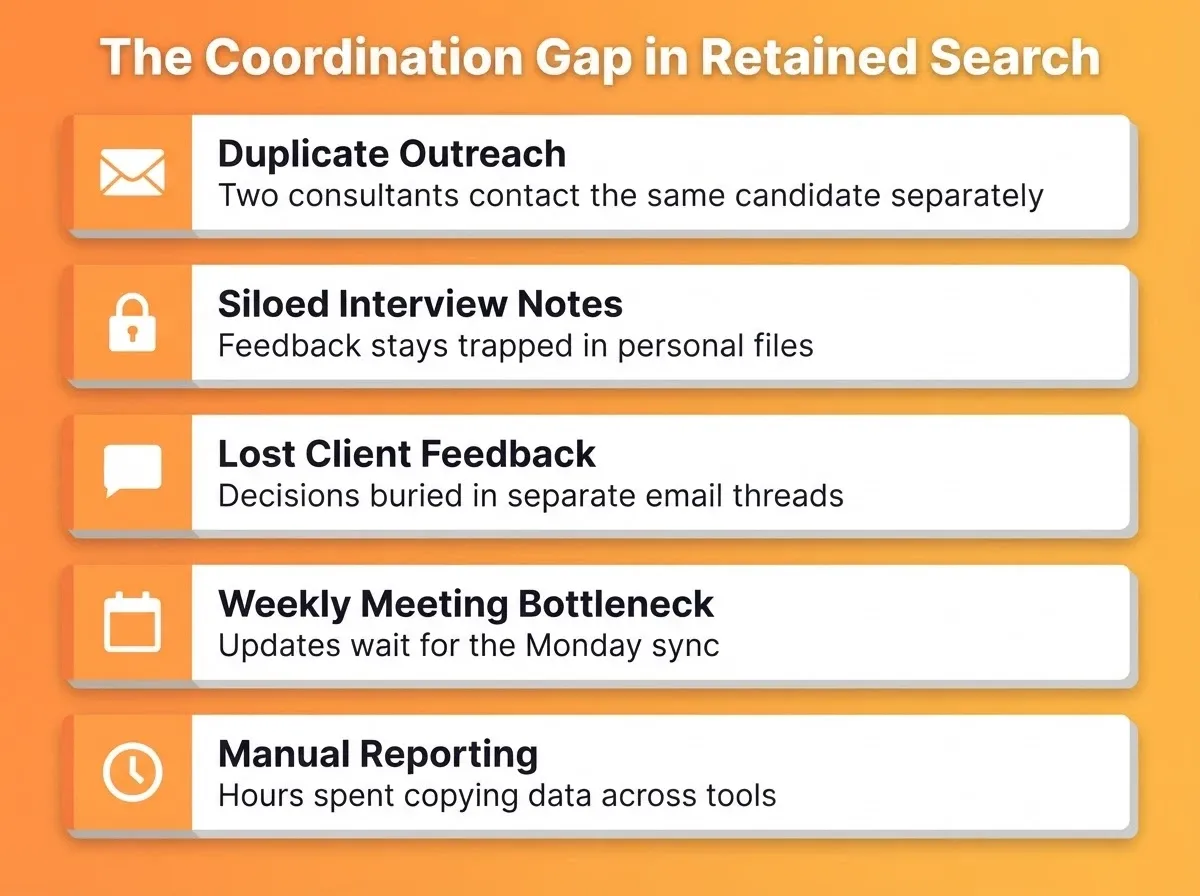
Duplicate outreach is the most visible symptom of a coordination gap. However, it is far from the only one. When a search team operates from disconnected tools, the same problems repeat across every active mandate.
-
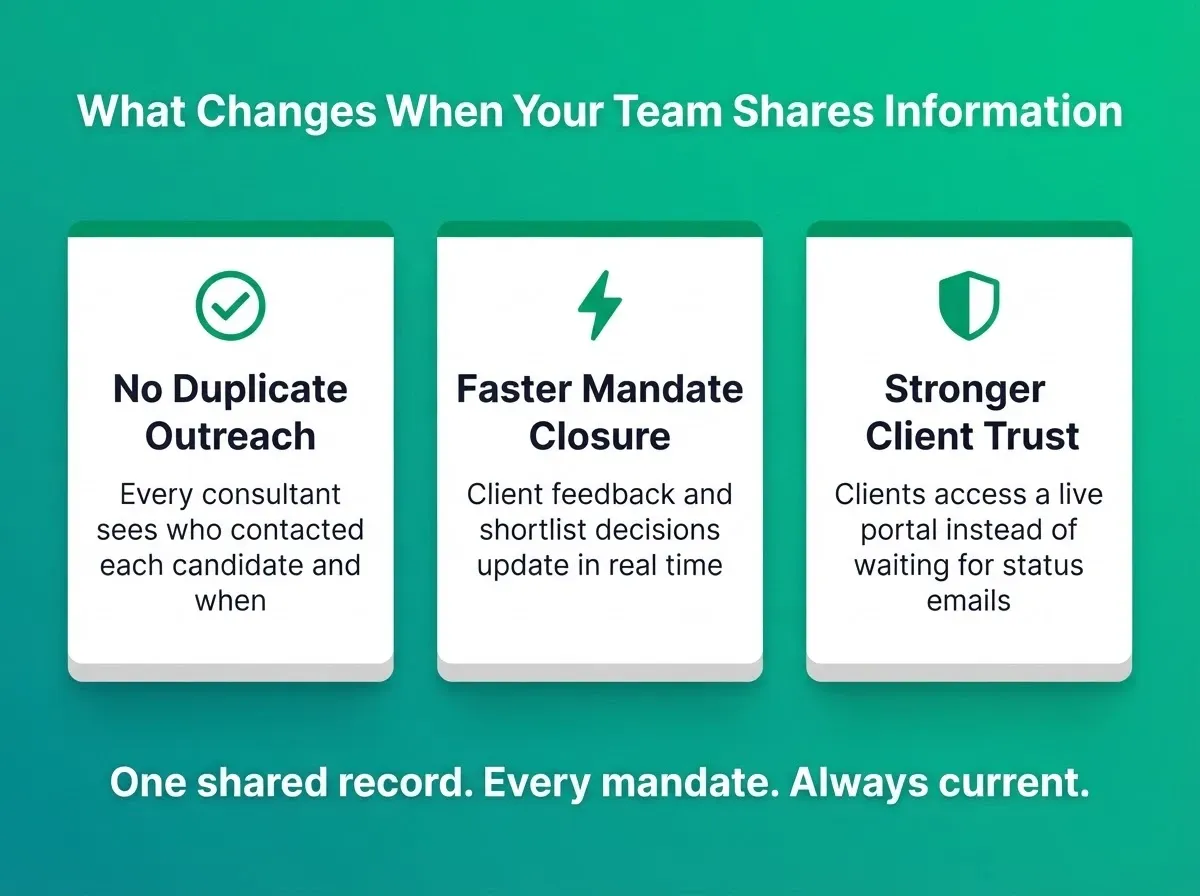
Two consultants reach the same candidate without knowing it. One sends a LinkedIn message on Tuesday. The other calls on Wednesday with a different pitch for the same role. The candidate questions how organized the firm is, and that first impression is hard to repair.
-
Interview notes stay locked in personal files. A senior associate completes three screening calls and records notes in a private document or email draft. When the partner needs to brief the client, they either request a summary or reconstruct the picture from memory.
-
Client conversations disappear into individual email threads. The managing director speaks with the client on Friday about narrowing the shortlist. The associate working the same search does not hear about it until Monday's standup, if it comes up at all.
-
The weekly meeting becomes the only reliable sync point. Shortlist approvals, candidate advances, and timeline adjustments all wait for the one hour when everyone sits in the same room. Between meetings, the search stalls even when action is possible.
-
Reporting takes hours that should go toward sourcing. Pulling together a client status report means copying data from an ATS and merging notes from email. The spreadsheet is already outdated by the time it reaches the partner's desk.
The core problem is not carelessness. It is the absence of a shared record that updates as the search progresses. Firms that invest in a live hiring dashboard for executive search teams see these coordination failures drop within the first week.
What Information Belongs in a Shared Pipeline View?
Not every piece of data needs to be visible to every person at all times. The goal is to find which categories cause the most coordination failures when siloed. Then, make those categories visible to the whole team in real time.
| Data Category | What It Includes | Who Needs It | Update Frequency |
|---|---|---|---|
| Candidate Status | Current pipeline stage, last contact date, next action | All consultants on the mandate | Real-time |
| Interview Notes | Structured feedback, scores against role criteria, red flags | Search lead, partner, hiring manager | After each conversation |
| Client Feedback | Shortlist reactions, requests for additional candidates, timeline changes | Entire search team | Within hours of client contact |
| Outreach History | Who contacted which candidate, through which channel, with what message | All consultants | Real-time |
| Compensation Data | Candidate expectations, client budget range, competing offer signals | Search lead, partner | As information surfaces |
| Search Timeline | Milestones, days in current stage, projected close date | All team members, client (limited view) | Daily |
According to McKinsey's State of Organizations report, two-thirds of business leaders describe their organizations as overly complex with significant coordination overhead. For search firms, that complexity lives in one specific gap. It sits between what one consultant knows and what the rest of the team can see.
As a result, a centralized candidate review system pulls all six categories into a single view. The search lead stops asking "where are we on this?" because the answer is always visible. The partner stops requesting status emails because the dashboard shows progress in real time.
When every data category lives in one place, the Monday sync shifts its purpose. Instead of catching everyone up, the team focuses on deciding what to do next. That is a fundamentally different conversation.
How Real-Time Visibility Prevents Client Confusion
Client confidence drops every time a search firm delivers contradictory information. When one consultant says the shortlist is ready Thursday and another mentions a two-week delay in a separate email, the client starts wondering who is running the search.
-
Conflicting timelines damage trust quickly. A client receiving two different status updates from the same firm within the same week will question the firm's internal coordination. For retained search, where the relationship spans months, that doubt compounds.
-
Delayed feedback loops stall searches unnecessarily. When a client rejects a candidate on Wednesday, the search team needs to know immediately. If they wait until Friday's meeting, two days of sourcing effort may target the wrong profile.
-
Shared visibility turns reactive updates into proactive decisions. The search lead can see pipeline movement in real time and flag issues before the client raises them. No more waiting to be asked for a status report.
LinkedIn's Global Talent Trends report found that internal mobility increased 6% year-over-year. This reflects a broader shift toward real-time talent visibility across organizations. Teuila Hanson, LinkedIn's SVP and Chief People Officer, noted:
For search firms, upgrading the talent playbook starts with making every piece of search data visible to every relevant team member. Building a team collaboration platform with AI around your firm's specific workflow does exactly that.
Retained Search Workflow That Scales With the Team
A command center is only as useful as the workflow it reflects. For retained search, that workflow runs from client intake through placement and post-placement follow-up. Here is a simplified version that most boutique firms can adapt to their own practice.
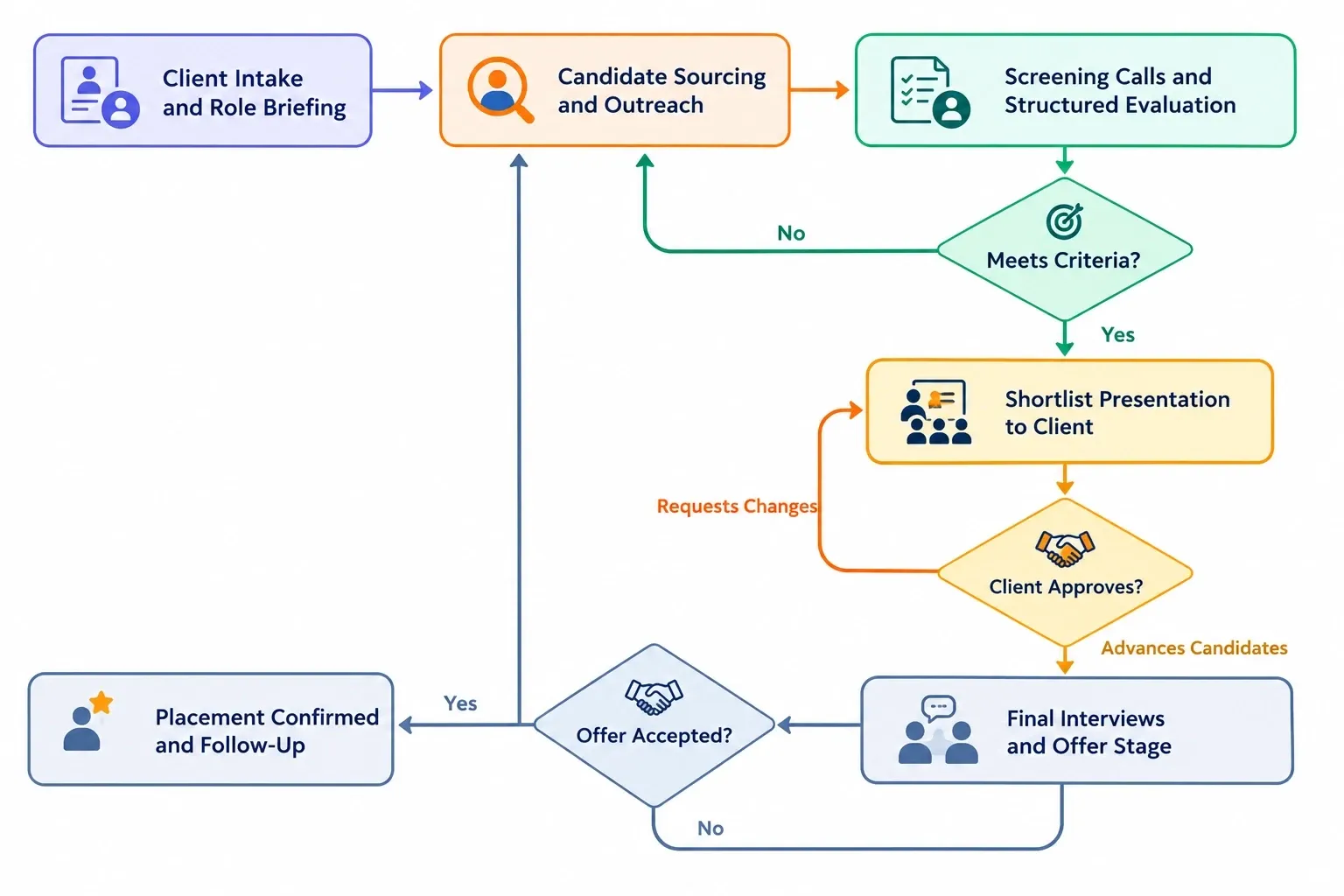
Retained search workflow from client intake to placement, with each stage feeding data into the shared command center.
Each stage generates data the rest of the team needs to see. Sourcing produces outreach history and pipeline depth. Evaluation produces interview scores. Client presentation produces approvals and revision requests. All of it should live in one place.
When a firm grows from two consultants to five, coordination overhead does not scale linearly. It compounds. A command center that reflects this workflow gives every team member one source of truth. That stays true no matter how many mandates are running in parallel.
Role-Based Access: Who Sees What
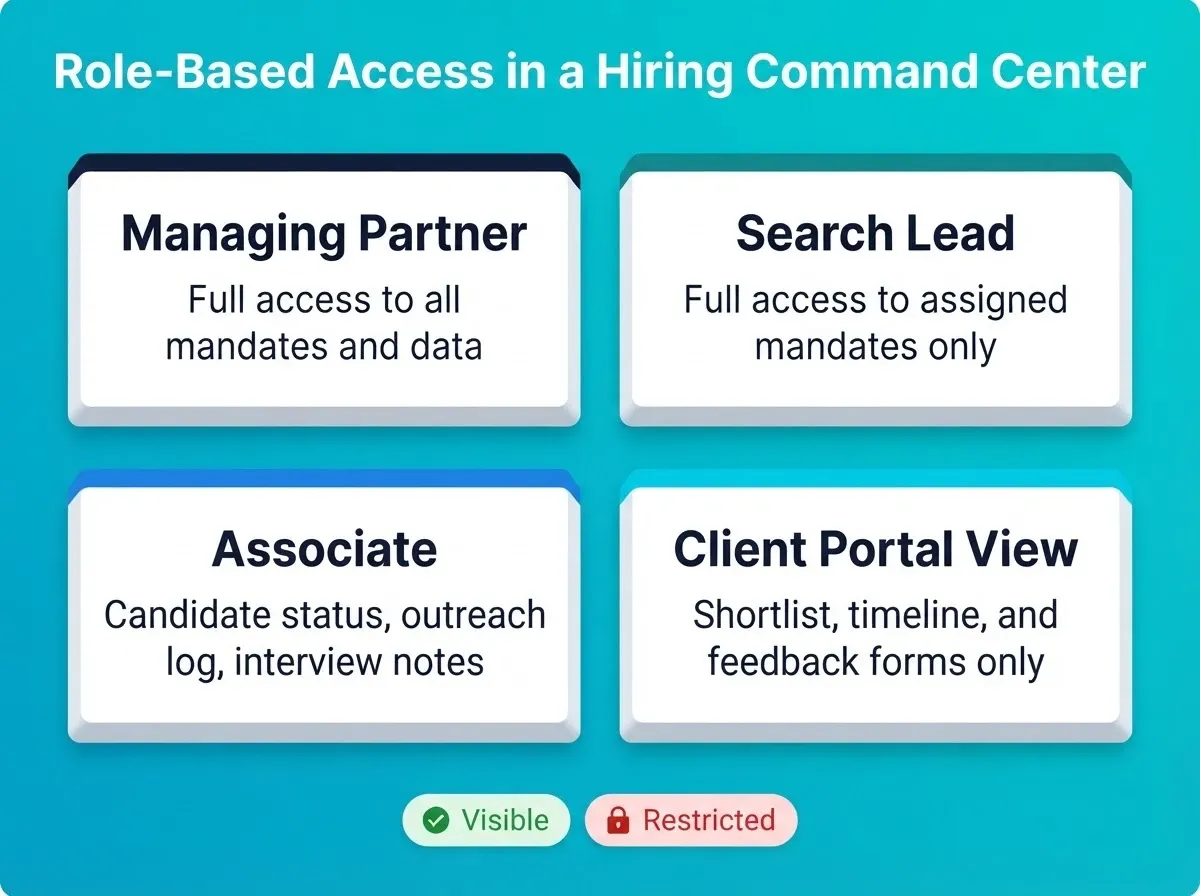
Not all data should be equally visible. A well-designed command center uses role-based access to protect sensitive information while keeping the team aligned.
| Role | Full Access | Restricted Access |
|---|---|---|
| Managing Partner | All mandates, all data | None |
| Search Lead | Assigned mandates, all data | Other leads' mandates |
| Associate | Candidate status, outreach log, interview notes | Compensation data, client financials |
| Client (Portal View) | Shortlisted candidates, timeline, feedback forms | Internal notes, compensation data, full pipeline |
Giving clients a read-only portal view of their mandate is one of the highest-leverage features a search firm can add. It eliminates the weekly status email, reduces inbound client calls, and positions the firm as operationally transparent.
How to Build Your Command Center With Rocket
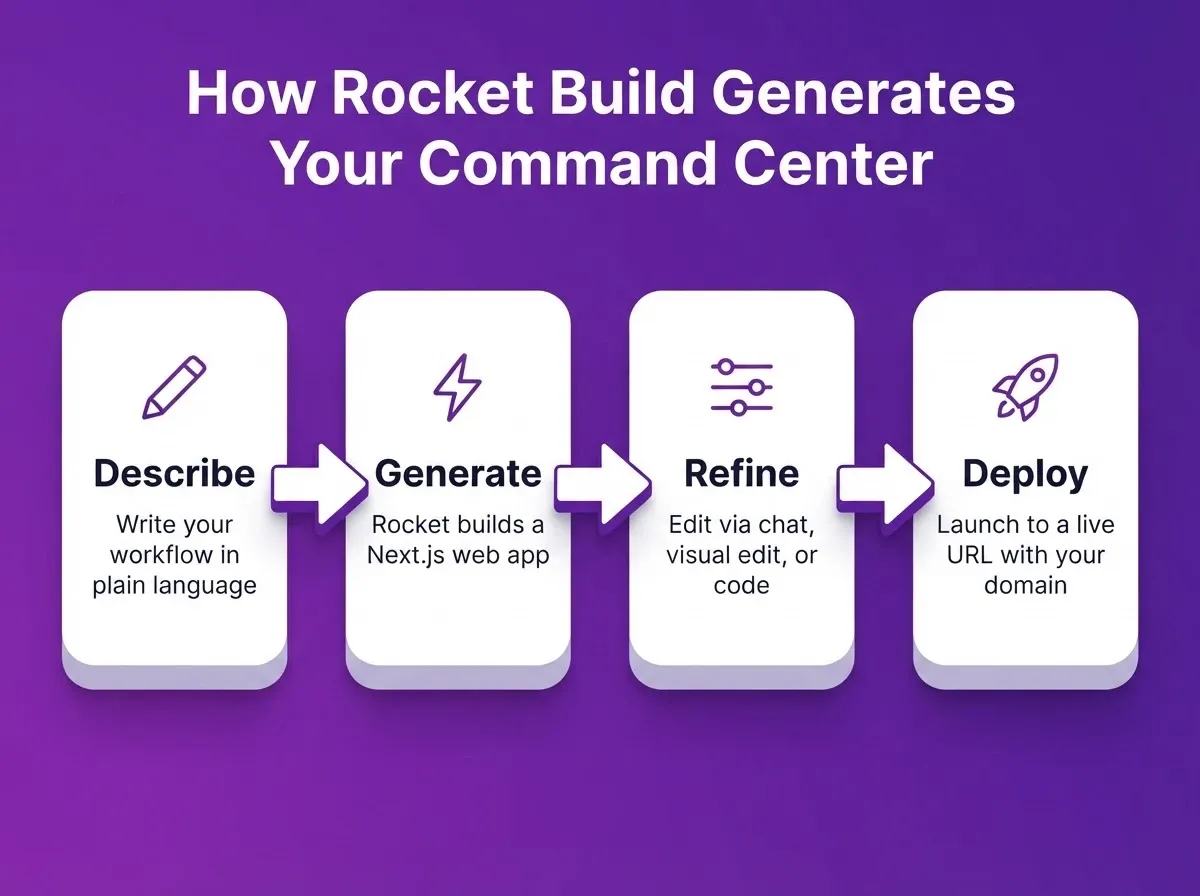
You describe your search firm's workflow in plain language. Rocket's Build capability then generates a fully functional, production-ready web application from that description. No developer is required.
Here is what a strong build prompt looks like for a search firm:
"Build a shared hiring command center for a boutique retained search firm. It needs a candidate pipeline view with stages (sourced, screened, shortlisted, interviewing, offer, placed), structured interview feedback forms, an outreach log showing who contacted each candidate and when, a client portal with read-only access to the shortlist and timeline, and a reporting dashboard showing days in each stage and mandate progress. Role-based access for partners, associates, and clients."
Rocket generates a production-ready Next.js web application with a live preview the moment generation finishes. From there, you refine through chat, visual edit, or code view until the application matches your firm's exact process. Add a new search stage, adjust the feedback form fields, or change the client portal layout. Describe the change and Rocket updates the tool in context.
Connect Your Existing Tools
Rocket supports 25+ integrations that link your command center to the tools your team already uses. Common connections for search firms include:
-
Supabase for structured candidate and mandate data with row-level security
-
Notion to pull context from existing research notes directly into the build
-
Airtable to sync existing candidate databases
-
Google Workspace to surface scheduling context alongside pipeline data
Connect what you need and leave out what you do not. The command center should serve your workflow, not force you to adopt a new one.
Rocket Plans at a Glance
| Plan | Price | Credits Included | Best For |
|---|---|---|---|
| Free | $0 | 20 (one-time) | Light, exploratory, and personal use |
| Pro | $25/month | 100/month | Building web apps, mobile apps, and landing pages |
| Rocket | $50/month | 250/month | Frequent use by individuals and teams |
| Booster | $250/month | 1,500/month | Power users and fast-moving teams |
All paid plans include unlimited team members. Credits cover Build, Solve, and Intelligence.
The Search Firm That Shares Information First Wins the Mandate
Retained search is a relationship business. Every relationship runs on trust. When your team shares candidate updates, interview feedback, and client decisions in real time, you close mandates faster. Clients come back because they trust the process. The firms still patching things together with email threads and spreadsheets lose time they cannot recover.
The operational side of search should not compete with the relational side. Build the system that handles coordination so your consultants can focus on judgment and relationships.
Start Building Your Shared Hiring Command Center Today
The way retained search firms operate is shifting. Clients expect faster updates, tighter coordination, and fewer surprises. A shared hiring command center is no longer a competitive advantage. It is the baseline.
Firms that build a shared hiring command center around their exact workflow will close mandates faster and deliver the transparency clients expect.
Describe your search process to Rocket and have a working command center deployed before your next client call. Start building on Rocket.new.
Table of contents
- -Why Search Teams Keep Contacting the Same Candidate Twice
- -What Information Belongs in a Shared Pipeline View?
- -How Real-Time Visibility Prevents Client Confusion
- -Retained Search Workflow That Scales With the Team
- -Role-Based Access: Who Sees What
- -How to Build Your Command Center With Rocket
- -Connect Your Existing Tools
- -Rocket Plans at a Glance
- -The Search Firm That Shares Information First Wins the Mandate
- -Start Building Your Shared Hiring Command Center Today