
Advisory firms that build buyer review center portals run tighter deal processes, protect seller confidentiality at every stage, and read buyer intent from behavioral data, not guesswork.
What happens when a PDF lands in the wrong inbox mid-deal?
When a boutique advisory firm manages six prospective buyers, the advisor controls who sees what, in what order, and when. That control disappears the moment someone forwards a document to the wrong party.
The pressure is real. According to Bain and Company's 2025 M&A Report, deal value rose to the second-highest year on record across all industries. More deal activity means more buyer groups for advisors to manage.
This blog walks through what a buyer review center includes, how it protects the seller, and how to set one up without an enterprise budget.
What Goes Into a Buyer Review Center?
A buyer review center is a private, deal-specific portal where prospective acquirers access documents and complete process milestones. Think of it as the operational backbone of a managed sale. All buyer activity flows through this single system, from the initial teaser through final bids.
Unlike a standard virtual data room, a buyer review center operates across the full sale process. It controls access at every stage. The advisor decides who receives the information memorandum, who advances to the management presentation, and who earns access to the full financial model.
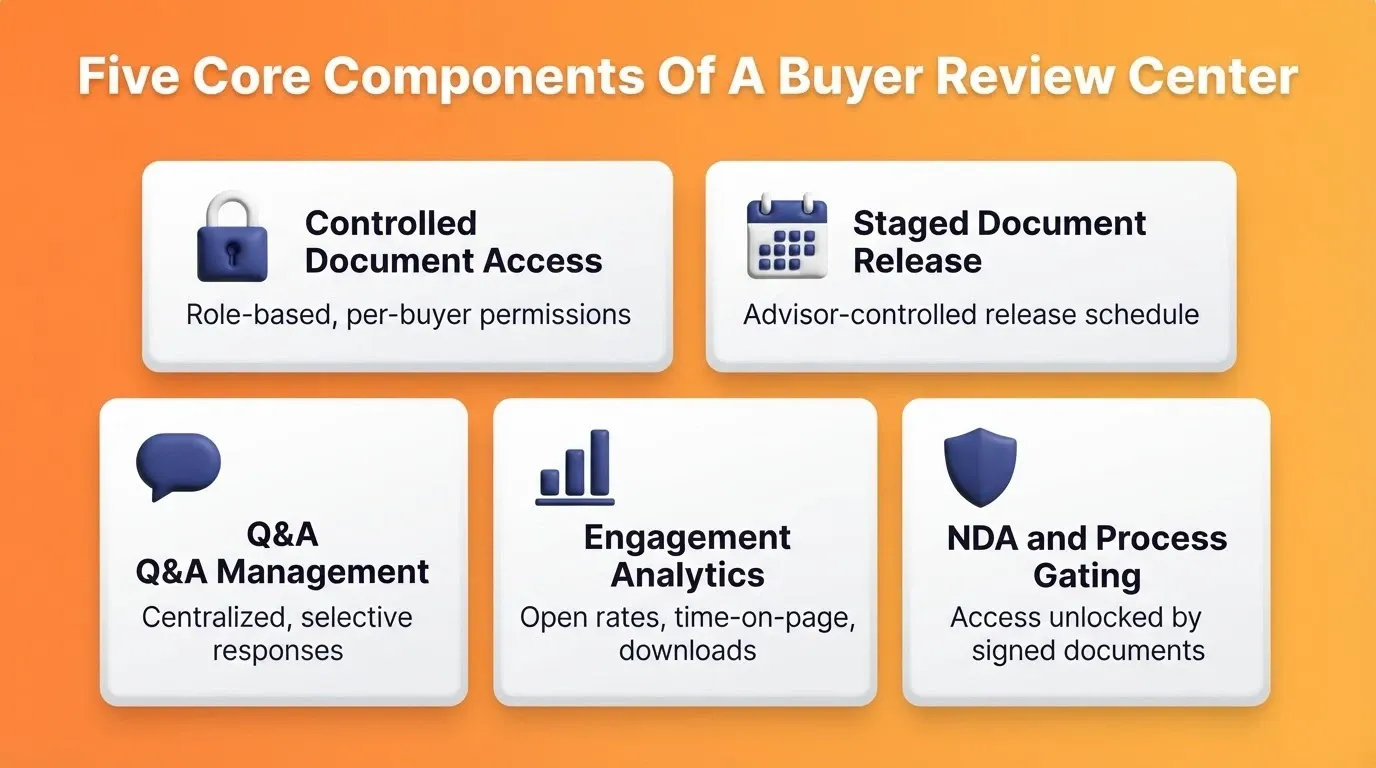
The core components typically include:
-
Controlled document access: Each buyer or buyer group gets a unique login with permissions tied to their deal stage.
-
Staged document release: The advisor decides when a new document package goes live. Buyers only see what they are cleared to view.
-
Q&A management: Questions from different buyers are tracked centrally. Answers are shared selectively or across the full group.
-
Engagement analytics: The advisor sees which documents were opened, how long a buyer spent reviewing, and whether materials were downloaded.
-
NDA and process gating: Access to later-stage materials requires a signed NDA or letter of intent before the portal releases them.
The gap is operational control. Advisory firms can describe what they need in plain language and generate a working portal using AI-powered app builders designed for M&A advisory teams. These tools handle permissions, gating, and tracking from the very first generation.
| Feature | Email and Shared Drive | Dedicated Buyer Portal |
|---|---|---|
| Document access control | Manual, error-prone | Role-based, automatic |
| Staged release | Requires separate sends | Scheduled or gated |
| Q&A tracking | Scattered across inboxes | Centralized log |
| Engagement visibility | None | Real-time analytics |
| NDA gating | Manual follow-up | Automated access triggers |
| Audit trail | None | Full timestamped record |
How Does Controlled Access Protect the Seller?
Sellers care about one thing during a managed process. Confidential information must reach only the right people at the right time. Controlled access is how the advisor delivers on that promise.
-
Tiered permission groups: Buyers at the initial indication of interest stage see a teaser and information memorandum. Buyers who submit binding offers get access to the full financial model, tax returns, and management presentations.
-
Time-limited access windows: The advisor sets an expiration on document availability. A buyer who drops out of the process loses visibility automatically.
-
Watermarked downloads: Every PDF downloaded carries the buyer's name and timestamp. This creates a clear deterrent against unauthorized sharing.
-
Audit trails for the seller: The advisor provides the seller with a weekly summary. It shows exactly which buyers accessed which materials and when.
According to McKinsey's 2026 M&A trends analysis, dealmaking has quickly assumed a grand scale, with momentum continuing into the current year. As deal volumes grow, the operational cost of a single information leak rises with them.
When access is automated, the advisor spends less time policing distribution. As a result, more time goes toward reading buyer behavior and advancing the deal. A well-configured buyer review center turns document delivery into a controlled, auditable workflow.
The Three-Tier Access Model
Most structured sales processes run through three distinct access tiers. A well-built buyer review center enforces each one automatically.
Tier 1, Initial Outreach: Buyers receive a teaser document and a non-disclosure agreement. The portal releases the information memorandum only after the NDA is countersigned. No manual follow-up is required.
Tier 2, Indication of Interest: Buyers who submit a non-binding IOI gain access to the management presentation, customer concentration data, and key operational metrics. Buyers who do not submit are automatically locked out of this tier.
Tier 3, Final Round: Shortlisted buyers receive the full financial model, tax returns, and legal documentation. Access is time-limited, watermarked, and fully logged.
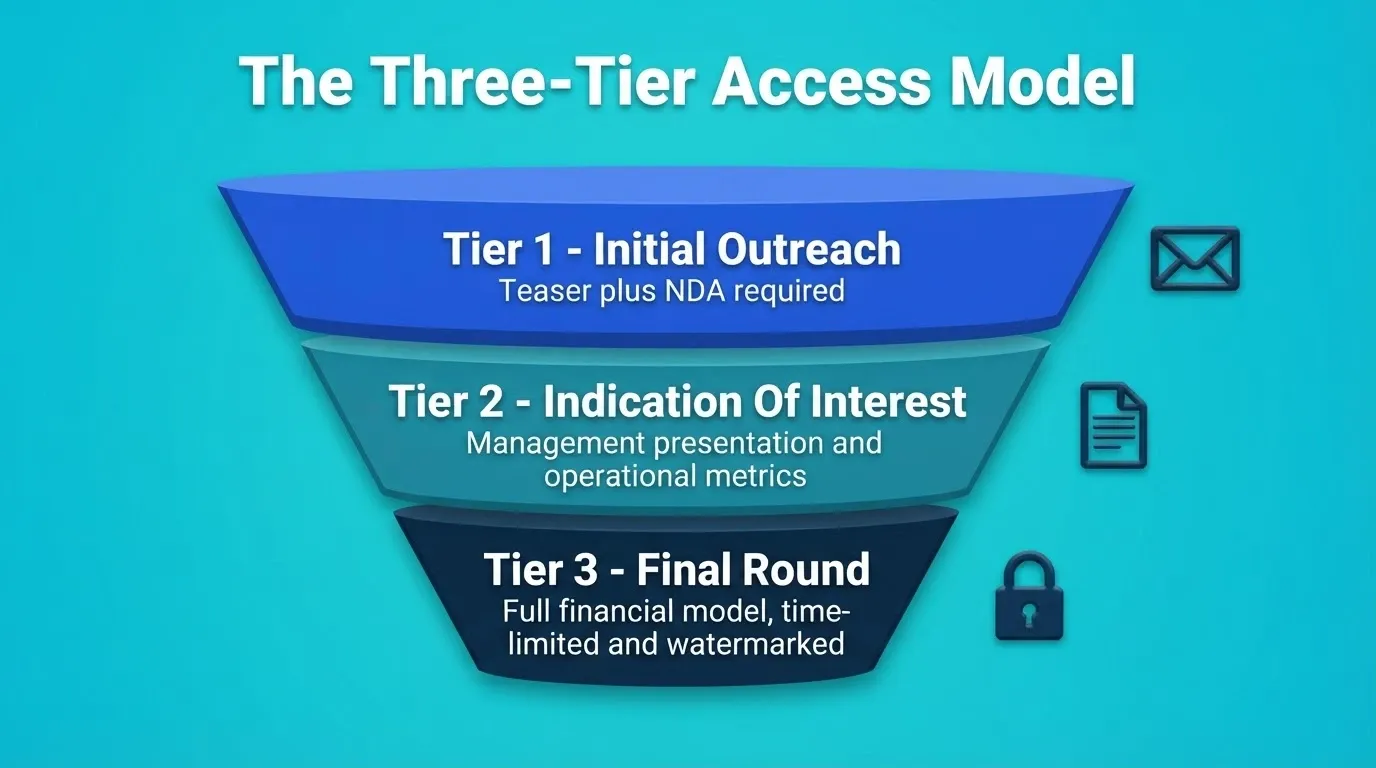
This architecture means the advisor never accidentally sends a Tier 3 document to a Tier 1 buyer. The system enforces the process, not the advisor's memory.
Can Engagement Tracking Replace Guesswork?
Most advisors gauge buyer interest through email responses and phone calls. That approach works until four or five serious parties move at different speeds. At that point, the signals start to blur.
-
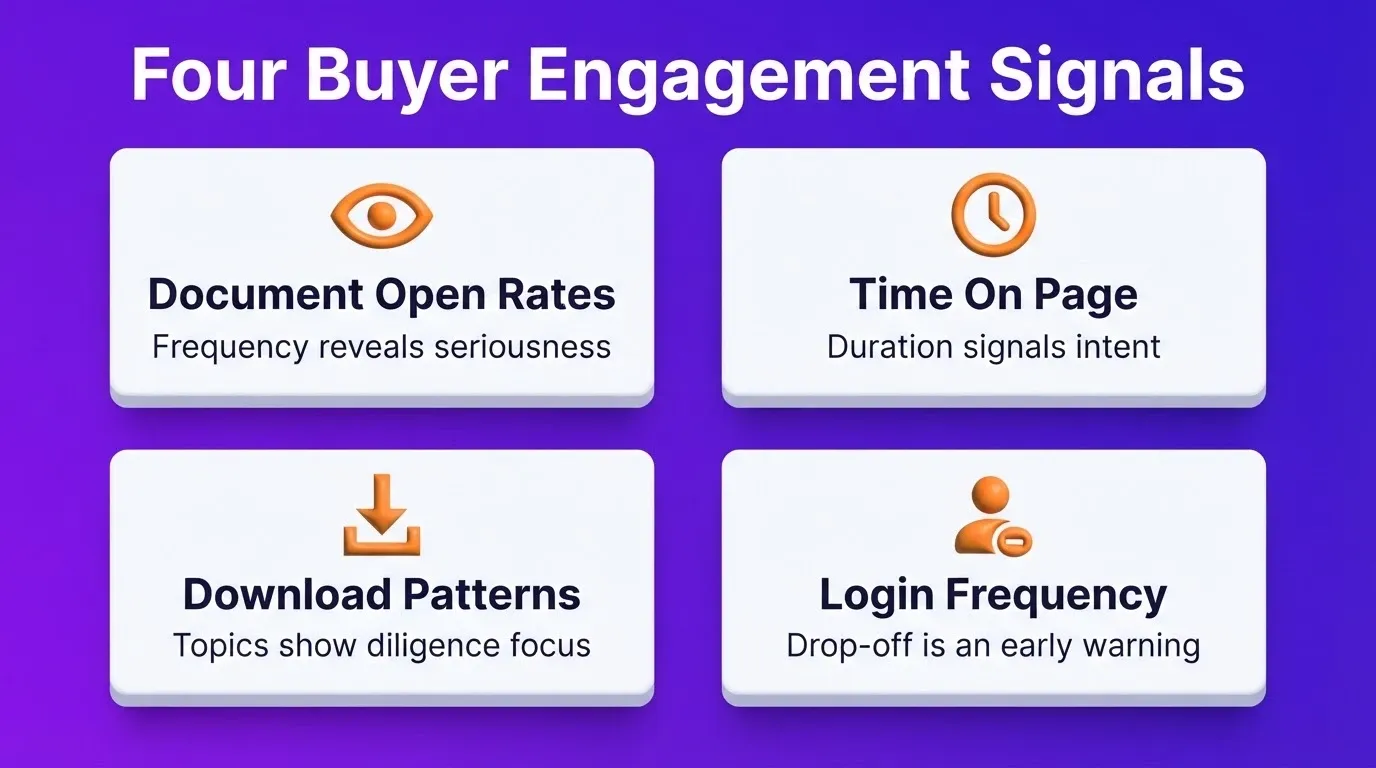
Document open rates: Buyer A opened the financial model six times in two days. That tells you something very different than Buyer B opening it once and not returning.
-
Time-on-page metrics: A buyer who spends forty minutes in the management presentation is likely preparing internal approval. One who skims in three minutes may be losing interest.
-
Download patterns: When a buyer downloads the customer concentration analysis and the environmental compliance summary on the same day, the advisor knows which diligence topics matter most.
-
Login frequency over time: A drop in login activity from a previously active buyer is an early warning signal. Something changed on their side.
M&A advisors on Axial's Middle Market Review consistently note that the strongest signal of buyer seriousness comes from what prospective acquirers do with deal materials when no one is watching.
These signals let the advisor rank buyer seriousness based on actions, not just words. Storing this engagement data inside a shared project context means the whole advisory team sees the same picture. No spreadsheets need to change hands.
What Separates a Portal from Shared Folders and Email?
The difference is not just technology. It is process control. A shared folder holds files. A portal manages a deal.
-
Permission control: Shared folders give access to everything at once. A portal releases documents in stages based on where each buyer sits in the process.
-
Identity verification: Email attachments can be forwarded to anyone. Portal logins tie every action to a specific, verified person.
-
Process integrity: When all buyer activity flows through one system, the advisor has a complete record of who did what and when.
-
Scalability: Managing three buyers via email is workable. Managing twelve across two concurrent deals is where the folder approach breaks down.
-
Version control: A portal maintains one authoritative version of every document. Email threads create competing versions with no clear record of which is current.
With tens of thousands of private transactions running each year across the lower middle market, the operational difference between a folder and a portal is the difference between running a process and reacting to one.
Here is how document delivery differs between the two approaches:
Email-Based Deal Management Vs. A Dedicated Buyer Review Center Portal
The portal path gives the advisor a closed system. Nothing leaves without a record, and the seller gets a clean audit trail at every stage.
How to Research Your Deal Strategy Before You Build
Before building the portal, the most effective advisory firms think through their process architecture first. What buyer stages will the deal run? How many document tiers fit this transaction size?
Rocket's Solve pillar answers these questions before a single screen is generated. Simply describe the deal context in plain language. Include the target company profile, expected buyer universe, and transaction size range. Solve returns a structured analysis covering process design, document release sequencing, and buyer qualification criteria.
This research-to-build flow means the portal reflects genuine deal thinking, not a generic template. The Solve output becomes context for the Build task. As a result, the portal's permission tiers, document categories, and Q&A workflows are already calibrated to the specific transaction before generation begins.
How Rocket Powers Private Deal Management
Advisory firms running private sales need dedicated deal environments. However, enterprise VDR platforms like Intralinks or Datasite were designed for large investment banks with six-figure annual contracts. A boutique firm running two or three concurrent processes does not need that overhead.
Rocket's Build pillar lets advisory teams describe the deal portal they need in plain language. Rocket then generates a production-ready Next.js web application with:
-
Role-based access for each buyer group: Assign permissions at the individual or group level using three-level access control (Admin, Creator, Viewer). This controls which documents and sections each party can see.
-
Supabase connector for backend: Connect Supabase once at the workspace level. This adds a PostgreSQL database, user authentication, and file storage with no SQL required.
-
Live preview and iteration: Review the portal before it goes to a single buyer, then refine it through conversation.
-
Staging and production environments: Use separate environments with full version history and one-click rollback.
-
Built-in analytics: Track visitor activity, document engagement, and access patterns from the same dashboard after launch.
Multiple advisors on the same engagement work inside one project with shared context. When one advisor adds a document or adjusts permissions, the change is immediately visible to the rest of the team.
Setting Up Your Portal Step by Step
An advisor using Rocket can complete this entire setup in an afternoon. The sequence below applies whether you are configuring a commercial VDR or generating a custom portal.
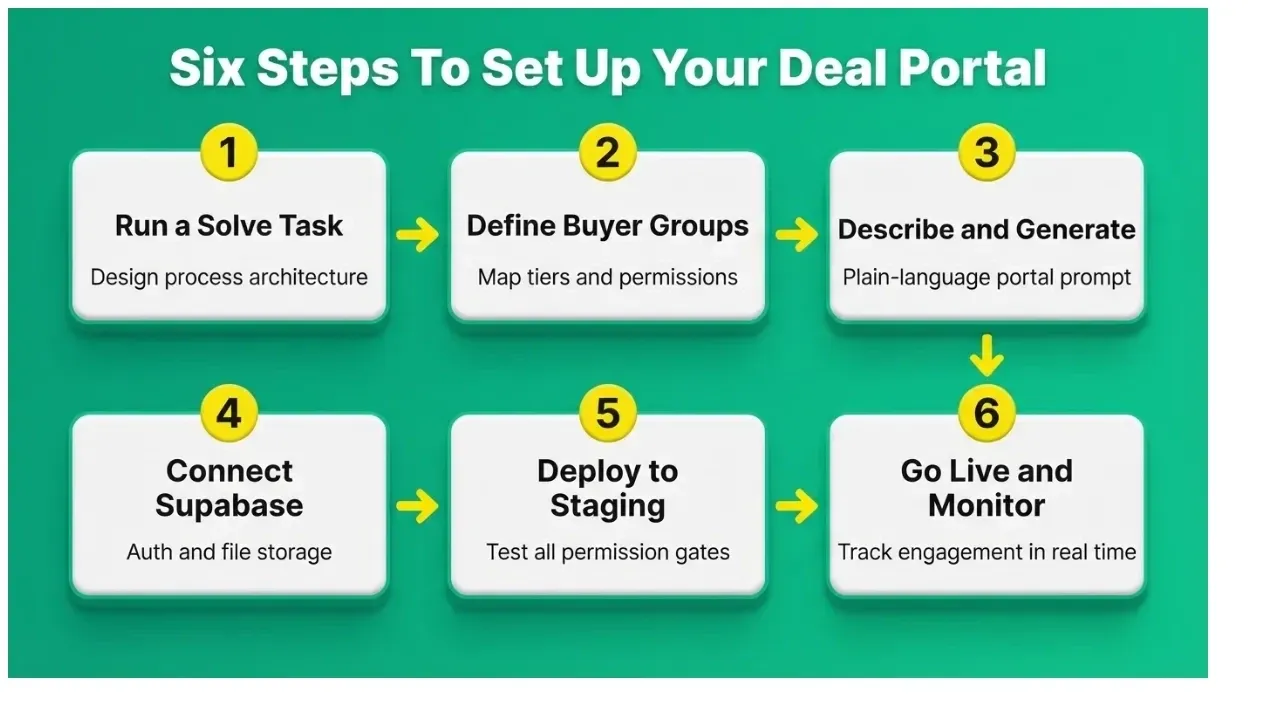
Step 1: Run a Solve task to design the process architecture. Describe the deal context to Rocket's Solve pillar. Get a structured recommendation on buyer stages, document tiers, and engagement metrics to track. This output then becomes the foundation of your Build prompt.
Step 2: Define your buyer groups and access tiers. List every prospective buyer, their current stage, and which documents they should see at each phase. Map this to three tiers: initial outreach, indication of interest, and final round.
Step 3: Describe the portal to Rocket and generate. Write a plain-language description of the portal. Include buyer groups, permission tiers, document categories, Q&A workflow, and engagement dashboard. Rocket generates a production-ready Next.js web application. Most builds complete in one to three minutes.
Step 4: Connect Supabase for authentication and file storage. From the workspace connectors panel, connect Supabase once. This adds a PostgreSQL database, user authentication, and file storage to the portal with no SQL or server configuration required.
Step 5: Deploy to staging and test. Launch a staging version. Walk through the experience as a test buyer at each tier. Verify that permission gates, NDA triggers, and document access controls work correctly.
Step 6: Push to production and monitor engagement. Deploy to a custom domain or hosted URL. From the built-in analytics dashboard, track buyer login frequency, document open rates, time-on-page, and download patterns. Use these signals to rank buyer seriousness throughout the process.
Each new deal gets its own environment. Past portals serve as templates for the next one, so the setup cost drops with every deal you run.
For teams that also need a broader document management workflow, creating a branded data room for client document sharing is a natural companion to the buyer review center setup.
The Standard Your Deal Process Sets
The quality of a deal process signals the quality of the advisory relationship behind it. A dedicated buyer portal tells prospective acquirers that the advisor is running a controlled, professional sale, not a loose collection of email threads.
As private deal volumes grow and buyer expectations rise, the advisory firms that build buyer review center infrastructure into every engagement will run faster, tighter, and more defensible processes. Rocket makes that infrastructure accessible to boutique and mid-market firms without enterprise overhead or a development team.
Describe your next deal's buyer management workflow on Rocket and get a working portal before your next process meeting.
Table of contents
- -What Goes Into a Buyer Review Center?
- -How Does Controlled Access Protect the Seller?
- -The Three-Tier Access Model
- -Can Engagement Tracking Replace Guesswork?
- -What Separates a Portal from Shared Folders and Email?
- -How to Research Your Deal Strategy Before You Build
- -How Rocket Powers Private Deal Management
- -Setting Up Your Portal Step by Step
- -The Standard Your Deal Process Sets