Pivoting your MVP no-code AI builder does not mean starting over. Use Solve to validate the new direction, roll back to your last stable version, and reprompt in Build. Your project context, version history, and prior research stay intact.
Pivoting your MVP no-code AI builder does not mean starting from scratch. With a platform built for iteration, you can redirect your minimum viable product in hours, using Solve to validate the new direction, Build to execute it in Next.js or Flutter, and one-click rollback to protect every version you have already shipped.
What is a no-code AI builder?
A no-code AI builder is a tool that generates working software from natural-language prompts without requiring the founder to write code. Rocket.new is a Vibe Solutioning platform, the first platform where business research, product building, and competitive intelligence happen in the same shared-context workspace.
Why Most MVPs Need A Direction Change
Why do startups that pivot once or twice grow 3.6x faster than those that refuse to change direction? The Startup Genome Project found that founders who redirect based on real signals raise 2.5x more money and gain users at a pace their stubborn peers simply cannot match. Yet most founders hit this wall after shipping their minimum viable product.
User feedback arrived, and the market clearly wants something adjacent to what you built. Now what? Rebuilding from zero feels like failure. Staying the course feels worse.
The real question is whether your build process was designed for pivoting in the first place. If you chose the right no code platforms and ai powered tools, changing course becomes a conversation, not a construction project. The no code MVP approach gives founders the agility to redirect without losing months of MVP development work.
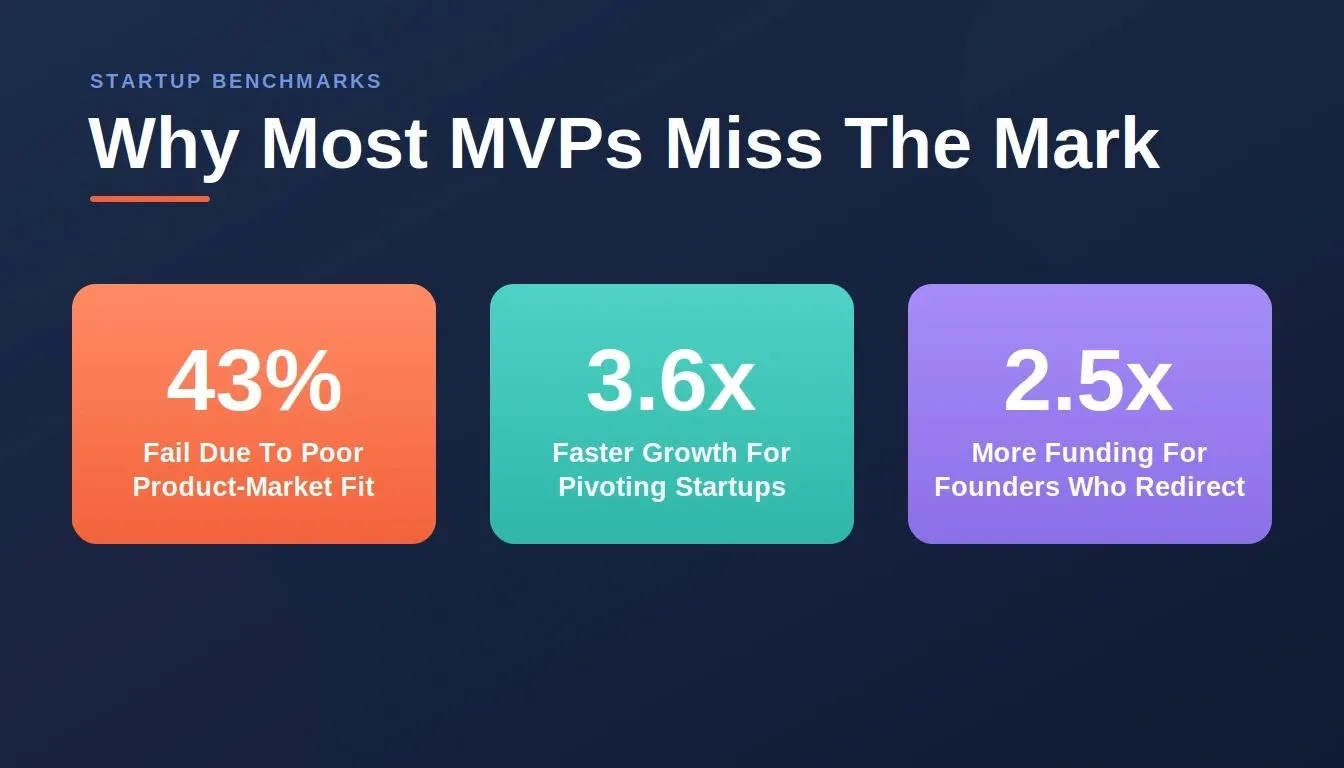
Key data behind why MVPs stall and why pivoting faster wins
The gap between what founders assume and what paying customers actually want is the core problem behind most startup failures.
-
43% of startup failures stem from poor product-market fit, according to CB Insights' analysis of 431 VC-backed companies that shut down since 2023. The product itself worked fine. The market simply did not care enough.
-
Most founders ship their minimum viable product based on assumptions, not validated demand. Those assumptions rarely survive contact with real target users who have specific pain points the original product did not address.
-
Market validation is not a one-time event. It is a continuous feedback loop that reshapes your direction after every release. Your first users will tell you what the core value actually is, often something you considered secondary.
The pattern is predictable. You build something. First users arrive. Their behavior tells you the core value lives in a feature you considered secondary. The thing you spent months on? They ignore it completely.
| Traditional Approach | Pivot-Ready Approach |
|---|---|
| Test assumptions first, build around signal from paying customers | |
| Use no code tools, ship in days without writing code | |
| Full version history lets you restore any previous state | |
| Feedback loop is built into the build process from day one | |
| Pivoting means redirecting with project context preserved |
The difference between a failed startup and a successful pivot is not talent or funding. It is speed. Startups that can change direction in days instead of months have a structural advantage in finding product market fit. No code platforms give non technical founders that speed advantage without hiring developers or waiting on a development team.
What Makes Pivoting So Painful On Traditional Tools?
Most no code platforms and code platforms were designed for building forward, not for changing direction. The build process assumes linear progress toward a fixed goal.
When founders use traditional development workflows or even drag and drop visual builders, they accumulate technical and structural debt that is nearly impossible to redirect. The code is tangled. The database schema assumed a specific user flow. Changing one screen breaks three others because of complex backend logic nobody documented.
No code tools like Bubble or Webflow give you speed on the first build. But pivoting on these platforms often means starting a new project from a blank screen. Your previous market research, user data, and design decisions do not carry forward.
Hiring developers or working with a development agency means long timelines and tens of thousands of dollars wasted. A pivot that should take days takes weeks because someone needs to re-scope, re-estimate, and re-build without the original context. You need no-code app builders for startups that are designed for iteration, not just initial generation.
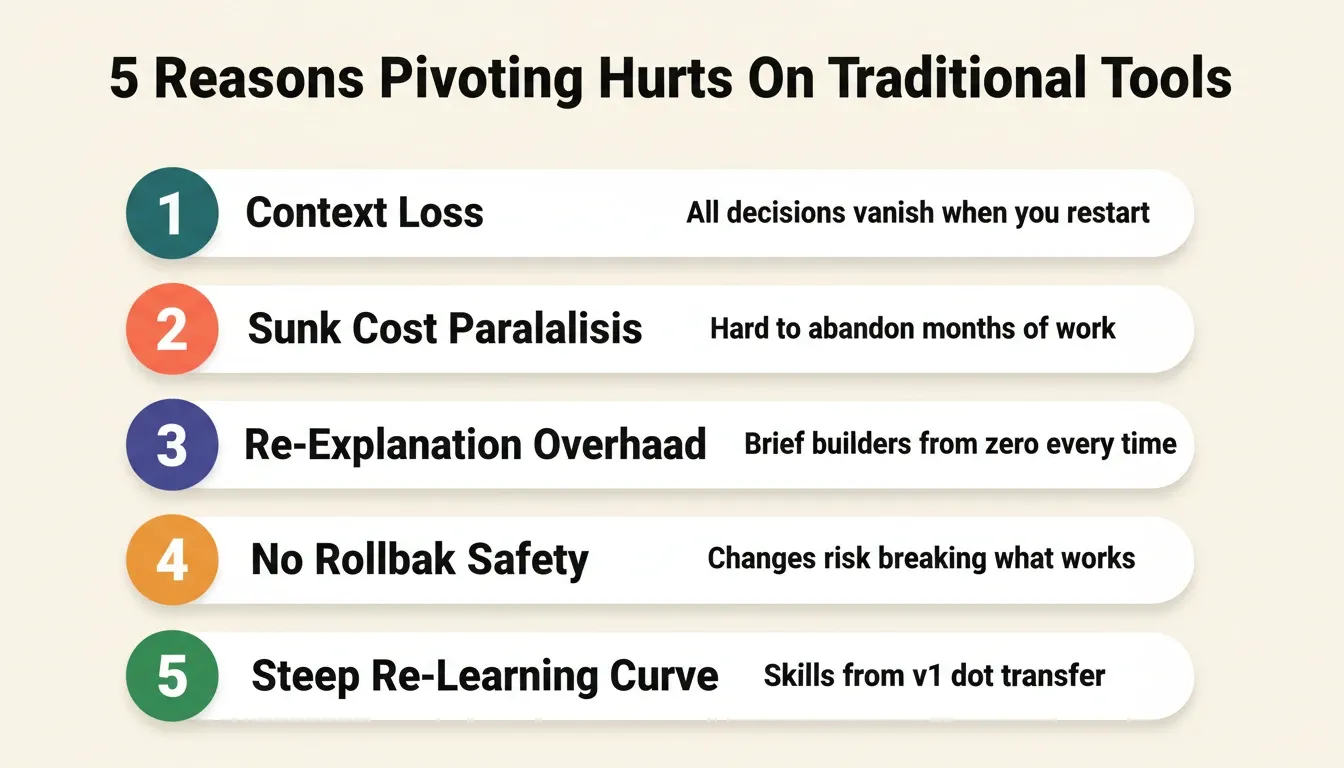
The five friction points that make pivoting expensive on traditional platforms
The five friction points founders hit when pivoting on traditional tools:
-
Context loss - every conversation with users and every prioritization decision gets thrown away when you start over
-
Sunk cost paralysis - months of work feel too expensive to abandon, even when the direction is wrong
-
Re-explanation overhead - external builders do not retain the reasoning behind decisions, so you brief from zero every time
-
No rollback safety net - changing direction risks breaking what already works, with no way to recover it
-
Steep re-learning curve - mastering one platform for v1 does not transfer when you need to pivot on it
Non technical founders feel this most acutely. Without a technical co founder or coding experience, they depend on external builders who do not retain the reasoning behind decisions. They are not just rebuilding the product. They are re-explaining the entire technical background and every SaaS idea that informed the original direction.
For technical founders, the frustration is different but equally real. They can see exactly what needs to change in the code. But their codebase was not designed for surgical pivots. Changing the core problem you solve means rewriting user authentication, the data model, and half the frontend.
Is A Pivot A New Project Or An Edit Inside One?
This is the decision point most founders miss. On Rocket, context persists within a project. Every file you uploaded, every Solve research session you ran, every Build task you completed lives in that project and is available to every subsequent task. That means:
-
An edit inside one project is the right move when your core user, core problem, and core tech stack are staying the same and you are adjusting features, positioning, or flows. Describe the change in natural language and Rocket applies it with full context of everything already built.
-
A new project makes sense when the pivot is genuinely a different product, with a different target user, different problem, and different architecture. You start fresh, but you can still upload your previous project's Solve output as context files.
Understanding this distinction saves you from either under-pivoting (tweaking when you needed a clean break) or over-pivoting (starting over when a re-prompt would have done it). For a deeper look at the iteration loop, see how generating MVPs with AI works in practice.
Can You Change Direction Without Losing Everything?
The short answer: yes, but only if your ai builder was designed with pivoting in mind from the start.
-
Solve validates before you rebuild. Rocket's Solve pillar takes any business question in plain language and delivers a complete, structured output, including market analysis, competitive landscape, risk matrix, and a direct recommendation, in 60 to 90 minutes. Before you re-prompt your entire app, run a Solve session on the new direction. Get the structured answer first. Build from it second.
-
Project context carries forward within your workspace. Every piece of market research you ran, every decision you documented, every user feedback note you saved in your Rocket project is available to every new task inside that project. When you tell Rocket "I need to pivot from a booking platform to a marketplace," it already knows your target users, your technical background, your design preferences, and which core features performed well.
-
Full version history means nothing is ever gone. Every generation and significant edit in Rocket's Build creates a new version entry. You can browse the full history and restore any previous version with one click. To understand exactly how this works, read about version history and one-click rollback in detail.
The code Rocket generates is production-grade from the first version, Next.js for web apps and Flutter for mobile apps. Changing a payment flow does not break the onboarding. Swapping a search bar for a recommendation engine does not require rewriting your database queries. Each component can be adjusted independently through chat, visual edit, or direct code access.
A Practical Framework For Pivoting Your MVP Fast
Pivoting is not random. It follows a pattern you can systematize with the right no code tools and a clear process. If you want to go deeper on the iteration side, the guide on how to iterate on your MVP with AI tools covers the full loop.
-
Step 1: Identify what signal triggered the pivot. Did paying customers ask for something different? Did user feedback reveal a pain point you missed? Did market research show a bigger adjacent opportunity? Name the signal clearly. The core problem you solve must change, or the target users you serve must change, or both.
-
Step 2: Preserve what worked from v1. Not everything from your first build is wrong. Your user authentication, payment integration, and landing page copy might still be perfect. Map what stays and what goes before touching a single line of code.
-
Step 3: Run Solve on the new direction before rebuilding. Rocket's Solve pillar is exactly the tool for this step. Describe the new direction as a business question and Solve runs thousands of queries across 150+ sources, surfaces the competitive landscape, identifies the risks, and delivers a structured recommendation with evidence. Gagan Biyani, co-founder of Maven, describes this kind of pre-build validation as the Minimum Viable Testing process. Solve is how you do it in 90 minutes instead of two weeks.
-
Step 4: Execute the pivot inside your existing Rocket project. Roll back to your last stable version, then describe the new direction in natural language. The Build pillar adjusts your Next.js or Flutter app with full context of everything already in the project. No blank screen. No re-explaining your technical background.
The key insight from this framework: MVP development is not linear. It is a loop. Market validation feeds into building, building feeds into learning, learning feeds into the next iteration. The fastest founders run this loop weekly using ai powered no code tools, not quarterly using traditional development cycles.
When Should You Pivot Vs. When Should You Shut Down?
Not every signal means pivot. Some mean stop. Here is a practical checklist:
Signals that mean pivot:
-
Users are engaging with a secondary feature more than the core one
-
A segment you did not target is converting better than the one you did
-
Paying customers are asking for something adjacent that you could build
-
Market research via Solve shows a larger, underserved opportunity one step away
-
Your retention is poor but your activation is strong. The product works, the direction is wrong
Signals that mean tweak, not pivot:
-
Conversion is low but qualitative feedback is positive, which is a messaging or positioning problem
-
One specific flow has high drop-off, which is a UX problem, not a direction problem
-
Users are churning after month two, which is an onboarding or value delivery problem
Signals that mean shut down:
-
Multiple Solve sessions across different adjacent directions all return low-signal markets
-
You have tested three or more directions through market validation and none produce paying customers
-
The core problem does not resonate with real people willing to pay, regardless of how you frame it
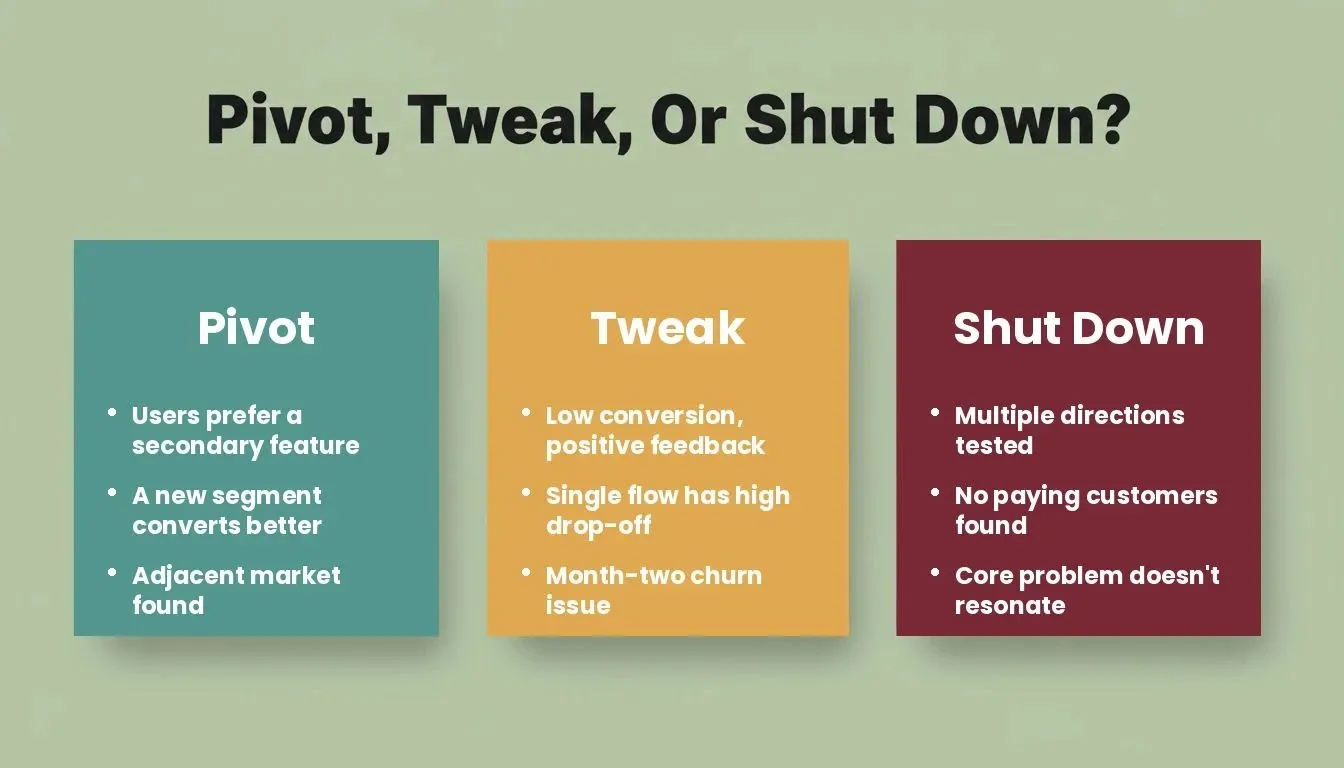
Use this framework to decide whether your next move is a pivot, a tweak, or a full stop
Pivot when user feedback points to a clear adjacent opportunity with demand signals from target users. Shut down when you have tested multiple directions through market validation and none produce paying customers or meaningful engagement. The core problem must resonate with real people willing to pay.
Why Rocket Makes MVP Pivots Feel Like A Chat Message
Most ai builders treat every prompt as a fresh start. You describe what you want, and the tool generates it from zero context. That works fine for project number one. But when you need to pivot, that stateless design becomes a serious limitation for MVP development.
Rocket.new is built differently. It is the world's first Vibe Solutioning platform, where business research, product building, and competitive intelligence happen in the same shared-context workspace. 1.5 million people have tried Rocket across 180 countries, from solopreneurs to enterprise teams.
Solve: Validate Before You Build
Solve takes any business question and delivers a complete, structured solution covering market dynamics, competitive landscape, risks, opportunities, and a direct recommendation, typically across 8 to 12 sections, with each finding tagged by signal strength. The output does not disappear after export. It becomes the foundation of everything that follows in the project.
For a pivot, this means: before you re-prompt your entire app, you know whether the new direction is worth building. That is the question most founders skip. Rocket makes it answerable in 90 minutes. The full path from market research to MVP is built into the platform's workflow.
Build: Execute The Pivot In Production-Grade Code
Rocket's Build pillar generates production-grade Next.js web apps and Flutter mobile apps from natural language descriptions. After a pivot, you describe the new direction in chat and Build applies the changes with full context of the project already intact.
Three iteration modes give you control at every level: Chat for natural language changes, Visual Edit for clicking directly on elements in the live preview, and Code for direct access to the generated Next.js or Flutter source. No change limit. No re-explaining what already exists.
Version History: Roll Back, Not Branch
Rocket's version history is full and non-destructive. Every generation and significant edit creates a new version entry. You can browse the complete history and restore any previous version with one click.
The real pivot workflow: identify the last stable version before the direction you are abandoning, roll back to it, then re-prompt the new direction from that clean foundation. The rolled-back version remains in history and you can roll forward again if needed. One practical note: if you have a live deployment and roll back, you will need to republish from the restored version.
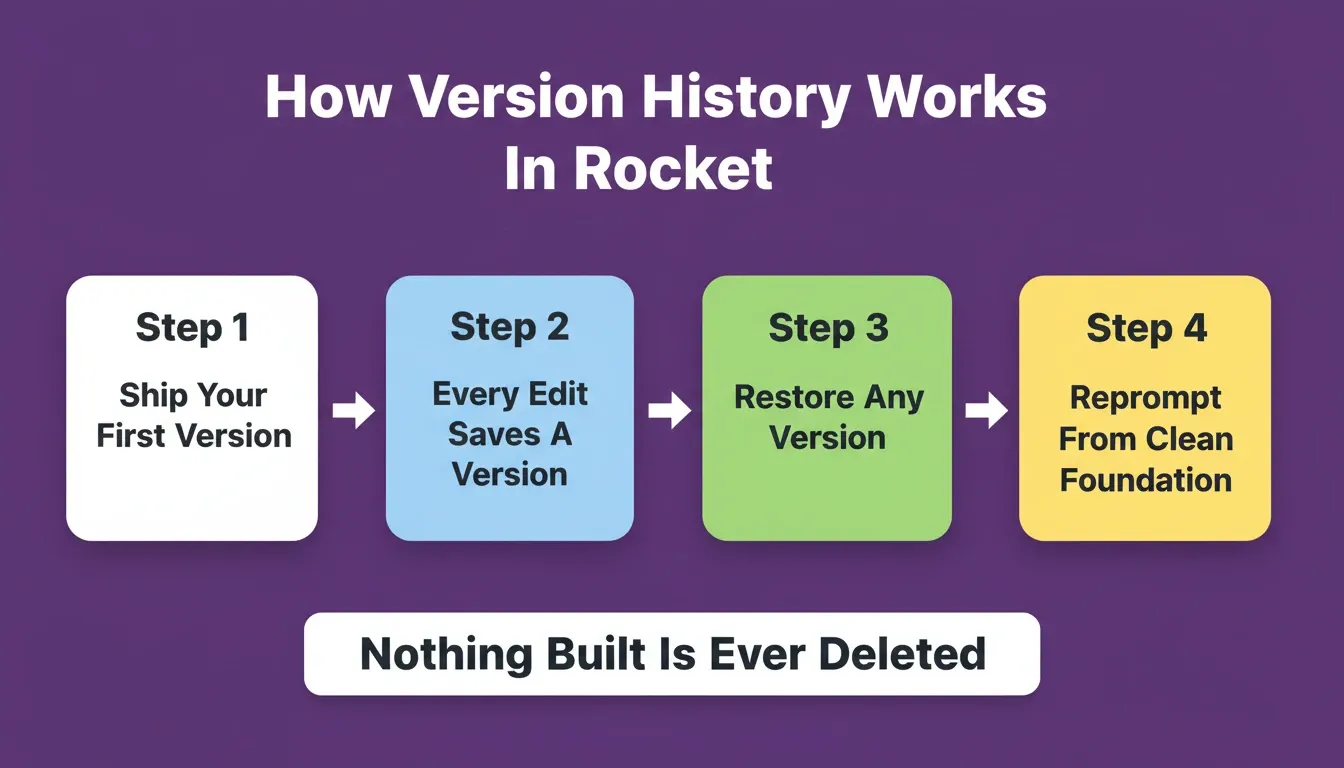
Rocket's version history workflow: every state is saved, nothing is ever deleted
| Capability | Traditional Dev | Standard No-Code | Rocket |
|---|---|---|---|
| Context retention across pivot | None, re-brief from scratch | None, new project from blank | Full, within project automatically |
| Version history | Git, requires technical setup | None or limited snapshots | Full history, one-click restore |
| Pre-pivot validation | Weeks of manual research | None built in | Solve: structured output in 60-90 min |
| Code output | Your stack | Platform-locked | Next.js (web), Flutter (mobile) |
| Time to new version | Weeks to months | Days to weeks | Hours |
| Cost to pivot | Dev agency rates | Time plus platform lock-in | Credits, no dev team needed |
Compared to other no code platforms, Rocket gives non technical founders and technical founders alike a way to pivot without hiring developers, without a development agency, and without starting from a blank screen. If you are evaluating your options, the comparison of best AI MVP builders for startups covers the landscape in detail.
Your Next Pivot Starts With A Single Prompt
The founders who win are not the ones who get it right on the first try. They are the ones who change direction faster than their competition using ai powered no code tools that retain context across every build. Pivoting is no longer a setback when your platform preserves every validated decision from your MVP development journey.
Your market already told you what it wants through user feedback and real behavior data. The only question is how fast you can respond with the right tool at your side.
When you are ready to pivot your no code MVP, start with a Solve session on the new direction. Get the structured answer first. Then roll back to your last stable version in Build, reprompt the new direction, and ship. The entire loop, validate, restore, rebuild, launch, happens inside one project, with one platform, without losing a single decision you have already made.
Start your next pivot on Rocket today, sign up free and run your first Solve session.
Table of contents
- -Why Most MVPs Need A Direction Change
- -What Makes Pivoting So Painful On Traditional Tools?
- -Is A Pivot A New Project Or An Edit Inside One?
- -Can You Change Direction Without Losing Everything?
- -A Practical Framework For Pivoting Your MVP Fast
- -When Should You Pivot Vs. When Should You Shut Down?
- -
- -Solve: Validate Before You Build
- -Build: Execute The Pivot In Production-Grade Code
- -Version History: Roll Back, Not Branch
- -Your Next Pivot Starts With A Single Prompt