Build your MVP for a mobile app without a development team or a single line of code. This guide covers problem definition, feature prioritization, development paths, and user testing so non-technical founders can validate and launch faster.
What Does MVP Stand For and Why Should Non-Technical Founders Care?
MVP stands for minimum viable product, the leanest and most focused first version of your app that lets real users experience its core value. For non-technical founders, getting this concept right early is what separates a smart startup from an expensive mistake.
- MVP means minimum, not mediocre. It is the simplest version that delivers the one thing your target audience needs most, nothing more and nothing less.
- Non-technical founders spend money on every feature. Without technical skills to build yourself, every addition costs time and money. An MVP forces the right question: what does the user actually need to get value right now?
- The development process for an MVP is short and feedback-driven. It is not a full product. It is a test of your core assumption about what the market wants.
- User feedback from a minimum viable product is more valuable than any amount of pre-launch planning. You learn more from 50 real users than from 500 hours of planning.
- MVPs reduce financial risk for founders with budget constraints. You validate the concept before committing to a full development cycle.
Not building for everyone. You are building for the one specific user story that proves your idea works. According to a Founders Forum Group analysis of startup failure data, 42% of startups fail because they build products nobody actually needs, and an MVP is how you find out early whether yours is the exception.
Why Most MVPs Fail Before They Are Even Built
Most non-technical founders do not fail because they cannot code. They fail because of decisions made before a single screen gets designed. The problems that kill MVPs are almost always strategic, not technical.
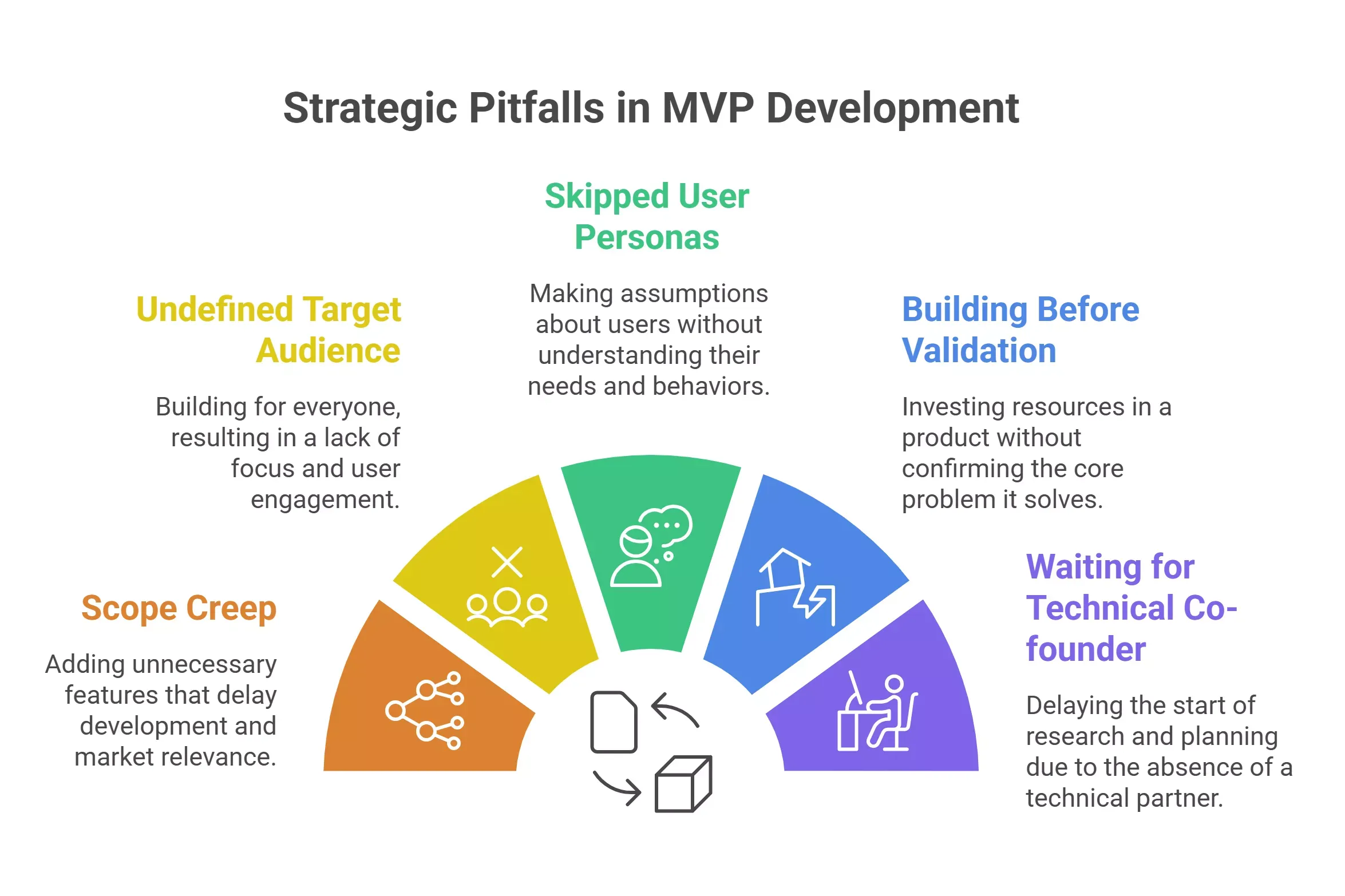
- Scope creep kills momentum. Adding features that seem interesting rather than features that users asked for turns a 4-week MVP into a 6-month product. By then, the market has moved.
- No defined target audience means building for no one. When the target audience is anyone who might want this, the development process loses all focus.
- Skipping user personas leads to wrong assumptions. Without a clear profile of your early adopters, every product decision is a guess.
- Building before validating the core problem is the most expensive mistake. One real example: a founder spent $80,000 over six months with three developers and launched with zero paying users. The app had social login, a 7-step onboarding flow, and an admin dashboard, none of which were what early users needed in week one.
- Waiting for a technical co-founder before starting anything. The research and planning that define a good MVP require domain expertise, not coding skills.
The right approach is to treat the planning phase as part of the development process, not a pre-step before the real work starts.
Step 1: Define Your Core Problem and Target Audience
Before any development starts, three questions need real answers. This is not a brainstorm. It is a product strategy. Get this right and everything downstream gets easier.
- What specific task does your app help one user accomplish? Not a category of tasks. One task. Be precise.
- Who is the very first person who will use it? Define your user persona: their role, their daily pain points, what they currently do to solve this problem, and what success looks like for them.
- What does success look like in their first session? If your user opens the app and does nothing useful in 3 minutes, the core user flow needs rethinking.
- Write a user story to lock in your scope. The format is: As a [user type], I want to [action], so that [benefit]. Example: As a small business owner, I want to track customer bookings in one place, so that I stop missing appointments.
- Your user story defines your MVP. Everything outside that story is a should-have or a won't-have for now.
- Conduct short user interviews before building. Talk to 5 to 10 people who match your user persona. Ask about the problem, not the product. What they tell you will reshape your assumptions before you spend a dollar.
A clearly defined user story is the single most useful document a non-technical founder can have before approaching a development agency, freelancers, or any build tool.
Step 2: Prioritize Core Features Using the MoSCoW Method
Once you have your user story, ideas multiply fast. The MoSCoW method is the clearest way to sort them so your initial release stays focused and within budget constraints.
- Must-haves are features without which the app literally does not work. These go into your MVP.
- Should-haves are valuable, but the app delivers its core value without them at launch.
- Could-haves are nice additions if time and budget allow, after must-haves are done.
- Won't-haves for now are good ideas for a future version, not this one.
Here is a practical example applied to a booking app MVP:
| Feature | Priority | Include in MVP? |
|---|---|---|
| User authentication (sign up / login) | Must-have | Yes |
| Booking form with date and time selection | Must-have | Yes |
| Email confirmation | Must-have | Yes |
| Customer profiles with booking history | Should-have | No |
| Push notifications | Should-have | No |
| Admin analytics dashboard | Could-have | No |
| Loyalty points system | Won't have for now | No |
This table alone saves weeks of unnecessary development. Any feature not in the must-have column waits until early users have confirmed the essential features are working for them.
Step 3: Choose Your MVP Development Path
Non-technical founders have four main routes to building a mobile app MVP. Each comes with a different cost structure, timeline, and set of risks worth understanding before committing.
| Build Path | Time to MVP | Starting Cost | Technical Skills Needed | Production-Ready Code? |
|---|---|---|---|---|
| Development Agency | 3-6 months | $30,000+ | None (but managing one is hard) | Yes |
| Freelancers | 1-3 months | $10,000+ | Some (for code oversight) | Depends on developer |
| No-Code Tools | 1-4 weeks | $0-$500/month | None | No (limited scalability) |
| Rocket.new | 1-3 days | Subscription | None | Yes (Flutter code) |
- No-code platforms: Tools like Bubble let you build apps without writing code. They are fast and cost-effective for simple apps, and work well for creating wireframes and prototypes. The limits appear quickly, though. Complex logic, native mobile features like push notifications or offline access, and performance at scale are often out of reach. Good for testing concepts, not always sufficient for a production-ready app.
- Hire freelancers: Freelancers offer flexibility and lower cost than agencies, typically charging $10,000 to $50,000 for a basic mobile app. The risk for non-technical founders is oversight. Without technical skills or a technical co-founder to evaluate code quality, you may not know if what you are getting is maintainable until you try to iterate.
- Development agency: A development agency brings a full team with a track record you can verify through client portfolios. They are a reliable development partner for post-MVP work, but the timeline and cost, often $30,000 or more and taking 3 to 6 months, make them slow for the rapid-test-and-iterate phase non-tech founders need early on.
- AI app builders: This is where the shift has been most significant. AI-powered platforms let you describe your app in plain language and receive back a working, production-ready mobile app, without developers to manage or technical skills required. The low-code development platform market was valued at USD 37.39 billion in 2025 and is projected to reach USD 376.92 billion by 2034 at a 29.10% CAGR, a clear signal of where the market is heading.
The right choice depends on your budget constraints, your timeline, and the complexity of your core features. For most non-technical founders testing a new app idea, AI builders and no-code tools provide the fastest path to real user feedback.
The MVP Development Flow
Here is how the full development process maps out from idea to user feedback:
What Your Mobile App MVP Needs From Day One
Certain things have to work correctly in your first version, not for aesthetics, but because they directly determine whether users stay long enough to give you the real user feedback that drives the next iteration.
- User authentication that works cleanly. Users need a way to sign in and have their data saved. Keep it simple: email and password, or one social login option. A multi-step account setup in the initial release creates friction before users have even seen the core value.
- A clear user flow from open to outcome. Users should accomplish the specific task the app is built for in as few steps as possible. Map this user flow before you build it, not after.
- A feedback loop is built in from the start. Real user feedback does not collect itself. Build simply for early users to share what is working and what is not, such as an in-app form, an email link, or a short survey. Early adopters who care about the problem will use it.
- Basic data tracking from the first session. Analytics from day one let you watch how users actually behave, where they drop off, what they skip, and where they spend time. This is more reliable than any assumption made during planning.
- Essential features only. Anything not directly connected to solving the core problem gets cut. Aesthetics, advanced settings, and secondary features are for later versions after the core is validated.
The goal at this stage is not a finished product. The goal is the minimum set of features that let a real user experience the core value and tell you whether it works. If you want to understand how to build a mobile app with AI step by step, Rocket.new has a detailed guide covering the full process.
User Testing and Iterative Development
Once your MVP is live, the development process shifts from building to learning. This phase is where non-technical founders have a genuine edge, as they are close to the customer and can interpret feedback in context.
- User testing means real users, not teammates. Put your app in front of people who match your user persona, not your co-founder or your close network. Give them a specific task to complete, then observe. Where do they pause? What do they skip entirely?
- Collect three types of feedback. Behavioral data (what users do, tracked through analytics), direct feedback (what users say when asked specific questions), and surveys (structured forms to identify patterns across a wider group).
- Iterative development is a loop, not a checklist. Build, test, gather feedback, iterate. Not: build everything possible, then release.
- Early adopters are your most valuable development partners. These are the users who find your product through early marketing because they genuinely care about the problem. They will engage honestly, and their input shapes the product far more than any assumption made in planning.
- Validate before adding features. Every new feature request from early users should be a data point, not an automatic roadmap item. If three users ask for the same thing independently, that is a signal worth acting on.
The fastest-learning MVPs are not always the most polished. They are the ones who close the feedback loop quickly and act on what they find. For a deeper look at iterating after launch, check out how to iterate on MVP with AI tools fast.
Where Traditional Options Leave Non-Tech Founders Stuck
Development agencies, freelancers, and no-code platforms each have legitimate use cases. For non-technical founders trying to move fast and iterate quickly, each comes with friction that slows the development process at the stage when speed matters most.
- Agencies are built for defined specs and long timelines. The first four to six weeks typically involve requirements gathering, design reviews, and sign-off cycles. By the time the initial release is ready, months have passed, and your original product strategy assumptions may already be outdated.
- Managing freelancers without technical skills is genuinely hard. Technical aspects like backend architecture, API structure, and code quality are difficult to evaluate without a technical co-founder or advisor. Hire the wrong developer, and you may not find out until you try to scale, at which point the cost of rebuilding is much higher.
- No-code platforms cap out quickly. They are useful for wireframes and early prototypes, but native mobile features, offline functionality, performance at scale, and complex data structures are often out of reach. Most platforms also lock you into a proprietary system. When you outgrow it, migration is painful.
- All three paths have slow feedback loops. The longer the time between idea and live app, the more assumptions pile up untested. Non-tech founders need a shorter cycle and the tools to run it independently.
The core problem is not that these options are bad. It is that they were built for a different kind of founder, with different resources and a different timeline. See how AI app builders compare to hiring a developer on ROI for a detailed cost breakdown.
Launch Your MVP Faster: How Rocket.new Changes the Game for Non-Technical Founders
Rocket.new is an AI-powered app builder that generates a production-ready Flutter mobile app from a plain-language description, without developers, without technical skills, and without waiting weeks for a first draft.
How Rocket.new Works for Non-Technical Founders
You describe your app the same way you would explain it to a developer. Rocket.new plans the architecture, writes the code, builds the navigation, and delivers a live, working mobile app, ready for user testing the same day. Not a mockup. Not a wireframe. A real app with real functionality.
- Plain-language building removes the need for technical skills entirely. You describe what you want, Rocket.new generates it. No handoffs, no developer briefs, no waiting.
- Flutter output runs on iOS and Android from one codebase. One build, both platforms, which matters when budget constraints are real, and your target audience is split across operating systems.
- Three refinement modes after generation: Chat for natural language changes, Visual Edit for direct element edits in the preview, and Code for source-level edits. Non-technical founders use Chat and Visual Edit throughout, with no technical knowledge required.
- Three deployment options match where you are in the development process: Web preview for instant sharing with early adopters, APK download for Android device user testing, and app store builds for Google Play and the Apple App Store when you are ready for a public initial release.
- 25+ built-in connections from day one: Stripe for payments, Supabase for backend data, Google Analytics for tracking, Mixpanel for product analytics, and Mailchimp for email. Each connects at generation time, so your MVP ships with real functionality rather than placeholder screens.
- Every build generates production-grade Flutter code. If your startup raises funding and a development partner needs to take over, the codebase is ready to hand off. You are not locked into a no-code platform you eventually outgrow.
Where Other AI Builders Fall Short
Other AI builders like Bolt, Lovable, and v0 are focused on web apps. They do not generate native Flutter mobile apps. They also lack a shared memory layer across projects. Every session starts fresh, with no carry-forward of earlier decisions, research, or brand context. Rocket.new's project context carries prior research, competitive analysis, and brand direction into every build, so each iteration starts from a stronger foundation.
Rocket.new was built for the builder who needs to move from idea to live mobile app without a developer in the loop, and then iterate based on real user feedback, not assumptions. Explore the best AI MVP builders for startups to see how Rocket.new stacks up.
The Real Goal of Your MVP Is Learning, Not Perfection
The most important mindset shift for any non-technical founder is this: your MVP is not your product. It is your first structured learning tool.
- Ship fast and observe. Every week spent polishing before users see it is a week without data. The fastest path to product-market fit is a live app in front of real users.
- Focus on the one user story that proves the concept. Everything else is a distraction from the core problem at this stage.
- Treat feedback as direction, not critique. What early adopters tell you is the raw material for the next iteration. The development process gets smarter with every feedback cycle.
- Iteration is not failure. It is the method. Most successful apps look very different at version 3 than they did at version 1. The ones that succeeded shipped version 1 fast enough to get to version 3.
The MVP that wins is rarely the most polished one in the market. It is the one that learns the fastest and adapts the quickest.
Building Your MVP for Mobile App Starts With One Decision
Building an MVP for a mobile app as a non-technical founder is no longer a question of whether it is possible. The tools, paths, and frameworks all exist. The question is which path you choose and how quickly you move from idea to feedback.
Start with a clearly defined core problem. Build only the must-haves. Get your first version in front of early adopters and treat every piece of user feedback as product direction. The MVP for mobile app that wins is the one that learns fastest and adapts quickest.
Ready to go from idea to live Flutter mobile app without writing a single line of code? Start building on Rocket.new today.
Table of contents
- -What Does MVP Stand For and Why Should Non-Technical Founders Care?
- -Why Most MVPs Fail Before They Are Even Built
- -Step 1: Define Your Core Problem and Target Audience
- -Step 2: Prioritize Core Features Using the MoSCoW Method
- -Step 3: Choose Your MVP Development Path
- -The MVP Development Flow
- -What Your Mobile App MVP Needs From Day One
- -User Testing and Iterative Development
- -Where Traditional Options Leave Non-Tech Founders Stuck
- -Launch Your MVP Faster: How Rocket.new Changes the Game for Non-Technical Founders
- -How Rocket.new Works for Non-Technical Founders
- -Where Other AI Builders Fall Short
- -The Real Goal of Your MVP Is Learning, Not Perfection
- -Building Your MVP for Mobile App Starts With One Decision