Real MVP success stories prove one thing: the founders who ship fast and learn faster win. From Airbnb's air mattress listing to Dropbox's two-minute demo video, the MVP success stories that shaped modern startups share a single playbook. Rocket.new gives today's founders the same edge.
What really separates founders who ship from those who stay stuck in planning mode forever?
The answer comes down to one concept: the minimum viable product.
A minimum viable product is not a perfect product. It is the simplest working version of your idea that you can put in front of real users. And it works.
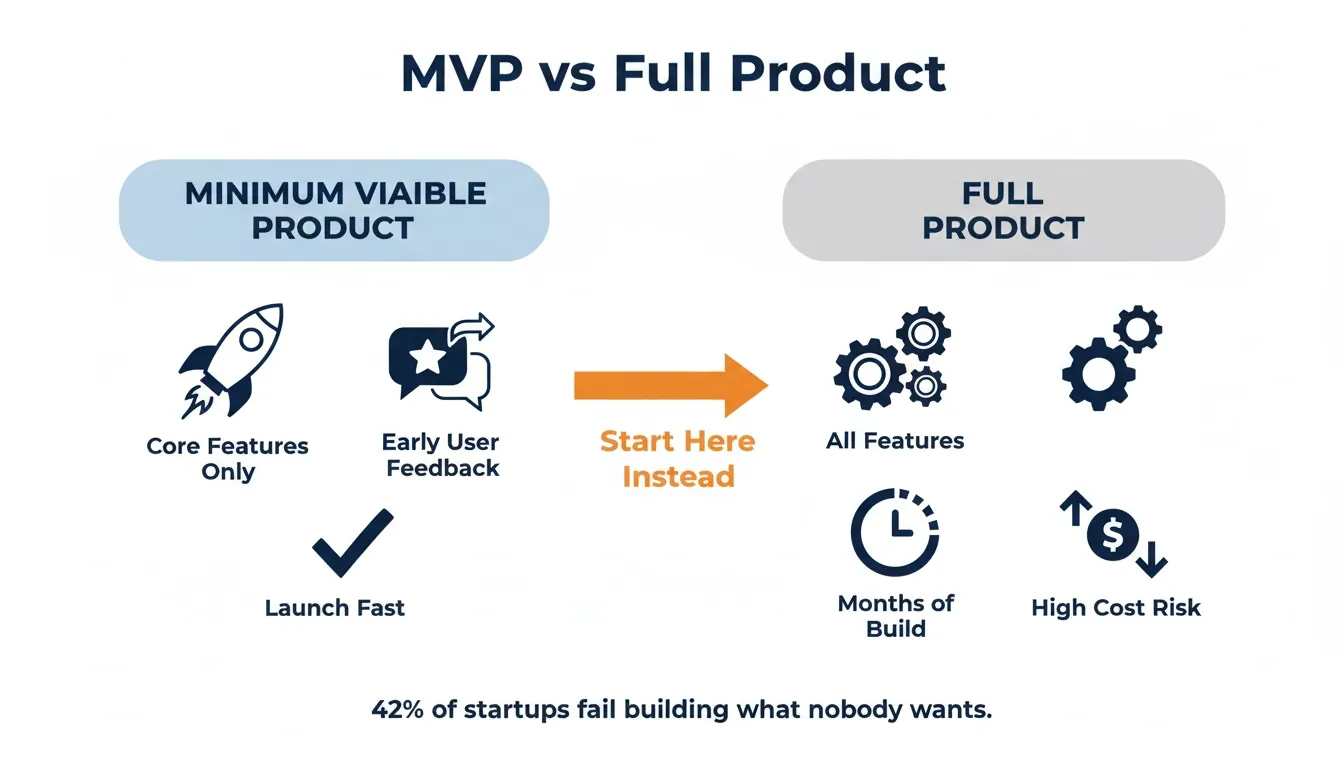
According to a Founders Forum report, 42% of startups fail because they build products no one actually wants. An MVP is your best defense against becoming that statistic.
What a Minimum Viable Product Is (And What It Isn't)
A minimum viable product has a simple definition, but the concept gets misunderstood all the time.
-
A minimum viable product is the version of your product with just enough core features to attract early adopters and gather user feedback.
-
Not a rough prototype, not a concept deck. A working product that real users can interact with, break, and respond to.
-
The goal of MVP development is not to stay small forever. It's to launch fast, learn from early users, and iterate toward something people love.
-
Every feature you add beyond that core set, before collecting customer feedback, is a bet made without data.
-
This is why MVP development matters more today than ever: time is finite, and the market does not wait for perfection.
The minimum viable product philosophy flips the usual order. You don't build to perfection, then show users. You show users early, then build toward what they actually need.
The MVP Success Stories Everyone Should Study
Airbnb, Dropbox, Instagram. Every MVP conversation comes back to these three names, and for good reason.
-
Airbnb started as a basic website listing one apartment with air mattresses in San Francisco. That basic website attracted 800 users in the first month, and now operates across 220+ countries.
-
Dropbox never built a product for their MVP. They made a two-minute demo video showing how file sync would work. It generated 75,000 signups in 24 hours.
-
Instagram shipped their photo-sharing minimum viable product in just 8 weeks. On launch day, 25,000 users showed up. Two years later, Facebook paid $1 billion for it.
-
Uber launched as a simple iPhone app covering black car rides in San Francisco only: one city, one feature, one validated hypothesis.
| Product | MVP Type | Time to Build | Early Traction |
|---|---|---|---|
| Airbnb | Basic website listing | Days | 800 users in month 1 |
| Dropbox | Explainer demo video | 1 day | 75,000 signups in 24 hours |
| Core photo-sharing app | 8 weeks | 25,000 users on launch day | |
| Uber | iPhone app, SF only | Weeks | Validated on-demand model |
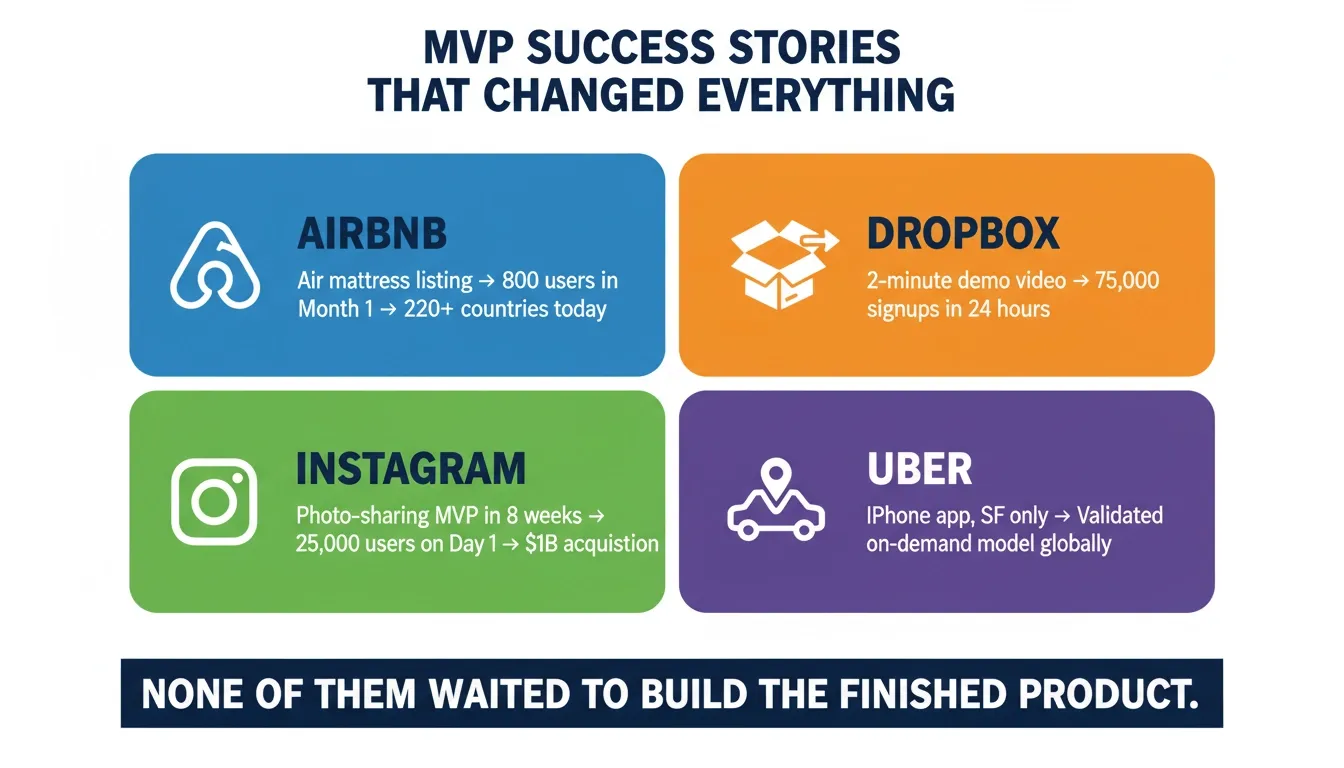 None of these teams waited to build the finished product. They shipped the minimum version needed to test one idea, then listened to what users told them.
The Problem with Traditional MVP Development
The MVP concept makes sense in theory. In practice, the traditional app development process has always made it expensive and slow.
-
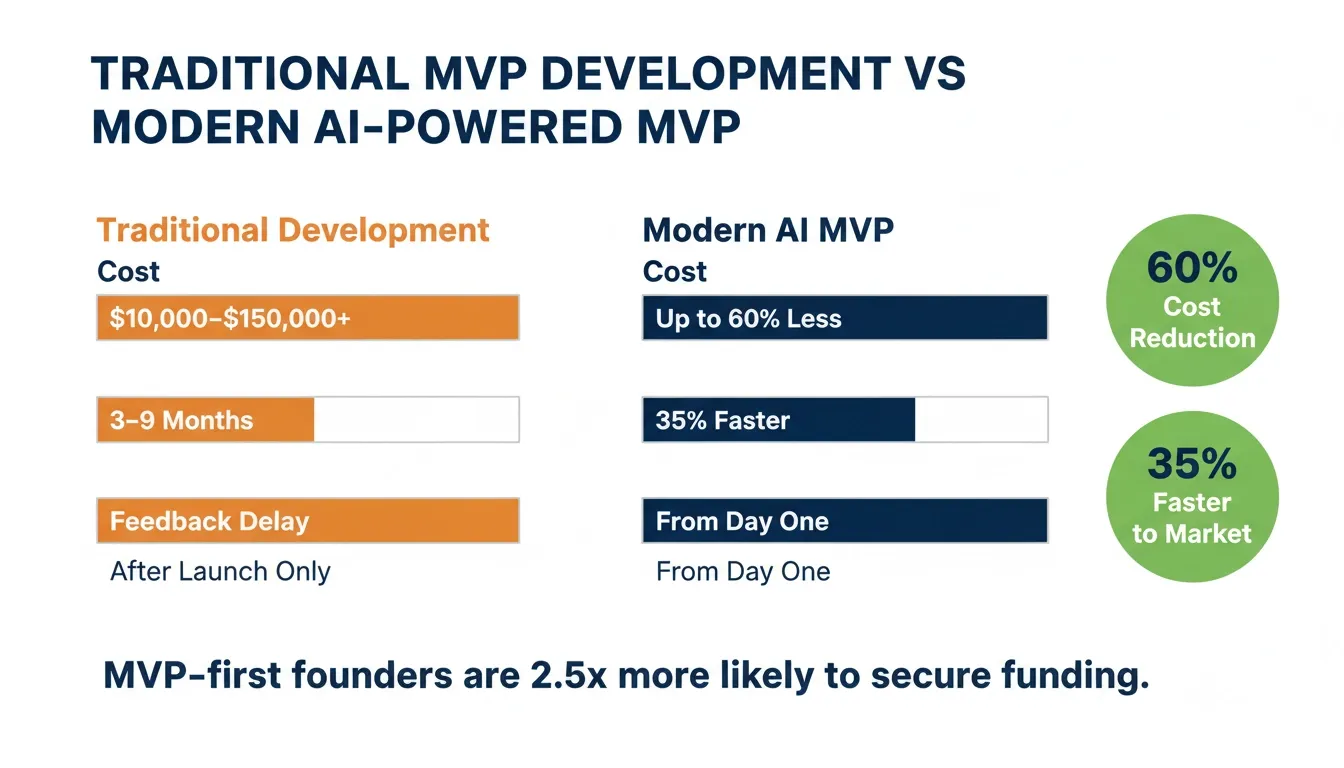
Custom app development for a simple minimum viable product costs anywhere from $10,000 to $50,000, and up to $150,000 or more for anything with real functionality.
-
The timeline alone is a problem: 3 to 9 months before a product reaches early users.
-
By the time a traditionally developed MVP launches, the market has often moved: competitors have shipped, and early adopters have already signed up elsewhere.
-
Most startup founders burn through their budget on the development process before collecting a single piece of meaningful user feedback.
-
When that early user feedback does arrive, they are too far along to act on it without a costly rebuild.
Traditional MVP development was designed for a slower era. The speed at which markets move today has made that model genuinely unworkable for most startup teams. This is why no-code app builders and AI app builders have become the go-to path for lean startup teams. If you want to build a web app without the traditional overhead, the tools available today make that genuinely possible.
User Stories, User Feedback: The Real Fuel for MVP Growth
Before writing a single line of code or submitting a single prompt, the best founders write user stories, and they take them seriously.
-
A user story is a plain-language description of what a user wants to do and why. For example: "As a freelance designer, I want to send automated invoices so I don't have to chase payments manually."
-
User stories help define which core features actually matter before the development process begins.
-
They also make the early user feedback you receive far more useful: specific, actionable, and tied to real needs rather than vague opinions.
-
Early adopters are more engaged when they can see their user stories reflected in what you have built.
-
The cycle that drives great product development, build, launch, gather user feedback, iterate, is the entire engine behind products that scale. The faster you run it, the faster you reach a product that generates revenue.
User stories are not documentation for documentation's sake. They are the shortest path between an idea and early user feedback that actually shapes a better product. Tools like Rocket's Solve capability help founders turn user stories into structured product briefs before a single line of code is written. Once you understand how to iterate on MVP cycles effectively, the entire build-learn loop accelerates.
The Other Half of MVP Success: Knowing Your Market
Building fast is one half of a successful minimum viable product. Knowing what the market is actually doing is the other.
-
Most founders spend weeks manually checking competitor websites, skimming press releases, and hoping a newsletter catches a relevant signal.
-
Those methods are slow, incomplete, and require constant attention, taking time away from the development process and user conversations.
-
Manual research gives you a snapshot. It doesn't tell you what's changing, what's trending, or what a competitor's pricing shift actually signals about their direction.
-
Low-code and no-code tools changed how fast founders build products. Intelligence tools are doing the same for how founders understand the competitive set they're building into.
-
Non-technical founders and small teams now have access to market intelligence that used to require a dedicated research function.
The founders who build MVPs that last are the ones who combine fast development with always-on market intelligence. Both sides of that equation now have proper tools. Whether you're exploring vibe coding or traditional development, the competitive intelligence layer is what separates products that stall from products that scale.
See What Your Competitors Can't Hide: Rocket Intelligence
Most intelligence tools throw data at you and hope you figure out what it means. Rocket Intelligence starts with who you are, and shapes every brief around that.
"I had never seen a low-code tool build such a complex application with just a single prompt! Tools like Lovable, Cursor, and Bolt.new require separate prompts for each section and feature, but Rocket.new handled everything in one go. It took less than 15 minutes." — Arsh Goyal, LinkedIn, May 2026
Always-On Intelligence Across Nine Signal Pillars
Rocket Intelligence monitors 6,000+ companies and delivers signals shaped by your role and your stated purpose for watching each company.
-
Follow any company from Rocket's library of 6,000+ companies, searchable by name or URL at rocket.new/intelligence
-
The full company canvas is publicly accessible at rocket.new/intelligence/[company-name], no login needed to start exploring
-
Each canvas shows pillar summary cards, a secondary stats row, Significant Signals tagged with confidence ratings (25%, 50%, 74%, or 92%), a Data Coverage chart, and an Activity Heatmap showing signal frequency by day and hour
-
Create an account with just your email (OTP login, no password needed) to start following companies and access your personalized For You feed
-
The For You feed surfaces intel cards from across the entire library: each card shows the company, signal type, source platform, timestamp, confidence rating, and a full interpretation
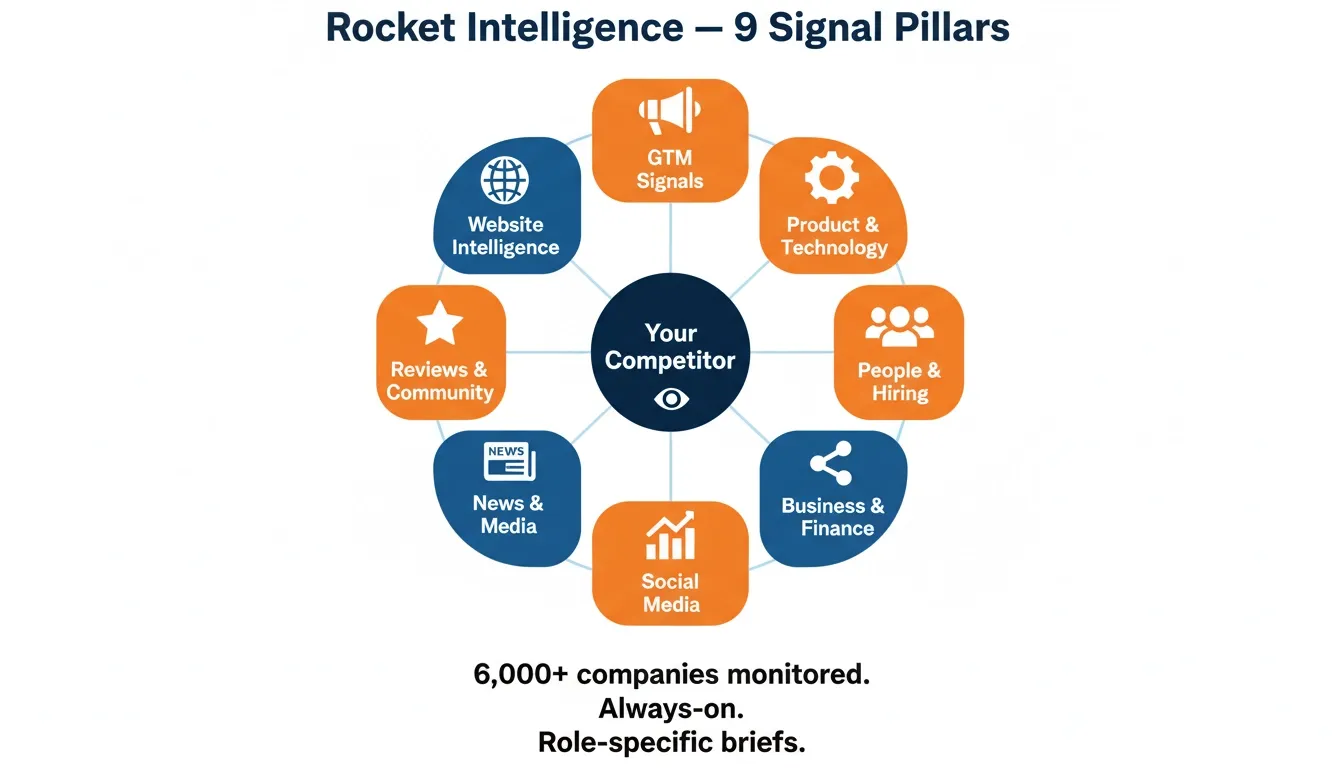 Rocket Intelligence does not just surface what happened. It tells you what it connects to and what it means.
Nine Signal Pillars: Each One Tells a Different Part of the Story
For founders in active MVP development, each signal pillar covers a different layer of competitive context.
-
Website Intelligence: Every change to a competitor's homepage, pricing page, product pages, legal docs, and technical documentation. When a feature quietly disappears from a homepage, that feature is dying. When enterprise language shows up on a pricing page, they're repositioning upmarket.
-
GTM: Live paid campaigns, creator and influencer activity, PR moves, and content marketing shifts. This is not the announcement. It's the actual strategy behind their launches.
-
Product and Technology: Releases, new features, API changes, engineering velocity. Before a competitor ships their next product, they build for it here first.
-
People and Hiring: Executive changes, hiring surges by department, headcount signals, and internal sentiment. Hiring data is the most honest signal a company publishes. You cannot fake hiring 40 engineers and call it something else.
-
Reviews and Community: G2, Trustpilot, Glassdoor, App Store, Reddit, HackerNews, and Product Hunt. The gaps in competitor products that your MVP can fill are written in their reviews, not their press releases.
-
Social Media: X, LinkedIn, TikTok, Instagram, Facebook, YouTube, and Reddit. Covers posts, patterns, and executive activity, including what your competitor's leadership is publicly testing as positioning before it becomes official messaging.
-
News and Media, Business and Finance: Press coverage, partnerships, funding signals, valuation moves, and revenue indicators.
Traffic visit counts and trend direction are visible on the Overview tab. Detailed traffic analytics are coming soon. For MVP teams, these nine pillars together give you a continuous picture of what the competitive set is actually doing, not just what it's announcing.
Intelligence Shaped by Who You Are
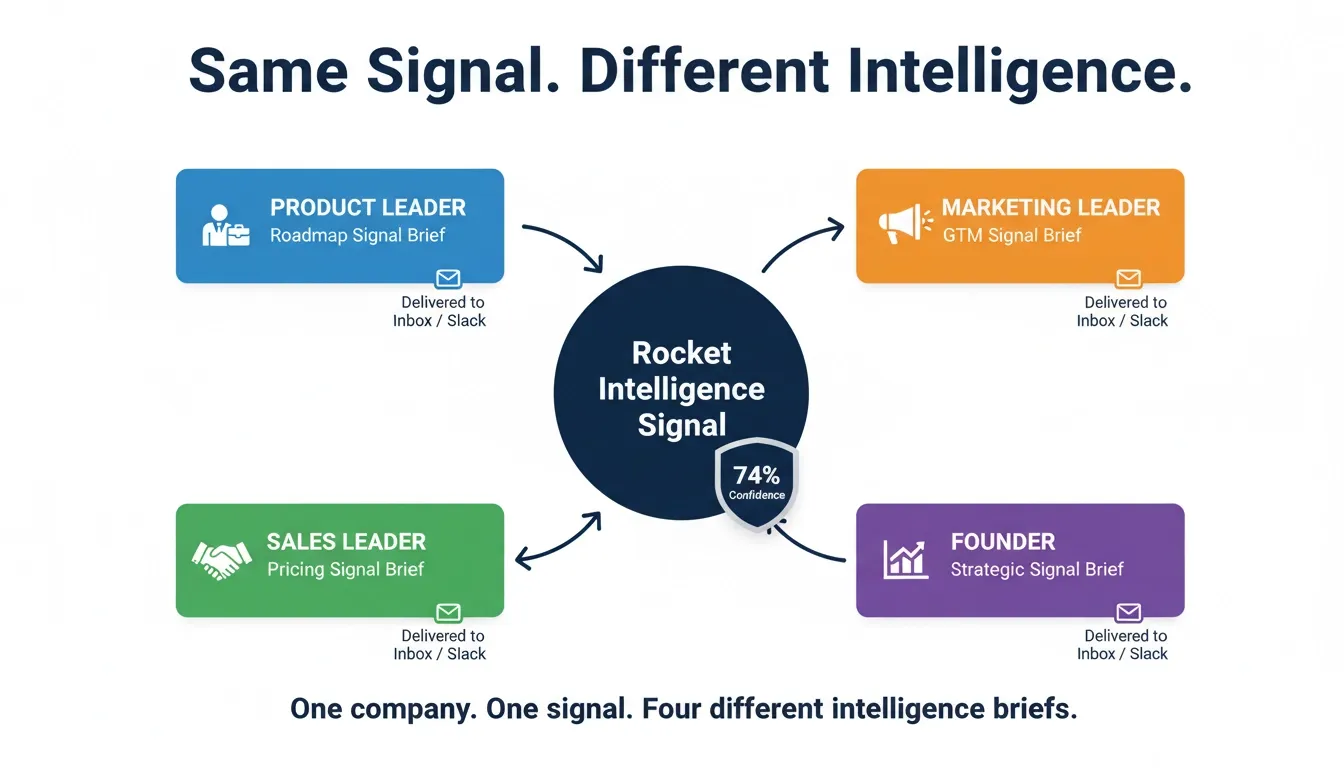
The same signal means something completely different depending on your role. Rocket Intelligence accounts for that.
-
When you subscribe to a company, Rocket asks: "Why are you following this company?" Select one or more purposes: Sales, Marketing, Product, Hiring, Funding, Traffic, or Competitive.
-
A product leader watching a competitor for roadmap signals receives a different brief from a sales leader watching the same company for pricing moves: same company, same data, completely different intelligence.
-
Briefs are delivered to your inbox, Slack, or directly in the dashboard, weekly digest or daily brief.
The purpose modal is where personalization activates. One short answer to "why are you watching this company?" shapes everything that follows.
Intelligence That Deepens the Longer You Use It
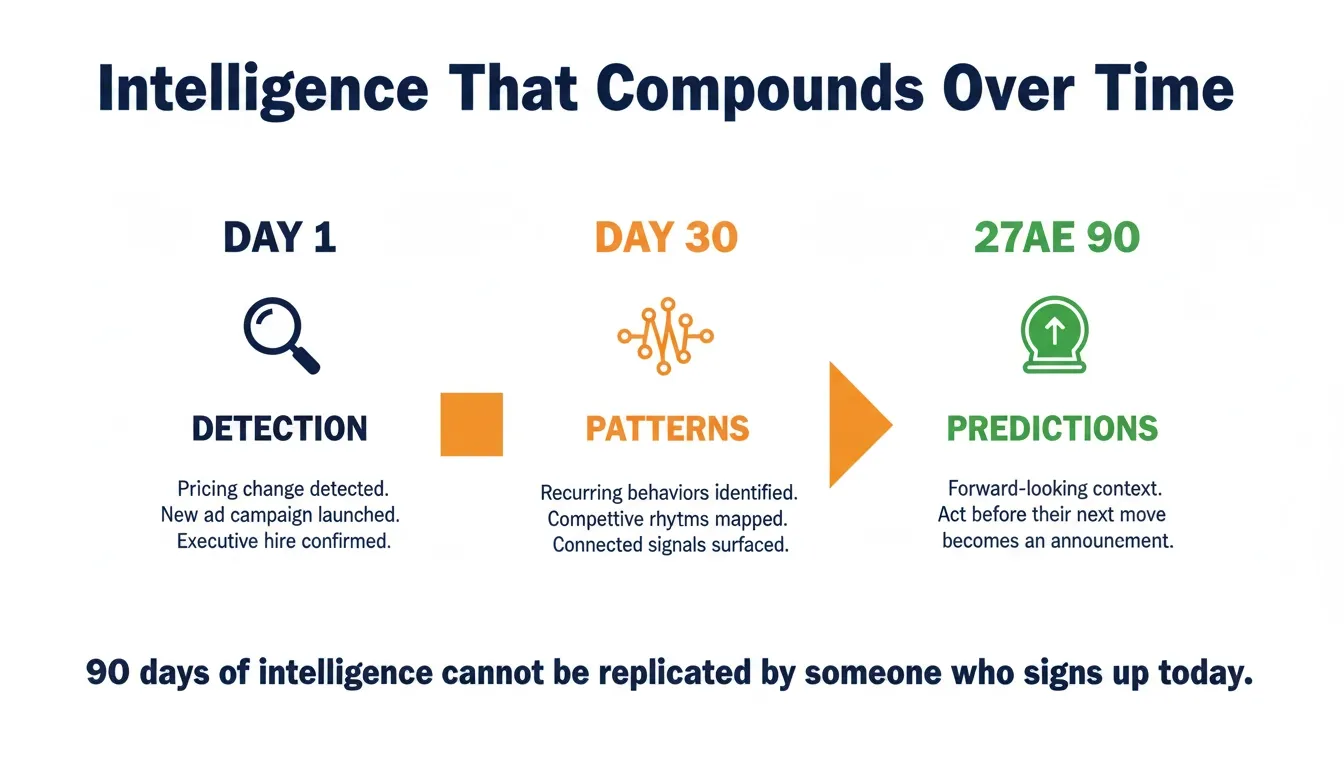
A one-shot competitor search gives you a snapshot. Rocket Intelligence gives you a pattern, and then a prediction.
-
Day 1: Detection: what happened today. A pricing change, an executive hire, a new ad campaign launched.
-
Day 30: Patterns: what keeps happening. Recurring behaviors, emerging rhythms, connected signals across multiple companies you follow.
-
Day 90: Predictions: what's coming. Signals that compound into forward-looking context you can actually act on, before a competitor's next move becomes an announcement.
| How founders track competitors | Manual search | News alerts | Rocket Intelligence |
|---|---|---|---|
| Signal coverage | Spotty | Headlines only | 9 signal pillars |
| Monitoring frequency | On demand | Daily digest | Always-on |
| Interpretation provided | None | None | Role-specific |
| Confidence rating | None | None | 25% - 92% |
| Deepens over time | No | No | Yes: Day 30, Day 90 |
| No login to explore | N/A | N/A | Yes, public canvas |
90 days of accumulated, context-aware intelligence cannot be replicated by someone who signs up today. For founders in active MVP development, starting now means having patterns and predictions while competitors are still checking LinkedIn manually.
From Spec to Live: The Real Takeaway
Building a minimum viable product used to mean months of planning, expensive developers, and anxiety about whether you were building the right thing for the right customers.
The best MVP success stories, Airbnb, Dropbox, Instagram, all followed the same playbook: ship something small, gather user feedback fast, and build from there. MVPs reduce development costs by up to 60% while getting products to market 35% faster than traditional development approaches. Startup founders who go MVP-first are 2.5x more likely to secure funding compared to those who present concept decks alone.
What separates the MVPs that become companies from the ones that stall is the quality of the market intelligence behind the decisions. With Rocket Intelligence, founders going from spec to live product on Rocket.new don't have to choose between building fast and understanding the market. They can follow the companies that matter, receive role-specific briefs, and let the intelligence compound into the kind of context that shapes better product decisions from day one.
Whether you're turning a startup idea to real app in hours or refining an existing product, and whether you need a product roadmap to guide your next sprint, the fastest AI app builder for startups and the smartest competitive intelligence platform are now the same place.
Table of contents
- -What a Minimum Viable Product Is (And What It Isn't)
- -The MVP Success Stories Everyone Should Study
- -The Problem with Traditional MVP Development
- -User Stories, User Feedback: The Real Fuel for MVP Growth
- -The Other Half of MVP Success: Knowing Your Market
- -
- -Always-On Intelligence Across Nine Signal Pillars
- -Nine Signal Pillars: Each One Tells a Different Part of the Story
- -Intelligence Shaped by Who You Are
- -Intelligence That Deepens the Longer You Use It
- -From Spec to Live: The Real Takeaway