
Most AI projects fail not because the model is bad, but because teams skip production readiness checks. This checklist covers every gate, from data and testing to security, governance, and monitoring, before your AI system goes live.
Why do AI systems work in demos but collapse under real users?
According to the RAND Corporation, more than 80% of artificial intelligence projects fail, twice the failure rate of traditional IT projects that do not involve AI. That number has not improved much since 2024.
The gap between a working prototype and a production system is where most AI initiatives die. Teams rush through pilots and celebrate strong demo results. Then they discover that data pipelines break under real traffic, models drift without monitoring, and governance frameworks are missing entirely.
This production AI development checklist covers every readiness gate between a successful pilot and a reliable production deployment. It helps teams avoid the failure patterns that sink AI projects year after year.
What Makes AI Systems Fail in Real Environments?
The most common failure patterns share a clear theme. Teams focus on model development while ignoring the operational foundation that keeps AI systems stable.
-
Poor data quality accounts for 63% of stalled AI initiatives: Gartner found that most organizations either lack or are unsure if they have the right data management practices for production AI (Gartner)
-
Weak governance and missing accountability structures mean nobody owns what happens when the system degrades or produces errors in high-risk operations
-
Insufficient testing: Teams run load testing once and call it done, missing edge cases that only appear under real-world conditions with concurrent users and traffic spikes
-
No incident response plan defined: When failures occur (and they will), teams scramble without clear escalation paths or human review processes
-
Cultural adoption gaps: BCG research shows 70% of AI success depends on organizational processes and change management, not the algorithm itself
| Failure Category | Root Cause | Impact on Production |
|---|---|---|
| Data Failures | Poor data quality, missing data labeling, unstructured data sources | Model accuracy degrades, outputs become unreliable |
| Infrastructure Failures | No load testing, missing rate limits, single points of failure | System crashes under traffic spikes, slow responses, downtime |
| Governance Failures | Weak governance, no compliance frameworks, unclear ownership | Compliance risks, reputational risks, regulatory exposure |
| Process Failures | No incident response, missing escalation paths, low adoption | Support load spikes, user complaints, costly manual fixes |
A structured production AI development checklist that covers all four categories simultaneously is what separates AI pilots that reach production from those abandoned halfway through deployment.
How Can Teams Assess Their AI Readiness Level?
Before writing a single line of deployment code, teams need an honest AI readiness assessment. The Cisco AI Readiness Index reveals that only 13% of organizations globally qualify as Pacesetters, companies ready to deploy artificial intelligence at the scale and speed needed to realize value. The remaining 87% are still building foundational capabilities.
An effective AI readiness checklist evaluates readiness across six pillars. Each one represents a production readiness gate that must be cleared before launch.
-
Strategy alignment: Does the AI strategy tie directly to measurable business outcomes with clear objectives and success criteria? Without strategic alignment, projects drift and budgets get cut
-
Data readiness: Are data pipelines clean, automated, and configured to deliver relevant data at the required freshness and quality level? Data scientists spend 80% of their time on data engineering when this layer is missing
-
Technology infrastructure: Can the production system handle concurrency, traffic spikes, timeouts, and retries without manual intervention?
-
Security and compliance: Does the system handle sensitive data with encryption in transit and at rest? Are compliance requirements like HIPAA mapped and validated?
-
Talent and skills: Do engineering teams and ML engineers have the required capabilities, or do skill gaps create bottlenecks?
-
Governance and change management: Are governance frameworks defined? Does the change management plan address cultural adoption and low adoption risk?
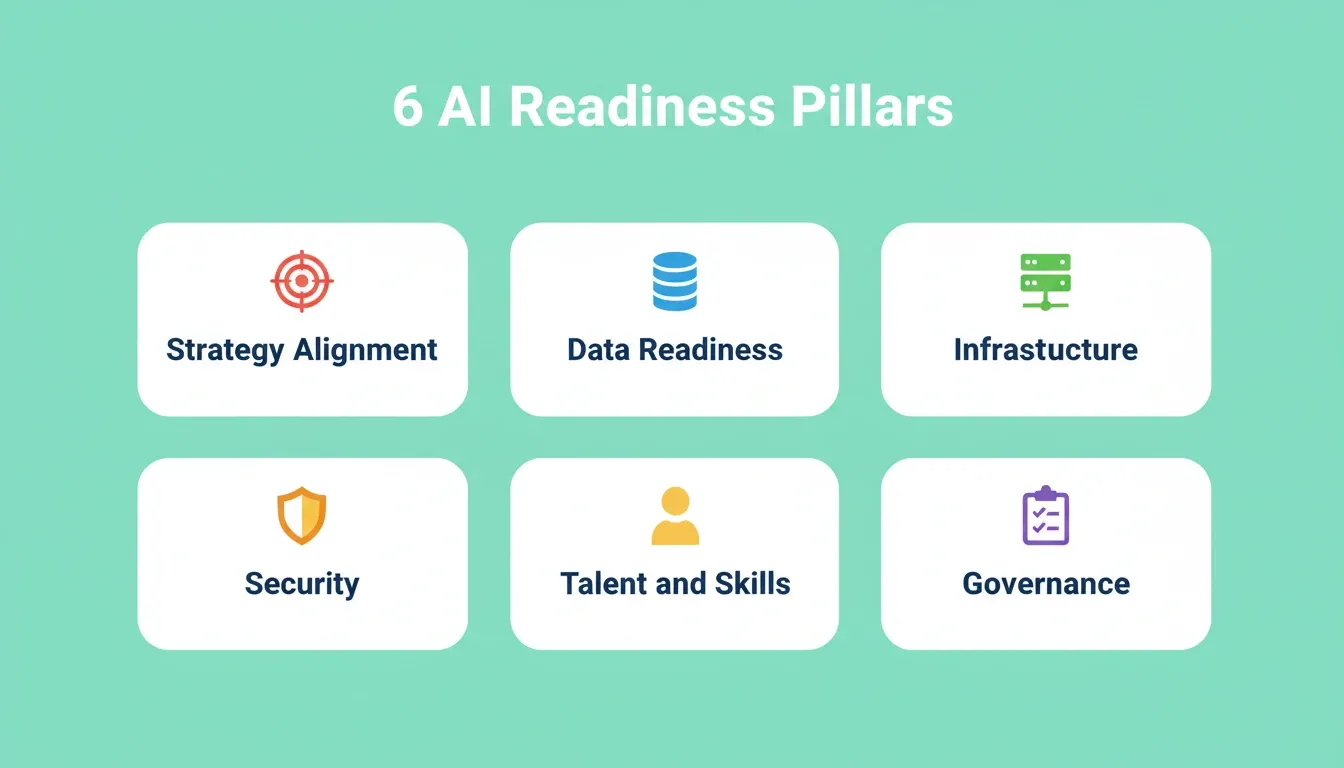
6 AI Readiness Pillars: Strategy Alignment, Data Readiness, Infrastructure, Security, Talent and Skills, Governance
Organizations that score poorly on any single pillar should stop and address potential gaps before pushing to production. A readiness checklist that reveals weakness early is far less expensive than a production failure that reveals it to customers. Teams focused on building secure AI platforms find that early readiness assessment saves months of rework later.
Data and Infrastructure Readiness Gates
Data readiness and infrastructure readiness form the technical foundation that every production AI system depends on. If either layer is unstable, everything built on top of it will fail under real-world performance demands.
-
Data pipeline validation: Verify that all data pipelines run on schedule, handle schema changes gracefully, and flag anomalies before they reach the model. Check data freshness, completeness, and whether new data flows match the patterns the model was trained on
-
Sensitive data controls: Map every location where sensitive data is stored, processed, or transmitted. Confirm encryption at rest and in transit. Validate access controls and check that API keys rotate on schedule
-
Integration tests across dependencies: Run integration tests that cover every external system, every API dependency, and every database connection. Test what happens when a dependency is slow, down, or returns unexpected responses
-
Load testing under realistic conditions: Simulate traffic at 2-3x expected peak. Measure latency, throughput, error rates, and resource allocation under pressure. Identify bottlenecks and confirm auto-scaling is configured correctly
-
Version control for models, prompts, and configurations: Every state-modifying operation should be traceable back to a specific version
Teams that pass through these gates with documented results gain confidence that their system will operate reliably under production conditions. Those that skip gates build on an unstable foundation where a single bad data day can cascade into a full system failure.
What Does a Complete Testing and Validation Framework Cover?
Testing for AI systems goes far beyond traditional software testing. Traditional apps produce deterministic outputs. AI agents and models produce probabilistic responses, and their behavior can shift based on inputs nobody planned for during development.
-
Functional testing of agent behavior: Does the system handle multi-step workflows correctly? What happens on unexpected inputs, prompt injection attempts, or requests outside defined boundaries? Test every failure scenario you can map, then test for the ones you cannot predict using chaos experiments
-
Response quality evaluation: Set up evaluation frameworks that measure response quality against defined success criteria. Track model accuracy, consistency, and whether outputs align with business processes the system supports
-
Load testing and scalability validation: Production AI systems face demand patterns that differ from staging. Test with realistic user behavior, concurrent requests, and extended run times to reveal issues that only surface under sustained load
-
Human review loops: For high-risk operations, define when human oversight kicks in. Build clear thresholds where the system stops and routes to human review rather than continuing with low-confidence outputs
-
Regression testing after every change: AI models are not one-time deployments. Every prompt update, model swap, or configuration change needs regression tests that verify nothing broke in the process
-
Adversarial and edge case testing: Deliberately probe the system with malformed inputs, boundary conditions, and adversarial prompts. AI systems that pass standard testing often fail at the edges where real users push hardest
As one Reddit user in r/nocode put it: "people see the AI output working in a demo and assume it's production ready. What helps is a pre-deploy checklist for the boring failure points" (Reddit r/nocode). That observation captures exactly why a complete production checklist matters. The boring failure points are the ones that break production.
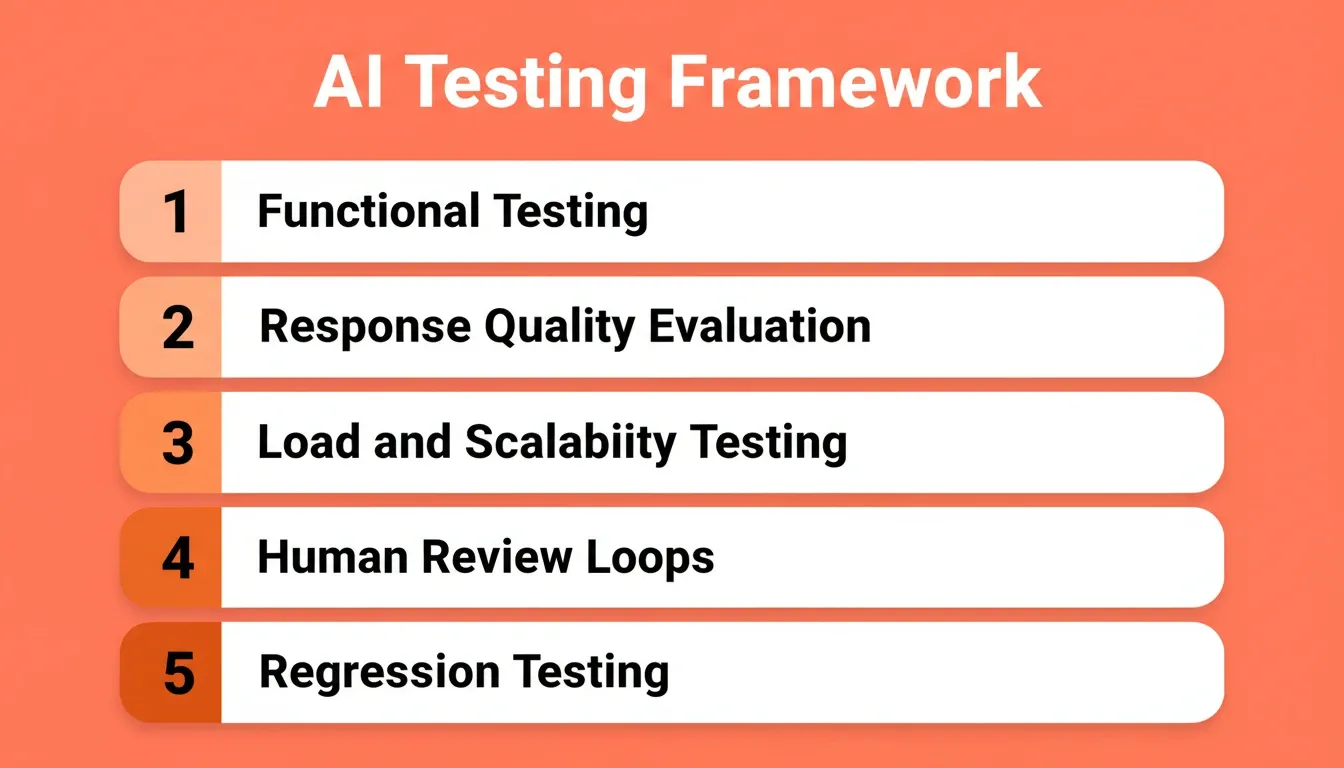
AI Testing Framework: Functional Testing, Response Quality Evaluation, Load Testing, Human Review Loops, Regression Testing
Teams building AI-powered applications need deployment readiness to be a structured process rather than a gut feeling. Every validation step should be documented, repeatable, and visible to stakeholders. Scaling these systems correctly requires the right infrastructure choices from day one.
How Should Security and Governance Be Structured?
Security and governance are where many AI initiatives stall. Teams treat these as late-stage concerns when they should be foundational decisions made before model development begins.
-
Data security architecture: Confirm encryption for sensitive data in transit and at rest. Define who has access to what, with role-based controls that prevent exposure. Audit storage locations and verify compliance with privacy regulations
-
Prompt injection and input validation: AI agents operating in production face adversarial inputs. Implement input validation, output filtering, and safety boundaries that prevent the system from executing harmful actions or leaking information
-
Governance frameworks with clear ownership: Define who owns the AI system post-launch. Assign responsibilities for monitoring, updates, incident response, and ongoing evaluation. Without clear ownership, systems decay fast
-
Compliance mapping: List every compliance requirement (GDPR, HIPAA, SOC 2, and industry regulations) and map each one to specific controls in the system. Maintain audit trails that show compliance is met, not just claimed
-
Escalation paths for when things go wrong: Build defined escalation paths that specify who gets called, what decisions they can make, and how fast the system can be rolled back or shut down if a production failure creates reputational risks
-
Regular updates and policy refresh cycles: Governance is not a one-time checkpoint. Schedule regular reviews as business conditions change, new regulations appear, or the AI system expands into new areas
-
API key management and secret rotation: Store every API key, service credential, and environment variable in a secrets manager, never in code. Establish a rotation schedule and verify that compromised keys can be revoked and replaced without downtime
Weak governance leads to exactly the pattern Gartner warns about. Organizations invest heavily in AI pilots, watch them succeed in controlled environments, then cannot scale to full adoption because nobody built the guardrails that enable teams to operate with confidence at scale.
The Pre-Launch Checklist: 25 Gates Before You Ship
Before any AI system goes live, run through each of these gates. A single unchecked item is a production incident waiting to happen.
Data Readiness
-
All data pipelines validated end-to-end with schema change handling
-
Sensitive data encrypted at rest and in transit, access controls audited
-
Data freshness and completeness verified against model training distribution
-
API keys and service credentials stored in a secrets manager, not in code
Infrastructure and Performance
-
Load tested at 2-3x expected peak traffic with documented results
-
Auto-scaling configured and verified under simulated traffic spikes
-
Rate limiting implemented on all AI model endpoints
-
Latency, throughput, and error rate baselines documented
-
Staging environment mirrors production configuration exactly
Testing and Validation
-
Functional tests cover all primary user workflows end-to-end
-
Adversarial and edge case tests completed, results documented
-
Regression test suite in place for every prompt, model, or config change
-
Human review thresholds defined for high-risk operations
-
Cross-device and cross-browser validation completed for web surfaces
Security and Compliance
-
Prompt injection defenses implemented and tested
-
Input validation and output filtering active on all model endpoints
-
Compliance requirements (GDPR, HIPAA, SOC 2) mapped to specific controls
-
Audit trail configured and verified
-
Third-party model dependency documented with fallback behavior defined
Governance and Operations
-
Clear ownership assigned for post-launch monitoring and updates
-
Incident response playbook written and reviewed by all stakeholders
-
Escalation paths defined with named contacts and decision authority
-
Rollback procedure tested and documented
-
Real-time monitoring dashboard configured with alert thresholds
-
Cost monitoring active with budget alerts set
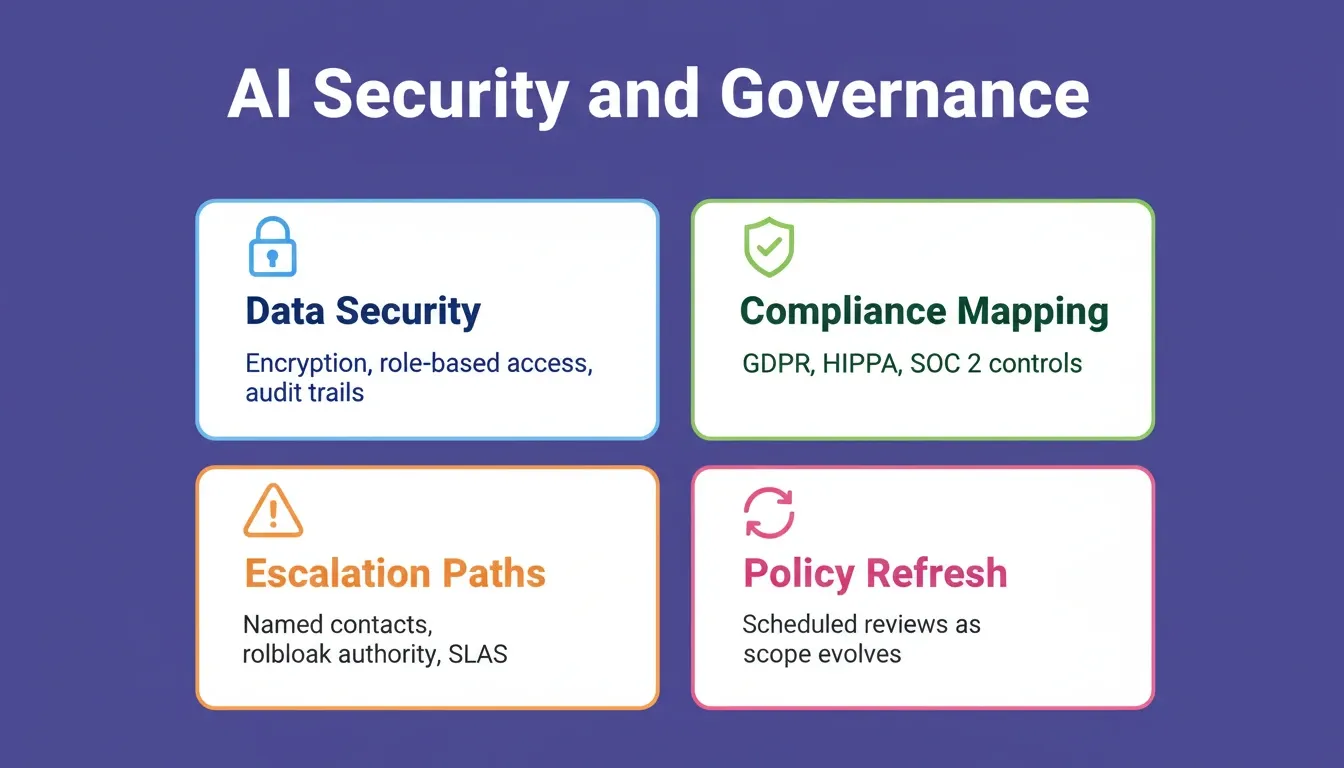
AI Security and Governance: Data Security, Compliance Mapping, Escalation Paths, Policy Refresh
Teams that use a structured pre-launch checklist catch most production failures before they reach users. The best AI workflow builders make this process repeatable rather than ad hoc.
Why Rocket Handles the Thinking Before the Build
Most AI tools start from a blank prompt and hand the hard decisions back to you. Rocket takes a different approach as the world's first Vibe Solutioning platform, where business thinking and building happen in the same place.
-
Solve before you build: Type any business question and get back a structured, research-backed report. Before a single line of code exists, teams validate whether the idea is worth building, what the market needs, and what production readiness actually requires for their specific use case
-
Build with production-grade defaults: Every build ships with SEO-ready structure, WCAG accessibility compliance, GDPR coverage, and performance monitoring built in. Web apps are generated in Next.js and mobile apps in Flutter, both with real design systems
-
Intelligence for ongoing monitoring: Post-launch, Rocket Intelligence continuously monitors competitive signals and market shifts. This keeps the production checklist alive rather than treating it as a one-time gate
-
Shared context architecture: Every decision, research finding, and validation step feeds into a persistent memory that carries forward. When the build starts, it starts from accumulated intelligence rather than a cold prompt
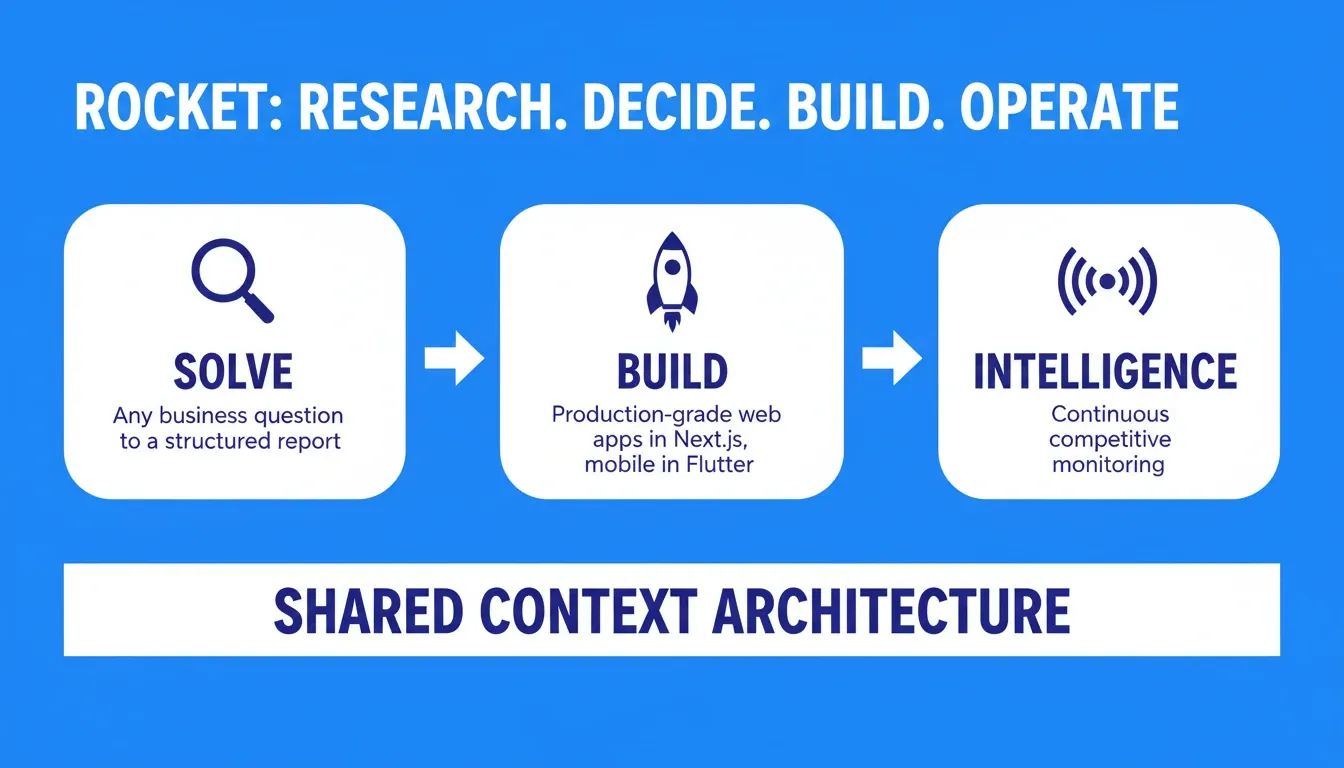
Rocket: Research. Decide. Build. Operate. Solve, Build, and Intelligence connected through Shared Context Architecture
Other AI builders generate code quickly but leave production readiness as an exercise for later. Rocket connects the thinking phase directly to the building phase, so the first version ships with the foundation already in place.
For teams that want their AI readiness to be a competitive advantage rather than a checkbox, Rocket enables teams to validate decisions, build with confidence, and maintain trust through every stage of the production lifecycle.
Operational Monitoring and Incident Response Planning
Launching is not the finish line. A production AI system requires continuous monitoring, ongoing evaluation, and clearly defined incident response procedures that keep the system healthy long after the initial deployment readiness check passes.
-
Real-time monitoring dashboards: Track system health metrics including latency, error rates, throughput, token usage, and model performance indicators. Configure alerts that trigger when metrics cross defined thresholds before users notice problems
-
Model drift detection: AI models degrade over time as real-world data shifts away from training distributions. Set up automated checks that measure model accuracy against baseline metrics and flag when performance drops below acceptable levels
-
Incident response playbooks: Document exactly what happens when the system fails. Define severity levels, assign roles and responsibilities, establish communication channels, and maintain rollback procedures that can restore service within defined SLAs
-
Cost monitoring and resource allocation: Track operational costs per LLM call, per user, and per feature. Set budget alerts, identify spending anomalies, and plan resource allocation for scaling as demand grows
-
Feedback loops from real users: Build channels that capture user satisfaction, user complaints, and patterns in how people interact with the system. This feedback feeds continuous optimization and reveals issues that automated monitoring might miss
-
Scheduled evaluation cycles: Beyond automated monitoring, schedule periodic reviews where engineering teams, data scientists, and business stakeholders assess whether the AI system still delivers against its original business goals
The most reliable AI systems belong to teams that invest as much in post-launch operations as they did in pre-launch preparation. Organizations that treat launch as the end discover expensive surprises later. Production readiness is an ongoing practice, not a checkpoint you pass once and forget.
Common Questions About AI Production Readiness
What is the difference between staging and production readiness?
Staging readiness means your system works correctly in a controlled environment that mirrors production. Production readiness means it has been validated under real traffic patterns, real user behavior, and real failure conditions. Many teams mistake staging success for production readiness, and the gap between them is where most AI systems fail.
How long should AI production readiness take?
For a simple AI feature added to an existing product, a thorough production readiness review takes one to two weeks. For a new AI-native product, expect four to eight weeks of readiness work before launch. Teams that skip this investment typically spend two to three times as long recovering from production failures.
What is model drift and how do you detect it?
Model drift occurs when the statistical distribution of real-world inputs diverges from the distribution the model was trained on. Detect it by tracking model output distributions over time, monitoring key accuracy metrics against a labeled evaluation set, and setting alerts when performance drops below defined thresholds.
What compliance frameworks apply to AI systems?
The applicable frameworks depend on your industry and geography. GDPR applies to AI systems processing EU personal data. HIPAA applies to healthcare AI in the US. The EU AI Act introduces risk-based requirements for AI systems operating in Europe, with high-risk systems facing the most stringent obligations. Map your specific requirements before development begins, not after.
How do you handle AI system failures gracefully?
Graceful failure means the system degrades in a controlled, predictable way rather than crashing or producing harmful outputs. Implement circuit breakers that stop sending requests to a failing model endpoint. Define fallback responses for when the model is unavailable, and route uncertain outputs to human review rather than returning them to users.
What is prompt injection and how do you prevent it?
Prompt injection is an attack where malicious input causes an AI system to ignore its instructions and execute unintended actions. Prevent it by validating and sanitizing all user inputs before they reach the model, implementing output filtering to catch harmful responses, and testing your system against known injection patterns before launch.
How do you build a rollback plan for an AI system?
A rollback plan requires versioning every component that can change: the model checkpoint or API version, the prompt templates, the configuration parameters, and the application code. Tag each production deployment with a version identifier, test the rollback procedure in staging before you need it in production, and define the conditions that trigger a rollback.
Your Production AI Development Checklist Starts Before the Build
Shipping an AI system without a structured production AI development checklist is the most expensive shortcut a team can take. The technology might be sound, the team talented, and the timing right. None of that matters if the foundation was never properly validated.
The organizations that succeed with AI at scale invest time in the thinking phase before rushing to deploy. They assess their data, test their infrastructure, define their governance, and plan for incidents that have not happened yet. That discipline is what separates production-ready systems from expensive experiments.
As AI systems grow more capable and more embedded in critical business operations, production readiness will only become more consequential, not less. The teams building that discipline now are the ones who will scale without the failures that sideline everyone else.
Rocket gives teams the platform to research, decide, and build from validated decisions. If your next AI project deserves a production-grade foundation from day one, start building on Rocket.
Table of contents
- -What Makes AI Systems Fail in Real Environments?
- -How Can Teams Assess Their AI Readiness Level?
- -Data and Infrastructure Readiness Gates
- -What Does a Complete Testing and Validation Framework Cover?
- -How Should Security and Governance Be Structured?
- -The Pre-Launch Checklist: 25 Gates Before You Ship
- -Data Readiness
- -Infrastructure and Performance
- -Testing and Validation
- -Security and Compliance
- -Governance and Operations
- -Why Rocket Handles the Thinking Before the Build
- -Operational Monitoring and Incident Response Planning
- -Common Questions About AI Production Readiness
- -What is the difference between staging and production readiness?
- -How long should AI production readiness take?
- -What is model drift and how do you detect it?
- -What compliance frameworks apply to AI systems?
- -How do you handle AI system failures gracefully?
- -What is prompt injection and how do you prevent it?
- -How do you build a rollback plan for an AI system?
- -Your Production AI Development Checklist Starts Before the Build