
Most founders either skip market research or get stuck in it. This post breaks down how Rocket.new's vibe solutioning platform connects research, AI app development, and competitor tracking in one shared context - so founders research less and ship more.
What if the market research holding up your launch is doing more harm than good?
Here is the short answer: it probably is. According to Founders Forum, 42% of startups fail because they build products no one wants - not because they skipped research, but because they did the wrong kind, too slowly.
The smartest founders today research enough to act, then build while they learn.
The Research Trap That Slows Founders Down
Most founders fall into one of two traps.
The first is skipping research entirely. They trust gut instinct, start building, and figure the market will catch up. Sometimes it works. Most of the time it does not.
The second trap is worse: research paralysis. Spreadsheets. Competitor audits. Customer interviews. Weeks pass. Nothing ships.
Both miss the point.
The real goal is research with a hard cutoff - enough data to know what to build, not so much that you never start. Founders Forum notes that entrepreneurs consistently underestimate market validation time by a factor of 3x. The research phase stretches well past what is useful, while the window to ship keeps shrinking. Human expertise gets buried under process instead of driving decisions.
What People Are Saying About Market Research
This community post from Threads captures the problem well:
"Most founders crack open market research the week their pitch deck is due. Companies that track their market daily spot the inflection points first."- Lennart Nacke, via Threads
That is the gap this blog is about. Not whether to do market research, but when and how - in a way that gives you clarity without losing momentum.
The Old Way vs. the Vibe Solutioning Way
Traditional market research treats intelligence-gathering and building as two separate phases. You research, write a report, hand it off to the team - and by the time anyone starts building, half the context is already gone.
Vibe solutioning keeps research, building, and competitor tracking in one shared context. No tab-switching. No losing context between what you learned and what gets built. No "wait, which version of that doc are we on?"
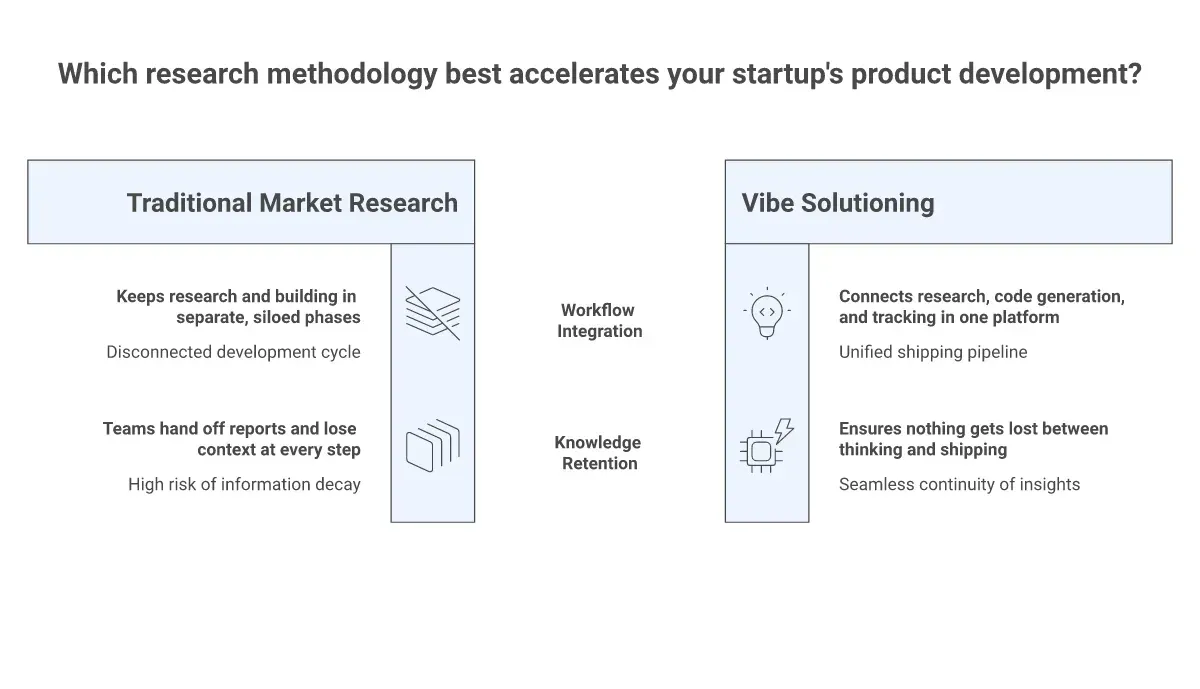 Section Image - Traditional vs Vibe Solutioning
| Traditional Research | Vibe Solutioning |
|---|---|
| Long research phase before building | Research flows directly into building |
| Separate AI tools for each step | One platform, one shared context |
| Manual competitor tracking | Automated tracking and hiring signals |
| Reports handed off to dev teams | Structured brief feeds code generation |
| Static one-time market snapshots | Live updates as the market moves |
This shift is what makes vibe coding so different from standard app development. The thinking and the building stay connected - and that is where human expertise actually shows up in the product.
Good as the Thinking: The Market Research Template Rocket Founders Use
A solid market research template for founders does not need to be 40 pages long. It needs five things working together:
-
The problem: What pain are users dealing with right now?
-
Market analysis: Who else is in this space? What is the real size of the opportunity?
-
Competitive intelligence: What are competitor websites doing well? Where are the gaps?
-
The brief: A structured brief that becomes the actual input for building.
-
The build: Production grade code that ships to real users.
The tricky part is keeping all five connected. Most companies use one tool for research, another for planning, and a third for building. Every handoff is a chance to lose context and slow down the whole company.
This loop is what makes a market research template actually useful. Markets shift. Competitors move. Your research should stay alive - not sit in a shared drive collecting dust.
Solve on Rocket.new: One Platform to Research, Build, and Watch
Rocket.new is the world's first vibe solutioning platform and the only place where all five template steps above live in one shared context, without losing what your team already knows.
Most AI tools help you build faster. None of them tell you what to build, or how to stay ahead after you ship. Rocket handles both and that matters because human expertise is most valuable when it is pointed in the right direction from the start.
Research and Competitive Intelligence
Rocket's intelligence layer scans competitor websites, watches competitor moves, and surfaces hiring signals that reveal where rivals are investing next. Founders get full background for the call before writing a single line of code.
No separate research subscriptions. No stitching together five different AI tools. All data lives inside the same company workspace where the build happens so every decision connects to what the team already researched.
Vibe Coding With Production-Grade Output
Once you know what to build, Rocket's vibe coding engine turns your structured brief into production-ready apps. Not toy prototypes. Not rough demos. Rocket generates Flutter for mobile and Next.js for web real code that ships to real users.
Human expertise stays central. You describe the problem and watch the AI handle code generation. Your team steers the direction. AI does the heavy lifting. What used to take a company months of ai app development now happens in weeks. This is what solve build and intelligence looks like as one connected system - one platform that carries context from research all the way to launch.
Competitor Tracking That Does Not Stop After Launch
Shipping is not the finish line. Rocket keeps watching after you go live. It tracks competitors, flags updates from competitor websites, and spots shifts in hiring signals that hint at upcoming product changes.
Over 1.5 million people across 180 countries have already put Rocket to work. Teams move faster because market analysis does not have to restart from scratch after every sprint. The vibe solutioning platform carries context forward so every build cycle benefits from what came before.
Moving Forward With Smarter Research
The real drag on any founding team is not competition. It is slow cycles. Market research that produces insights no one acts on. Competitive intelligence that lives in a slide deck instead of feeding the next build.
Market research works when it flows directly into action. Rocket.new gives founders a research less, ship more template that stays alive: research feeds the build, the build gets tracked, and the tracking informs the next round of market research. All in one shared context. All through one company platform.
That is how the best founders research less and ship more.
Table of contents
- -The Research Trap That Slows Founders Down
- -What People Are Saying About Market Research
- -The Old Way vs. the Vibe Solutioning Way
- -Good as the Thinking: The Market Research Template Rocket Founders Use
- -Solve on Rocket.new: One Platform to Research, Build, and Watch
- -Research and Competitive Intelligence
- -Vibe Coding With Production-Grade Output
- -Competitor Tracking That Does Not Stop After Launch
- -Moving Forward With Smarter Research